Hazy math: DoE explains why your AQI says 250 when the official API is 175数学计算令人困惑:美国能源部解释了为什么您的空气质量指数显示为 250,而官方空气质量指数为 175。
KUALA LUMPUR, Oct 8 — The Department of Environment (DOE) has clarified that higher air quality figures displayed on independent mobile applications and third-party websites do...
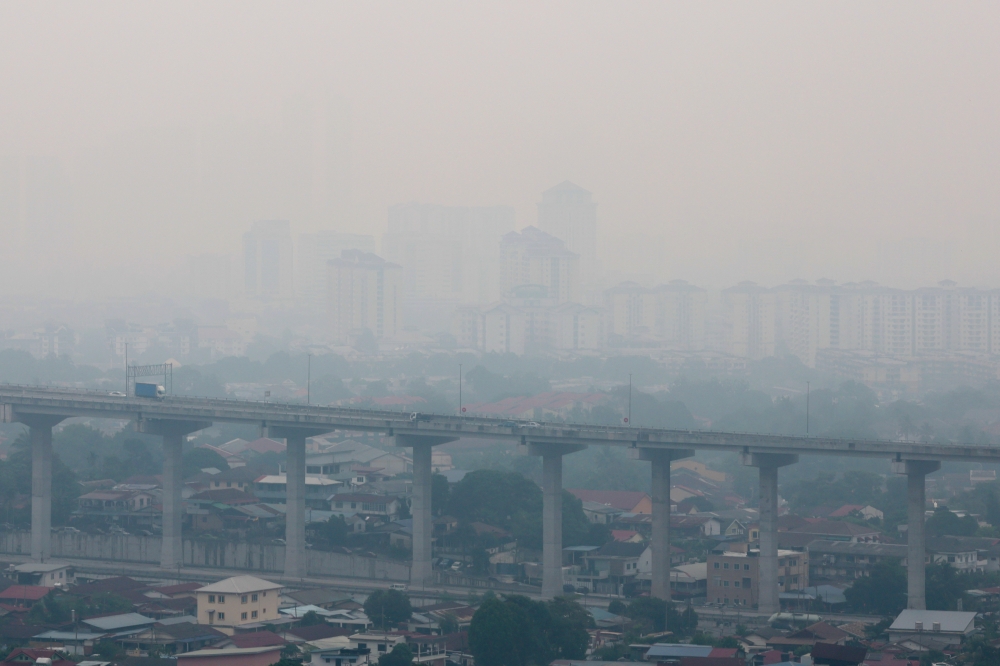
The Department of Environment (DOE) in Malaysia clarified discrepancies between official air quality readings and those on independent platforms, attributing them to different methodologies and data sources.
As 38 areas in Malaysia reported unhealthy air quality, the DOE advised the public to rely on the official Air Pollutant Index Management System for accurate data.
The current haze, exacerbated by prolonged dry spells and transboundary smoke from regional fire hotspots, prompted the activation of health advisories, including the suspension of outdoor school activities when API levels exceed 100.
KUALA LUMPUR, Oct 8 — The Department of Environment (DOE) has clarified that higher air quality figures displayed on independent mobile applications and third-party websites do not reflect data suppression or inaccuracies in official records
Just as 38 areas in Malaysia logged unhealthy air quality today, the department explained that Malaysia’s Air Pollutant Index (API) and commercial Air Quality Index (AQI) platforms frequently show divergent numbers because they rely on different index scales, mathematical models, concentration thresholds, averaging durations, update intervals, and sensory inputs.
Many international applications employ the US AQI standard or rely on low-cost uncalibrated sensors, predictive computational models, or satellite imagery.
Satellite monitoring, the DOE pointed out, evaluates total aerosol column density across the upper atmosphere rather than air quality at ground level where human respiration occurs. Importantly, satellite sensors can misidentify atmospheric cloud cover or water vapour as particulate haze.
The department stressed that valid comparisons between platforms cannot be drawn from single headline figures alone, but must match identical geographic coordinates and time stamps, direct pollutant concentrations, and specific indexing methodologies.
The DOE advised the public to rely on verified data from the Air Pollutant Index Management System (APIMS) web portal or the MyJAS EQMS mobile application.
These platforms update hourly and serve as the government’s official benchmark for health advisories and disaster response protocols.
Malaysia’s national API is calculated using continuous measurements of six core criteria pollutants, with fine particulate matter (PM2.5) acting as the dominant driver during haze events.
The system draws data from 68 continuous monitoring stations nationwide that comply with strict ISO standards and US Environmental Protection Agency guidelines.
Unhealthy air quality blankets 38 areas
As of 3pm today, no monitoring stations in the country recorded good air quality, with 30 stations registering moderate levels and 38 falling into the unhealthy category (API 101 to 200).
Southern and central states recorded the most severe pollution levels, led by Segamat at 190, Seremban at 186, Nilai at 185, and Kluang at 181. Rompin in Pahang and peat fire hotspot Johan Setia in Selangor each logged 178, while the administrative centre of Putrajaya recorded 175.
Across the Greater Klang Valley, elevated readings were recorded in Cheras (174), Shah Alam (171), and Petaling Jaya (165). Unhealthy air quality was also recorded across monitoring stations in Kedah, Penang, Perak, Melaka, and Terengganu, where Paka registered the lowest reading in the unhealthy bracket at 126.
The DOE attributed the deteriorating air quality to prolonged dry spells across the southern Asean region.
Citing data from the Asean Specialised Meteorological Centre (ASMC), the department noted that 210 fire hotspots were detected in Sumatra and 94 in Kalimantan on Oct 7, compared to just one localized hotspot in Pahang, Malaysia.
The ASMC observed moderate to dense transboundary smoke plumes drifting across central and southern Sumatra, Singapore, and southern Peninsular Malaysia.
Under the National Haze Action Plan, all outdoor school activities must be suspended immediately when local API readings surpass 100. Should readings exceed the 200 threshold, schools, kindergartens, and daycare centres are ordered to close.
If API levels remain consistently above 150 for more than 24 hours, the National Disaster Management Agency (Nadma) convenes its disaster coordination committee to assess cloud seeding operations, subject to suitable atmospheric moisture and cloud conditions.
Zambry: MOHE targets 30,000 AI graduates by 2030 to meet future workforce needs
Malaysia strengthens space disaster SOPs, prepares for risk of falling space objects, says Chang Lih Kang
King grants audience to IPCC chairman at Istana Negara
马来西亚环境部澄清了官方空气质量读数与独立平台读数之间的差异,并将这些差异归因于不同的方法和数据来源。
马来西亚有 38 个地区报告空气质量不健康,环境部建议公众依靠官方的空气污染指数管理系统获取准确数据。
当前的雾霾,加上持续的干旱和来自区域火灾热点的跨境烟雾,导致卫生部门发布了健康警告,包括当空气污染指数 (API) 超过 100 时暂停户外学校活动。
吉隆坡,10月8日讯——环境部澄清,独立移动应用程序和第三方网站上显示的较高空气质量数据并不反映官方记录中的数据被压制或存在不准确之处。
就今天马来西亚有 38 个地区的空气质量不健康而言,该部门解释说,马来西亚的空气污染指数 (API) 和商业空气质量指数 (AQI) 平台经常显示不同的数字,因为它们依赖于不同的指数尺度、数学模型、浓度阈值、平均持续时间、更新间隔和感官输入。
许多国际应用采用美国空气质量指数标准,或者依赖低成本的未经校准的传感器、预测计算模型或卫星图像。
美国能源部指出,卫星监测评估的是高层大气中的气溶胶柱总密度,而不是人类呼吸作用发生的地面空气质量。值得注意的是,卫星传感器可能会将大气云层或水蒸气误判为颗粒物雾霾。
该部门强调,不能仅凭单一的总体数据就对平台进行有效比较,而必须匹配相同的地理坐标和时间戳、直接污染物浓度以及特定的指数方法。
美国能源部建议公众依赖来自空气污染物指数管理系统 (APIMS) 网络门户或 MyJAS EQMS 移动应用程序的已验证数据。
这些平台每小时更新一次,是政府发布健康建议和灾害应对方案的官方基准。
马来西亚的国家空气污染指数 (API) 是通过对六种核心污染物进行连续测量计算得出的,其中细颗粒物 (PM2.5) 是雾霾事件期间的主要驱动因素。
该系统从全国 68 个连续监测站获取数据,这些监测站均符合严格的 ISO 标准和美国环境保护署的指导方针。
空气质量不佳的地区覆盖38个区域
截至今天下午 3 点,全国没有一个监测站记录到良好的空气质量,30 个监测站记录到中等水平,38 个监测站记录到不健康水平(API 101 至 200)。
南部和中部各州的污染程度最为严重,其中昔加末为 190,芙蓉为 186,汝来为 185,居銮为 181。彭亨州的罗宾和雪兰莪州的泥炭火灾热点地区约翰塞蒂亚的污染程度均为 178,而行政中心布城的污染程度为 175。
大巴生谷地区,蕉赖(174)、莎阿南(171)和八打灵再也(165)的空气质量读数偏高。吉打、槟城、霹雳、马六甲和登嘉楼的多个监测站也记录到空气质量不健康,其中帕卡的读数最低,为126,但仍处于不健康水平。
美国能源部将空气质量恶化归咎于东盟南部地区持续干旱。
该部门援引东盟专业气象中心(ASMC)的数据指出,10 月 7 日在苏门答腊岛发现了 210 个火灾热点,在加里曼丹岛发现了 94 个火灾热点,而马来西亚彭亨州仅发现了一个局部热点。
ASMC观测到中等至浓密的跨境烟羽飘过苏门答腊中部和南部、新加坡以及马来西亚半岛南部。
根据国家雾霾行动计划,当当地空气污染指数(API)读数超过 100 时,所有户外学校活动必须立即暂停。如果读数超过 200 的阈值,学校、幼儿园和日托中心将被勒令关闭。
如果 API 水平持续高于 150 超过 24 小时,国家灾害管理机构 (Nadma) 将召集其灾害协调委员会,在适宜的大气湿度和云量条件下评估人工增雨作业。
Zambry:高等教育部计划到2030年培养3万名人工智能毕业生,以满足未来劳动力需求。
张立康表示,马来西亚加强了太空灾难标准作业程序,为应对太空物体坠落风险做好准备。
金在国家皇宫接见政府间气候变化专门委员会主席