Malaysia’s top 100 startups in the spotlight马来西亚百强创业公司成为焦点
KUALA LUMPUR: The 100 Malaysian technology startups featured in the Malaysia Top 100 Startups – 2026 Edition collectively generated RM8.5bil in revenue for FY2024. Recording an average compound annual growth rate (CAGR) of 87%, says Science, Technology and Innovation Minister Datuk Chang Lih Kang.
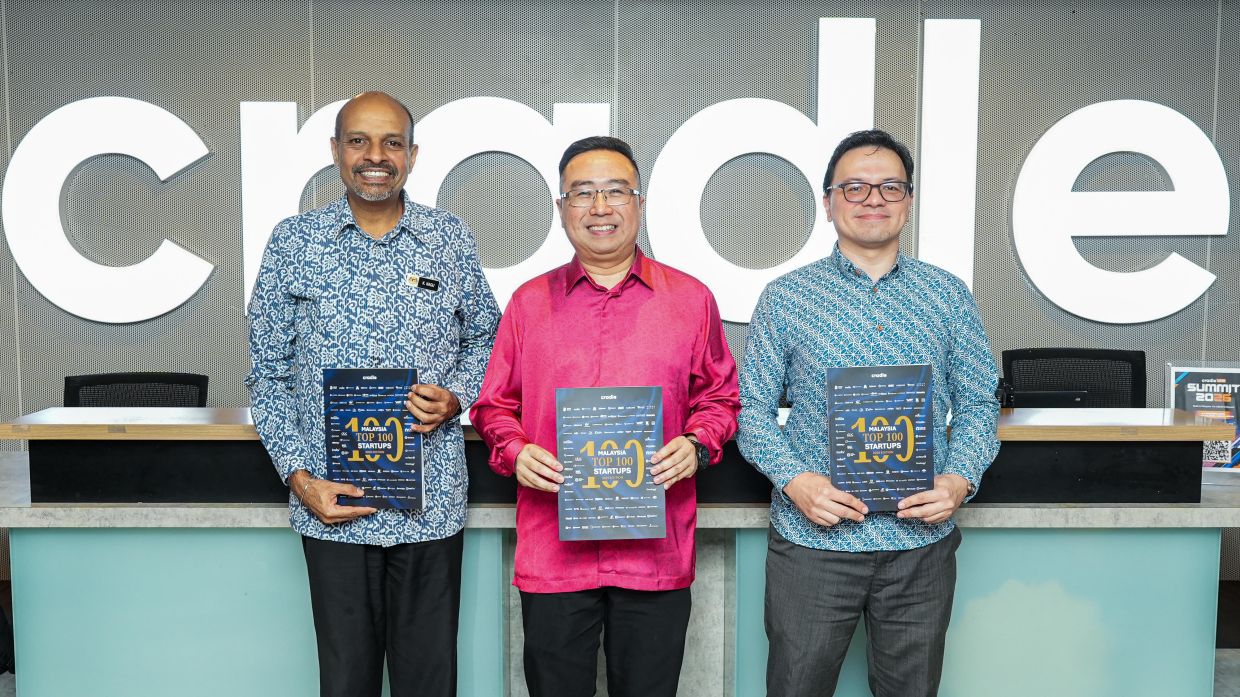
Chang (middle), Norman (right) and Nagulendran at the launch of Malaysia Top 100 Startups – 2026 Edition.
KUALA LUMPUR: The 100 Malaysian technology startups featured in the Malaysia Top 100 Startups – 2026 Edition collectively generated RM8.5bil in revenue for FY2024, recording an average compound annual growth rate (CAGR) of 87%, says Science, Technology and Innovation Minister Datuk Chang Lih Kang.
But revenue growth is only part of the story, he said, as stronger signs of commercial sustainability have also been observed.
“Thirty-six startups recorded more than RM1mil in net profit, with some reaching this milestone as early as the pre-seed and seed stages,” he said at the launch of the publication at Cradle Fund Sdn Bhd, an agency under the Science, Technology and Innovation Ministry (Mosti).
“This tells us that our startups are increasingly building businesses with stronger commercial fundamentals, rather than focusing solely on raising capital or pursuing growth at any cost,” the minister added.
The inaugural publication recognises Malaysian technology startups that have demonstrated business growth, commercial traction and the ability to scale beyond the domestic market.
It is a data-led recognition – not a ranking or a league table – providing a perspective on companies demonstrating tangible business performance and growth.
They are divided into seven major sectors, namely AI & Data, Sustainability & Environment, Fintech, Enterprise & Workforce, Deeptech & Life Sciences, Commerce & Consumers and Automotive & Logistics.
Cradle group chief executive officer Norman Matthieu Vanhaecke said the strong performance of the top 100 highlights the unique strength of Malaysian founders and the depth of talent across the ecosystem.
“What stands out from this edition is the progress that Malaysian startups are making
in building sustainable businesses and achieving profitability, while still maintaining a
very strong growth trajectory.”
Highlights at a glance
Beyond Malaysia: 58 of the top 100 startups are operating across regional and global markets.
AI and data: Artificial intelligence and data-driven businesses account for 66% of the top 100.
Largest sectors by revenue : Automotive & Logistics at RM4.5bil, Commerce & Consumers at RM2.5bil, Fintech at RM0.7bil.
Highest growth: AI & Data, with an average CAGR of 177%. Revenue reached RM207mil in FY2024 on just RM13.7mil in combined disclosed funding.
Cradle-funded: 33 startups of the top 100 have received Cradle funding through grants or investments.
Malaysia’s startup ecosystem now comprises more than 5,000 companies across the country.
While the majority are concentrated in the central region, with 2,222 in Selangor and 1,810 in Kuala Lumpur, other states are also emerging as important hubs. Penang (301), Johor (190) and Sarawak (129), for instance, have a sizable number of startups focusing on Commerce and Consumers tech.
In addition to the top 100 startups, the Malaysia Top 100 Startups – 2026 Edition also recognises established players that have helped shape Malaysia’s startup ecosystem, such as Grab, ADAPTIS e-commerce (formerly known as iPay88), Fave, Foodie Media and Carro Malaysia (formerly known as myTukar).
It also shines a spotlight on startups to watch – up-and-coming founder-led companies at the frontier of deeptech and emerging technology.
Rounding out the publication is a guide to the government support available to founders, founders, investors and tech talents, providing a useful resource for locals and foreigners who are looking to navigate Malaysia’s startup ecosystem.
Since its inception in 2003, Cradle has provided funding to about 1,300 Malaysian startups.
The commercialisation rate for prototype grants reached nearly 80%, shared Norman.
Having funded one-third of the top 100 startups in Malaysia is a recognition of Cradle’s works, he added.
“But it is also important to know that the other 67 are there due to the efforts of angel investors, alternative funders, corporate partners and even the founders’ own money. We need to recognise these private contributions as well.
“The government is there to catalyse and supplement, but the involvement of private capital is equally important for the early stage,” he said.
For those that Cradle funded, the agency monitors their revenue generation, increase in revenue, job creation and sustainability for three years, while supporting them through their growth.
“What we do want to push for is the value creation from each ringgit that has been spent by the government for the grant,” Vanhaecke said.
“At the end of the day, it is the country and the people that we are in for, and the impact.”
Government’s support
The Federal Government has introduced the MySTI initiative to give local startups a head start in commercialisation and marketing of their products.
Under the programme, goods and services developed through local research and development activities are identified with the MySTI logo.
Chang said there is a common perception that the government tends to place trust in multinational companies, and the MySTI initiative gives local startups priority in the procurement system.
There is also The BIG Programme to connect government-linked companies with startups to drive corporate innovation.
Meanwhile, the government has issued a circular to encourage all ministries to buy local research and development products, said Mosti secretary-general Datuk Dr Nagulendran Kangayatkarasu.
Two schemes administered by Malaysian Technology Development Corporation help propel startups in securing government procurement.
Under Dana Mudahcara MySTI, Malaysian startups and small and medium enterprises are given financial capital to help cover production costs, ensuring their readiness for government use.
Dana Uji Beli MySTI provides the opportunities for eligible products and services to be deployed on a trial basis at a relevant ministry or agency.
“The big boys have had the advantage so the government introduced these two schemes to give confidence to ministries and allow them to try out local products to see if they are equally good,” he said.
Read the Malaysia Top 100 Startups – 2026 Edition at https://www.mystartup.gov.my/insights/malaysia-top-100-startups-2026-edition/template1
Cradle LIVE! Summit 2026
Malaysia aspires to become the world’s top 20 startup hub by 2030, a goal the minister said remains on track to achieve.
“We need to double our effort,” Chang said. “Besides Cradle, we have other agencies that provide grants, holding the startups’ hands up till a certain stage.”
Events such as the upcoming Cradle LIVE! Summit 2026 create a platform to raise the profile of Malaysia’s investors, founders and talents, he added, while the publication of Malaysia Top 100 Startups – 2026 Edition puts Malaysia’s ecosystem on the global stage.
With a theme of “Build in Malaysia. For ASEAN & Beyond”, the Cradle LIVE! Summit 2026 will be held on Nov 4 and 5 at the Arch Galleries, Kuala Lumpur, bringing together startups, investors,
industry players and ecosystem partners from Malaysia and beyond.
For details, visit https://live.cradle.com.my/ .
Thank you for your report!
Federal Court upholds acquittal of Samirah in Cradle Fund CEO murder case
Apex court to hear prosecution's appeal in Cradle Fund ex-CEO's murder case from Nov 10 to 12
Start-ups can now access up to RM2mil in funding
张(中)、诺曼(右)和纳古伦德兰出席了《马来西亚百强创业公司 – 2026 年版》的发布会。
吉隆坡:马来西亚科技创新部长拿督张立康表示,入选《马来西亚百强创业公司——2026版》的100家马来西亚科技创业公司在2024财年共创造了85亿令吉的收入,平均复合年增长率(CAGR)为87%。
但他表示,收入增长只是故事的一部分,因为也观察到了更强的商业可持续性迹象。
“36 家初创企业净利润超过 100 万令吉,其中一些企业早在种子轮和种子轮阶段就达到了这一里程碑,”他在 Cradle Fund Sdn Bhd(隶属于科学、技术和创新部 (Mosti) 的机构)的出版物发布会上表示。
部长补充说:“这表明,我们的初创企业越来越注重建立更强大的商业基本面,而不是仅仅专注于筹集资金或不惜一切代价追求增长。”
首期出版物旨在表彰那些展现出业务增长、商业吸引力以及能够拓展到国内市场以外的马来西亚科技初创企业。
这是一项以数据为导向的认可——不是排名或排行榜——它提供了一个视角,来审视那些展现出切实业务绩效和增长的公司。
它们分为七大领域,分别是人工智能与数据、可持续发展与环境、金融科技、企业与劳动力、深度科技与生命科学、商业与消费者以及汽车与物流。
Cradle 集团首席执行官 Norman Matthieu Vanhaecke 表示,前 100 名的强劲表现凸显了马来西亚创业者的独特实力以及整个生态系统的深厚人才储备。
“本届展会最引人注目的是马来西亚初创企业取得的进步。”
在构建可持续发展的企业并实现盈利的同时,还要保持……
增长势头非常强劲。
亮点一览
马来西亚以外:排名前 100 的创业公司中有 58 家在区域和全球市场开展业务。
人工智能和数据:人工智能和数据驱动型企业占前 100 强企业的 66%。
按收入计算最大的行业:汽车与物流(45亿令吉)、商业与消费(25亿令吉)、金融科技(7亿令吉)。
增长最快的领域:人工智能和数据,平均复合年增长率达 177%。在已披露的融资总额仅为 1370 万令吉的情况下,2024 财年营收就达到了 2.07 亿令吉。
获得 Cradle 资助:排名前 100 的初创公司中有 33 家通过拨款或投资获得了 Cradle 资助。
马来西亚的创业生态系统目前涵盖了全国5000多家公司。
虽然大多数初创企业集中在中部地区,雪兰莪州有2222家,吉隆坡有1810家,但其他州属也正在崛起成为重要的中心。例如,槟城(301家)、柔佛(190家)和砂拉越(129家)都拥有相当数量的专注于商业和消费科技的初创企业。
除了前 100 名创业公司外,《马来西亚 2026 年百强创业公司》还表彰了帮助塑造马来西亚创业生态系统的成熟企业,例如 Grab、ADAPTIS 电子商务(前身为 iPay88)、Fave、Foodie Media 和 Carro Malaysia(前身为 myTukar)。
它还重点关注值得关注的创业公司——处于深度科技和新兴技术前沿的、由创始人领导的新兴公司。
该出版物最后还提供了政府为创始人、投资者和科技人才提供的支持指南,为希望了解马来西亚创业生态系统的本地人和外国人提供有用的资源。
自 2003 年成立以来,Cradle 已为约 1300 家马来西亚初创企业提供资金。
诺曼表示,原型资助项目的商业化率接近 80%。
他补充说,Cradle 为马来西亚排名前 100 的创业公司中的三分之一提供了资金,这是对 Cradle 工作的认可。
“但同样重要的是要知道,另外67家公司能够成立,要归功于天使投资人、其他投资方、企业合作伙伴,甚至创始人自己的资金。我们也需要认可这些私人贡献。”
“政府的作用是起到催化和补充作用,但私人资本的参与对于早期阶段同样重要,”他说。
对于 Cradle 资助的项目,该机构会监测其三年的收入产生、收入增长、就业创造和可持续性,并在其发展过程中为其提供支持。
“我们真正想要推动的是,政府为这项拨款花费的每一令吉都能创造价值,”范哈克说。
“归根结底,我们所关心的是国家和人民,以及由此产生的影响。”
政府的支持
联邦政府推出了 MySTI 计划,旨在帮助本地初创企业在产品商业化和市场营销方面抢占先机。
根据该计划,通过本地研发活动开发的产品和服务将带有 MySTI 标志。
张先生表示,人们普遍认为政府倾向于信任跨国公司,而MySTI计划则在采购体系中给予本地初创企业优先权。
此外,还有“BIG计划”,旨在将政府关联企业与初创企业联系起来,以推动企业创新。
与此同时,Mosti秘书长拿督纳古伦德兰·康加亚特卡拉苏博士表示,政府已发布通告,鼓励所有部门购买本地研发产品。
马来西亚科技发展公司管理的两项计划有助于推动初创企业获得政府采购。
根据 Dana Mudahcara MySTI,马来西亚初创企业和中小企业获得财政资金,以帮助支付生产成本,确保它们做好被政府使用的准备。
Dana Uji Beli MySTI 为符合条件的产品和服务提供了在相关部委或机构进行试用部署的机会。
他说:“大公司一直占据优势,所以政府推出了这两项计划,以增强各部委的信心,并允许他们尝试使用本地产品,看看这些产品是否同样好。”
请访问 https://www.mystartup.gov.my/insights/malaysia-top-100-startups-2026-edition/template1 阅读《马来西亚百强创业公司——2026版》
2026年摇篮现场峰会!
马来西亚的目标是到 2030 年成为世界前 20 大创业中心,部长表示,这一目标仍有望实现。
张先生说:“我们需要加倍努力。除了Cradle之外,还有其他机构提供资助,为初创企业提供一定阶段的支持。”
他补充说,即将举行的 Cradle LIVE! Summit 2026 等活动为提升马来西亚投资者、创始人及人才的知名度创造了平台,而《马来西亚百强创业公司——2026 年版》的发布则将马来西亚的创业生态系统推向了全球舞台。
以“立足马来西亚,服务东盟及更广阔地区”为主题的2026年Cradle LIVE!峰会将于11月4日至5日在吉隆坡Arch Galleries举行,届时将汇聚初创企业、投资者等各界人士。
来自马来西亚及其他地区的行业参与者和生态系统合作伙伴。
详情请访问 https://live.cradle.com.my/ 。
感谢您的报告!
联邦法院维持对萨米拉在摇篮基金首席执行官谋杀案中的无罪判决
最高法院将于11月10日至12日审理摇篮基金前CEO谋杀案中检方的上诉。
初创企业现在最多可获得 200 万令吉的资金。