Palm‑sized hatchlings, big win: Malaysia’s green turtles defy global wildlife decline手掌大小的幼龟破壳而出,意义重大:马来西亚绿海龟逆全球野生动物数量下降的趋势而存活
MATAKING, Oct 8 — The palm-sized green turtle hatchling flailing through the sand on a Malaysian island may seem vulnerable, but its species has emerged as a symbol of hope for...
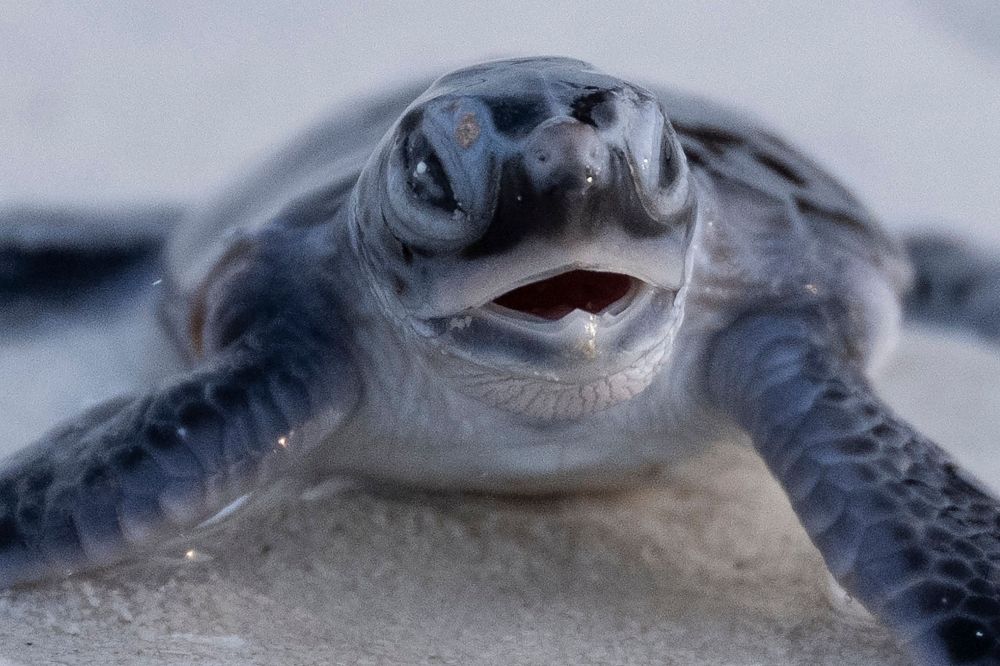
The green turtle, once endangered, has successfully moved to the "least concern" category in global conservation rankings, highlighted as a symbol of hope amid widespread wildlife declines as noted in the WWF's Living Planet Report.
The conservation success story is attributed to dedicated efforts like egg relocation, marine protection, and trade bans spearheaded by local communities and experts such as Malaysian turtle researcher Juanita Joseph.
However, challenges persist, including regional population declines, threats from poaching, climate change, and development, emphasizing the need for sustained, long-term conservation strategies.
The collaborative efforts in Malaysia, involving local communities and resorts, underscore the importance of continuous support and innovative research in preserving green turtle populations for future generations.
MATAKING, Oct 8 — The palm-sized green turtle hatchling flailing through the sand on a Malaysian island may seem vulnerable, but its species has emerged as a symbol of hope for wildlife conservation.
Green turtles have made the rare jump from endangered to “least concern” in global conservation rankings, a remarkable success when many species are declining.
Conservation NGO World Wildlife Fund (WWF), in its biannual Living Planet Report released Thursday, found a 73-per cent decline in the average size of monitored wildlife populations over 53 years.
But around 50 per cent of the thousands of vertebrates monitored for the report are stable or increasing.
That includes green turtles, thanks to decades of efforts including egg relocation, marine protection and trade bans.
Malaysian turtle expert Juanita Joseph has spent years on the frontlines, carrying out cutting-edge genetic research and even convincing her own father to stop eating turtle eggs.
Still, when the International Union for the Conservation of Nature last year announced green turtles were no longer endangered, she could hardly believe it.
“Never in my mind (did I think) that one day turtles can be ‘least concern’. I cried... I said I’ve done my part,” she told AFP at Universiti Malaysia Sabah, where she is a professor.
All six other sea turtle species are still vulnerable or critically endangered, apart from the flatback turtle, whose status is unclear because of data shortages.
Turtles are targeted for food and their shells, killed in fishing nets, and constrained by development and pollution at nesting beaches and feeding grounds.
Climate change also skews populations more female because heat determines sex development in eggs.
Even now, recovery is uneven. While green turtles globally are “least concern”, some regional populations are still endangered and declining.
Malaysia is something of a regional exception. Green turtle nesting at Sabah state’s Turtle Islands has tripled since the 1970s to over 20,000 nests annually.
That reflects “over five decades” of work, said Sabah Parks director Maklarin Lakim.
The Turtle Islands have been protected since 1977, and Sabah banned turtle meat and egg consumption in 1997.
“This is our heritage, this is our biodiversity,” Maklarin said.
“We would like to protect that as long as possible.”
Much of the conservation success has relied on people like Sitti Rasah Abdul, 50, from a fishing community on Malaysia’s Omadal island.
Since 2012, she and other members of a women’s cooperative have relocated turtle eggs from beaches to a hatchery to protect them from predators and poachers.
The 20-strong team started conservation work with WWF, but now self-funds, ploughing 10 per cent of revenue from their handicraft and catering business into turtle protection.
“I’m already old,” said Rasah, on the wooden jetty that extends from her home into aquamarine seawater.
“But I feel a sense of responsibility to ensure that there are still turtles around for the next generation.”
A 45-minute boat ride away, green and hawksbill turtle hatchlings emerged from relocated nests in a hatchery at the high-end Mataking Reef Resort.
Hotel owner Sophia Sie fell in love with turtles decades ago when her father acquired land on Mataking island, and now around 10 per cent of her staff works on conservation.
In 2006, “we had about 600 eggs collected... today we have about 36,000 eggs,” Sie told AFP.
Guests can release hatchlings, and while Sie considers conservation a passion, it is also good business.
“The survival of our business here is very much dependent on the natural resources and the beauty around us,” she said.
The hatchlings tipped from a basket onto a Mataking beach face long odds. Just one in 1,000 will survive to sexual maturity at 20 years old.
Hatchlings spend around a decade in the open ocean, a period sometimes called the “lost years” because scientists know so little about it.
Working out where turtles spend those years, and where they forage and reproduce, is key to sustaining conservation success, said Gavin Jolis, marine species strategy manager at WWF-Malaysia.
The NGO has created the world’s first global turtle DNA database, Shellbank, using samples from turtle tissue and shells to trace populations and even target poachers.
“In order to save sea turtles, we have to look at the life cycle,” said Jolis.
“That’s where the genetic work comes in.”
The neat rows of test tubes in Joseph’s lab contain bits of hatchling flipper snipped from babies that did not survive.
Sequencing them reveals a turtle’s “haplotype”, a kind of genetic fingerprint.
The work has already helped show that turtles foraging in parts of Malaysia come from Micronesia, and identified the likely source of turtle shell intercepted in Britain.
While each conservation effort faces different challenges, the battle to protect green turtles teaches “to really be resilient and patient with the work”, said Jolis.
“We should not look at just a short-term project, it’s a long-term project.” — AFP
From ‘kodokushi’ in Japan to Perak villages, lonely deaths rise as Malaysia’s ageing population grows
Nature in freefall: WWF says wildlife populations plunge 73pc since 1970
Where Hokkien traders settled and miners thrived, Dungun’s ‘kedai kayu’ still whisper history
Budget 2027 aims to sustain growth while protecting households from subsidy reforms and cost pressures
‘Clean air not a luxury’: Manufacturers in Malaysia demand Asean accelerate haze-free roadmap
Anwar to table Budget 2027 today, promising resilience, reforms and relief for Malaysians
绿海龟曾一度濒临灭绝,如今已成功跻身全球保护排名中的“无危物种”行列,在世界自然基金会《地球生命力报告》指出的野生动物数量普遍下降的背景下,绿海龟被视为希望的象征。
保护工作的成功归功于当地社区和专家(例如马来西亚海龟研究员胡安妮塔·约瑟夫)带头开展的专项努力,例如海龟蛋迁移、海洋保护和贸易禁令。
然而,挑战依然存在,包括区域人口下降、偷猎威胁、气候变化和发展,这凸显了制定可持续的长期保护战略的必要性。
马来西亚当地社区和度假村的合作努力,凸显了持续支持和创新研究对于保护绿海龟种群,造福子孙后代的重要性。
马塔金,10 月 8 日——一只手掌大小的绿海龟幼龟在马来西亚一座岛屿的沙滩上挣扎,它看起来很脆弱,但它的物种已经成为野生动物保护的希望象征。
绿海龟在全球保护等级中罕见地从濒危物种跃升至“无危物种”,这在许多物种数量都在下降的情况下是一个了不起的成就。
环保非政府组织世界自然基金会(WWF)在其周四发布的两年一度的《地球生命力报告》中发现,在过去的 53 年里,受监测的野生动物种群平均规模下降了 73%。
但据该报告监测的数千种脊椎动物中,约有 50% 的数量保持稳定或正在增长。
这其中就包括绿海龟,这要归功于数十年来人们所做的努力,包括海龟卵迁移、海洋保护和贸易禁令。
马来西亚海龟专家胡安妮塔·约瑟夫多年来一直奋战在第一线,开展尖端的基因研究,甚至说服了自己的父亲停止食用海龟蛋。
然而,当国际自然保护联盟去年宣布绿海龟不再濒危时,她简直不敢相信。
“我做梦也没想到有一天海龟会成为‘无危物种’。我哭了……我说我已经尽力了。”她在马来西亚沙巴大学接受法新社采访时说道,她在该校担任教授。
除了平背海龟之外,其他六种海龟仍处于易危或极危状态,而平背海龟由于数据不足,其生存状况尚不明确。
海龟因被捕食和获取龟壳而成为猎物,被渔网缠住而丧命,筑巢海滩和觅食地也受到开发和污染的限制。
气候变化也导致种群中雌性比例增加,因为温度决定了卵子的性别发育。
即使现在,绿海龟的恢复情况也并不均衡。虽然全球绿海龟已被列为“无危物种”,但一些地区的种群仍然濒临灭绝,数量还在不断下降。
马来西亚的情况在区域内较为特殊。自 20 世纪 70 年代以来,沙巴州海龟岛的绿海龟筑巢数量增加了两倍,每年超过 2 万个巢穴。
沙巴公园总监 Maklarin Lakim 表示,这反映了“超过五十年”的工作成果。
自 1977 年以来,龟岛一直受到保护,沙巴州于 1997 年禁止食用龟肉和龟蛋。
“这是我们的遗产,这是我们的生物多样性,”马克拉林说。
“我们希望尽可能长时间地保护它。”
保护工作的成功很大程度上要归功于像 50 岁的 Sitti Rasah Abdul 这样的人,她来自马来西亚奥马达尔岛的一个渔村。
自 2012 年以来,她和妇女合作社的其他成员将海龟蛋从海滩转移到孵化场,以保护它们免受捕食者和偷猎者的侵害。
这支由 20 人组成的团队最初与世界自然基金会 (WWF) 合作开展保护工作,但现在他们自筹资金,将手工艺品和餐饮业务收入的 10% 投入到海龟保护中。
“我已经老了,”拉萨站在从她家延伸到碧蓝海水中的木制码头上说道。
“但我感到有责任确保下一代还能看到海龟。”
乘船 45 分钟即可到达位于高档马塔金礁度假村的孵化场,在那里,绿海龟和玳瑁幼龟从迁移的巢穴中破壳而出。
酒店老板索菲亚·西耶几十年前就爱上了海龟,当时她的父亲在马塔金岛获得了土地,现在她大约 10% 的员工从事海龟保护工作。
谢告诉法新社:“2006年,我们收集了大约600枚鸡蛋……如今,我们收集了大约36000枚鸡蛋。”
客人可以放生幼龟,虽然 Sie 认为保护动物是他的爱好,但这也是一项不错的生意。
“我们在这里的业务能否生存,很大程度上取决于我们周围的自然资源和美景,”她说。
从篮子里倾倒在马塔金海滩上的幼龟生存几率很低。只有千分之一的幼龟能活到20岁性成熟。
幼鱼会在开阔的海洋中度过大约十年时间,这段时期有时被称为“失落的岁月”,因为科学家对这段时期知之甚少。
世界自然基金会马来西亚分会海洋物种战略经理加文·乔利斯表示,弄清楚海龟在哪里度过这些年,在哪里觅食和繁殖,是维持保护工作成功的关键。
该非政府组织创建了世界上第一个全球海龟 DNA 数据库 Shellbank,利用海龟组织和龟壳的样本来追踪海龟种群,甚至打击偷猎者。
“为了拯救海龟,我们必须了解它们的生命周期,”乔利斯说。
“这就需要用到基因工程了。”
约瑟夫的实验室里整齐地摆放着一排排试管,里面装着从夭折的幼龟身上剪下来的鳍状肢碎片。
对它们进行测序可以揭示海龟的“单倍型”,这是一种基因指纹。
这项研究已经帮助证明,在马来西亚部分地区觅食的海龟来自密克罗尼西亚,并确定了在英国截获的龟壳的可能来源。
Jolis表示,虽然每项保护工作都面临着不同的挑战,但保护绿海龟的斗争教会了我们“真正地要有韧性和耐心”。
“我们不应只关注短期项目,而应着眼于长期项目。”——法新社
从日本的“孤尸”到霹雳州的村庄,随着马来西亚人口老龄化,孤独死亡的案例也在增加。
自然界急剧衰落:世界自然基金会称,自1970年以来,野生动物数量锐减73%。
在福建商人定居、矿工兴旺的地方,东贡的“木屋”至今仍在低语着历史。
2027年预算案旨在维持经济增长,同时保护家庭免受补贴改革和成本压力的影响。
“清洁空气并非奢侈品”:马来西亚制造商呼吁东盟加快制定无雾霾路线图
安华今天将提交2027年财政预算案,承诺增强马来西亚的韧性,推行改革,并为马来西亚人民提供救济。