Koh Samui Israeli expat the first to be deported under Prime Minister Anutin’s new deportation regime苏梅岛一名以色列侨民成为总理阿努廷新驱逐政策实施后首位被驱逐出境的人员。
5-year Israeli expat Yaacov Ohayon is ordered deported after a Samui zoo threats conviction. Anutin uses Thailand’s new deportation rules eight days after launch, as… Read More ›
新闻视频
September 5, 2026 at 11:00 pm
in Crime , Living , Media , Politics , Thailand
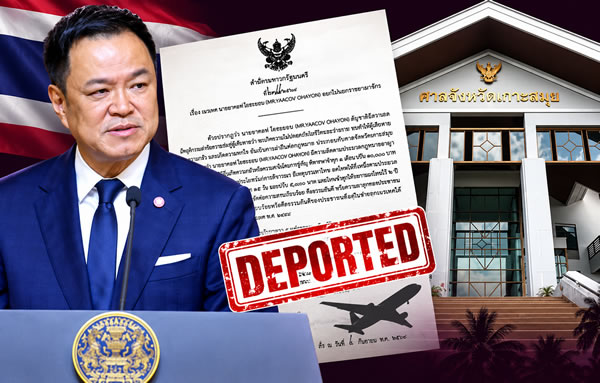
Prime Minister Anutin Charnvirakul has ordered five-year Koh Samui expatriate Yaacov “Jacob” Ohayon deported, making him the first reported foreigner targeted under Thailand’s new 2026 deportation rules. The order came just eight days after they took effect and followed a conviction carrying only a ฿5,000 fine and a suspended 15-day jail term. Yet a bitter Samui Exotic Park dispute involving threats, a Palestinian flag, online attacks and police checkpoints has now put Ohayon’s Thai residency on the line. He has seven days to appeal as the government intensifies its crackdown on foreign misconduct, nominee businesses and immigration breaches across major tourist centres.
Prime Minister Anutin Charnvirakul’s deportation order against Israeli expat Yaacov Ohayon was released Saturday, making him the first reported target of Thailand’s new rules. It follows a Koh Samui court verdict for threatening a zoo owner, with a ฿5,000 fine and a suspended 15-day jail term. ( Source: Khaosod )
Prime Minister Anutin Charnvirakul has ordered a five-year Israeli expatriate deported after his conviction for threatening a Koh Samui zoo owner. Yaacov “Jacob” Ohayon is the first reported foreigner targeted under Thailand’s new 2026 deportation procedures. The order came only eight days after the rules took effect.
Ohayon is a real estate developer who also operates a sandwich business on Koh Samui. He had lived on the island for about five years.
Yet a bitter dispute involving Samui Exotic Park has now placed his Thai residency at risk. A ฿5,000 fine and suspended prison sentence ultimately triggered a far more serious administrative sanction.
Anutin signs first deportation order under new 2026 rules as Ohayon is given seven days to appeal
Anutin signed the Interior Ministry order on Friday, September 4. He acted in his separate capacity as interior minister. The order directs Ohayon’s deportation under Section 5 of the Deportation Act B.E. 2499. It also invokes the new Prime Minister’s Office Regulation on Deportation B.E. 2569.
Crucially, Thailand did not acquire its deportation power under the new regulation. The principal legal authority has existed since the Deportation Act was enacted in 1956. Rather, the August regulation creates a clearer procedure for using those existing powers. It links courts, government departments and the Interior Ministry through a standing administrative process.
Notably, Ohayon is therefore not Thailand’s first deported foreigner. Nor is he the first foreigner subjected to removal action under Anutin. He is the first reported case handled through the new 2026 framework. That distinction makes the Koh Samui dispute the regulation’s first major public test.
Anutin signed the regulation on August 26. It appeared in the Royal Gazette the following day. It then took effect on August 28. By September 4, the interior minister had already signed Ohayon’s deportation order.
However, the Israeli businessman has not exhausted his legal options. He can appeal within seven days after formal notification. That appeal is made to the prime minister. As of Saturday night, there was no confirmation that Ohayon had physically left Thailand.
Samui zoo dispute widens from visitor complaints and animal claims to Palestinian flag confrontation
There was also no confirmation that he had filed his appeal. Accordingly, the precise position is that he has been ordered deported. Reports do not establish that the removal has already been carried out. For now, the ministerial order remains the decisive development.
The case began with a confrontation at Samui Exotic Park in Mae Nam. Thai woman Jindarat “Sai” Sattayapun operates the attraction with her French husband, Kevin. Earlier disputes had already developed between the park and some Israeli visitors. Those incidents later became part of a much larger confrontation.
Jindarat said some Israeli visitors disputed entrance fees and demanded refunds. She also complained that some ignored rules concerning the park’s animals. In another claim, she said visitors took animal feed belonging to other customers. She additionally described serious incidents involving the handling of animals.
Separately, Jindarat said one visitor struck a bird after it landed on the person’s shoulder. She said the bird subsequently died. Those allegations were not findings against Ohayon in his criminal prosecution. They instead formed part of the wider dispute surrounding the park.
The confrontation acquired another dimension when the park displayed support for Palestinians. A Palestinian flag appeared at the attraction. Kevin was also reported to have displayed a sign welcoming Palestinians. That changed the character of an already difficult customer dispute.
Israeli family refusal and online clashes draw police checkpoints as Samui dispute gains wider attention
On August 12, another confrontation followed after an Israeli family was refused admission. The argument then spread rapidly online. Social media carried competing accounts of what was happening at the Koh Samui attraction. The increasingly hostile exchanges soon drew wider public attention.
In response, Ohayon contacted Kevin and demanded removal of the Palestinian flag. Kevin refused. Their communication became increasingly aggressive and was later circulated online. Meanwhile, Jindarat complained that threats had been made against her.
The situation then moved rapidly beyond an ordinary business dispute. Police established a checkpoint outside Samui Exotic Park from around August 15. Security was also introduced around properties linked with the opposing sides. Officers began monitoring an increasingly volatile confrontation.
At the same time, the dispute was making headlines in Thailand and Israel. Surat Thani security officials became concerned about its wider effect. They saw two damaging narratives developing around the island. One portrayed Israelis as threatening Koh Samui residents.
Security fears deepen as Ohayon is convicted and Interior Ministry moves from court case to deportation
The other suggested Koh Samui itself was becoming hostile towards Israelis. Consequently, officials feared the confrontation could develop into broader religious or ethnic tensions. They were also concerned about damage to the island’s tourism business. The visible security operation reflected those concerns.
Eventually, police arrested Ohayon. His case went before Koh Samui Provincial Court under Section 392 of the Criminal Code. That provision covers threats causing another person fear or alarm. The court found the Israeli businessman guilty.
Initially, the court sentenced him to one month in prison. It also imposed a ฿10,000 fine. Ohayon then pleaded guilty. As a result, both penalties were reduced by half.
The final sentence was 15 days in prison and a ฿5,000 fine. The prison term was suspended for two years. Therefore, Ohayon did not immediately enter prison. Nevertheless, the court judgment opened a second and potentially more consequential process.
The Interior Ministry subsequently reviewed whether he should remain in Thailand. Its order said Ohayon posted threatening messages concerning the victim’s life and physical safety. The ministry said those communications caused Jindarat fear and alarm. It also said his conduct violated Thai law.
One-star review campaign and threats bring Ohayon under Section 5 as Thai residency is put at risk
In addition, the order referred to an online campaign against Samui Exotic Park. Ohayon was accused of orchestrating one-star reviews targeting the business. The ministry considered those actions alongside the threatening communications. It then assessed his conduct under the Deportation Act.
The ministry concluded his behaviour was contrary to public order, good morals or public wellbeing. That finding brought the case within Section 5. Anutin then signed the removal order. The administrative sanction immediately became much more serious than the underlying criminal penalty.
For Ohayon, the difference is substantial. The criminal case produced a ฿5,000 fine and a suspended 15-day sentence. Deportation threatens his right to remain in Thailand entirely. It could also end roughly five years of residence and commercial activity on Koh Samui.
Earlier reports described Ohayon as holding a business visa. He was already established economically on the island. He operated a sandwich business and was involved in real estate. Thus, the order is not simply the removal of a short-stay visitor after a criminal incident.
More importantly, his case demonstrates a key feature of the new regulation. A foreign offender need not receive a lengthy prison sentence before deportation becomes possible. Suspended imprisonment can still trigger the administrative process. A fine can also lead to further examination.
New procedures connect court rulings to deportation decisions across immigration, business and crime cases
Under the new procedures, relevant court information can be sent for Interior Ministry consideration. That allows criminal punishment and immigration consequences to proceed separately. A court can impose a limited sentence while the government considers removal. Ohayon has become the first reported example.
As part of this, the regulation covers two broad categories of foreigners. One category concerns conduct deemed contrary to public order, good morals or public wellbeing. Another covers foreigners convicted of specified offences. The procedures then determine how those cases reach the interior minister.
The framework extends well beyond threats or public disturbances. It includes cases involving illegal entry and other immigration offences. Illegal employment can also activate the machinery. Certain Foreign Business Act offences are included as well.
Likewise, cases involving forged official documents can enter the process. Serious criminal offences are also covered. Principals, instigators and supporters can fall within the procedures where applicable. The regulation therefore creates a broad administrative route for qualifying cases.
On another front, it also deals with foreign prisoners approaching release. Corrections officials must provide relevant case information before qualifying inmates leave custody. Normally, that information must arrive at least 15 days before release. Deportation planning can therefore begin while the prisoner remains incarcerated.
Deportation rules extend to prisoners as foreign business crackdowns widen across tourist centres
This procedure is intended to avoid long gaps between release and immigration action. Deportation orders can also restrict a foreigner from returning. Those bans may apply for specified periods. The mechanism therefore extends beyond simply placing somebody on an outbound flight.
The Ohayon decision also comes during intensified enforcement against foreign business activity. Several major tourist centres are under increased scrutiny. They include Phuket, Koh Samui, Koh Phangan, Koh Tao and Pattaya. Nominee businesses have become a particular focus.
Koh Samui has been central to that campaign. Officials reviewed 12,906 companies on the island. Of those, 8,254 had foreign shareholders. A further 875 businesses were identified for closer examination.
The review produced 60 cases involving 59 companies. Officials identified 88 suspects. Moreover, 37 land plots worth approximately ฿1.2 billion came under review. Those investigations were already underway before the Ohayon order.
In parallel, Koh Tao has seen extensive foreign employment checks. Six foreign diving instructors were arrested during an August operation. Five were Spanish nationals and one was British. Three Myanmar workers were also arrested.
Earlier in 2026, another 47 foreign arrests were recorded on Koh Tao. Revenue Office 2 also examined 110 business entities. Meanwhile, a Koh Phangan land review identified 112 entities above the examination threshold. The southern islands have consequently become a major enforcement zone.
Phuket scrutiny widens as over 100 companies face checks with combined revenues exceeding ฿5 billion
Phuket has faced similar scrutiny. An August 6 operation examined more than 100 companies. Their combined revenues exceeded ฿5 billion. Sixteen people were prosecuted following the checks.
Ten were Thai nationals. The remaining six were foreigners. They included two Canadians, three Russians and one Kazakhstani. These operations focused on suspected nominee structures and foreign business activity.
Further north, Pattaya has also come under investigation. An August 21 operation targeted a suspected Israeli nominee business network. Assets involved were valued at several hundred million baht. That probe was separate from the Ohayon criminal case.
Even so, the timing places his deportation within a broader enforcement drive. The government has increased attention on foreign residents, businesses and employment. Visa compliance has also become a prominent issue. Deportation now provides another available administrative mechanism.
Tourism minister warns of visa cancellation and blacklisting as Samui officials had already weighed action
Tourism and Sports Minister Surasak Panjaroenworakul reinforced the policy on August 28. He warned foreigners that serious disturbances could lead to visa cancellation. He also cited deportation and blacklisting. His warning came the same day the new deportation regulation took effect.
Yet official concern about the Samui Exotic Park dispute had begun earlier. Surat Thani security officials were already considering immigration action during August. Colonel Thitiphong Inwasa discussed the situation publicly on August 22. He is deputy director of the Internal Security Operations Command in Surat Thani.
At that stage, officials were assembling cases involving both Ohayon and Kevin. The original response was therefore not aimed solely at the Israeli businessman. Officials were reacting to the escalating confrontation itself. They viewed the increasingly international dispute as a security and tourism problem.
Afterwards, Ohayon’s criminal conviction materially changed his position. The court judgment provided a concrete legal basis for further government action. Soon afterwards, the new regulation took effect. The Interior Ministry then moved to deport him.
Separate ฿500,000 bounty claim is kept apart from Ohayon case as his conviction drives deportation action
A separate strand of the dispute involved reports of a ฿500,000 bounty connected with Kevin. That issue requires a clear distinction. The allegation was not the basis of Ohayon’s conviction. Another individual was reported to be linked with the bounty claim.
Police investigated that matter separately. Therefore, the ฿500,000 allegation should not be attributed to Ohayon on the supplied evidence. Several Israelis became associated with different parts of the broader dispute. That contributed to confusion in some early reporting.
For example, reports on August 25 said an Israeli’s visa had already been revoked. That report was linked with the broader bounty allegations. However, the person was not named. Ohayon’s case instead rests directly on his Section 392 conviction.
The sequence in his case is now clear. First came disputes involving Israeli visitors at Samui Exotic Park. Then came the Palestinian flag controversy. The conflict subsequently moved onto social media. Threatening communications followed.
Police then introduced checkpoints and additional security. Ohayon was arrested and prosecuted. Koh Samui Provincial Court convicted him. His guilty plea reduced his punishment to 15 days and ฿5,000.
Eight-day rollout turns suspended sentence into first reported deportation under Thailand’s new framework
Shortly afterwards, the deportation regulation came into force. The Interior Ministry considered his case under the new procedures. Anutin signed the removal order on September 4. Within weeks, a private island dispute had become Thailand’s first reported case under the new framework.
The speed of the process is significant. The regulation became effective on August 28. The first reported deportation order followed eight days later. Ohayon also received no immediate custodial sentence. His jail term was suspended.
Even so, the administrative machinery continued after the criminal court finished its work. That is the central legal feature of the case. A relatively minor sentence did not end the consequences. Instead, the Interior Ministry separately examined whether Ohayon should remain in Thailand.
The decision also demonstrates the difference between criminal sentencing and deportation. Koh Samui Provincial Court punished Ohayon for his offence. It did not deport him. The Interior Ministry later made that separate decision under existing deportation law.
New process links court sentence and removal as Ohayon faces appeal to Anutin after deportation order
Under the new framework, those two processes can now follow each other rapidly. Information from the courts can move directly into deportation consideration. That mechanism is particularly relevant where imprisonment is suspended. Ohayon’s judgment falls squarely within that category.
There remains one unusual procedural feature. Ohayon’s appeal goes to the prime minister. Anutin, however, signed the deportation order as interior minister. He therefore occupies both offices relevant to successive stages of the case.
Ohayon has seven days after notification to challenge the decision. He may seek revocation of the deportation order. He may also seek permission to leave Thailand under the applicable procedure. No appeal had been confirmed by Saturday night.
Nor had his physical departure been confirmed. Accordingly, the case remains at the deportation-order stage. What is established is that Anutin has formally ordered his removal. That decision represents the first reported use of the new 2026 procedures.
Only weeks earlier, Ohayon was still a five-year Koh Samui expatriate businessman. Then came the zoo confrontation, online threats, police intervention and a court case. A guilty plea reduced his sentence sharply. Yet the consequences did not stop there.
Instead, a ฿5,000 fine and a suspended 15-day prison term were followed by a ministerial deportation order. Unless overturned, that order will end Ohayon’s residence in Thailand. It also makes him the first reported foreigner caught by Anutin’s newly formalised deportation regime.
Nationalist group meets Minister urging probes into illegal activity linked to foreigners on Koh Samui
100 Phuket firms with revenues of 5 billion using naturalised citizens investigated after police raids
Raids in Pattaya on Friday led by two ministers targeting Israeli business networks and legal advisors
Frenchman’s Koh Samui business empire enmeshed in knotty police probe of nominee firms and pot farm
Drive against foreign owned property and business on Koh Samui and Koh Phangan now targets leases
International reservations system used by hotels targeted in latest Koh Phangan swoop by ministers
Anutin visits Koh Phangan as nominee crackdown shows 68% of firms with foreign ownership links
Blitzkrieg on foreign firms and enterprises on Koh Phangan continues with French owned resort busted
35-year-old Frenchman arrested on Koh Phangan on Sunday for rape as island-wide swoop nets 6 suspects
Ten foreign Poker players arrested in a police swoop on a rented house in Koh Phangan on Tuesday night
Russian-Chinese Koh Phangan alliance to sell drugs to foreigners. Accused entered Thailand illegally
Sex, drugs, business and work abuses linked to expats targeted this week by police raids on Koh Phangan
Ten arrested and two illegal hostels shuttered on Koh Phangan as fierce crackdown continues on the island
Joseph Anthony is an expat from Ireland who has lived in Thailand for the last decade. He has worked extensively in the media including editorial positions in Ireland and Thailand. He is focused on economic and business stories in Thailand as well as the expat lifestyle.
All posts by Joseph O' Connor
Stock market 2026 recovery not built on a sound footing. Depends on foreign capital and one company September 2, 2026 Bangkok’s stock market roared back 26% after three
New visa regime hits Western visitors and expats in Thailand hard with shorter stays and long haul trips September 1, 2026 Thailand’s new visa squeeze halves tourist stays to
Thais take to government TH AI project on the first day with ChatGPT reporting outages later on Monday September 1, 2026 More than 1.36 million Thais register for the TH-AI
Devastating tragedy in Bangkok as pregnant teacher takes her life after paternity fight with boyfriend September 1, 2026 A customer finds a pregnant Bangkok teacher dead
Thailand’s stiff restrictions on small foreign investors a significant problem for its daring OECD aspirations August 31, 2026 Thailand chases OECD membership by 2028 while
Travel Blogger claims he was accosted by cocaine hucksters in broad daylight on Bangkok’s Sukhumvit August 31, 2026 Sukhumvit’s cocaine hucksters approach a travel
Business tenants of Bangkok’s Khlong Thom Centre wiped out after decades of work went up in flames August 31, 2026 Generations of family enterprise go up in flames as
Thailand wins Asian Women’s Volleyball title for the third time in a thrilling win over China on Sunday August 30, 2026 Thailand’s volleyball queens conquer China 3-2 on
PM Anutin raises questions about Tuesday’s Songkhla cabinet meeting after renewed insurgency violence August 30, 2026 Pattani gunmen storm Global House, clear shoppers,
Underage woman ran up 60,000 baht tab at host bar after pursuing a man. Bill paid by shaving her hair August 30, 2026 A Bangkok host-bar manager shaves an 18-year-old
Thai government pushes AI in two programmes one aimed at the public and the other aimed at startups August 29, 2026 Yotsanan brings OpenAI’s first official Asian
Nationalist group meets Minister urging probes into illegal activity linked to foreigners on Koh Samui August 29, 2026 Polpeera receives Thai Mai Thon’s dossier on
Norway’s King Haakon VIII ascends the throne in Oslo after death on Friday of much loved King Harald V August 29, 2026 King Harald V dies peacefully at 89 as Haakon VIII
Israeli Embassy urges the media to be accurate about reporting nationalities after Phuket dine and dash August 29, 2026 Israel’s embassy demands false reports be removed
Police probing Chinese woman’s kidnapping on the trail of human trafficking gang. More victims feared August 28, 2026 Photos of bound Chinese people found on a suspect’s
Anutin as Interior Minister assigns himself sweeping powers to deport foreigners under new regulations August 28, 2026 Anutin unleashes fast-track deportations against
Thailand’s evil serial killer of women Somkid was released in 2019 and murdered a woman in months August 27, 2026 Death and life sentences collapsed into early freedom
People’s Party firebrand attacks flagship TH AI project launched this week with corruption agency filing of claims September 2, 2026
The boys are back in town. US servicemen return to Pattaya, a town they helped create, for wartime R&R September 2, 2026
Pot shop worker attacks UK man on his motorbike over 29,200 baht fraud on Monday in broad daylight September 1, 2026
Woman in northern Thailand builds thriving concern farming and selling live cockroaches for fishing in nearby rivers September 1, 2026
Pattaya police probe a nightclub shooting on the city’s Southside in the early hours of Monday morning August 31, 2026
Anutin begins week with twin economic headaches as car makers and rail consortium threaten to walk August 31, 2026
American man arrested in Phuket on US state and federal warrants relating to sexual abuse of minors at home August 31, 2026
Bangkok storm’s nightlife charts to be crowned the World’s number one and the most visited city on earth August 30, 2026
Pattaya police operation targets street sex workers ahead of expected arrival of US sailors on Wednesday August 30, 2026
Thailand approaches a seminal moment in politics as Senate collusion case decision set for September 14 August 30, 2026
Thailand’s America’s Got Talent star returned home on Friday ahead of her September date with destiny August 30, 2026
Myanmar authorities remain tight lipped over death of US diplomat in May and his jailed Thai partner August 29, 2026
New face of Thailand’s Tourism Police. Minister visits HQ and speaks of a new era of high tech security August 29, 2026
Police respond within 10 minutes to drunk foreign tourist attacking and breaking into ATM for lost card August 29, 2026
Huge fire in central Bangkok at a major electronics retail centre. Governor Chadchart was on the scene August 29, 2026
Pheu Thai leader Julapun insists coalition government is ‘very strong’ at Government House on Friday August 28, 2026
Police cordon off mountain area to manhunt for man who murdered his lover’s husband after affair ended August 28, 2026
Tourism Authority of Thailand (TAT) turns to railway to boost the appeal of Thailand to foreign tourists August 27, 2026
Koh Samui zoo dispute morphs into wider protest at Israelis and foreigners misbehaving in Thailand August 27, 2026
Tourism chiefs monitor Chinese media after rescue of young woman by Kamphaeng Phet police. 4 arrested August 27, 2026
Central bank holds interest rate steady at 1% as real economy strains and investment targets technology August 26, 2026
Immigration Koh Tao raids see UK and Spanish diving instructors arrested for working on DTV visas August 26, 2026
© 2026 Thai Examiner. All rights reserved.
2026年9月5日晚上11点
在“犯罪”、“生活”、“媒体”、“政治”、“泰国”等类别中
泰国总理阿努廷·查恩维拉库尔下令将居住在苏梅岛五年的外国人雅科夫·“雅各布”·奥哈永驱逐出境,使他成为泰国2026年新遣返条例生效后首位被报道的被驱逐的外国人。该命令在新条例生效仅八天后下达,此前奥哈永仅被判处5000泰铢罚款和15天缓刑。然而,一场涉及巴勒斯坦国旗、网络攻击和警方检查站的激烈苏梅岛异域公园纠纷,如今使奥哈永的泰国居留权岌岌可危。他有七天时间提出上诉,与此同时,政府正在加大力度打击主要旅游中心的外国人不当行为、名义企业和违反移民法的行为。
泰国总理阿努廷·查恩维拉库尔(Anutin Charnvirakul)对以色列侨民雅科夫·奥哈永(Yaacov Ohayon)的驱逐令于周六生效,使他成为泰国新规的首位目标人物。此前,苏梅岛一家法院判处奥哈永因威胁动物园老板而受到处罚,罚款5000泰铢,并缓刑15天。(来源:Khaosod)
泰国总理阿努廷·查恩维拉库尔下令将一名在泰国居住五年的以色列籍男子驱逐出境,此前该男子因威胁苏梅岛一家动物园园主而被定罪。据报道,雅各布·奥哈永是首位根据泰国2026年新遣返程序被驱逐的外国人。该命令是在该程序生效仅八天后下达的。
奥哈永是一名房地产开发商,同时在苏梅岛经营一家三明治店。他已经在岛上生活了大约五年。
然而,一场与苏梅岛异域公园有关的激烈纠纷,如今却危及了他的泰国居留权。5000泰铢的罚款和缓刑最终引发了更为严重的行政处罚。
阿努廷根据2026年新规签署了首份驱逐令,奥哈永有七天时间提出上诉。
阿努廷于9月4日星期五签署了内政部命令。他以内政部长的身份单独签署了该命令。该命令指示根据佛历2499年《驱逐法》第5条将奥哈永驱逐出境。该命令还援引了佛历2569年《首相府关于驱逐出境的新条例》。
至关重要的是,泰国的驱逐出境权并非依据新规获得。其主要法律依据自1956年《驱逐出境法》颁布以来就已存在。相反,8月份的这项新规旨在为行使这些现有权力制定更清晰的程序。它通过一套既定的行政流程,将法院、政府部门和内政部联系起来。
值得注意的是,奥哈永并非泰国首位被驱逐出境的外国人,也不是首位根据《阿努廷法案》被遣返的外国人。他是首例根据2026年新框架处理的已公布案例。这一特殊性使得苏梅岛的这起争议成为该法规首次受到公众的重大考验。
阿努廷于8月26日签署了这项法令。该法令于次日刊登在皇家公报上,并于8月28日生效。到9月4日,内政部长已经签署了奥哈永的驱逐令。
然而,这位以色列商人尚未用尽所有法律途径。他可以在正式通知发出后的七天内提出上诉。该上诉将提交给总理。截至周六晚间,尚无消息证实奥哈永已离开泰国。
苏梅岛动物园纠纷从游客投诉和动物索赔扩大到巴勒斯坦国旗对抗
目前尚无证据表明他已提出上诉。因此,确切情况是他已被下令驱逐出境。报道并未证实驱逐程序已经执行。目前,部长级命令仍是决定性因素。
事件起因于湄南府苏梅岛异域公园发生的一起冲突。泰国女子金达拉特·“赛”·萨塔亚蓬与她的法国丈夫凯文共同经营着这家景点。此前,该公园与一些以色列游客之间就已存在纠纷。这些纠纷后来演变成一场规模更大的冲突。
金达拉特表示,一些以色列游客对门票费用提出异议并要求退款。她还抱怨说,一些游客无视公园关于动物的规定。此外,她还声称有游客拿走了其他游客的动物饲料。她还描述了一些涉及虐待动物的严重事件。
此外,金达拉特称,一名游客在鸟儿落在其肩上后将其击打。她说,这只鸟随后死亡。这些指控并非针对奥哈永刑事诉讼的定罪证据,而是围绕该公园的更广泛争议的一部分。
当公园公开支持巴勒斯坦人时,冲突升级了。公园里出现了一面巴勒斯坦国旗。据报道,凯文还展示了一块欢迎巴勒斯坦人的标语牌。这改变了原本就棘手的顾客纠纷的性质。
以色列家庭拒绝入境以及网络上的冲突导致警方设立检查站,苏梅岛争端引发广泛关注
8月12日,一个以色列家庭被拒绝入内后,又发生了一起冲突。随后,这场争论迅速在网络上蔓延开来。社交媒体上充斥着对苏梅岛景点事件的不同说法。这些日益激烈的争论很快引起了公众的广泛关注。
作为回应,奥哈永联系了凯文,要求他移除巴勒斯坦国旗。凯文拒绝了。他们的沟通变得越来越激烈,后来这些内容被上传到了网上。与此同时,金达拉特抱怨说她受到了威胁。
随后,事态迅速升级,不再仅仅是一场普通的商业纠纷。警方从8月15日左右开始在苏梅岛异域公园外设立检查站,并在双方相关物业周围部署了安保人员。警方开始密切关注这场日益激烈的对峙。
与此同时,这场争端在泰国和以色列都引起了广泛关注。素叻他尼府的安全官员开始担忧其更广泛的影响。他们发现岛上正在形成两种有害的说法。其中一种说法将以色列人描绘成威胁苏梅岛居民的人。
奥哈永被定罪,内政部将案件从法庭审理转为驱逐出境,安全担忧加剧。
另一种说法是,苏梅岛本身对以色列人的态度正在变得敌对。因此,官员们担心冲突可能会演变成更广泛的宗教或种族紧张局势。他们也担心这会损害岛上的旅游业。此次引人注目的安保行动也反映了这些担忧。
最终,警方逮捕了奥哈永。他的案件根据《刑法》第392条提交苏梅岛省法院审理。该条款涵盖了造成他人恐惧或惊慌的威胁行为。法院认定这位以色列商人有罪。
最初,法院判处他一个月监禁,并处罚金1万泰铢。奥哈永随后认罪。因此,两项刑罚均减半。
最终判决为监禁15天并处罚金5000泰铢,缓刑两年执行。因此,奥哈永并未立即入狱。然而,法院的判决开启了第二个可能影响更为深远的诉讼程序。
随后,内政部审查了他是否应该留在泰国。内政部裁定,奥哈永发布了威胁受害者生命和人身安全的恐吓信息。内政部表示,这些信息使金达拉特感到恐惧和惊慌。内政部还表示,他的行为违反了泰国法律。
一星差评和威胁使 Ohayon 因泰国居留权受到威胁而面临第五条法律的制裁。
此外,该命令还提及了针对苏梅岛异域公园的网络攻击。奥哈永被指控策划针对该公园的一星差评。该部门将这些行为与威胁性信息一并考虑,并根据《驱逐出境法》对其行为进行了评估。
该部认定他的行为有悖于公共秩序、良好道德或公共福祉。这一认定使该案符合第五条的规定。随后,阿努廷签署了免职令。行政处罚的严重程度立即超过了原先的刑事处罚。
对奥哈永而言,差别巨大。刑事案件仅判处他5000泰铢罚款和15天缓刑。而遣返则彻底威胁到他在泰国的居留权,也可能终结他在苏梅岛近五年的居住和商业活动。
早前报道称,奥哈永持有商务签证,并在岛上已拥有稳定的经济基础。他经营一家三明治店,并涉足房地产行业。因此,这项命令并非仅仅是在发生犯罪事件后驱逐一名短期访客。
更重要的是,他的案例凸显了新规的一个关键特点:外国罪犯无需服长期监禁即可被驱逐出境。缓刑仍可启动行政程序。罚款也可能导致进一步调查。
新程序将法院裁决与移民、商业和犯罪案件的驱逐出境决定联系起来。
根据新程序,相关的法院信息可以提交内政部审议。这样一来,刑事处罚和移民后果就可以分开处理。法院可以判处较短刑期,而政府则可以考虑遣返。奥哈永的案例是首例有报道的案例。
作为其中的一部分,该法规涵盖两大类外国人。一类涉及被认为有损公共秩序、良好道德或公共福祉的行为。另一类涉及被判犯有特定罪行的外国人。相关程序随后规定了这些案件如何提交内政部长处理。
该框架的适用范围远不止于威胁或扰乱公共秩序。它还包括非法入境和其他移民违法行为。非法就业也可能触发该机制。某些违反《外国商业法》的行为也包含在内。
同样,涉及伪造官方文件的案件也可以纳入该程序。严重的刑事犯罪也包含在内。主犯、教唆犯和支持者在适用情况下也可能受到该程序的约束。因此,该法规为符合条件的案件提供了一条广泛的行政途径。
另一方面,该规定也涉及即将获释的外国囚犯。惩教官员必须在符合条件的囚犯离开监禁场所之前提供相关的案件信息。通常情况下,这些信息必须在释放前至少15天送达。因此,遣返计划可以在囚犯仍在狱中时就开始实施。
随着旅游中心对外国企业打击力度加大,驱逐出境规定也适用于囚犯。
此程序旨在避免释放与移民行动之间出现过长的时间间隔。驱逐令还可以限制外国人返回。这些禁令可能在特定期限内有效。因此,该机制不仅仅是将某人送上离境航班。
奥哈永案的判决正值政府加大力度打击外国商业活动之际。包括普吉岛、苏梅岛、帕岸岛、涛岛和芭堤雅在内的几个主要旅游中心都受到了更严格的审查。代持企业尤其成为重点关注对象。
苏梅岛一直是这项行动的核心。官员们审查了岛上12906家公司,其中8254家有外国股东。另有875家企业被确定为需要进一步审查的对象。
此次审查共查出60起案件,涉及59家公司。官员们确认了88名嫌疑人。此外,价值约12亿泰铢的37块土地也接受了审查。这些调查在奥哈永命令发布之前就已经展开。
与此同时,涛岛也开展了大规模的外国人就业审查。8月份的一次行动中,六名外国潜水教练被捕,其中五人为西班牙公民,一人为英国公民。另有三名缅甸籍工人被捕。
2026年初,涛岛又有47名外国人被捕。第二税务局还对110家商业实体进行了检查。与此同时,帕岸岛的土地审查发现有112家实体超过了审查门槛。因此,南部岛屿已成为重点执法区域。
普吉岛监管力度加大,超过100家公司面临审查,总收入超过50亿泰铢。
普吉岛也面临类似的审查。8月6日的一次行动检查了100多家公司,这些公司的总收入超过50亿泰铢。检查结束后,16人被起诉。
其中十人为泰国公民,其余六人为外国人,包括两名加拿大人、三名俄罗斯人和一名哈萨克斯坦人。这些行动主要针对涉嫌的代理人组织和海外商业活动。
更北部的芭堤雅也受到了调查。8月21日的一次行动针对的是一个涉嫌由以色列代理人经营的商业网络。涉案资产价值数亿泰铢。该调查与奥哈永刑事案件无关。
即便如此,此次遣返的时机也符合政府更广泛的执法行动。政府已加大对外国居民、企业和就业的关注力度。签证合规性也成为一个突出问题。遣返如今成为又一种可行的行政手段。
旅游部长警告称,苏梅岛官员已在考虑采取行动,签证可能被取消并列入黑名单。
旅游及体育部长素拉萨·潘加罗恩沃拉库尔于8月28日重申了这项政策。他警告外国人,严重的骚乱可能导致签证被取消,并可能被驱逐出境和列入黑名单。他的警告与新的驱逐出境条例生效日期相同。
然而,官方对苏梅岛异域公园争议的关注由来已久。早在8月份,素叻他尼府安全官员就已开始考虑采取移民行动。8月22日,素叻他尼府内部安全行动指挥部副主任提提蓬·因瓦萨上校公开讨论了这一情况。
当时,官员们正在收集有关奥哈永和凯文的案件信息。因此,最初的应对措施并非仅仅针对这位以色列商人。官员们是在应对不断升级的冲突本身。他们将这场日益国际化的争端视为一个安全和旅游问题。
此后,奥哈永的刑事定罪从根本上改变了他的处境。法院判决为政府的进一步行动提供了具体的法律依据。不久之后,新规生效。内政部随后着手将他驱逐出境。
另一起50万泰铢的赏金案与奥哈永的案件分开处理,因为他的定罪导致了驱逐出境行动。
这场纠纷的另一条线索涉及与凯文有关的50万泰铢赏金的报道。这个问题需要明确区分。该指控并非奥哈永被定罪的依据。据报道,另有一人与这笔赏金有关。
警方对此事进行了单独调查。因此,根据现有证据,不应将50万泰铢的指控归咎于奥哈永。一些以色列人与这场更广泛争端的不同方面产生了关联,这导致早期一些报道出现混乱。
例如,8月25日的报道称,一名以色列人的签证已被吊销。该报道与更广泛的悬赏指控有关。然而,报道并未提及此人的姓名。奥哈永的案件则直接基于他因违反《1988年移民和海关执法局法》第392条而被定罪。
他的事件经过现在已经很清楚了。首先是与以色列游客在苏梅岛异域公园发生的纠纷。然后是巴勒斯坦国旗争议。冲突随后蔓延到社交媒体,并伴随着威胁信息。
随后警方设立了检查站并加强了安保措施。奥哈永被捕并被起诉。苏梅岛省法院判其有罪。他认罪后,刑期减至15天监禁和5000泰铢罚款。
八天试点后,泰国新框架下首例判决被暂缓执行。
不久之后,驱逐出境条例生效。内政部根据新程序审理了他的案件。阿努廷于9月4日签署了驱逐令。几周之内,这起私人岛屿纠纷就成为泰国在新框架下首例被报道的案件。
这一过程速度惊人。该法规于8月28日生效,首份驱逐令在八天后发出。奥哈永也没有立即被判处监禁,他的刑期被缓期执行。
即便如此,刑事法庭审理结束后,行政程序仍在继续。这正是本案的核心法律特征。相对较轻的判决并未终结后续影响。相反,内政部另行审查了奥哈永是否应留在泰国。
该决定也体现了刑事判刑和驱逐出境之间的区别。苏梅岛省法院对奥哈永的罪行进行了处罚,但并未将其驱逐出境。内政部随后根据现行驱逐出境法另行作出了驱逐出境的决定。
新程序将法院判决与遣返联系起来,奥哈永在驱逐令下达后将对阿努廷提出上诉。
在新框架下,这两个程序可以迅速衔接。法院提供的信息可以直接用于量刑偏离审查。这一机制在缓刑的情况下尤为重要。奥哈永的判决就属于这种情况。
还有一个不寻常的程序特点。奥哈永的上诉要提交给总理。然而,阿努廷签署驱逐令时是内政部长。因此,他同时担任与案件各个阶段相关的两个职务。
奥哈永在收到通知后有七天时间对该决定提出异议。他可以申请撤销驱逐令,也可以根据相关程序申请离开泰国。截至周六晚间,尚未确认有任何上诉。
他的实际离境尚未得到证实。因此,该案件仍处于驱逐令阶段。目前已确定的是,阿努廷法官已正式下令将其驱逐出境。该决定是据报道首次使用2026年新程序。
仅仅几周前,奥哈永还是一位在苏梅岛生活了五年的外籍商人。随后,动物园冲突、网络威胁、警方介入和法庭审判接踵而至。认罪使他的刑期大幅减轻。然而,后果远不止于此。
最终,他被处以5000泰铢罚款和15天缓刑,随后被部长下令驱逐出境。除非该命令被推翻,否则奥哈永将失去在泰国的居留权。这也使他成为据报道首位被阿努廷新近正式实施的驱逐出境制度抓获的外国人。
民族主义团体会见部长,敦促其调查与苏梅岛外国人有关的非法活动。
警方突击搜查后,对普吉岛100家年营业额达50亿比索、涉嫌使用入籍公民的公司展开调查。
周五,两名部长领导的突击搜查行动在芭堤雅展开,目标是以色列商业网络和法律顾问。
法国人在苏梅岛的商业帝国卷入了一起错综复杂的警方调查,调查内容涉及代理公司和大麻种植场。
针对苏梅岛和帕岸岛外国所有房产和企业的打击行动,现在重点针对租赁合同。
部长们最近突击检查帕岸岛酒店时,目标酒店使用的国际预订系统
阿努廷访问帕岸岛,与此同时,打击代理人犯罪的行动显示,68%的公司与外国所有权有关联。
对帕岸岛外国公司和企业的闪电战仍在继续,一家法国拥有的度假村被查封。
周日,一名35岁的法国男子在帕岸岛因涉嫌强奸被捕,全岛范围的突击行动共抓获6名嫌疑人。
周二晚间,警方突袭帕岸岛一处出租屋,逮捕了十名外国扑克玩家。
俄罗斯与中国在帕岸岛结盟,向外国人贩卖毒品。被告非法入境泰国。
本周,警方突击搜查了帕岸岛上的外籍人士,调查内容涉及性侵、毒品、商业和工作方面的侵权行为。
帕岸岛持续开展严厉打击行动,十人被捕,两家非法旅馆被查封。
约瑟夫·安东尼是一位来自爱尔兰的侨民,过去十年一直居住在泰国。他曾在爱尔兰和泰国的媒体行业担任过编辑职务,拥有丰富的媒体从业经验。他主要关注泰国的经济和商业新闻,以及侨民的生活方式。
约瑟夫·奥康纳的所有帖子
2026年股市复苏并非建立在稳固的基础之上,而是依赖于外资和一家公司。2026年9月2日,曼谷股市在经历了三个月的低迷后强劲反弹,涨幅达26%。
新签证政策对在泰西方游客和外籍人士造成沉重打击,缩短停留时间和增加旅行次数 2026年9月1日 泰国新的签证紧缩政策将游客停留时间减半
泰国民众踊跃参与政府的TH人工智能项目,但ChatGPT在9月1日星期一晚些时候报告出现故障。超过136万泰国人注册了TH-AI项目。
曼谷发生令人痛心的悲剧:一名怀孕女教师因与男友争夺孩子抚养权而自杀身亡(2026年9月1日) 一名顾客发现这名怀孕的曼谷女教师已死亡
泰国对小型外国投资者的严格限制对其雄心勃勃的经合组织入盟目标构成重大障碍 2026年8月31日 泰国力争在2028年加入经合组织
一位旅游博主声称,2026年8月31日,他在曼谷素坤逸路光天化日之下遭到可卡因兜售者的骚扰。
2026年8月31日,曼谷空通中心的一家商户在一场大火中损失惨重,数十年的心血付之一炬。几代人的家族企业化为灰烬。
2026年8月30日星期日,泰国女排在与中国队的比赛中以3比2的比分险胜,第三次夺得亚洲女子排球锦标赛冠军。
2026年8月30日,在叛乱暴力事件再次爆发后,阿努廷总理对周二的宋卡府内阁会议提出质疑。北大年武装分子冲进环球大厦,清空购物者。
2026年8月30日,一名未成年女子在一家男招待酒吧消费6万泰铢,因追求一名男子而被酒吧经理剃光头发以支付账单。
泰国政府推出两项人工智能计划,一项面向公众,另一项面向初创企业。2026年8月29日,Yotsanan 出席了 OpenAI 的首个亚洲官方会议。
民族主义团体会见部长,敦促调查与外国人在苏梅岛有关的非法活动(2026年8月29日);Polpeera收到泰国Mai Thon提交的档案。
挪威国王哈康八世于2026年8月29日星期五在奥斯陆登基,此前深受爱戴的哈拉尔五世国王去世。哈拉尔五世国王安详辞世,享年89岁,哈康八世继位。
以色列大使馆敦促媒体在报道普吉岛“吃霸王餐”事件后准确描述涉事人员的国籍(2026年8月29日)。以色列大使馆要求删除不实报道。
警方正在调查一起中国女子被绑架案,并追踪人口贩卖团伙。担心会有更多受害者。2026年8月28日,在一名嫌疑人身上发现了被捆绑的中国人的照片。
阿努廷就任内政部长后,根据新规赋予自己广泛的权力驱逐外国人(2026年8月28日) 阿努廷启动快速驱逐程序
泰国连环杀人犯颂基(Somkid)于2019年获释,几个月后,他于2026年8月27日再次杀害一名女性。此前,他被判处死刑和终身监禁,但最终却提前获释。
人民党激进派人士抨击本周启动的旗舰人工智能项目TH AI,并向反腐机构提交索赔申请(2026年9月2日)
士兵们回来了。2026年9月2日,美国军人返回他们曾参与创建的芭堤雅城,进行战时休假。
2026年9月1日星期一,光天化日之下,一名大麻店店员因29200泰铢的诈骗案袭击了一名骑摩托车的英国男子。
2026年9月1日,泰国北部一名女子通过养殖和出售活蟑螂供附近河流的渔民捕鱼,建立了一项蓬勃发展的生意。
芭堤雅警方正在调查2026年8月31日星期一凌晨发生在芭堤雅南区一家夜总会的枪击案。
阿努廷本周伊始就面临双重经济难题:汽车制造商和铁路财团威胁要退出合作。2026年8月31日
2026年8月31日,一名美国男子在普吉岛被捕,他因涉嫌在家中性侵未成年人而被美国州和联邦政府通缉。
曼谷夜生活风靡全球,有望在2026年8月30日荣膺世界第一和全球游客最多的城市。
芭堤雅警方在美军预计于2026年8月30日星期三抵达前夕,针对街头性工作者展开行动。
泰国政治即将迎来一个关键时刻,参议院串谋案的判决将于9月14日公布(2026年8月30日)。
这位来自泰国的《美国达人秀》明星于周五返回家乡,准备迎接她9月份的命运之约(2026年8月30日)。
缅甸当局对5月份美国外交官的死亡及其被监禁的泰国同伴的事件(2026年8月29日)保持沉默。
泰国旅游警察迎来新面貌。部长视察总部,谈及高科技安保新时代(2026年8月29日)
2026年8月29日,一名醉酒的外国游客袭击并撬开自动取款机寻找丢失的银行卡,警方在10分钟内赶到现场。
曼谷市中心一家大型电子产品零售中心发生大火。查查特府于2026年8月29日赶赴现场。
为泰党领袖朱拉蓬于2026年8月28日星期五在总理府坚称联合政府“非常强大”。
2026年8月28日,警方封锁山区,追捕一名男子,该男子在与情人分手后谋杀了情人的丈夫。
泰国旅游局(TAT)转向铁路以提升泰国对外国游客的吸引力 2026年8月27日
苏梅岛动物园纠纷演变为针对以色列人和外国人在泰国不当行为的更大规模抗议活动 2026年8月27日
旅游部门负责人密切关注中国媒体,此前甘烹碧府警方解救了一名年轻女子。4人于2026年8月27日被捕。
央行维持利率在1%不变,实体经济承压,投资重点转向科技领域 2026年8月26日
2026年8月26日,移民局突击检查了涛岛,逮捕了多名持DTV签证在岛上工作的英国和西班牙潜水教练。
© 2026 Thai Examiner。版权所有。