Russia-Belarus military drills start this week. Here’s what to know俄罗斯和白俄罗斯的联合军事演习本周开始。以下是您需要了解的信息。
The last time Russia and Belarus held major joint military drills in 2022, Moscow sent its troops into Ukraine just days later.
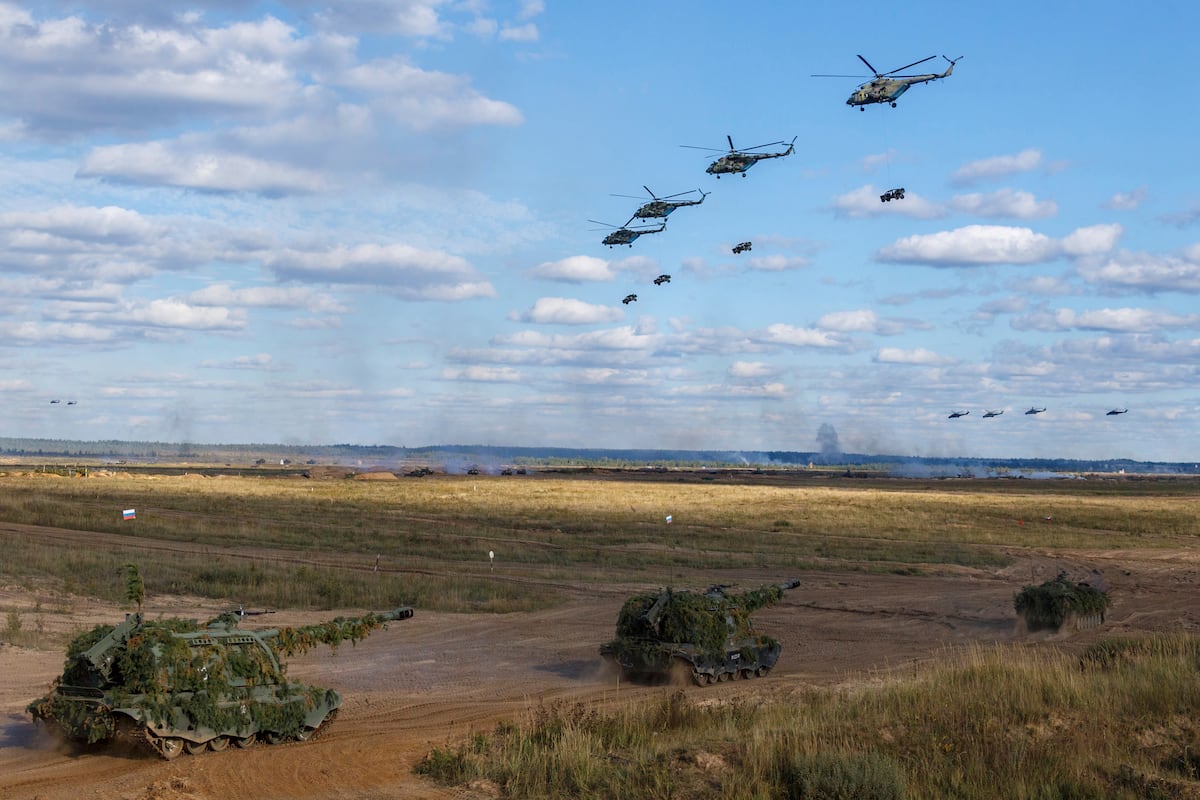
TALLINN, Estonia — The last time Russia and Belarus held major joint military drills in 2022, Moscow sent its troops into Ukraine just days later. Now the two close allies are conducting war games again, raising tensions anew in the region
The war games, dubbed “Zapad 2025,” or “West 2025,” take place in Belarus starting Friday and will last until Sept. 16. Troops from both countries will simulate repelling an attack, including airstrikes and sabotage, according to official reports.
The aim is to showcase the close links between Moscow and Minsk, as well as Russian military might amid its 3½-year-old war in neighboring Ukraine.
The war games have drawn concerns in Kyiv and its Western allies of Latvia, Lithuania and Poland, which border Belarus. Russian President Vladimir Putin sent troops rolling into Ukraine on Feb. 24, 2022, many of them crossing from Belarus.
The Ukrainian Foreign Ministry said this year’s exercise “hinders peaceful efforts” by U.S. President Donald Trump to end the war and “poses an immediate threat not only to Ukraine, but also to Poland, the Baltic states and all of Europe.”
On Wednesday, tensions in the region spiked even further after Poland said multiple Russian drones entered its territory and were shot down with help from NATO allies. A significant number came from Belarus, Polish Prime Minister Donald Tusk said.
The Russian military said it wasn’t targeting Poland, and Belarus suggested drones went off course — but several European leaders said it appeared intentional.
What to know about the exercise:
Belarus plays down the scale
Belarusian defense officials initially said about 13,000 troops would participate in the exercise that was to take place near its western border. In May, however, its Defense Ministry said the number would be cut nearly in half, and that the main maneuvers would take place deeper inside the country. Parts of the exercise will also take place inside Russia.
Last month, Defense Minister Viktor Khrenin said most of the exercise will happen around the city of Barysaw, about 74 kilometers (46 miles) northeast of Minsk, although some “small units will carry out practical tasks to repel a hypothetical enemy” in areas close to the border with Poland and Lithuania. Two of five new fortifications that have been erected for the drills also are located in those areas, Khrenin said.
Belarus also sent formal invitations to all member states of the Organization for Security and Cooperation in Europe and nine countries with NATO military attaches in Minsk to monitor the drills.
Authoritarian President Alexander Lukashenko recently signaled willingness to mend his relationship with the West, which has been severely strained for years over his brutal crackdown on dissent and his support for Russia’s war in Ukraine.
The past year has seen regular releases of political prisoners and public calls for a rapprochement with the West. Lukashenko spoke by phone last month with Trump, who called him a “highly respected President” in a social media post. That’s a stark contrast from other Western leaders, who have largely shunned the Belarusian.
Lukashenko has ruled Belarus with an iron hand for over 30 years and has relied on Kremlin subsidies and support. He allowed Russia to use his country’s territory as a staging ground to send troops into Ukraine and to host some of Moscow’s tactical nuclear weapons .
Now, Lukashenko “is pushing a narrative of de-escalation, promising to influence Putin’s actions and make concessions such as releasing political prisoners,” said Ryhor Astapenia, the Belarus Initiative director at Chatham House, in a recent commentary.
Another reason is that Russia, bogged down in a war of attrition across a roughly 1,000-kilometer (600-mile) front in Ukraine, can’t spare a sizable number of troops for the drills, and Belarus’ numbers also are limited, says Belarusian analyst Alexander Alesin.
Western estimates varied. Some suggested the number of troops involved could be around 30,000, while others said up to 150,000. In September 2021, the last time the Zapad drills were held, about 200,000 troops took part, according to Russian authorities.
Tanks participate in Russian-Belarusian military drills at the Obuz-Lesnovsky training ground in Belarus on Feb. 19, 2022. (AP)
Practicing plans for nuclear weapons
During this year’s drills, the troops will practice “planning the use of” Russian nuclear weapons and nuclear-capable intermediate range missiles that Moscow has promised to supply to Minsk, according to Khrenin.
In December, Lukashenko and Putin signed a treaty giving security guarantees to Belarus, including the possible use of Russian nuclear weapons to help repel any aggression.
At the time, Lukashenko asked Putin to deploy more advanced weapons in Belarus, including the nuclear-capable Oreshnik intermediate-range ballistic missile that Russia used for the first time in November against Ukraine.
Putin responded that Oreshnik missiles could be deployed to Belarus in the second half of 2025, adding they will remain under Russian control but Moscow will allow Minsk to select targets.
The treaty followed Moscow’s revision of its nuclear doctrine , which for the first time placed Belarus under Russia’s nuclear umbrella amid tensions with the West.
Russia hasn’t said how many tactical nuclear weapons it deployed to Belarus, but Lukashenko said in December that his country had several dozen. The deployment extends Russia’s capability to target several NATO allies in Eastern and Central Europe.
Andrey Baklitskiy, senior researcher at the United Nations Institute for Disarmament Research, said both countries announced that only the decision-making about the nuclear weapons was to be practiced in the drills — not their physical deployment.
With Russian nuclear weapons in Belarus, much needs to be worked out in terms of procedures, Baklitskiy said.
“You have dual subordination, you have your own superiors. … In order to understand how this should work, there may well be an exercise aimed at this,” he said.
NATO members remain wary
Despite the seemingly toned-down rhetoric from Belarus about Zapad 2025, NATO members are still wary.
Even before the drone incursion, Tusk said Tuesday the Zapad exercises constituted “very aggressive” military maneuvers “very close” to his country’s border, accompanied by “provocations” by Russia and Belarus.
Poland is responding with its own military exercises.
Tusk added that the Suwalki Gap — a strategic stretch of land in Poland and Lithuania that separates Belarus from Russia’s Baltic Sea exclave of Kaliningrad — was one of the targets of Zapad, and he suggested there was a fear in Poland that they might be practice for a later attack.
The Suwalki Gap has long been considered a potential flashpoint in a standoff between Russia and NATO. Lukashenko has brushed aside the idea of attacking the Suwalki Gap during the Zapad drills as “utter nonsense.”
President Gitanas Nauseda of Lithuania said in June that even though the drills looked to be “two to three times smaller” than those in 2021, Vilnius and its allies are ready for “any kind of surprises.” Lithuanian Defense Minister Dovilė Šakalienė added that it would carry out exercises in parallel with Zapad 2025.
Germany is leading its own major military exercise, Quadriga 2025, over several weeks in September, with parts expected to coincide with Zapad 2025.
Ukrainian President Volodymyr Zelenskyy repeatedly has warned that Russia might be plotting another attack during the drills.
Baklitskiy said it was “not obvious” that a sizable, combat-ready contingent could be amassed in Belarus at this point, and there are no indications of that happening. Still, “when they’re exercising to fight, it always elicits concerns, it always elicits negative reaction,” he said.
Associated Press writers Geir Moulson in Berlin and Claudia Ciobanu in Warsaw contributed.
The Associated Press receives support for nuclear security coverage from the Carnegie Corporation of New York and Outrider Foundation . The AP is solely responsible for all content.
爱沙尼亚塔林——俄罗斯和白俄罗斯上次举行大规模联合军事演习是在2022年,之后仅仅几天,莫斯科就向乌克兰派兵。如今,这两个亲密盟友再次举行联合军事演习,令该地区的紧张局势再度升级。
此次名为“Zapad 2025”(西方2025)的军事演习将于周五在白俄罗斯举行,并将持续到9月16日。据官方报道,两国军队将模拟击退包括空袭和破坏在内的攻击。
其目的是展示莫斯科和明斯克之间的紧密联系,以及俄罗斯在与邻国乌克兰长达三年半的战争中所展现的军事实力。
此次联合军事演习引起了基辅及其西方盟友拉脱维亚、立陶宛和波兰的担忧,这些国家与白俄罗斯接壤。俄罗斯总统弗拉基米尔·普京于2022年2月24日向乌克兰派遣军队,其中许多士兵是从白俄罗斯越境进入乌克兰的。
乌克兰外交部表示,今年的军演“阻碍了”美国总统唐纳德·特朗普为结束战争所做的和平努力,并且“不仅对乌克兰,而且对波兰、波罗的海国家和整个欧洲构成直接威胁”。
周三,波兰方面称多架俄罗斯无人机进入其领空,并在北约盟国的协助下被击落,此举进一步加剧了该地区的紧张局势。波兰总理图斯克表示,其中相当一部分无人机来自白俄罗斯。
俄罗斯军方表示,此次袭击并非针对波兰,白俄罗斯方面则暗示无人机偏离了航线——但几位欧洲领导人表示,这似乎是蓄意的。
关于这项练习,你需要了解以下几点:
白俄罗斯的表现逊色不少
白俄罗斯国防部官员最初表示,约有13000名士兵将参加在其西部边境附近举行的演习。然而,5月份,白俄罗斯国防部表示,参演人数将减少近一半,主要演习将在该国境内更深处进行。部分演习也将在俄罗斯境内举行。
上个月,国防部长维克托·赫列宁表示,此次演习的大部分将在明斯克东北约74公里(46英里)的巴里索夫市附近进行,不过一些“小型部队将在靠近波兰和立陶宛边境的地区执行击退假想敌的实战任务”。赫列宁还表示,为此次演习新建的五座防御工事中,有两座也位于这些地区。
白俄罗斯还向欧洲安全与合作组织所有成员国以及在明斯克设有北约武官的九个国家发出正式邀请,请他们监督此次演习。
乌克兰独裁总统亚历山大·卢卡申科最近表示愿意修复与西方的关系。多年来,由于他对异见人士的残酷镇压以及对俄罗斯在乌克兰战争的支持,乌克兰与西方的关系一直十分紧张。
过去一年,白俄罗斯政府陆续释放了政治犯,并公开呼吁与西方国家改善关系。卢卡申科上个月与特朗普通了电话,特朗普还在社交媒体上发文称他为“备受尊敬的总统”。这与其他西方领导人形成了鲜明对比,后者大多对这位白俄罗斯总统避而远之。
卢卡申科以铁腕统治白俄罗斯超过30年,并依赖克里姆林宫的补贴和支持。他允许俄罗斯利用白俄罗斯领土作为向乌克兰派遣军队的跳板,并允许俄罗斯在其境内部署部分战术核武器。
查塔姆研究所白俄罗斯倡议主任雷戈尔·阿斯塔佩尼亚在最近的一篇评论中表示,卢卡申科现在“正在推动缓和局势的叙事,承诺影响普京的行动并做出让步,例如释放政治犯”。
另一个原因是,俄罗斯深陷于乌克兰长达约 1000 公里(600 英里)的消耗战中,无法抽出大量兵力参加演习,而白俄罗斯的兵力也有限,白俄罗斯分析人士亚历山大·阿列辛表示。
西方各方估计不一。一些人认为参演兵力可能在3万人左右,而另一些人则认为可能高达15万人。据俄罗斯官方数据,2021年9月举行的上一次“西部”联合军演中,约有20万名士兵参加。
2022年2月19日,在白俄罗斯奥布兹-列斯诺夫斯基训练场,俄白联合军用坦克参加军事演习。(美联社)
演练核武器计划
据赫列宁称,在今年的演习中,部队将练习“计划使用”俄罗斯核武器和莫斯科承诺向明斯克提供的可携带核弹头的中程导弹。
12月,卢卡申科和普京签署了一项条约,向白俄罗斯提供安全保障,其中包括俄罗斯可能使用核武器来帮助击退任何侵略行为。
当时,卢卡申科要求普京在白俄罗斯部署更先进的武器,包括俄罗斯于 11 月首次对乌克兰使用的可携带核弹头的“奥列什尼克”中程弹道导弹。
普京回应称,奥列什尼克导弹可能在 2025 年下半年部署到白俄罗斯,并补充说,这些导弹仍将处于俄罗斯的控制之下,但莫斯科将允许明斯克选择目标。
该条约是在莫斯科修改其核战略之后签订的,此次修改首次将白俄罗斯置于俄罗斯的核保护伞之下,而此时白俄罗斯与西方关系紧张。
俄罗斯尚未透露向白俄罗斯部署了多少枚战术核武器,但卢卡申科去年12月曾表示,白俄罗斯拥有数十枚此类武器。此次部署增强了俄罗斯打击东欧和中欧多个北约盟国的能力。
联合国裁军研究所高级研究员安德烈·巴克利茨基表示,两国都宣布,演习内容仅限于核武器的决策,而非实际部署。
巴克利茨基表示,由于俄罗斯在白俄罗斯拥有核武器,因此在程序方面还有很多问题需要解决。
“你们实行双重下属制度,你们有自己的上级……为了理解这种制度应该如何运作,或许可以专门安排一次演练,”他说。
北约成员国仍保持警惕
尽管白俄罗斯在“西部2025”战略谈判中似乎有所缓和,但北约成员国仍然保持警惕。
甚至在无人机入侵事件发生之前,图斯克周二就表示,“西部”军事演习构成了“非常具有侵略性”的军事行动,而且“非常接近”他的国家边界,同时还伴随着俄罗斯和白俄罗斯的“挑衅”。
波兰以自己的军事演习作为回应。
图斯克补充说,苏瓦乌基山口——波兰和立陶宛之间的一块战略要地,将白俄罗斯与俄罗斯波罗的海飞地加里宁格勒隔开——是“西部”行动的目标之一,他还暗示波兰担心这可能是为日后发动袭击做准备。
苏瓦乌基山口长期以来一直被视为俄罗斯与北约对峙的潜在爆发点。卢卡申科曾驳斥在“西部”军演期间攻击苏瓦乌基山口的想法,称其“纯属无稽之谈”。
立陶宛总统吉塔纳斯·瑙塞达 (Gitanas Nauseda) 6 月表示,尽管此次演习规模看起来只有 2021 年演习的“二到三倍”,但维尔纽斯及其盟友已做好应对“任何意外情况”的准备。立陶宛国防部长多维莱·沙卡列内 (Dovilė Šakalienė) 补充说,立陶宛将与“西部-2025”联合军演同步进行演习。
德国将于9月举行为期数周的“四战车2025”大型军事演习,其中部分内容预计将与“西部2025”演习重合。
乌克兰总统泽连斯基多次警告称,俄罗斯可能正在策划另一次袭击,而此次演习正值关键时刻。
巴克利茨基表示,目前白俄罗斯能否集结一支规模可观、随时可以作战的部队“尚不明朗”,也没有任何迹象表明这种情况正在发生。但他同时指出,“他们进行作战演习总是会引起担忧,总是会招致负面反应。”
美联社驻柏林记者盖尔·穆尔森和驻华沙记者克劳迪娅·乔巴努对此文亦有贡献。
美联社的核安全报道得到了纽约卡内基基金会和Outrider基金会的支持。美联社对所有内容负全部责任。