The Only Missile-Toting Ekranoplan Russia Ever Built Just Took Its Last Trip On The Caspian俄罗斯建造的唯一一架携带导弹的地效飞行器刚刚完成了它在里海的最后一次飞行。
The sole completed Lun class ekranoplan is now set to go on public display after decades of languishing in disrepair.
新闻视频
By Joseph Trevithick
Updated Nov 27, 2020 6:33 PM EST
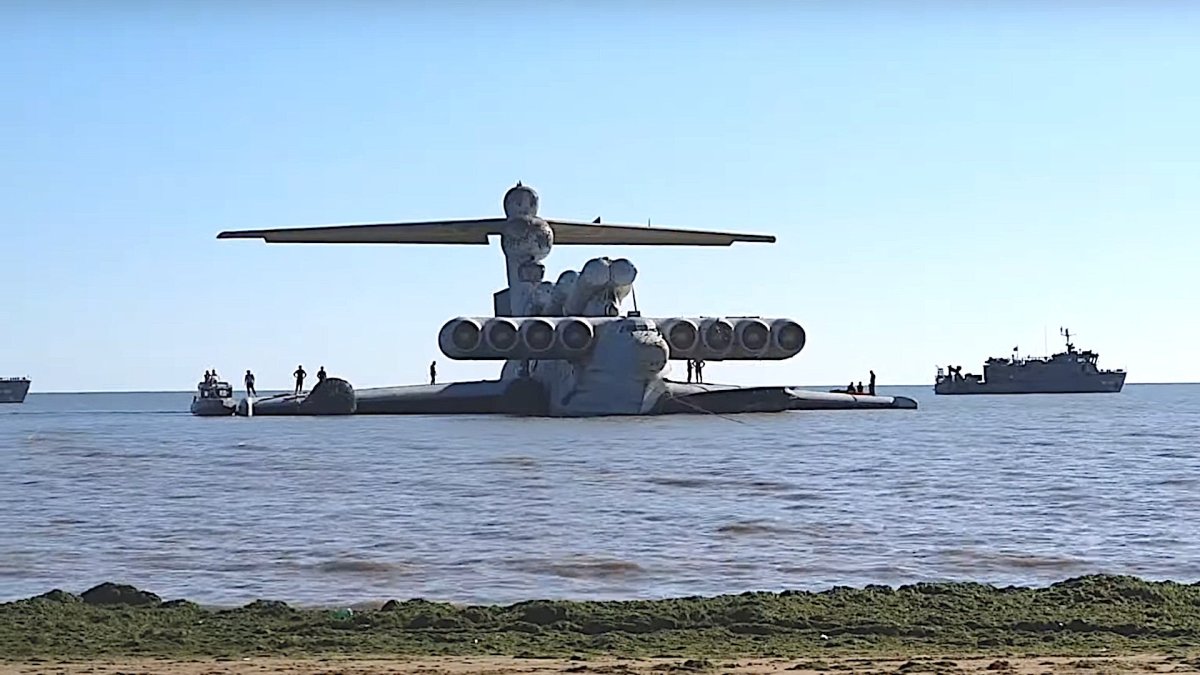
Russia’s only completed Project 903 Lun class ekranoplan , a type of wing-in-ground-effect craft , recently floated out onto the Caspian Sea for the first time in decades and probably for the last time ever. Designed by the Soviet Union during the latter stages of the Cold War as a high-speed anti-ship missile craft, it only saw very limited service and is now going on display at Patriot Park in the city of Derbent in Russia’s semi-autonomous republic of Dagestan.
On July 31, 2020, the Russian Ministry of Defense announced that the ekranoplan, also known as MD-160, had arrived in Derbent after a 14-hour journey south from the Russian Navy’s base in Kaspiysk, which is also in Dagestan, where it has been languishing in disrepair since it was withdrawn from service sometime in the late 1990s. It took a day to prepare the craft, which is non-operational at present, for the trip and a tug towed it to its new home. The plan to send MD-160 to Derbent had first emerged publicly in January.
The primary construction of MD-160, which had a maximum takeoff weight of 837,757 pounds, began at the Krasnoye Sormovo plant along the Volga River in the city of Nizhny Novgorod, more than 940 miles north of Kaspiysk, in 1986. It was powered by eight Kuznetsov NK-87 turbofan engines, each with a maximum thrust rating of 28,600 pounds, mounted in two banks of four engines on each side of the forward fuselage.
Wing-in-ground-effect designs are effectively very large aircraft that would primarily fly very close to the surface. They are generally flying boats, though, which allows for very efficient sustained high-speed flight, because it is easier and safer to operate them over water. However, any large flat space, including ice, will technically provide a suitable operating environment.
Work on MD-160 was finished in 1991, just in time for the collapse of the Soviet Union, afterwords it was transferred to the Capsian Sea Flotilla, which had become part of the new Russian Navy. The Capsian Sea Flotilla had already been tasked with testing and evaluating ekranoplans under the Soviet Union, particularly the massive Korabl Maket, or “Ship Prototype,” better known as the Caspian Sea Monster , which arrived in 1966 and operated in the region until it was destroyed in an accident in 1980.
The Caspian Sea Monster had a maximum takeoff weight of 1,199,315 pounds and was powered by 10 Dobrynin VD-7 turbojets, each rated at 28,670 pounds of thrust. It held the title of the largest and heaviest aircraft in the world until the Soviet Union’s Antonov An-225 Mriya flew for the first time in 1988.
While the Capsian Sea Monster had been largely a research and development platform, the Lun class, which was originally expected to comprise eight examples in total, was to be a combat craft. The design featured six P-270 Moskit anti-ship missiles, also known to NATO as the SS-N-22 Sunburn, mounted in pairs on top of the central fuselage. A large surface search radar was installed in the tail. These ekranoplans were intended to launch high-speed attacks on hostile surface warships, while using their low-level flight profile and speed to enhance their survivability.
However, Russia’s wing-in-ground-effect force never came to be. The economic turmoil in Russia that followed the fall of the Soviet Union led to the cancellation of numerous military projects.
A satellite image of MD-160 at Kaspiysk in April 2020., Google Earth
Even before the Soviet Union fell, there were questions about the future of the Lun class. A second example was under construction, but the Soviets had already decided to build it as an unarmed missile resupply variant to support MD-160. After the Soviet nuclear submarine K-278 Komsomolets sank in 1989, a proposal emerged to change its configuration again to one of search and rescue and mobile hospital platform, dubbed Spasatel , or “Rescuer.” You can read more about the K-278 accident, which has left the submarine leaking radiation on the bottom of the Barents Sea to this day, in this past War Zone piece .
A model of Spasatel., TASS
Russia revived the idea of finishing Spasatel in 2017 with a focus on operations in the increasingly strategic Arctic region , but no work to this end appears to have happened so far. This craft was reportedly nearly complete when the project came to an indefinite halt in the 1990s, but it has sitting in Nizhny Novgorod ever since and looks to be in questionable condition today. In 2018, there were also reports that the Russian military might be interested again in fielding missile-armed ekranoplans, but there have been no clear developments in this regard since then.
Whatever Russia’s future ekranoplan plans might hold, the only completed example of the Lun class appears to have taken its last trip, but will now hopefully be better preserved as the interesting piece of history that it is.
Contact the author: joe@thedrive.com
Comments couldn’t be loaded. Please refresh the page.
作者:约瑟夫·特雷维西克
更新于美国东部时间2020年11月27日下午6:33。
俄罗斯唯一一艘完工的903型“月球”级地效飞行器,一种翼地效应飞行器,近日数十年来首次,也可能是最后一次,驶入里海。该飞行器由苏联在冷战后期设计,最初是一种高速反舰导弹飞行器,但服役时间非常有限,现在将在俄罗斯半自治共和国达吉斯坦共和国杰尔宾特市的爱国者公园展出。
2020年7月31日,俄罗斯国防部宣布,一架名为MD-160的地效飞行器已抵达杰尔宾特。此前,这架飞行器从位于达吉斯坦共和国卡斯皮斯克的俄罗斯海军基地出发,历经14小时的航程,抵达杰尔宾特。自上世纪90年代末退役以来,该飞行器一直闲置在卡斯皮斯克,年久失修。这架目前处于非运行状态的飞行器,经过一天的准备,由一艘拖船拖至其新的驻地。将MD-160送往杰尔宾特的计划最早于今年1月公开。
MD-160 的主要建造工作于 1986 年在伏尔加河畔的下诺夫哥罗德市克拉斯诺耶索尔莫沃工厂开始,该工厂位于卡斯皮斯克以北 940 多英里处。MD-160 的最大起飞重量为 837,757 磅。它由八台库兹涅佐夫 NK-87 涡扇发动机提供动力,每台发动机的最大推力为 28,600 磅,安装在机身前部两侧各两组四台发动机中。
地效翼飞机实际上是体型非常大的飞行器,主要在极低的高度飞行。它们通常是水上飞机,这使得它们能够高效地进行持续高速飞行,因为在水面上操作更便捷、更安全。然而,任何大型平坦区域,包括冰面,理论上都可以提供合适的飞行环境。
MD-160的研制工作于1991年完成,恰逢苏联解体。之后,它被移交给里海舰队,该舰队当时已成为新成立的俄罗斯海军的一部分。里海舰队此前已在苏联时期承担过地效飞行器的测试和评估任务,特别是巨型“科拉布尔·马克特”(Korabl Market,意为“舰船原型”),也就是更为人熟知的“里海怪物”。“科拉布尔·马克特”于1966年抵达里海,并在该地区服役直至1980年因事故损毁。
“里海怪兽”的最大起飞重量为1,199,315磅,由10台多勃雷宁VD-7涡轮喷气发动机提供动力,每台发动机的推力为28,670磅。在苏联的安-225“梦想”号于1988年首飞之前,它一直保持着世界上最大、最重飞机的称号。
虽然“卡普西亚海怪”主要用作研发平台,但最初计划建造八架的“伦”级地效飞行器则是一款作战舰艇。该设计在机身中部上方成对安装了六枚P-270“蚊子”反舰导弹(北约代号SS-N-22“日灼”)。尾部则安装了一部大型水面搜索雷达。这些地效飞行器旨在利用其低空飞行特性和速度优势,对敌方水面舰艇发起高速攻击,从而提高自身的生存能力。
然而,俄罗斯的翼地效应部队最终未能建成。苏联解体后俄罗斯的经济动荡导致众多军事项目被取消。
2020年4月卡斯皮斯克MD-160卫星图像,谷歌地球
早在苏联解体之前,人们就对“伦”级潜艇的未来产生了疑问。当时第二艘“伦”级潜艇正在建造中,但苏联方面已经决定将其建造为无武装的导弹补给舰,用于支援MD-160导弹运输机。1989年苏联核潜艇K-278“共青团员”号沉没后,有人提议再次将其改装为搜救和移动医院平台,并命名为“救援者”(Spasatel)。关于K-278号潜艇事故,以及至今仍在巴伦支海海底泄漏放射性物质的情况,您可以在之前的“战区”文章中了解更多信息。
Spasatel 模型。(塔斯社)
俄罗斯于2017年重启了“太空卫星”(Spasatel)项目的计划,重点在于日益重要的北极地区的作战行动,但迄今为止,该项目似乎并未取得任何进展。据报道,该项目在20世纪90年代无限期搁置时已接近完工,但此后一直停放在下诺夫哥罗德,如今的状况令人担忧。2018年,也有报道称俄罗斯军方可能再次有意部署导弹武装的地效飞行器,但此后这方面并无明确进展。
无论俄罗斯未来的地效飞行器计划如何,目前唯一完工的“月球”级地效飞行器似乎已经完成了它的最后一次飞行,但希望它能作为一件有趣的史料得到更好的保存。
联系作者:joe@thedrive.com
评论加载失败,请刷新页面。