Russia Still Uses This Cold War Relic Of An Underground Anti-Ship Missile System In Crimea俄罗斯仍在克里米亚使用这种冷战时期遗留下来的地下反舰导弹系统。
In service for almost 50 years, the 3M44 Progress anti-ship missile system, and the elaborate bunker that houses it, still supports defending Crimea.
新闻视频
Updated Nov 27, 2020 6:12 PM EST
A recently released video provides a close look at one of Russia’s lesser-known weapons, the mighty Utes coastal-defense anti-ship missile system, in action. The particular weapon is assigned to the hardened battery that protects the maritime approaches to Sevastopol, on the strategically important Crimea peninsula that was seized by Russia in 2014.
It’s unclear when the footage was recorded, but it was posted online on October 14, 2020, by TV Zvezda , the official television channel of the Russian Ministry of Defense. The accompanying report suggests the missile-firing exercise occurred after the large-scale Kavkaz-2020 maneuvers, which also took place partly in the Black Sea, in late September.
According to a summary provided by TV Zvezda , the video shows a joint missile firing exercise involving the Russian Navy’s frigate Admiral Grigorovich , which is the lead ship of its class, and Sevastopol’s Utes battery.
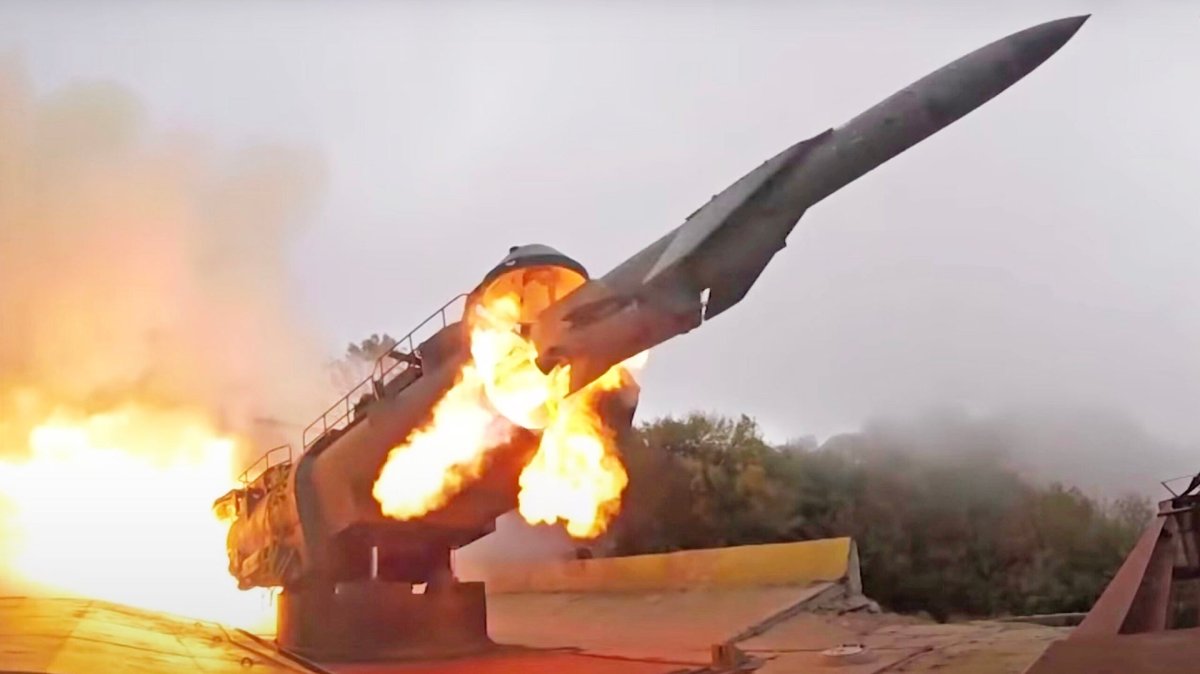
The report explains that a 3M44 Progress anti-ship missile was launched from the Utes battery and was then successfully intercepted by the frigate’s air defense systems from a distance of more than 6.2 miles. Two video shows the Progress missile’s fiery departure from the right-side of the twin-tube launcher, which then disappears back into its bunker, protected by huge metal doors.
The Utes’ twin-launcher for the 3M44 Progress anti-ship missile in a semi-retracted position., RUSSIAN MINISTRY OF DEFENSE SCREENCAP
The missile leaps out of its launch canister, with the wings still folded., RUSSIAN MINISTRY OF DEFENSE SCREENCAP
The missile climbs out over the Black Sea as the wings deploy., RUSSIAN MINISTRY OF DEFENSE SCREENCAP
The anti-ship weapon was downed by a missile from the frigate’s Shtil air defense system, in this, its latest form, known to NATO as SA-N-7C Gollum. A 9M317M missile — an advanced, containerized version of the weapon used in the land-based Buk mobile surface-to-air missile system — is seen being launched from the warship’s 24-cell vertical launch system (VLS) at around the 2:10-minute mark in the accompanying video. The missile launch is seen from various different perspectives, emphasizing the “cold launch” ejection from the VLS before the rocket motor engages.
A 9M317M is launched from the Russian Navy’s frigate Admiral Grigorovich. , RUSSIAN MINISTRY OF DEFENSE SCREENCAP
The 9M317M launch viewed from the bow, looking back down the warship., RUSSIAN MINISTRY OF DEFENSE SCREENCAP
To ensure safety, the maritime range in the waters off Sevastopol that hosted the live-fire exercise was closed to other maritime traffic, with more than 10 warships and auxiliary vessels from the Black Sea Fleet patrolling the area to keep out intruders.
While these drills showcase some of the latest Russian weaponry, they also reveal the continued importance of the veteran Utes and its unique relationship to the Crimea peninsula.
The story of the Utes, meaning Cliff in Russian, dates all the way back to 1954, according to this authoritative Russian-language account . What is claimed to be the world’s first coastal underground anti-ship missile system was installed in the mountains near Balaklava, to protect Sevastopol and the Soviet Union’s southern maritime approaches.
The commanding location of the Utes site today., RUSSIAN MINISTRY OF DEFENSE SCREENCAP
The secretive site at Balaklava was codenamed Object 100 and consisted of two identical launch sites and associated underground complexes located 3.7 miles apart and armed with first-generation Sopka anti-ship cruise missiles, with a range of around 62 miles.
A former East German Sopka anti-ship cruise missile preserved at the Bundeswehrmuseum in Dresden., JAN REHSCHUH/WIKIMEDIA COMMONS
Buried under thick layers of concrete to protect it from nuclear attack, the complete facilities included command posts, missile storage, and workshops for preparing and refueling the missiles, which were themselves transported on special trucks, with their wings folded.
To provide a degree of independent operation, the underground missile base was provided with diesel powerplants, filtration and ventilation units, plus stocks of fuel, water, and food.
The initial version of Object 100 was commissioned into service in July 1957 as the Soviet Navy’s first coastal missile unit.
By the early 1960s, the subsonic Sopka was showing its age and the decision was taken to replace it with the Utes system armed with a new supersonic anti-ship missile, the P-35B, which was also used in a road-mobile coastal defense system, the Redut.
A road-mobile Redut coastal defense system assigned to the Russian Pacific Fleet., SERGEY KONOVALOV/WIKIMEDIA COMMONS
The Utes complex went online in April 1973 and also involved the installation of a new radar, identification-friend-or-foe system, as well as an updated control center, launchers, and various new ground equipment.
The liquid-fueled P-35B missiles could be prepared below ground with their wings folded, before being raised to their firing position by elevating the launchers. These would then return below ground for reloading.
In 1982, the Utes complex was modernized again with the introduction of a third-generation missile, the 3M44 Progress. This had an effective range of a reported 286 miles, compared to 168 miles for the previous P-35B. It also included the option of a 350-kiloton nuclear warhead.
In December 1991, the Soviet Union broke up into 15 new states, each of which set about organizing its own armed forces. The Soviet-era Black Sea Fleet was divided between Russia and Ukraine, with Kyiv allowing temporary stationing of the Russian Black Sea fleet in Crimea. Meanwhile, Objekt 100 was transferred to the Ukrainian Navy in 1996 and apparently fell out of use.
However, a change in fortunes came with Russia’s illegal seizure and subsequent annexation of Crimea in 2014. The Utes was rapidly returned to combat status, with a first missile launch during an exercise occurring in April 2016.
More recently, Russia’s Black Sea Fleet has begun to deploy more modern and capable coastal defense assets in the region, as well. These include the K-300P Bastion-P mobile system, known to NATO as the SSC-5 Stooge. The missiles launched by this system reportedly have a range of 186 miles and a speed of around Mach 2.5.
Shorter-ranged, but similarly mobile, is the 3K60 Bal coastal defense missile system, which is also in use with the Black Sea Fleet. Designated SSC-6 Sennight by NATO, the Bal is a subsonic missile, broadly similar to the American Harpoon, and has a range of 75 miles. Each Bal launch vehicle can carry eight missiles, and a pair of launch vehicles can deliver a 16-missile volley against their target.
Both the Bastion-P and Bal were used during the live-fire portion of the recent Kavkaz-2020 exercise. According to the Russian Ministry of Defense, the missile systems were employed against a simulated enemy amphibious task force approaching the Black Sea coast in the Krasnodar region, immediately east of Crimea.
Compared to the aging Utes system, the Bastion-P and Bal are harder to target, being able to launch their solid-fuel missiles rapidly before moving to another location. They are also able to receive targeting data from a wide variety of sources, including unmanned aerial vehicles, which was also practiced during Kavkaz-2020. Both these new systems have also been deployed in Crimea .
These coastal defense systems are just one aspect of what is one of the largest concentrations of anti-ship missile capabilities in the world. Combined with their Black Sea fleet and Russian airpower counterparts, they can quickly transform nearly the whole of the confined Black Sea into a super anti-ship missile engagement zone on short notice.
While the combat efficiency of the Utes cruise missile system is questionable, it’s clear that the Russian Navy still sees value in it. Even if it is now at least partially being used for air defense training, this Cold War warrior is still playing a useful role.
Contact the author: thomas@thedrive.com
Comments couldn’t be loaded. Please refresh the page.
更新于美国东部时间2020年11月27日下午6:12
最近发布的一段视频近距离展示了俄罗斯鲜为人知的武器之一——威力强大的“乌特斯”(Utes)岸防反舰导弹系统。该武器部署在加固的防御工事内,负责保护塞瓦斯托波尔的海上通道。塞瓦斯托波尔位于具有重要战略意义的克里米亚半岛,该半岛于2014年被俄罗斯占领。
目前尚不清楚这段视频的拍摄时间,但它于2020年10月14日由俄罗斯国防部官方电视台“红星电视台”(TV Zvezda)发布到网上。相关报道显示,此次导弹试射演习发生在9月下旬举行的“高加索-2020”大规模联合军演之后,该演习的部分区域也在黑海进行。
据俄罗斯电视台“红星”提供的摘要显示,该视频展示了俄罗斯海军“格里戈罗维奇海军上将”号护卫舰(该级舰艇的首舰)与塞瓦斯托波尔的“乌特斯”导弹发射阵地进行的联合导弹发射演习。
报告解释说,一枚3M44“进步”反舰导弹从“尤特斯”号导弹发射阵地发射,随后被护卫舰的防空系统在6.2英里(约10公里)以外成功拦截。两段视频显示,“进步”导弹从双管发射架右侧腾空而起,随后发射架缩回由巨大金属门保护的掩体中。
“尤特斯”级自行高炮的3M44“进步”反舰导弹双联装发射装置处于半收起状态。(俄罗斯国防部截图)
导弹从发射筒中跃出,弹翼仍处于折叠状态。(俄罗斯国防部截图)
导弹在黑海上空爬升,机翼展开。(俄罗斯国防部截图)
这枚反舰导弹被护卫舰“施蒂利亚”号防空系统发射的导弹击落,该系统采用的是最新型的“施蒂利亚”防空系统,北约代号为SA-N-7C“咕噜”。在随附视频中,大约在2分10秒处可以看到一枚9M317M导弹——它是陆基“山毛榉”移动式地空导弹系统所用导弹的先进集装箱式版本——从该舰的24单元垂直发射系统(VLS)发射。视频从多个不同角度拍摄了导弹发射过程,重点展示了火箭发动机点火前导弹从垂直发射系统“冷发射”的弹出过程。
一枚9M317M型火箭从俄罗斯海军“格里戈罗维奇海军上将”号护卫舰上发射升空。(俄罗斯国防部截图)
从舰艏向后望去,可以看到9M317M型火箭发射的画面。(俄罗斯国防部截图)
为确保安全,在塞瓦斯托波尔附近水域举行实弹演习的海上靶场已对其他海上交通关闭,黑海舰队派出 10 多艘军舰和辅助船只在该地区巡逻,以防止入侵者进入。
虽然这些演习展示了一些最新的俄罗斯武器,但也揭示了老牌乌特斯人的重要性及其与克里米亚半岛的独特关系。
据这篇权威的俄语记载,乌特斯人(俄语意为“悬崖”)的故事可以追溯到1954年。据称,世界上第一个沿海地下反舰导弹系统被安装在巴拉克拉瓦附近的山区,用于保护塞瓦斯托波尔和苏联南部的海上通道。
今日乌特斯遗址的制高点。(俄罗斯国防部截图)
巴拉克拉瓦的秘密基地代号为“100 号工程”,由两个相同的发射场和相关的地下设施组成,相距 3.7 英里,配备了第一代“索普卡”反舰巡航导弹,射程约为 62 英里。
一枚保存在德累斯顿联邦国防军博物馆的东德前“索普卡”反舰巡航导弹。(图片来源:JAN REHSCHUH/WIKIMEDIA COMMONS)
为了防止核攻击,整个设施被埋在厚厚的混凝土层下。这些设施包括指挥所、导弹储存库以及导弹的准备和燃料加注车间,导弹本身则用特殊的卡车运输,机翼折叠起来。
为了实现一定程度的独立运作,地下导弹基地配备了柴油动力装置、过滤和通风装置,以及燃料、水和食物储备。
100工程的初始版本于1957年7月投入使用,成为苏联海军第一支岸基导弹部队。
到 20 世纪 60 年代初,亚音速的索普卡导弹系统已经显得老旧,因此决定用配备新型超音速反舰导弹 P-35B 的乌特斯导弹系统来取代它。P-35B 导弹也被用于公路机动海岸防御系统“雷杜特”中。
俄罗斯太平洋舰队装备的公路机动式“里杜特”海岸防御系统。(图片来源:SERGEY KONOVALOV/WIKIMEDIA COMMONS)
尤特斯综合设施于 1973 年 4 月投入使用,还安装了新的雷达、敌我识别系统以及更新的控制中心、发射器和各种新的地面设备。
使用液体燃料的P-35B导弹可以在地下进行准备,机翼折叠,然后通过抬升发射架将其升至发射位置。发射后,导弹将返回地下进行重新装填。
1982年,尤特斯导弹防御系统再次进行现代化改造,引进了第三代导弹——3M44“进步”导弹。据报道,该导弹的有效射程为286英里,而之前的P-35B导弹的有效射程为168英里。此外,该导弹还可选配350千吨级的核弹头。
1991年12月,苏联解体为15个新的国家,每个国家都开始组建自己的武装力量。苏联时期的黑海舰队被俄罗斯和乌克兰瓜分,基辅允许俄罗斯黑海舰队在克里米亚临时驻扎。与此同时,1996年,“100号工程”被移交给乌克兰海军,之后似乎便不再使用。
然而,随着俄罗斯在 2014 年非法吞并克里米亚,命运发生了转变。“乌特斯”导弹迅速恢复了作战能力,并在 2016 年 4 月的一次演习中进行了首次导弹发射。
近年来,俄罗斯黑海舰队也开始在该地区部署更多现代化、高性能的近岸防御装备,其中包括北约代号为SSC-5“傀儡”(Stooge)的K-300P“堡垒-P”(Bastion-P)移动防御系统。据报道,该系统发射的导弹射程达186英里,速度约为2.5马赫。
射程较短但机动性相近的是3K60“巴尔”(Bal)岸基防御导弹系统,该系统也装备于黑海舰队。北约将其命名为SSC-6“森奈特”(Sennight),“巴尔”是一种亚音速导弹,与美国的“鱼叉”(Harpoon)导弹大致相似,射程为75英里。每辆“巴尔”发射车可携带8枚导弹,两辆发射车可同时向目标发射16枚导弹。
在近期举行的“高加索-2020”联合军演的实弹射击环节中,俄罗斯使用了“堡垒-P”和“巴尔”两款导弹系统。据俄罗斯国防部称,这些导弹系统被用于攻击一支模拟敌方两栖特遣部队,该部队当时正逼近位于克里米亚以东克拉斯诺达尔边疆区的黑海沿岸。
与老旧的“乌特斯”系统相比,“堡垒-P”和“巴尔”系统更难被锁定,因为它们能够快速发射固体燃料导弹并迅速转移到其他位置。它们还能从包括无人机在内的多种来源接收目标数据,这项技术在“高加索-2020”演习中也得到了验证。这两种新型系统均已部署在克里米亚。
这些海岸防御系统只是世界上规模最大的反舰导弹力量集中地之一。结合其黑海舰队和俄罗斯空军的相应力量,它们可以在短时间内将几乎整个狭小的黑海海域转变为超级反舰导弹交战区。
尽管“乌特斯”巡航导弹系统的作战效能值得商榷,但俄罗斯海军显然仍然看重它的价值。即便它现在至少部分用于防空训练,这套冷战时期的装备依然发挥着作用。
联系作者:thomas@thedrive.com
评论加载失败,请刷新页面。