This Is The First Photo Ever Of A Stealthy Black Hawk Helicopter这是有史以来第一张隐形黑鹰直升机的照片
Almost a decade since we learned of the stealth Black Hawks used in the Bin Laden raid, we have seen no images of them or of their lineage, until now.
By Joseph Trevithick and Tyler Rogoway
Updated Nov 27, 2020 6:34 PM EST
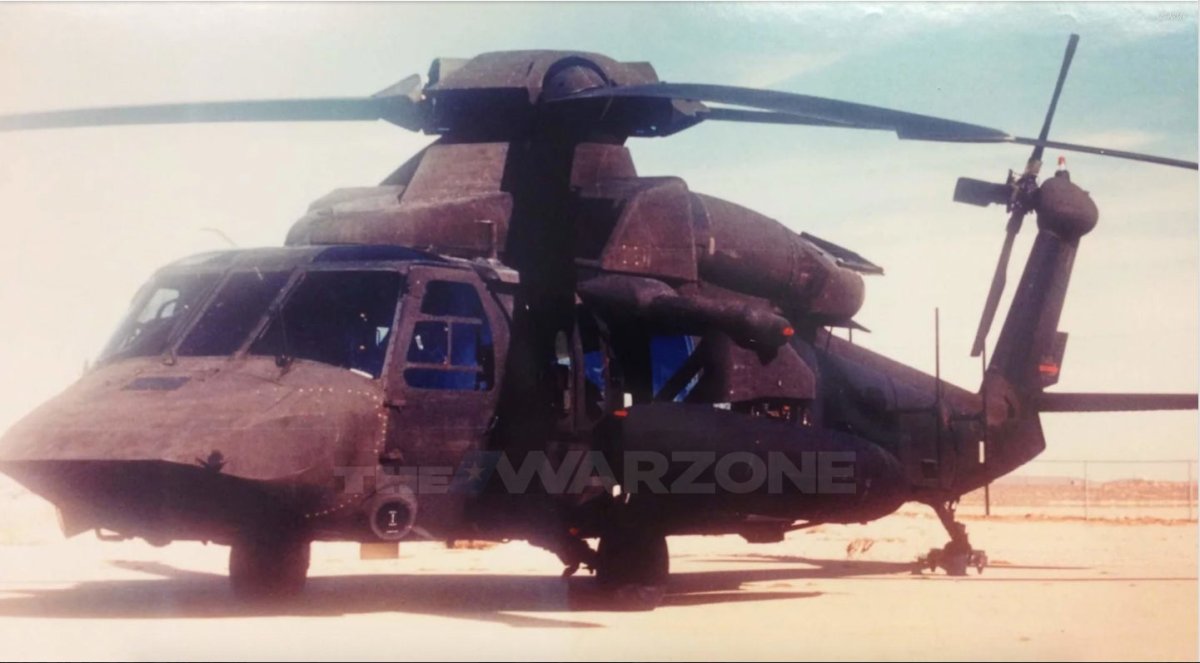
We are constantly on the lookout for more details about the U.S. military’s highly elusive stealthy Black Hawk helicopters, one of which famously crashed during the raid that led to the death of Al Qaeda leader Osama Bin Laden in 2011, as well as any possible predecessors that predated them. Now, what appears to be a previously unpublished picture has come to our attention that shows a heavily modified EH-60 electronic warfare and signals intelligence variant of the Black Hawk. Is seems to be, at the very least, one of the missing links connecting the unique Black Hawk helicopters used on the Bin Laden raid and stealthy Black Hawk design concepts dating back to the 1970s.
It is our understanding that the picture in question seen at the top of this story and again below in a slightly enhanced manner, has a relation to Fort Eustis in Virginia. In addition to being home to 128th Aviation Brigade, previously known as the U.S. Army Aviation Logistics School, Fort Eustis’ Felker Army Airfield it also hosts a unit commonly known as the Flight Concepts Division (FCD), that is now called the Aviation Technology Office (ATO). This is the unit understood to be responsible for leading the development of the stealth Black Hawks used during the Bin Laden raid and many of the U.S. Army’s most advanced and secretive rotary-wing capabilities.
The picture is undated and we have no immediate information about any program or programs the helicopter might have been associated with. The location where it was taken is also unknown, but is a desert locale that could indicate it was shot somewhere in the American southwest, which is home to a number of aviation test facilities, including top-secret air bases, such as Area 51 and the Tonopah Test Range Airport . The stealthy Black Hawks used in the Bin Laden raid were housed at the former, according to reports .
The Bin Laden raid Black Hawks were said to be based on the special operations MH-60 airframe. However, the helicopter seen in the photo is clearly a heavily modified Sikorsky EH-60 variant, though it’s not clear if it is an EH-60A or EH-60L version. Both of these helicopters carried versions of the AN/ALQ-151 Quick Fix system , which was capable of both intercepting hostile electronic emissions and providing direction-finding information to locate the source, as well as electronic warfare jamming. The EH-60A carried the AN/ALQ-151(V)2 Quick Fix II system, while the EH-60L was equipped with the more capable AN/ALQ-151(V)3 Advanced Quick Fix suite.
The helicopter has the four dipole antennas, two on each side of the tail boom, found on both the EH-60A and EH-60L. Under the fuselage, it appears to have the long, retractable whip antenna found on the EH-60A, versus the more robust antenna system found on the EH-60L. This ventral antenna is associated with of the AN/ALQ-17A(V)2 Trafficjam communications jamming system, which is part of the larger Quick Fix II suite.
An early EH-60A helicopter in flight with its retractable ventral antenna in the deployed position., US Army via Ray Wilhite
An EH-60L helicopter, showing its significantly different ventral antenna configuration., US Army
It also has two large missile approach warning sensors, one on each side of the nose under the main cockpit doors, which are part of the AN/ALQ-156A Missile Approach Warning System (MAWS) found on EH-60As and EH-60Ls. Two identical sensors were also mounted well behind the fuselage doors on this system, providing the Black Hawk with 360-degree coverage. The EH-60s were eventually equipped with a version of the AN/APR-39 radar warning system , as were other Black Hawks, which includes smaller receivers on the nose and tail of the helicopter.
An EH-60A supporting Operation Desert Storm with the radar warning receivers seen fitted., US Army
Two more radar warning receivers were installed at the rear of the fuselage between the main cabin and the tail boom., US Army
Interestingly, it also has stub wings, which provide one hardpoint on each side of the helicopter. These are more commonly associated with MH-60L/M Direct Action Penetrators assigned to the Army’s elite 160th Special Operations Aviation Regiment, as well as U.S. Navy MH-60S Seahawks . The External Stores Support System (ESSS) wing kit, which has two hardpoints on each side of the helicopter and was used on the EH-60L, is far more common.
One of the US Army’s 160th Special Operations Aviation Regiment’s MH-60L Direct Action Penetrators., US Army
The helicopter’s most notable features are, of course, the extreme modifications to the nose, the “doghouse” where the engines and main gearbox are situated, as well as the engine intakes and exhausts. It also has a heavily modified rotor hub. All of these features appear to be designed to reduce its radar signature, especially from the critical forward hemisphere aspect.
The duckbill-like nose is reminiscent in many ways of stealthy design concepts that Sikorsky crafted in 1978 for the U.S. Army Research and Technology Laboratory, a unit at Fort Eustis. This extensive study was the first indication of the Army’s interest in a reduced signature Black Hawk. You can read all about it in this previous War Zone feature .
A diagram showing a stealthy Black Hawk concept that Sikorsky developed for the US Army in the late 1970s., USArmy
In addition, the nose, as well as the doghouse and rotor hub, all have some visual similarities to a kit that Bell developed for the OH-58X Kiowa in the 1980s. We also detailed this little known about Kiowa stealth upgrade in this past War Zone feature . The Army evaluated, but did not adopt the OH-58X en masse, though it did buy a number of the stealthy kits for use with its OH-58D Kiowa Warrior armed scout helicopters.
An OH-58X demonstrator., Bell via Flight Global
Sikorsky had proposed using advanced radar-absorbing composite materials as part of its stealthy Black Hawk design studies in the late 1970s and Bell incorporated similar concepts into its OH-58X. Sikorsky also experimented with its S-75 technology demonstrator during the mid-1980s, which made heavy use of composites and informed the development of the abortive Boeing-Sikorsky RAH-66 Comanche . The Comanche also featured a complex shrouded rotor hub design similar to this particular Black Hawk. It is almost certain that many, if not most of the additions to this EH-60 were also made of composites to help improve with radar signature reduction and limit the additional weight added to the helicopter when installed.
The Sikorsky S-75., Sikorsky
An RAH-66A Comanche prototype., Boeing-Sikorsky
It’s also worth noting that the modified engine intakes on this Black Hawk appear to help conceal the fan faces of its two turbine engines and dramatically clean up the area around the engine nacelles and forward doghouse area. These are all features that traditionally have a high degree of radar reflectivity.
Later model UH-60As and UH-60Ls, as well as other H-60 variants based on those versions, also have infrared reduction fairings over their exhausts that have an opening at the front that allows cool air to pass through. On the aircraft in question, this area has been screened-over likely with a radar attenuating mesh.
A closeup of the engine intake and exhaust fairing as seen on typical UH-60As and Ls., US Army
A mirrored close up of the intake and exhaust on the modified EH-60 for comparison., US Army
Unlike the helicopters used in the Bin Laden raid, this particular example has no modifications to its tail rotor, which would have negatively impacted its all-aspect radar reflectivity and especially its acoustic signature. However, the radar reflectivity of the helicopter’s front aspect would have been the most pressing concern when it comes to RF stealth, especially when penetrating into heavily defended areas. We also don’t know whether additional stealthy add-ons, especially for the tail, were developed later for this project or were otherwise not fitted in this particular instance.
Without knowing the particular variant of EH-60, it is especially hard to try to determine the date of this photograph. Sikorsky began developing the EH-60A for the Army in 1980 after the service decided against fielding the Quick Fix II system on a variant of the venerable Bell Huey helicopter known as the EH-1X. The EH-60As would eventually replace older EH-1H helicopters equipped with the AN/ALQ-151 and AN/ALQ-151(V)1 Quick Fix suites.
A low-quality picture of one of the 10 EH-1Xs built for the Army before work shifted to the EH-60A. Note the Quick Fix II system’s whip antenna in its deployed position under the tail., US Army
Between 1989 and 1990, work began on the Advanced Quick Fix system, which was originally supposed to go on another UH-60A variant, known as the EH-60C. The Army eventually decided to install it on a modified UH-60L, taking advantage of that variant’s more powerful engines. This became the EH-60L. This is not to be confused with EUH-60L helicopters configured as airborne command posts. The Army did not ultimately pursue the Advanced Quick Fix system, and the helicopter to go with it, on a widespread basis, a fate that befell many U.S. military programs in development right around the collapse of the Soviet Union in 1991.
Based on what we know, it is very plausible that this photograph was taken sometime in the late 1980s or more likely the 1990s. This would fit with the work Sikorsky was doing together with Boeing at that time on what would become the RAH-66, though it’s not clear how these two efforts may have been related.
The use of an EH-60, in this case, may simply have had to do with this particular helicopter being available to take part in some tests. The small EH-60 force is known to be used for various tests and modifications trials. It’s also worth noting that it has long been reported that the stealth Black Hawks employed during the Bin Laden raid had a “snap-on”-type kit, but the tail from the one that crashed has long seemed far too elaborate to be part of that kind of very temporary modification.
It’s possible that there might have been some confusion as to how far work on stealthy modifications to the Black Hawk had progressed by time of the historic raid. The helicopters were an extremely well-kept secret at the time, one that we would have likely never learned about if the crash hadn’t occurred. Pentagon officials could have misconstrued older tests with more basic kits with a far more elaborate configuration used on the raid.
There is also a possibility that the Army may have been interested in developing a stealthy kit for more general use on its Black Hawks and this was one rendition of such a solution. Adding these features to the EH-60 variants specifically could have been a more concerted effort, as well. A decreased radar signature could help those platforms get close to their targets without detection and then jam them, creating paths for non-stealthy helicopters, as well as fixed-wing aircraft, to follow through.
A kit that could be added and removed from any Black Hawk variant, as necessary, would have been a good way to prevent any unnecessary exposure of the capability during routine operations. Any degradation in performance would not have been permanent, either, allowing the helicopters to fly in a normal configuration the rest of the time.
Finally, we have to address the big question outstanding: could these modifications be the same as those used on the Bin Laden raid helicopters? Clearly it didn’t have anywhere near the same treatment to its tail. Could a kit exists that uses these forward elements, or very similar ones, with the addition of a far more elaborate tail assembly to reduce acoustic signature as well? That is possible, but at this point, our best guess is that this was an evolutionary stepping stone, or an earlier iteration, of what would eventually lead to the now-famous, but never seen ‘Stealth Hawks.’ Still, nobody who isn’t forbidden to discuss it on the record really knows for sure.
In the past, The War Zone has been told that the Stealth Hawks used a MH-60 for their base platform, but an outer composite body was specifically built by Sikorsky to accommodate it, making it a far more elaborate and permanent application. We still have not been able to corroborate these claims. In addition, it is stated that newer and even more complex generations of the Stealth Hawks were built following the Bin Laden raid and are in service now.
It’s amazing to think that it has been nearly a decade after the daring mission into Abbottabad went down, yet we still don’t have any additional official information about the helicopters used nor a single spotting of a similar platform. Maybe the best description of the aircraft from someone who actually took part in Operation Neptune Spear came from Robert O’Neil, who is often referred to controversially as ‘the man who killed Osama Bin Laden.’ He recounts the following in the weeks leading up to the raid:
When we got to Nevada a few days later, where the team trained on another full-scale compound model, but this one crudely fashioned from shipping containers , we turned the corner, saw the helos we’d actually use, and I started laughing. I told the guys, “The odds just changed. There’s a 90 percent chance we’ll survive.” They asked why. I said, “I didn’t know they were sending us to war on a fucking Decepticon.”
Now, thanks to this image, we finally have some hard evidence of what at least one rendition of a ‘Stealth Hawk’ actually looked like and Decepticon certainly fits the bill.
We have already reached out to the Army for more information about this particular Black Hawk and any information about its stealthy features. We will be sure to let you know what else we are able to uncover about this helicopter.
Authors Note: The original version of this story said that the EH-60s had a certain type of radar warning receivers, but those sensors are actually part of the AN/ALQ-156A Missile Approach Warning System. We have updated the article to reflect that.
Contact the authors: joe@thedrive.com and Tyler@thedrive.com
Comments couldn’t be loaded. Please refresh the page.
作者:约瑟夫·特雷维西克和泰勒·罗戈韦
更新于美国东部时间2020年11月27日下午6:34
我们一直在密切关注美国军方神秘的“黑鹰”隐形直升机的更多细节。其中一架“黑鹰”直升机在2011年击毙基地组织领导人奥萨马·本·拉登的行动中坠毁,我们也一直在寻找其更早的型号。如今,一张似乎从未公开过的照片引起了我们的注意,照片显示的是经过大幅改装的EH-60型“黑鹰”电子战和信号情报专用直升机。这张照片至少表明,它是连接参与击毙本·拉登行动的“黑鹰”直升机与可追溯至20世纪70年代的“黑鹰”隐形直升机设计理念的关键线索之一。
据我们了解,本文开头和下方略加增强处理的图片与弗吉尼亚州的尤斯蒂斯堡有关。尤斯蒂斯堡的费尔克陆军机场不仅是第128航空旅(前身为美国陆军航空后勤学校)的驻地,还设有一个通常被称为飞行概念部(FCD)的单位,该单位现已更名为航空技术办公室(ATO)。据悉,正是该单位负责领导研发了在击毙本·拉登行动中使用的隐形黑鹰直升机,以及美国陆军许多最先进、最机密的旋翼机技术。
这张照片没有标注日期,我们目前也无法得知这架直升机可能参与过的任何项目。拍摄地点也未知,但照片显示的是沙漠地区,这可能表明它是在美国西南部拍摄的。西南部拥有众多航空测试设施,包括一些高度机密的空军基地,例如51区和托诺帕试验场机场。据报道,参与击毙本·拉登行动的隐形黑鹰直升机就驻扎在51区。
据称,参与击毙本·拉登行动的黑鹰直升机是以特种作战型MH-60为基础开发的。然而,照片中的直升机显然是经过大幅改装的西科斯基EH-60,但尚不清楚是EH-60A还是EH-60L。这两种直升机都配备了AN/ALQ-151快速定位系统,该系统能够拦截敌方电子信号并提供定位信息以定位信号源,同时还具备电子战干扰能力。EH-60A搭载的是AN/ALQ-151(V)2快速定位II型系统,而EH-60L则配备了性能更强的AN/ALQ-151(V)3高级快速定位系统。
这架直升机配备了四根偶极天线,尾梁两侧各两根,与EH-60A和EH-60L相同。机身下方似乎装有EH-60A上那种长而可伸缩的鞭状天线,而非EH-60L上那种更坚固的天线系统。这根腹部天线与AN/ALQ-17A(V)2“交通干扰”通信干扰系统相连,该系统是“快速修复II”通信干扰系统的一部分。
一架早期的EH-60A直升机正在飞行,其可伸缩的腹部天线处于展开状态。(美国陆军,图片来自Ray Wilhite)
一架EH-60L直升机,展示了其显著不同的腹部天线配置。(美国陆军)
它还配备了两个大型导弹逼近告警传感器,分别位于机头两侧、主驾驶舱门下方,是EH-60A和EH-60L直升机上AN/ALQ-156A导弹逼近告警系统(MAWS)的一部分。该系统还在机身舱门后方安装了两个相同的传感器,使黑鹰直升机能够实现360度全方位探测。EH-60最终也像其他黑鹰直升机一样,配备了AN/APR-39雷达告警系统,该系统在直升机的机头和机尾都装有小型接收器。
一架参与“沙漠风暴”行动的EH-60A直升机,机身上装有雷达告警接收器。(美国陆军)
美国陆军在机身后部、主舱和尾梁之间又安装了两台雷达告警接收机。
有趣的是,它还配备了短翼,在直升机两侧各提供一个外挂点。这种短翼常见于陆军精锐第160特种作战航空团的MH-60L/M“直接行动渗透者”直升机以及美国海军的MH-60S“海鹰”直升机。而EH-60L直升机上使用的外部挂载支援系统(ESSS)翼套件则更为常见,该套件在直升机两侧各有两个外挂点。
美国陆军第160特种作战航空团的一架MH-60L直接行动渗透直升机。
这架直升机最显著的特征当然是其机头、发动机和主变速箱所在的“狗窝”以及发动机进气口和排气口的大幅改装。此外,它的旋翼轮毂也经过了大幅改造。所有这些特征似乎都是为了降低其雷达反射截面积,尤其是在至关重要的前向半球方向上。
这种鸭嘴状的机头在很多方面都让人联想到西科斯基公司1978年为美国陆军研究与技术实验室(位于尤斯蒂斯堡的一个单位)设计的隐身概念。这项广泛的研究首次表明了陆军对低特征黑鹰直升机的兴趣。您可以在之前的《战区》专题报道中了解更多详情。
一张示意图,展示了西科斯基公司在20世纪70年代末为美国陆军开发的隐形黑鹰直升机概念。
此外,机头、机舱和旋翼毂在外观上都与贝尔公司在20世纪80年代为OH-58X“基奥瓦”直升机开发的套件有几分相似。我们曾在之前的“战区”专题报道中详细介绍过这项鲜为人知的“基奥瓦”隐形升级。美国陆军曾对OH-58X进行过评估,但最终并未大规模采用,不过他们确实购买了一些隐形套件,用于其OH-58D“基奥瓦勇士”武装侦察直升机。
贝尔公司通过 Flight Global 发布的 OH-58X 演示机照片
西科斯基公司在20世纪70年代末期就提出在其隐形黑鹰直升机设计研究中采用先进的雷达吸波复合材料,贝尔公司也将类似概念融入到其OH-58X直升机中。西科斯基公司还在20世纪80年代中期对其S-75技术验证机进行了试验,该验证机大量使用了复合材料,并为最终夭折的波音-西科斯基RAH-66科曼奇直升机的研发提供了参考。科曼奇直升机也采用了与这架黑鹰直升机类似的复杂封闭式旋翼轮毂设计。几乎可以肯定的是,这架EH-60直升机的许多(如果不是全部)附加部件也采用了复合材料,以降低雷达反射截面积并减少安装后增加的额外重量。
西科斯基S-75,西科斯基
波音-西科斯基公司的RAH-66A“科曼奇”原型机
值得注意的是,这架黑鹰直升机的改进型发动机进气口似乎有助于隐藏其两台涡轮发动机的风扇面,并显著改善发动机舱周围和前部机舱区域的视觉效果。这些区域通常都具有很高的雷达反射率。
后期型号的UH-60A和UH-60L,以及其他基于这些型号的H-60衍生机型,其排气管上方都装有红外减波整流罩,整流罩前端留有开口,允许冷空气通过。而这架涉事飞机的这一区域很可能已被雷达反射截网覆盖。
这是美国陆军UH-60A和UH-60L型直升机发动机进气和排气整流罩的特写照片。
为了便于比较,图中展示了改装后的EH-60直升机进气口和排气口的镜像特写。(美国陆军)
与参与击落本·拉登行动的直升机不同,这架直升机的尾桨没有进行任何改装,这原本会对其全方位雷达反射率,尤其是声学特征产生负面影响。然而,就射频隐身而言,直升机正面的雷达反射率才是最关键的问题,尤其是在深入防御严密区域时。我们也不清楚该项目后期是否开发了额外的隐身附加装置,特别是用于尾部的装置,或者这架直升机本身就没有安装这些装置。
由于不清楚EH-60的具体型号,因此很难确定这张照片的拍摄日期。1980年,西科斯基公司开始为美国陆军研发EH-60A,此前陆军决定不在贝尔休伊直升机的EH-1X改型上部署Quick Fix II系统。EH-60A最终将取代配备AN/ALQ-151和AN/ALQ-151(V)1 Quick Fix套件的老式EH-1H直升机。
这是一张低质量照片,展示了美国陆军在转而生产 EH-60A 之前建造的 10 架 EH-1X 直升机中的一架。请注意尾部下方处于展开状态的 Quick Fix II 系统鞭状天线。(美国陆军)
1989年至1990年间,先进快速修复系统(Advanced Quick Fix)的研发工作启动,该系统最初计划安装在另一款UH-60A改进型——EH-60C上。但陆军最终决定将其安装在改进型UH-60L上,以利用该型号更强大的发动机。由此诞生了EH-60L。需要注意的是,这与配置为空中指挥所的EUH-60L直升机并非同一型号。最终,陆军并未大规模推广先进快速修复系统及其配套直升机,这与许多在1991年苏联解体前后正在研发的美国军事项目一样,最终未能实现。
根据我们掌握的信息,这张照片很可能拍摄于20世纪80年代末,或者更可能是90年代。这与西科斯基公司当时与波音公司合作研发RAH-66直升机的时间吻合,尽管目前尚不清楚这两项工作之间有何关联。
在这种情况下,使用EH-60直升机可能仅仅是因为这架直升机正好可以参与某些测试。众所周知,这支规模较小的EH-60部队常用于各种测试和改装试验。此外,值得注意的是,长期以来一直有报道称,在击落本·拉登行动中使用的隐形黑鹰直升机配备了一种“卡扣式”改装套件,但坠毁的那架直升机的尾翼看起来过于复杂,不太可能是那种临时改装件。
在这次历史性的突袭行动发生时,人们对黑鹰直升机的隐形改装进展情况可能存在一些误解。当时,这些直升机的研发工作高度保密,如果不是这次坠机事件,我们可能永远不会知道它们的存在。五角大楼官员可能将早期使用较简易套件进行的测试结果,与突袭行动中使用的更为复杂的配置混淆了。
还有一种可能是,陆军有意为其黑鹰直升机开发一种通用的隐身套件,而这或许就是其中一种方案。将这些功能专门添加到EH-60系列直升机上,也可能是一项更为集中的研发工作。降低雷达反射截面积有助于这些平台在不被发现的情况下接近目标,然后对其进行干扰,从而为非隐身直升机以及固定翼飞机开辟后续行动路线。
如果有一种套件可以根据需要添加到任何黑鹰直升机型号上或从其上移除,就能有效避免在日常行动中不必要地暴露其性能。而且,性能的任何下降也不会是永久性的,这样直升机在其他时间仍能以正常配置飞行。
最后,我们必须解答一个悬而未决的关键问题:这些改装是否与击毙本·拉登的直升机所用的改装相同?显然,它的尾翼处理方式截然不同。是否存在一种套件,可以使用这些前部部件或非常相似的部件,并加装一个更为精密的尾翼组件以降低声学特征?这并非不可能,但目前我们最好的猜测是,这只是一个演进阶段的垫脚石,或者说是最终发展成如今闻名遐迩却从未面世的“隐形鹰”直升机的早期版本。然而,除非被禁止公开讨论此事,否则没有人能够真正确定。
过去,《战区》曾获悉,隐形鹰直升机以MH-60为基础平台,但西科斯基公司专门为其打造了复合材料外壳,使其成为一种更为复杂和永久性的改装方案。我们至今仍未能证实这些说法。此外,据称在击毙本·拉登行动之后,西科斯基公司建造了更新、更复杂的隐形鹰直升机,目前这些直升机已投入使用。
令人难以置信的是,距离那次大胆的阿伯塔巴德突袭行动已经过去了近十年,但我们仍然没有关于所用直升机的任何官方信息,也没有发现任何类似机型的踪迹。或许对参与过“海王星之矛行动”的人中,对那架飞机描述最详尽的要数罗伯特·奥尼尔了,他经常被颇具争议地称为“击毙奥萨马·本·拉登的人”。他在突袭行动前几周的叙述如下:
几天后我们到了内华达州,在那里,小队在另一个用集装箱粗略搭建的全尺寸训练基地模型上进行训练。我们转过弯,看到了我们真正要用的直升机,我忍不住笑了起来。我告诉伙计们:“胜算改变了。我们有90%的概率能活下来。”他们问为什么。我说:“我不知道他们要派我们去跟一个该死的霸天虎作战。”
现在,多亏了这张图片,我们终于有了确凿的证据,可以了解“隐形鹰”的至少一个版本究竟是什么样子,而霸天虎无疑符合这个描述。
我们已联系陆军,以获取有关这架黑鹰直升机的更多信息,包括其隐身性能方面的任何信息。一旦我们掌握了关于这架直升机的任何其他信息,我们一定会立即通知您。
作者注:本文原版本称EH-60直升机配备了某种类型的雷达告警接收器,但实际上这些传感器是AN/ALQ-156A导弹逼近告警系统的一部分。我们已更新文章以反映这一错误。
联系作者:joe@thedrive.com 和 Tyler@thedrive.com
评论加载失败,请刷新页面。