As one Australian Army brigade bulks up with armor, its fuel and ammo needs spike随着澳大利亚陆军一个旅大量采购装甲车辆,其燃料和弹药需求激增。
The formation is expected to burn through 300,000 liters of diesel per day during high-intensity operations, compared with 40,000 liters previously.
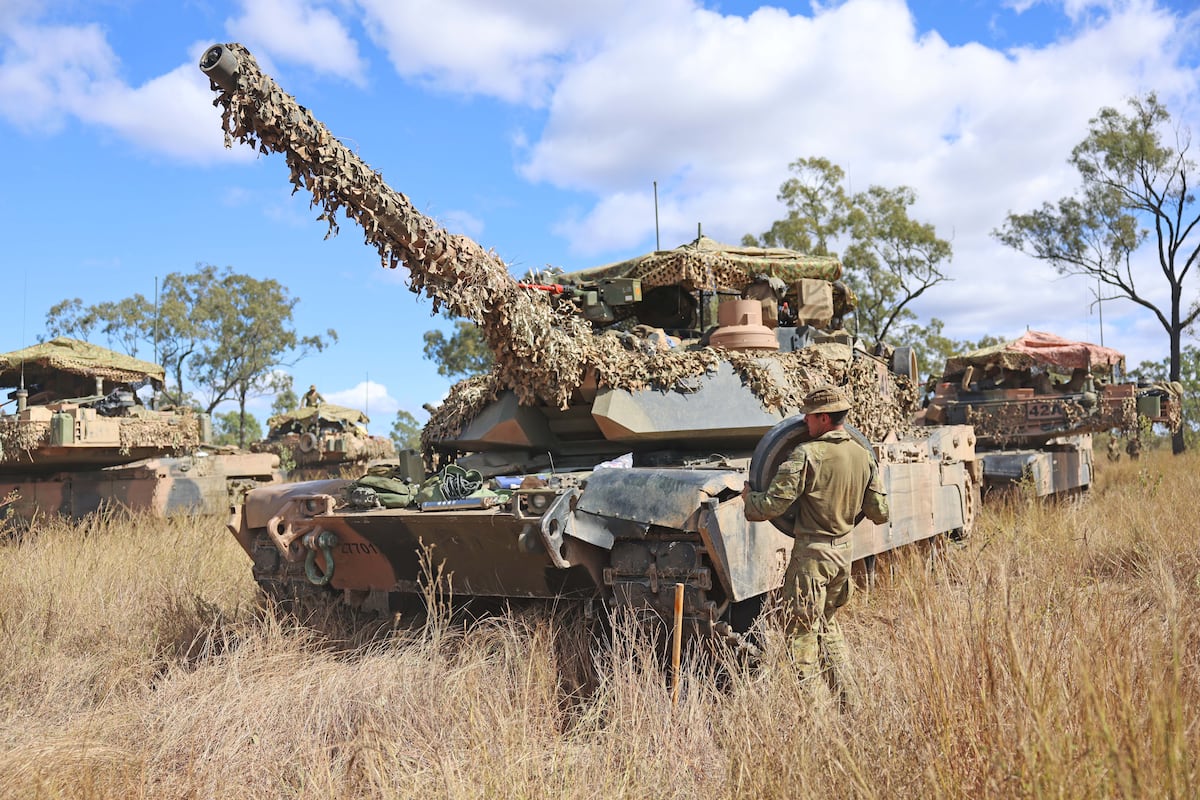
TOWNSVILLE, Australia — Based in Townsville in northern Queensland, the Australian Army’s 3rd Brigade is undergoing a massive transformation, as the heavy armored formation absorbs whole new fleets of vehicles.
Yet this modernization push has major knock-on effects in terms of logistics support.
Brigadier Ben McLennan, the brigade’s commander, told Defense News, “The Australian Army is undergoing its most significant recapitalization, at least since World War Two, and I’d say it’s happening at record pace.”
Yet he noted most of his bandwidth is invested on how to sustain this armored brigade that has “the potential to be the most lethal formation of its type on the planet.”
McLennan quoted figures to underscore the criticality of logistics. “This brigade’s heavy armored vehicle fleet increases 630% in three years. Also, the brigade is going from 3,200 to around 4,000 personnel in three years,” including growth in “the very, very important logistics echelon.”
As another example of the growing sustainment burden, McLennan said his former multirole combat brigade is moving from an average of 40,000 liters (roughly 10,000 gallons) of diesel per day in high-intensity operations to a daily fuel requirement of over 300,000 liters (79,000 gallons).
An important reason for such a thirst for fuel stems from heavier armored vehicles. For example, the 2nd Cavalry Regiment has already received its full complement of new M1A2 SEPv3 Abrams main battle tanks.
Furthermore, two armored engineering squadrons will have received all their Abrams-based combat engineering vehicles – the M1150 Assault Breacher Vehicle and M1074 Joint Assault Bridge – by the end of 2026.
The first AS9 Huntsman 155mm self-propelled howitzer from Hanwha to join the Australian Army’s 3rd Brigade in Townsville. (Gordon Arthur)
The first Hanwha AS9 Huntsman self-propelled howitzer (SPH) has arrived in Townsville, and due next year are Hanwha AS21 Redback infantry fighting vehicles. Then, Rheinmetall’s Boxer 8x8 combat reconnaissance vehicle will start replacing the long-serving ASLAV in 2028.
McLennan added, “Our stock of M88A2 recovery vehicles has tripled over the two years that I’ve been here, and our armored logistics battalion increases by a subunit at the end of this year.”
It is not just heavy armor that is snowballing either, for the brigade is adopting greater numbers of aerial drones for logistics, surveillance and attack. The commander revealed that unmanned ground vehicles will arrive soon too, including variants that can enter minefields dragging a tube full of explosives to clear paths.
All these new weapon systems require rearming too. McLennan spoke of the need for resilient logistics units “to move the heavy natures of ammunition and the increasing types of ammunition: 30mm, Spike LR, different types of 155mm, a whole lot more 12.7mm.”
He pointed out the brigade’s heavy-duty expansion “will take us from about 30 pallets of ammunition a day to 105 when we factoring us conducting high-intensity combat as a brigade with all our equipment. So it’s a significant transformation.”
The brigade’s 4th Regiment, Royal Australian Artillery is trading in its M777A2 towed howitzers for the AS9 Huntsman. The first 155mm SPH reached 106 Battery in late May, and the unit will eventually have a full allotment of six AS9s plus three AS10 armored ammunition resupply vehicles.
The regiment’s two other batteries will be identically equipped by the end of 2027. Significantly, the 4th Regiment is moving from four M777A2s per battery to six AS9s, with McLennan claiming the new structure and platforms “increase our capability, our firepower, our mobility, our protection by at least 300%.”
Maj. Fergus Robinson, commander of 106 Battery, highlighted: “One of the biggest challenges for soldiers will be vehicle husbandry – this is your vehicle, this is your home and you’re responsible for it. Their ability to maintain the vehicle, as well as the weapon system, is extremely important.”
Given the hulking size of the 48-ton AS9s and their supporting AS10s, the 4th Regiment will receive M88A2 Hercules recovery vehicles for the first time. “That will be something where we need to practice and develop our own skills to get it to a mature point, where we’re confident we can do this under night, under fire, under contact,” Maj. Robinson admitted.
All this expansion in capability requires new infrastructure, with McLennan discussing a transformation at the brigade’s home turf of Lavarack Barracks in Townsville.
“We’ll have opened by the end of the year probably the best common user facility, certainly in the Southern Hemisphere and perhaps the most modern in the world, that services all these fleets with light- and medium-grade repair.” That infrastructure work continues over the next couple of years as new equipment pours in.
As an example, the artillery regiment opened a new maintenance hangar in May. This features a 10-tonne gantry crane that permits vehicle power pack changes.
McLennan added: “Concurrently, additional range facilities are being built up at the Townsville Field Training Area to enable the armored brigade to achieve its mission-essential task lists in training year on, year on.”
While some army units around the world are seeking to become lighter and more mobile, the opposite is true of Australia’s 3rd Brigade.
As McLennan explained to Defense News: “The fact is that the combined-arms fighting system – not just tanks, but armored engineering vehicles, self-propelled artillery – are just as relevant, if not more relevant, than ever. They’re adapting to the threat and also the technologies that can help them reach a level of potential that we previously couldn’t.”
He said “we’re very, very focused” on this transformation, and “we’re drawing lessons from others who are doing it for real routinely.”
As well as transforming the 3rd Brigade, the Australian Army is simultaneously raising a Littoral Maneuver Group, maturing its 10th Brigade equipped with HIMARS and NASAM, and inducting the AH-64E Apache helicopter.
Gordon Arthur is an Asia correspondent for Defense News. After a 20-year stint working in Hong Kong, he now resides in New Zealand. He has attended military exercises and defense exhibitions in about 20 countries around the Asia-Pacific region.
澳大利亚汤斯维尔——驻扎在昆士兰州北部汤斯维尔的澳大利亚陆军第3旅正在经历一场巨大的变革,这支重型装甲部队正在吸收全新的车辆。
然而,这种现代化推进对后勤保障产生了重大的连锁反应。
该旅指挥官本·麦克伦南准将告诉《防务新闻》:“澳大利亚陆军正在经历自二战以来最重大的装备更新换代,而且我认为更新换代的速度是创纪录的。”
但他指出,他大部分精力都投入到如何维持这支装甲旅的运转上,这支装甲旅“有可能成为地球上同类型部队中最具杀伤力的”。
麦克伦南引用数据来强调后勤的重要性。“该旅的重型装甲车辆数量在三年内增长了630%。此外,该旅的人员规模也在三年内从3200人增加到4000人左右,”其中包括“极其重要的后勤部门”的人员增长。
麦克伦南举例说明了后勤保障负担的日益加重。他表示,他以前所在的多用途作战旅在高强度作战中每天平均消耗 40,000 升(约 10,000 加仑)柴油,而现在每天的燃料需求量超过 300,000 升(79,000 加仑)。
造成如此巨大燃料需求的一个重要原因是重型装甲车辆的出现。例如,第二骑兵团已经全部接收了新型M1A2 SEPv3艾布拉姆斯主战坦克。
此外,到 2026 年底,两个装甲工程中队将全部接收其基于艾布拉姆斯主战坦克的战斗工程车辆——M1150 突击破障车和 M1074 联合突击桥梁。
首辆韩华制造的AS9“猎人”155毫米自行榴弹炮交付澳大利亚陆军汤斯维尔第3旅。(戈登·阿瑟摄)
首辆韩华AS9“猎人”自行榴弹炮已抵达汤斯维尔,韩华AS21“红背蜘蛛”步兵战车预计明年交付。随后,莱茵金属公司的“拳击手”8x8战斗侦察车将于2028年开始取代服役多年的ASLAV装甲车。
麦克伦南补充道:“在我任职的这两年里,我们的 M88A2 抢修车库存增加了两倍,而且到今年年底,我们的装甲后勤营还将增加一个分队。”
不仅重型装甲装备在迅速发展,该旅还大量采用无人机进行后勤、侦察和攻击。指挥官透露,无人地面车辆也将很快到位,其中包括一些能够拖曳装满炸药的管状装置进入雷区清除障碍的型号。
所有这些新型武器系统也都需要重新装填弹药。麦克伦南谈到需要有韧性的后勤部队,“来运输重量庞大且种类日益增多的弹药:30毫米炮弹、长钉弹、各种类型的155毫米炮弹,以及大量的12.7毫米炮弹。”
他指出,该旅的重型扩充“将使我们每天的弹药量从大约30托盘增加到105托盘,这其中考虑到了我们作为一个旅级单位携带所有装备进行高强度作战的情况。因此,这是一个重大转变。”
该旅的皇家澳大利亚炮兵第4团正在用AS9“猎人”自行榴弹炮替换其M777A2牵引式榴弹炮。首辆155毫米自行榴弹炮于5月下旬交付至第106炮兵连,该部队最终将配备全部六辆AS9自行榴弹炮以及三辆AS10装甲弹药补给车。
到 2027 年底,该团的另外两个炮兵连也将配备相同的装备。值得注意的是,第 4 团的每个炮兵连将从 4 辆 M777A2 型自行火炮升级到 6 辆 AS9 型自行火炮。麦克伦南声称,新的结构和平台“使我们的能力、火力、机动性和防护能力至少提高了 300%”。
第106炮兵连指挥官弗格斯·罗宾逊少校强调:“士兵面临的最大挑战之一是车辆维护——这是你的车辆,这是你的家,你要对它负责。他们维护车辆以及武器系统的能力至关重要。”
鉴于48吨重的AS9装甲车及其支援车辆AS10的庞大体型,第四团将首次接收M88A2“大力神”抢修车。“我们需要进行演练,提升自身技能,才能使其达到成熟状态,让我们有信心在夜间、炮火下、近距离作战中完成操作,”罗宾逊少校坦言。
能力的全面提升需要新的基础设施,麦克伦南正在讨论对该旅位于汤斯维尔的拉瓦拉克兵营进行改造。
“到今年年底,我们将建成可能是南半球最好的公共用户设施,或许也是世界上最现代化的设施,为所有这些车队提供轻型和中型维修服务。” 随着新设备的陆续到位,这项基础设施建设工作将在未来几年继续进行。
例如,炮兵团在五月份启用了一个新的维修机库。该机库配备了一台10吨级的龙门起重机,可以更换车辆动力组件。
麦克伦南补充道:“与此同时,汤斯维尔野战训练区正在建设额外的靶场设施,以使装甲旅能够年复一年地完成其训练中的关键任务清单。”
虽然世界各地的一些军队都在寻求变得更轻便、更机动,但澳大利亚第3旅的情况却恰恰相反。
正如麦克伦南向《防务新闻》解释的那样:“事实上,诸兵种合成作战系统——不仅仅是坦克,还包括装甲工程车辆、自行火炮——即便不是比以往任何时候都更加重要,也依然至关重要。它们正在适应威胁,同时也在适应能够帮助它们达到我们以前无法企及的潜力水平的技术。”
他说:“我们非常非常专注于”这一转型,“我们正在向其他真正经常这样做的人汲取经验教训”。
除了改造第 3 旅之外,澳大利亚陆军还在同时组建一个近岸机动群,使其第 10 旅装备 HIMARS 和 NASAM,并引进 AH-64E 阿帕奇直升机。
戈登·阿瑟是《防务新闻》的亚洲特派记者。在香港工作20年后,他现居新西兰。他曾到访亚太地区约20个国家,参加过军事演习和防务展览。