He taught himself traditional Teochew crafts as a boy. More than 40 years later, he's still learning他从小就自学潮州传统工艺。40多年过去了,他仍在学习。
Mr Francis Tan Kwee Chye began teaching himself traditional Teochew crafts at nine years of age, improvising with chocolate wrappers, scrap wood and a penknife. More than four decades later, he is still making, learning and trying to pass on a craft with a dwindling number of practitioners.
新闻视频
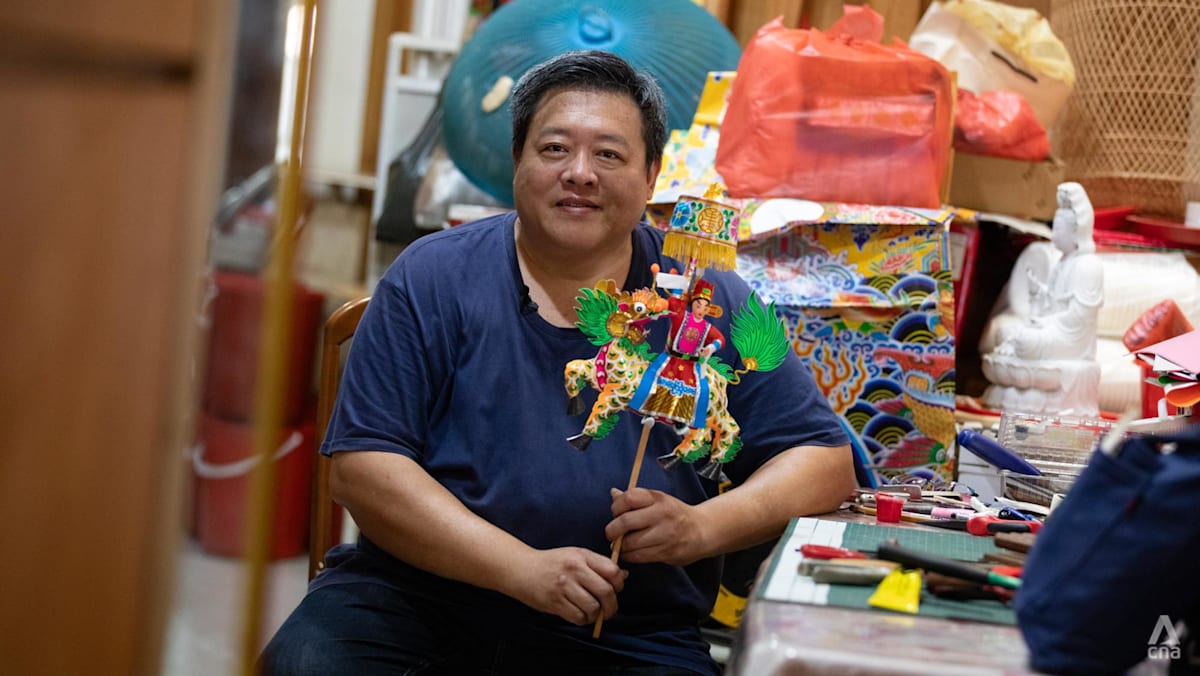
Mr Francis Tan Kwee Chye began teaching himself traditional Teochew crafts at nine years of age, improvising with chocolate wrappers, scrap wood and a penknife. More than four decades later, he is still making, learning and trying to pass on a craft with a dwindling number of practitioners.
Mr Francis Tan posing for a picture with a craftwork he made in his home studio on Aug 17, 2026. (Photo: CNA/Mak Jia Kee)
This audio is generated by an AI tool.
I had been in the living quarters of Sean Hua Zee Temple only for a few minutes, but I was already starting to sweat. Despite the afternoon heat, the ceiling fan remained off.
It couldn't be helped, though. In the middle of the room, Mr Francis Tan Kwee Chye was hard at work, carefully rubbing gold leaf into a wooden signboard. Turning the fan on for some cooling relief would blow the delicate foil away.
When I had arrived at the temple off Changi Road, which doubles as Mr Tan's home and studio, the 50-year-old welcomed me in before apologetically asking for a few minutes to finish the work in front of him.
As a master of traditional Teochew crafts, he's spent over three decades handmaking wood carvings, temple lanterns, paper effigies and even refurbishing deity statues.
CNA Games Guess Word Crack the word, one row at a time Buzzword Create words using the given letters Mini Sudoku Tiny puzzle, mighty brain teaser Mini Crossword Small grid, big challenge Word Search Spot as many words as you can Show More Show Less Mr Tan is not especially talkative, but once the conversation turns to his work, he seems to light up. He readily reaches for photographs, old pieces or reference books, eager to explain how something was made or point out a detail that might otherwise escape my notice. At one point during my visit, he even broke open a container that had been sealed for about two decades to show me the miniature figurines kept inside, some of which he had made in primary school. Straightforward doesn't interest him – he prefers the challenge of elaborate flowers, birds and animals over simpler creations such as tables and chairs. "I like to make special things," he said simply. Presented with proof after proof of Mr Tan's artistry, I was surprised to learn that his impressive skills were almost entirely self-taught. He has never formally apprenticed under a master, instead painstakingly honing his abilities through years of observation, failed attempts and fragments of guidance from other artists.
Mr Tan is not especially talkative, but once the conversation turns to his work, he seems to light up. He readily reaches for photographs, old pieces or reference books, eager to explain how something was made or point out a detail that might otherwise escape my notice.
At one point during my visit, he even broke open a container that had been sealed for about two decades to show me the miniature figurines kept inside, some of which he had made in primary school.
Straightforward doesn't interest him – he prefers the challenge of elaborate flowers, birds and animals over simpler creations such as tables and chairs.
"I like to make special things," he said simply.
Presented with proof after proof of Mr Tan's artistry, I was surprised to learn that his impressive skills were almost entirely self-taught.
He has never formally apprenticed under a master, instead painstakingly honing his abilities through years of observation, failed attempts and fragments of guidance from other artists.
Mr Francis Tan crafting a figurine in his home studio on Aug 17, 2026. (Photo: CNA/Mak Jia Kee)
Books used by Mr Francis Tan for reference and self-learning in his home studio on Aug 17, 2026. (Photo: CNA/Mak Jia Kee)
LEARNING WITHOUT A TEACHER
At first glance, Sean Hua Zee Temple looks like a regular home, wedged into the middle of a row of landed houses. A red banner and signboard beckon devotees in to make their prayers and offerings.
Growing up in a home temple made objects such as wood carvings and lanterns a familiar part of his surroundings. As a child, Mr Tan also often accompanied his mother to street opera performances. He understood little of what was being sung on stage, but was drawn to crafts used in the street opera that were similar to those displayed around the temples.
In Primary 3, Mr Tan started trying to reproduce some of them himself.
One of his earliest projects was a miniature joss paper dragon traditionally presented to deities during birthday celebrations.
With no YouTube or internet tutorials to consult back then, Mr Tan photographed a full-sized version with a camera, scaled down its proportions, then drew and coloured in the smaller version himself.
Proper materials were expensive for a nine-year-old, so he improvised. "Instead of buying gold foil, I used chocolate wrappers to get the same effect," he said.
By around Primary 6, Mr Tan had also started trying his hand at wood carving. Still aged only 12, Mr Tan would run out after school to nearby factories to ask for unwanted wooden pallets. He would break them down with a hammer himself and carry the usable pieces home.
Having no carving tools, he relied on a penknife, but the makeshift tool left his hands blistered, while mistakes were frequent. "When you first carve, you don't know how to control your strength," he said. "So it's either I cut it too deep or I scraped off the part which I wanted."
With no teacher to instruct him, he spent several months on his first wood carving: a sea lion. Even now, about 40 years later, he still keeps some of those early pieces to measure his progress – a physical record from a time when taking photographs was costly and mobile phones did not yet exist.
Mr Tan's first wood carving, a sea lion, which he made when he was in primary school. (Photo: Francis Tan)
Mr Tan remembers his mother being "quite supportive, because I (wasn't) doing anything wrong or illegal". Nevertheless, he's aware that his dedication and persistence back then may have been seen as rather unusual by others, given his young age.
At around 15, Mr Tan joined a lion dance troupe. After a friend in the troupe mentioned his craft hobby to an events company they worked with, Mr Tan was invited to make miniature Chinese opera masks in front of tour groups as a live demonstration.
"I was young, so I felt quite excited that my work was being recognised," he recalled.
Despite that early recognition, Mr Tan never imagined that crafts would eventually become his livelihood.
Mr Francis Tan, then aged 12, with his father. (Photo: Francis Tan)
A CRAFT THAT NEVER LEFT HIM
After his O-Levels, Mr Tan studied drafting at the Institute of Technical Education. After graduating, he worked as a draftsman for a few years before being unexpectedly retrenched. He later became a construction project coordinator at another company.
All the while, though, he found himself unable to set aside traditional crafts.
His construction boss allowed him to take discarded materials from work sites, so he continued taking on craft projects on the side, partly for extra income but also "because of passion".
At the same time, he struggled to find senior craftsmen to teach him to perfect the skills he'd already developed.
When Mr Tan was about 24, a relative who ran a joss paper shop asked him to refurbish a deity statue. Mr Tan turned him down because he didn't feel confident he could do the work.
His relative persisted, assuring him that a professional could take over if needed. Mr Tan agreed, and upon completing his refurbishment, his relative showed it to experienced craftsmen without revealing who had done it.
Mr Tan was present, allowing him a rare chance to listen to qualified critiques.
"I just sat there and listened to the feedback … just tried to improve from there."
About six years after that, Mr Tan approached a joss paper shop owner hoping to learn from him, but was turned away for reasons he never learnt.
With no one willing to teach him, Mr Tan has been honing his craft skills much as he did in childhood – by studying finished objects and, in a way, reverse engineering the techniques that went into creating them by himself.
Even today, his workspace is crowded with reference books on Chinese opera characters, costumes and traditional weapons to fill the gaps in his formal knowledge.
In his early 40s, Mr Tan concluded his career in construction, concerned about prolonged exposure to cement and sand dust. Having built up a small base of regular customers for his craft work, he decided it was time to make his part-time passion a full-time occupation.
A joss paper dragon robe hanging on a wall at Sean Hua Zee Temple, which also serves as Mr Francis Tan’s home studio, on Aug 17, 2026. (Photo: CNA/Mak Jia Kee)
AN OLD CRAFT IN MODERN SINGAPORE
Mr Tan's line of work is one that some people would rather keep at a distance. In his experience, some are reluctant even to touch joss paper or enter shops selling it because of the associations with the dead.
"But if you don't do it, who is going to do it? Somebody has to do this," he said.
For some customers, Mr Tan's creations serve a deeply personal purpose.
Several years ago, a couple approached him with an unusual request: Would he make them two joss paper replicas of the same portable handheld fan, each in a different colour?
The request was made through a third party, who told Mr Tan that the couple had dreamt of their recently deceased daughter asking for the fans, and wanted joss paper versions that could be burnt as offerings for her.
They had spent some time searching around Singapore and even making inquiries with Malaysia-based businesses, but no one seemed to be able or willing to take on their request.
He did not know much else – not even the couple's ages, nor how old their daughter had been when she died.
With only a photograph and no measurements provided, Mr Tan had to rely on online specifications for the fan's dimensions. After about six months of experimentation, he eventually made two fans out of joss paper. The customer had separately asked for a power bank and cable to accompany them.
Mr Tan admitted to having felt daunted at first. He had even suggested the parents simply buy real fans for about S$20 (US$15.80) each, rather than pay him much more to create joss paper replicas.
"After listening to their story, to me it's a motivation," he said. "It pushed me to make (the fans) more detailed, and try to make the deceased happy."
He has since gone on to recreate other contemporary objects out of traditional joss paper, including track shoes and dumbbells. Such customised orders often require extensive trial and error, so he takes them on only when he has time to spare.
The joss paper portable fans Mr Francis Tan made in 2021, which took him about six months to complete. (Photo: Mr Francis Tan)
"To me, it's a form of respect to the deceased," he said. "Try to make it as real as possible, even though it's a joss paper product."
After spending so much of his life in traditional crafts, Mr Tan said he is no longer uneasy about the trade's association with death. He sees it instead as a service to the deceased and, in turn, to the families commissioning the pieces, who may find some comfort in being able to fulfil a loved one's final or imagined wishes.
KEEPING TRADITIONAL CRAFTS ALIVE IN SINGAPORE
As much as Mr Tan struggled to find master craftsmen to learn from in his young adulthood, that struggle may be even greater for young learners today.
He said most traditional craftsmen in Singapore are already well into their 60s and older. And at the age of 50, he reckons he could be among the youngest of those still working today.
Two years ago, Mr Tan began conducting traditional craft workshops and found that many participants recognised the objects he showed them without knowing how they were made or what they meant. Among locals, older participants also tended to outnumber younger adults.
Some young people have nevertheless approached him wanting to learn directly from him, placing the self-taught craftsman in the unfamiliar role of potential teacher.
While Mr Tan is willing, he has yet to accept an apprentice. Showing interest alone is not enough for him.
"I'm still observing people. Before you teach someone, you have to see their character."
The challenges don't end there for the micro-industry of traditional Teochew crafts.
The already small pool of traditional craft makers and craft businesses is dwindling as older practitioners retire. The work also demands long hours and specialised skills, making it difficult to bring in temporary help during periods of heightened demand, such as the seventh month of the Chinese lunar calendar.
"You feel sad, but (you have) no choice," said Mr Tan.
Paper effigies of hell officer deities made by Mr Francis Tan in 2016. (Photo: Francis Tan)
At the same time, demand for handmade work is dipping in a sea of cheaper, ready-made alternatives easily available on e-commerce sites such as Shopee and Taobao. To less-informed customers, printed or machine-made products may look little different from handmade ones.
These days, it's not unusual for Mr Tan to spend up to a week making an item that sells for only about S$100.
Also at risk of disappearing are the rich history and knowledge behind these traditional artefacts – the symbolism and significance behind the colours, motifs and forms they bear, all of which Mr Tan has absorbed over decades of making them.
"It's art, but it's also connected with culture," he said. "After you do it for some time, you will understand more about Chinese culture."
By now, little separates Mr Tan's work from the rest of his life. Sean Hua Zee Temple is both home and studio, filled with tools, reference books and pieces accumulated over decades.
Mr Francis Tan carving wood for an ancestral tablet in his home studio on Aug 17, 2026. (Photo: CNA/Mak Jia Kee)
Details of a wood carving for an ancestral tablet crafted by Mr Francis Tan in his home studio on Aug 17, 2026. (Photo: CNA/Mak Jia Kee)
The craft was already part of that life when he met his wife through a dating service in 2013, while he was still working in construction. Before they married, he made clear what he did.
"I did tell her what I'm doing," he recalled. "If she accepts it, then we can get together. If she cannot accept it, then no choice."
Certainly, Mr Tan's trade may seem an unconventional one compared to the office jobs that dominate the job market today.
But Mr Tan said he prefers not to make such comparisons – nor does he appear to feel particularly isolated working in a small, shrinking trade. He's become accustomed to solving problems on his own, trying different ideas, materials or methods until something works.
It is far from the future Mr Tan imagined at nine, when crafts were simply a hobby. At 50, he now sees himself continuing for as long as his strength and eyesight allow.
"Maybe I'll just continue until the day I am not very fit to do this type of traditional craft."
If he has his way, even retirement won't part him from his art. Even after stepping back from work, he sees himself continuing to make paper crafts "as a memory, or just for myself".
Get our pick of top stories and thought-provoking articles in your inbox
Stay updated with notifications for breaking news and our best stories
Join our channel for the top reads for the day on your preferred chat app
陈桂财先生九岁时就开始自学潮州传统工艺,用巧克力包装纸、废木料和小刀进行创作。四十多年过去了,他仍然在制作、学习,并努力将这项技艺传承下去,因为这项技艺的传承者越来越少。
2026年8月17日,陈先生在家中工作室里与他制作的手工艺品合影。(图片:CNA/麦嘉琪)
这段音频由人工智能工具生成。
我才在仙华池寺的住所待了几分钟,就已经开始冒汗了。尽管午后天气炎热,吊扇却一直没开。
然而,这也无可避免。房间中央,陈桂财先生正埋头苦干,小心翼翼地将金箔贴到一块木制招牌上。如果打开风扇降温,就会把脆弱的金箔吹走。
当我到达樟宜路附近的这座寺庙时(这里同时也是陈先生的家和工作室),这位 50 岁的老人热情地接待了我,然后抱歉地请求给我几分钟时间完成他面前的工作。
作为潮州传统工艺大师,他三十多年来一直手工制作木雕、寺庙灯笼、纸塑,甚至还修复神像。
CNA游戏 猜词游戏 逐行破解单词 流行词游戏 用给定的字母组成单词 迷你数独 小谜题,脑力挑战 迷你填字游戏 小方格,大挑战 单词搜索 尽可能多地找出单词 显示更多 显示更少 陈先生并不特别健谈,但一旦话题转向他的作品,他似乎就兴致勃勃。他会毫不犹豫地拿出照片、旧作品或参考书,热情地解释作品的制作过程,或指出一些我可能忽略的细节。在我拜访期间,他甚至打开了一个密封了近二十年的容器,向我展示里面保存的微型人偶,其中一些是他小学时制作的。他不喜欢简单的东西——比起桌椅之类的简单作品,他更喜欢制作精致的花卉、鸟类和动物。“我喜欢做特别的东西,”他简单地说。看到陈先生精湛的技艺,我惊讶地发现,他令人印象深刻的技能几乎完全是自学的。他从未正式拜师学艺,而是通过多年的观察、失败的尝试以及其他艺术家的零星指导,一点一滴地磨练自己的能力。
谭先生平时不太爱说话,但一旦话题转到他的工作上,他就好像焕发了光彩。他会毫不犹豫地拿出照片、旧物或参考书,热情地解释某件东西的制作过程,或者指出一些我可能忽略的细节。
在我参观期间,他甚至一度打开了一个密封了大约二十年的容器,向我展示里面保存的微型人偶,其中一些是他小学时制作的。
他不喜欢简单直接的东西——比起桌椅之类的简单作品,他更喜欢创作精致的花卉、鸟类和动物,这更具挑战性。
“我喜欢制作特别的东西,”他简单地说。
在看到谭先生精湛技艺的种种证明后,我惊讶地发现他令人印象深刻的技能几乎完全是自学的。
他从未正式拜师学艺,而是通过多年的观察、失败的尝试以及其他艺术家的零星指导,一点一滴地磨练自己的能力。
2026年8月17日,陈先生在家中工作室制作小雕像。(图片:CNA/麦嘉琪)
2026年8月17日,陈先生在家中工作室里用于参考和自学的书籍。(图片:CNA/麦嘉琪)
无师自学
乍一看,仙华池庙就像一栋普通的民居,嵌在一排排独立式住宅中间。红色的横幅和招牌吸引着信徒们前来祈祷和供奉。
在寺庙中长大,木雕和灯笼等物品对他来说早已习以为常。小时候,陈先生也经常陪母亲去看街头戏曲表演。虽然他听不懂台上唱的是什么,但他却被街头戏曲中使用的工艺品所吸引,因为这些工艺品与寺庙里展示的物品很相似。
小学三年级时,陈先生开始尝试自己复刻其中的一些作品。
他最早的作品之一是生日庆祝活动中献给神灵的微型纸扎龙。
由于当时没有 YouTube 或互联网教程可以参考,谭先生用相机拍摄了一个全尺寸的版本,按比例缩小,然后自己绘制并着色了较小的版本。
对一个九岁的孩子来说,合适的材料太贵了,所以他想了个办法。“我没有买金箔,而是用巧克力包装纸来达到同样的效果,”他说。
大约在小学六年级时,谭先生也开始尝试木雕。当时他只有12岁,放学后就会跑到附近的工厂去要废旧的木托盘。他会自己用锤子把托盘敲碎,然后把能用的部件搬回家。
由于没有雕刻工具,他只能用一把小刀,但这临时工具让他的双手磨出了水泡,而且经常出错。“刚开始雕刻的时候,你不知道怎么控制力道,”他说,“所以要么是切得太深,要么是把我想雕刻的部分刮掉了。”
由于没有老师指导,他花了几个月的时间完成了他的第一件木雕作品:一头海狮。即使在40年后的今天,他仍然保留着一些早期的作品,以此来衡量自己的进步——这是在拍照成本高昂、手机尚未普及的年代留下的实物记录。
这是陈先生的第一件木雕作品,一只海狮,是他小学时创作的。(照片:陈先生)
谭先生回忆说,他的母亲“非常支持我,因为我(没有)做任何错事或违法的事”。尽管如此,他也意识到,考虑到他当时的年纪,他的奉献精神和坚持不懈在别人看来可能相当不寻常。
谭先生大约15岁时加入了一个舞狮队。后来,队里的一位朋友向他们合作的一家活动公司提到了他的手工艺爱好,谭先生便受邀在旅游团面前现场制作微型中国戏曲面具。
“我当时还年轻,所以我的作品能得到认可,我感到非常兴奋,”他回忆道。
尽管很早就发现了自己的才华,但谭先生从未想过手工艺最终会成为他的谋生手段。
当时12岁的陈先生和他的父亲。(照片:陈先生)
一项从未离开过他的技艺
陈先生中学毕业后,在工艺教育学院学习制图。毕业后,他做了几年绘图员,但后来意外被裁员。之后,他转到另一家公司担任建筑项目协调员。
然而,他始终无法放弃传统工艺。
他的建筑老板允许他从工地带走废弃的材料,所以他继续业余时间做手工项目,部分是为了赚取额外收入,但也“出于热爱”。
与此同时,他还在努力寻找资深工匠来指导他,以完善他已经掌握的技能。
谭先生大约24岁时,一位经营纸钱店的亲戚请他帮忙翻新一尊神像。谭先生拒绝了,因为他觉得自己没有信心完成这项工作。
他的亲戚坚持不懈,向他保证如果需要的话可以请专业人士接手。谭先生同意了,装修完成后,他的亲戚把房子拿给经验丰富的工匠看,但没有透露是谁做的。
谭先生在场,这让他有机会聆听到一些有见地的评论。
“我就坐在那里听取反馈……然后努力改进。”
大约六年之后,谭先生找到一家纸钱店的老板,希望能向他学习,但却被拒绝了,至于原因,他始终不得而知。
由于没有人愿意教他,谭先生只能像小时候那样,通过研究成品,并在某种程度上逆向工程出制作这些成品的技术,来磨练自己的工艺技能。
即使在今天,他的工作空间里仍然堆满了关于中国戏曲人物、服装和传统兵器方面的参考书籍,以弥补他正规知识的不足。
谭先生四十出头时结束了建筑行业的工作,因为他担心长期接触水泥和沙尘对身体有害。凭借着精湛的手工艺,他积累了一小批固定客户,于是决定将自己的业余爱好发展成全职事业。
2026年8月17日,在华华寺(同时也是陈先生的工作室)的墙上,挂着一件纸扎龙袍。(图片:CNA/麦嘉琪)
现代新加坡的古老工艺
陈先生的工作性质特殊,有些人宁愿避而远之。据他所知,有些人甚至不愿触碰冥纸,或踏入售卖冥纸的店铺,因为他们觉得冥纸与死者有关。
“但如果你不做,谁来做?总得有人去做这件事,”他说。
对于一些顾客来说,谭先生的作品具有非常私人的意义。
几年前,一对夫妇向他提出了一个不同寻常的要求:能否请他为他们制作两个不同颜色的同款便携式手持扇子的纸扎复制品?
这项请求是通过第三方提出的,该第三方告诉谭先生,这对夫妇梦见他们最近去世的女儿想要扇子,想要一些可以烧作祭品的纸扇。
他们花了一些时间在新加坡四处寻找,甚至向马来西亚的企业咨询过,但似乎没有人能够或愿意接受他们的请求。
他对其他事情也知之甚少——甚至不知道这对夫妇的年龄,也不知道他们的女儿去世时的年龄。
由于只有一张照片,没有尺寸数据,谭先生只能依靠网上资料来确定扇子的尺寸。经过大约六个月的试验,他最终用纸钱制作了两把扇子。顾客还单独要求附赠一个移动电源和连接线。
陈先生承认自己起初感到有些不知所措。他甚至建议家长们直接花大约20新元(15.80美元)购买真正的扇子,而不是花更多的钱让他制作纸扎的复制品。
“听了他们的故事后,我深受鼓舞,”他说。“这促使我把(粉丝们)的形象塑造得更加细致,并努力让逝者感到欣慰。”
此后,他又用传统的冥纸制作了其他现代物品,包括跑鞋和哑铃。这类定制订单通常需要反复试验,因此他只在有空的时候才会接单。
这是陈先生于2021年制作的纸扎电扇,耗时约六个月完成。(照片:陈先生)
“对我来说,这是对逝者的一种尊重,”他说。“即使只是纸扎祭祀用的纸钱,也要尽量做得逼真。”
陈先生一生致力于传统工艺,他说自己不再对这门行业与死亡的关联感到不安。相反,他认为这是一种对逝者的服务,同时也能为委托制作工艺品的家属带来慰藉,因为家属们或许能从实现亲人最后的愿望或想象中的愿望中获得一些安慰。
在新加坡传承传统工艺
谭先生年轻时很难找到可以学习的技艺精湛的师傅,而如今的年轻学习者可能面临的困难更大。
他说,新加坡大多数传统工匠都已年过六旬。而他今年50岁,他认为自己可能是目前仍在从事这项工作的工匠中最年轻的之一。
两年前,陈先生开始举办传统工艺工作坊,他发现许多参与者虽然认得他展示的物品,却不知道它们的制作方法或象征意义。在当地居民中,老年参与者的人数也往往多于年轻人。
尽管如此,还是有一些年轻人主动接近他,希望直接向他学习,这使得这位自学成才的工匠扮演了潜在教师这个陌生的角色。
谭先生虽然有意愿,但至今尚未收徒。仅仅表示感兴趣对他来说还不够。
“我还在观察别人。在教导别人之前,你必须先了解他们的品格。”
对于潮州传统手工艺品这个微型产业来说,挑战远不止于此。
随着老一辈从业者退休,原本就数量不多的传统手工艺人和手工艺企业更是日益萎缩。此外,这项工作需要长时间投入和专业技能,因此在需求高峰期(例如农历七月)很难找到临时帮手。
“你会感到难过,但你别无选择,”谭先生说。
2016年,陈先生用纸制作了地狱官神的塑像。(照片:陈先生)
与此同时,在Shopee和淘宝等电商平台上琳琅满目的廉价成品的冲击下,人们对手工制品的需求正在下降。对于不太了解情况的消费者来说,印刷品或机器制造的产品可能与手工制品看起来并无太大区别。
如今,陈先生花费长达一周的时间制作一件售价仅为 100 新元左右的商品并不罕见。
此外,这些传统工艺品背后蕴含的丰富历史和知识也面临消失的风险——它们所承载的颜色、图案和形状背后的象征意义和重要性,这些都是谭先生在几十年的制作过程中吸收的。
“它是艺术,但也与文化息息相关,”他说。“当你从事这项工作一段时间后,你就会对中国文化有更深入的了解。”
如今,陈先生的工作与他的生活已密不可分。肖恩华泽寺既是他的家,也是他的工作室,里面摆满了工具、参考书籍以及他几十年来积累的各种物件。
2026年8月17日,陈先生在家中工作室雕刻祖先牌位。(图片:CNA/麦嘉琪)
2026年8月17日,陈先生在家中工作室雕刻了一幅祖先牌位木雕的细节图。(图片:CNA/麦嘉琪)
2013年,他还在建筑工地工作时,通过约会网站认识了妻子,那时他的手艺已经是生活的一部分了。结婚前,他向妻子明确说明了自己的职业。
“我告诉过她我的计划,”他回忆道。“如果她能接受,我们就可以在一起。如果她不能接受,那就没办法了。”
当然,与当今就业市场中占据主导地位的办公室工作相比,谭先生的职业似乎显得非同寻常。
但谭先生表示,他并不想做这样的比较——而且他似乎也不觉得在这样一个规模小、日渐萎缩的行业工作有什么特别的孤立感。他已经习惯了独自解决问题,尝试不同的想法、材料或方法,直到找到有效的解决方案。
这与谭先生九岁时设想的未来相去甚远,那时手工艺对他来说只是一种爱好。如今五十岁的他,希望只要体力和视力允许,就能继续从事手工艺。
“也许我会一直做下去,直到我身体无法再从事这种传统手工艺为止。”
如果一切顺利,即使退休也不会让他放弃艺术。即使不再工作,他仍然会继续制作纸艺,“作为一段回忆,或者只是为了自己”。
订阅我们的邮件,即可获取精选热门新闻和引人深思的文章。
订阅通知,第一时间获取突发新闻和精彩报道。
加入我们的频道,即可在您常用的聊天应用上获取当日热门文章。