Anduril unveils Steelfin interceptor as cheaper option to PAC-3 missilesAnduril公司推出Steelfin拦截器,作为PAC-3导弹的更经济选择
Anduril executives said the system can be “reconfigured” to be tailored toward defeating both low cost and exquisite systems.
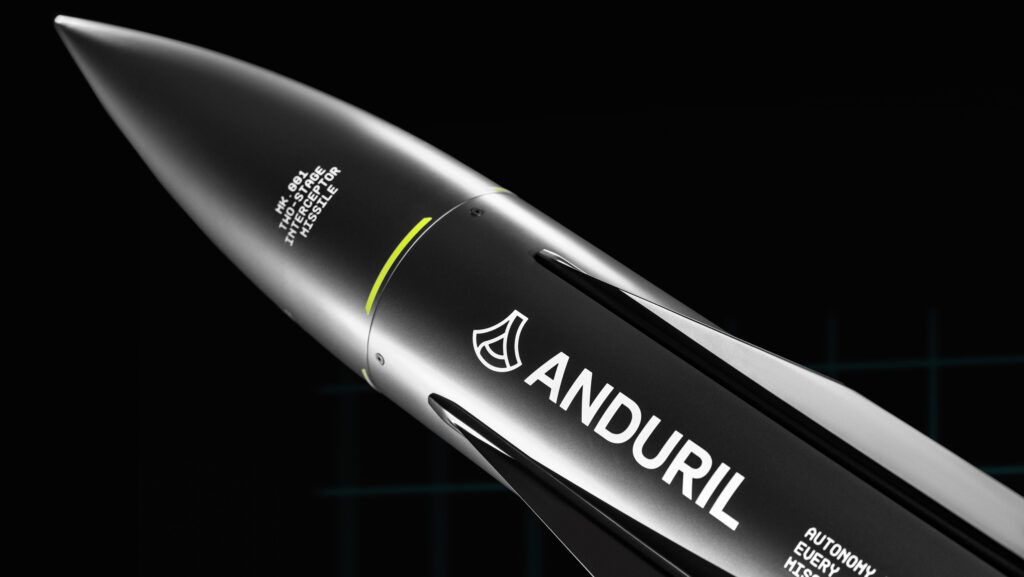
The new interceptor is “modular,” meaning it can fly with different rocket motors, different seekers and be launched from different platforms, Anduril executives said. (Photo courtesy of Anduril.)
WASHINGTON — Anduril today unveiled its new Steelfin interceptor, which company executive s are aiming to cost a third of the price of the Patriot’s current PAC-3 missile segment enhancement (MSE).
“One-way attack drones, ballistic missiles, cruise missiles, hypersonic weapons… our military and our allies’ militaries are struggling with a set of legacy interceptors that are not scalable, and are not able to match the volume of the threat that they’re faci ng,” Chris Brose, Anduril’s president and chief strategy officer, told reporters in a preview call ahead of the announcement.
Brose said the company has “been working on Steefin for a couple of years,” driven by a belief that the market would soon have a desire for cheaper interceptors.
The new interceptor is “modular,” Brose said, meaning it can fly with different rocket motors, different seekers and be launched from different platforms ranging from PAC-3, CAML and Typhoon systems to containerized munitions canisters. Brose said the system can be “reconfigured” to be tailored from defeating low-cost systems like the Iranian Shaheds to more exquisite systems like ballistic cruise missiles and hypersonic weapons.
Steve Milano, the company’s senior director of missiles, said the company is vying for the Army’’s low cost interceptor program with the Steelfin. Anduril was one of many vendors chosen to move forward with testing and demonstrations following the service’s recent xTech Apex Intercept competition — the event the Army held to try to find as many effective yet affordable interceptors as it could.
However, there may be a different competition that Anduril is also running Steelfin in. On Friday, Breaking Defense first reported that Lockheed Martin and one other undisclosed company were selected for the Army’s Future Interceptor program , a previously unknown effort which seeks to find a next-gen version of the current PAC-3 MSE.
Anduril executives declined to comment on if the Steelfin was selected for the Future Interceptor program, however, Steve Milano, the company’s senior director of missiles, said the Steelfin is a “natural fit in that domain space. ” Under that competition, Milano said, the Army is looking for a seven to 10 inch terminal storage interceptor with a 10 to 13 inch booster to fit into the existing Patriot launcher and Common Autonomous Multi Domain Launcher (CAML), and Steelfin “fits very well” with those requirements.
Regarding production, Milano said he expects Anduril to reach full rate production for the Steelfin at the end of 2028 or the beginning of 2029. He said he suspects “on the low end” the company will target producing “multiple thousands” of Steelfins per year, with a “higher end” of “closer to hundreds of thousands” per year, depending on the demand signal from the US and customers abroad.
Milano said Anduril’s “intent” is to build most of the sub assemblies for Steelfin at the company’s Arsenal-1 facility in Ohio, and then do the “final integration” of the interceptor with a “handful of our partners.” As to the solid rocket motors for Steelfin, Milano added that some will come from Anduril and some from other companies.
“We’ve intentionally designed the Steelfin configuration with a modular mounting, so we can take in new providers as well as utilize our integrated and internal rocket motor systems,” Milano explained.
Breaking Defense Video
New leaders, new drone command: What we expect from AUSA 2026
Unpacking Boeing’s F/A-XX win, plus a report from wartime Ukraine
How Hegseth envisions a new Autonomous Warfare Command
What Europe’s military air fleets will look like in 30 years
Riyadh gets closer to F-35s, Damascus presses sovereignty and an expert take on Iran
Drone-hunting on the border, plus turmoil at an Air Force think tank
The future of European airpower might be unmanned
The big news out of AFA, plus a guided tour of the show floor
Why the ‘right to repair’ matters to the Pentagon
What the Pentagon is testing along the US-Mexico border
安杜里尔公司高管表示,新型拦截器采用“模块化”设计,这意味着它可以搭载不同的火箭发动机、不同的导引头,并从不同的发射平台上发射。(图片由安杜里尔公司提供。)
华盛顿——安杜里尔公司今天推出了其新型“钢鳍”拦截器,该公司高管的目标是使其成本仅为“爱国者”导弹当前PAC-3导弹段增强型(MSE)的三分之一。
“单向攻击无人机、弹道导弹、巡航导弹、高超音速武器……我们的军队和我们盟友的军队正在努力应对一系列无法扩展的传统拦截器,这些拦截器无法应对他们所面临的威胁规模,”安杜里尔公司总裁兼首席战略官克里斯·布罗斯在发布会前的预览电话会议上告诉记者。
布罗斯表示,该公司“几年来一直在研发 Steefin”,其动机是相信市场很快就会需要更便宜的拦截器。
布罗斯表示,新型拦截器采用“模块化”设计,这意味着它可以搭载不同的火箭发动机和导引头,并可从多种平台发射,包括PAC-3、CAML和台风导弹系统以及集装箱式弹药筒。布罗斯还表示,该系统可以“重新配置”,从而能够应对从伊朗“沙赫德”导弹等低成本系统到弹道巡航导弹和高超音速武器等更精密的系统。
该公司导弹高级主管史蒂夫·米兰诺表示,安杜里尔公司正凭借其“钢鳍”(Steelfin)拦截导弹竞标陆军的低成本拦截导弹项目。在陆军近期举办的“xTech Apex拦截导弹”竞标活动中,安杜里尔公司是众多入选进行测试和演示的供应商之一。该活动旨在寻找尽可能多的高效且价格合理的拦截导弹。
然而,Anduril公司可能还在参与另一项竞争,其Steelfin项目也在进行中。上周五,《防务新闻》(Breaking Defense)率先报道称,洛克希德·马丁公司和另一家未公开名称的公司入选了陆军的“未来拦截者”(Future Interceptor)项目。该项目此前鲜为人知,旨在寻找现役PAC-3 MSE的下一代产品。
安杜里尔公司高管拒绝就“钢鳍”(Steelfin)导弹是否入选未来拦截器项目置评,但该公司导弹高级主管史蒂夫·米兰诺表示,“钢鳍”导弹“完美契合该领域”。米兰诺说,根据该竞标方案,陆军正在寻找一种7至10英寸末端存储拦截器,并配备10至13英寸助推器,以便适配现有的“爱国者”(Patriot)导弹发射装置和通用自主多域发射装置(CAML),而“钢鳍”导弹“非常符合”这些要求。
关于生产方面,米兰诺表示,他预计安杜里尔公司将在2028年底或2029年初实现Steelfin的全面投产。他表示,他估计公司“最低”目标是每年生产“数千台”Steelfin,而“最高”目标则为每年“接近数十万台”,具体取决于来自美国和海外客户的需求信号。
米兰诺表示,安杜里尔公司的“计划”是在其位于俄亥俄州的阿森纳-1工厂生产“钢铁鳍”拦截器的大部分子组件,然后与“少数合作伙伴”进行拦截器的“最终集成”。至于“钢铁鳍”的固体火箭发动机,米兰诺补充说,一部分将由安杜里尔公司提供,一部分将由其他公司提供。
“我们特意将 Steelfin 配置设计成模块化安装,这样我们就可以引入新的供应商,并利用我们集成的内部火箭发动机系统,”米兰诺解释说。
突破性防御视频
新领导人,新无人机指挥部:我们对 AUSA 2026 的期待
深入剖析波音F/A-XX的竞标结果,以及来自战时乌克兰的报道
赫格塞斯设想的新型自主作战指挥部
30年后欧洲军用空军机队会是什么样子
利雅得距离F-35战机更近一步,大马士革强调主权,以及专家对伊朗的看法
边境无人机猎杀行动,以及空军智库的动荡
欧洲空军的未来或许在于无人化。
AFA展会最新动态,以及展会现场导览。
为什么“维修权”对五角大楼如此重要
五角大楼正在美墨边境测试什么?