Anduril Unveils Steelfin Family Of Modular Surface-To-Air Missiles安杜里尔公司推出“钢鳍”系列模块化地对空导弹
Anduril aims to produce Steelfin interceptors at scale by leveraging common components that can be configured for different threats.
Published Oct 12, 2026 1:30 AM EDT
Anduril has unveiled Steelfin, a family of surface-to-air interceptor missiles designed to share a common architecture and manufacturing process while being configured for different air and missile defense missions. The company says this approach will enable high-volume production at significantly lower cost than existing weapons, though it has not disclosed prices or detailed performance specifications.
The announcement comes as the U.S. military seeks to expand air defense inventories against an increasingly diverse range of threats, from inexpensive drones to cruise missiles, ballistic missiles, and advanced maneuvering weapons, including hypersonic ones. Recent experiences from Ukraine and the Middle East make it abundantly clear that the challenge is not simply developing interceptors capable of defeating those targets but producing enough of them to sustain operations without exhausting stocks of more expensive weapons.
A company rendering showing the front end of the second stage of one of the Steelfin iterations. Anduril TREVOR DALTON
Using high-end interceptors against comparatively inexpensive threats can rapidly consume limited inventories, as it has in the Middle East, especially, even when engagements are necessary to protect personnel and critical infrastructure. A broader range of defensive weapons, matched to different threats and engagement requirements, could help ease that burden.
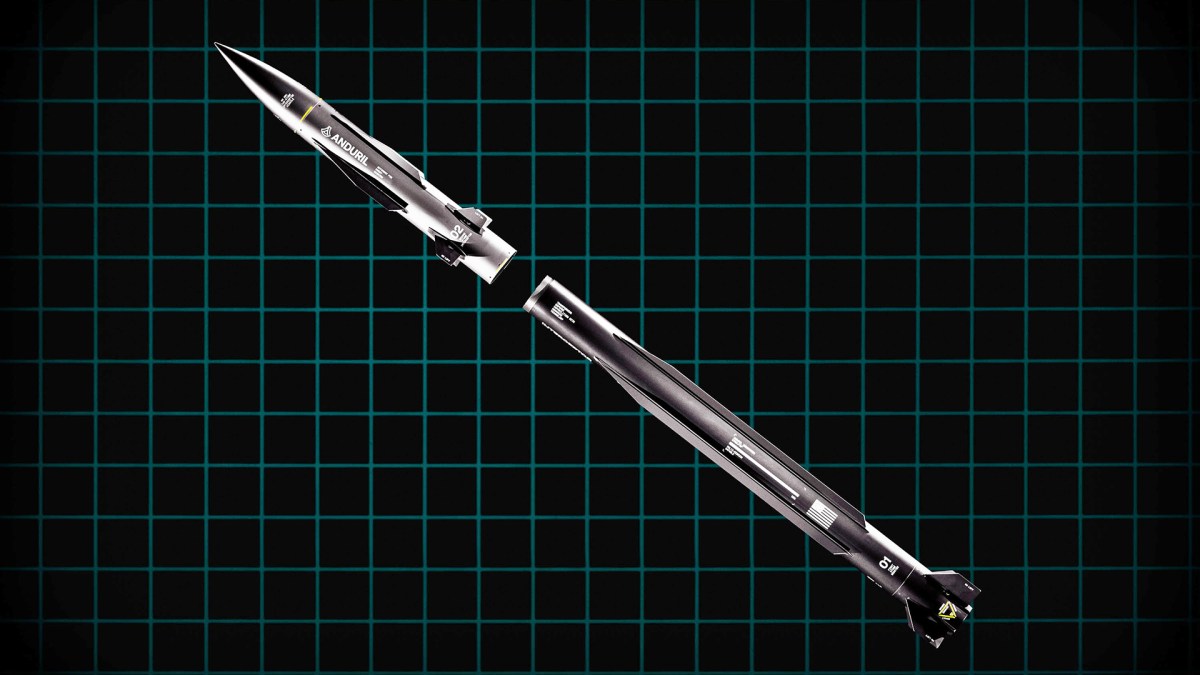
Anduril’s answer is a family of missiles built around a common two-stage design. The first stage consists of a booster, while the second is a terminal interceptor intended to share a baseline airframe, avionics, software, flight control system, and interfaces across variants. Different boosters and terminal-stage components would allow the company to tailor individual configurations to specific missions without developing an entirely new missile for each requirement. Both hit-to-kill and blast-fragmentation terminal-stage interceptors will be offered, Anduril says.
“It is an open system, so the ability to fly it with different rocket motors, different seekers, to be able to swap these components out, to be able to reconfigure the system for a range of different threats is a feature that we built into this,” explained Christian Brose, who serves as the president and chief strategy officer at Anduril. He was speaking to members of the media, including TWZ , ahead of the official unveiling of Steelfin.
The rear end of the booster stage of one of the Steelfin missiles. Anduril TREVOR DALTON
The company says the family is intended to cover missions ranging from point defense and lower-tier integrated air and missile defense to upper-tier ballistic missile defense. It also identifies cruise, ballistic, and hypersonic missiles among the threats the broader family is designed to address. Overall, is an extremely ambitious goal, and something that has not been attempted previously to this degree.
The announcement does not specify which variants would address individual threats or provide engagement envelopes and performance figures with which to assess those claims.
Brose did clarify that the different ranges that the various Steelfin variants will achieve will be based on the booster sizing. “Right now, we’re looking at integrating on 10-inch, 18-inch, and 21-inch boosters, but we’re also looking at quad pack and dual pack for the Mk 41 Vertical Launch System as well for different installations, which imply different range and altitudes.”
A sailor aboard the guided missile destroyer USS Fitzgerald inspects the Mk 41 Vertical Launching System (VLS). U.S. Navy photo by Photographer’s Mate Airman Adam York (RELEASED) A Sailor aboard the guided-missile destroyer USS Fitzgerald (DDG-62) inspects the MK 41 Vertical Launching System (VLS) for water to prevent electrical failure. The MK 41 Vertical Launching System (VLS) is a canister launching system, which provides a rapid-fire launch capability against hostile threats. (U.S. Navy photo by Photographer’s Mate Airman Adam York)
Anduril’s emphasis on commonality is also intended to address the industrial challenges associated with conventional interceptor production. Different missile programs traditionally require specialized tooling, manufacturing processes, suppliers, and facilities, limiting opportunities to shift production rapidly as operational requirements change.
Steelfin variants are intended to use shared production lines and equipment, with mission-specific boosters and terminal-stage components incorporated during final assembly. Anduril says this would allow manufacturing capacity to be redirected toward whichever variant is in greatest demand. The company is planning near-term production on the order of several thousand missiles annually, with capacity designed to expand or shift according to requirements.
That remains a production ambition, and Anduril has not provided a detailed production schedule or contracted quantities demonstrating how quickly it could reach that scale.
The company also says Steelfin is designed to be compatible with existing land- and sea-based launch infrastructure, including the M903A2 launcher used by newer PAC-3 series interceptors , the Mk 41 Vertical Launch System , and Typhon , as well as emerging containerized launchers. It cites compatibility with established fire-control systems, including AEGIS and the Army’s Integrated Battle Command System (IBCS).
A graphic showing various load configurations for the M903 launcher, as compared to the previous M901 and M902 launchers. Lockheed Martin
When it comes to cost, Steve Milano, the lead for Air Dominance & Strike at Anduril, suggested that the “more exquisite version” of the Steelfin would sit somewhere above the PAC-3 MSE and below THAAD, but would accomplish “100 percent of the THAAD mission at a fraction of the cost.” In a different configuration, tailored for the PAC-3-type mission, Steelfin would accomplish 80 percent of that mission at less than 50 percent of the cost, Milano added.
While THAAD is aimed at taking out short, medium, and intermediate-range ballistic missiles in the terminal phase of flight, PAC-3 provides high-altitude, hit-to-kill air and missile defense against tactical ballistic missiles, cruise missiles, and aircraft.
Milano continued: “Looking at the lower end of the the spectrum, as far as low-cost interceptors are concerned, I just saw an article on the [aircraft carrier USS Abraham ] Lincoln coming back with all of the Shahed markings on the side, and I was contemplating the number of SM-2s that were fired against those assets. When I think of that cost exchange, the Steelfin enters into that market and provides greater than 80 percent of the capability of an SM-2 for a third of the cost.”
For reference, a single THAAD interceptor costs around $15.5 million. The unit price of each PAC-3 MSE interceptor now stands at approximately $5.3 million, according to the Army’s latest proposed budget for the 2027 Fiscal Year . Meanwhile, the price of a single SM-2 Block IIIC interceptor, the most advanced version of that missile currently in service, is around $2.5 million.
The test launch of a THAAD interceptor. U.S. Army (U.S. Army)
Steelfin is entering a market in which the U.S. military is already pursuing several approaches to expanding its low-cost interceptor inventory.
In May, the U.S. Army sought industry proposals for a Patriot-compatible interceptor with a target unit cost below $1 million. The effort reflects the service’s desire for a less expensive weapon for appropriate engagements, preserving higher-end interceptors for targets that warrant their cost and capabilities. The Army’s solicitation also emphasizes component-level cost targets and competition among suppliers, including for rocket motors, seekers, and guidance systems.
Lockheed Martin has offered a separate industry response with its PAC-3 Adapted Capability Effector (ACE), a lower-cost interceptor intended to operate within the Patriot ecosystem. Unveiled in July, the weapon is intended to cost less than half as much as the PAC-3 Missile Segment Enhancement (MSE), according to the company. The MSE’s unit price is approximately $5.3 million in the Army’s fiscal 2027 budget request, putting the ACE’s implied price at around $2.5 million if Lockheed’s comparison holds.
A Patriot Advanced Capability-3 (PAC-3) missile is launched during an Integrated Battle Command System (IBCS) flight test at White Sands Missile Range. U.S. Army Darrell Ames
Its projected price would still be well above the Army’s separate sub-$1 million target, reflecting the different objectives and requirements behind the two efforts.
The Navy, meanwhile, is pursuing a potentially broader shift toward modular interceptor architectures. Its Naval Modular Missile initiative envisions a family of surface-to-air weapons built around a common Terminal Stage Interceptor, with different boosters and canisters producing configurations for different missions and platforms. The plans include variants intended to fit multiple missiles within a Mk 41 launcher cell, as well as a version designed for launch from Virginia class submarines equipped with the Virginia Payload Module .
The Navy’s longer-term vision is to replace its existing Standard Missile family with modular variants, although the effort remains in development. The concept highlights potential operational benefits beyond manufacturing: smaller interceptors could increase the number of weapons carried aboard ships, while other configurations could preserve longer-range capabilities. The Navy has also outlined an ambition to reach production of 1,000 missiles annually within five years of a contract award.
Both the Navy’s modular missile initiative and Steelfin reflect a push toward common architectures that can support multiple interceptor configurations without requiring an entirely new missile for every mission. Steelfin’s stated scope is particularly broad, with Anduril pitching the family for missions spanning point defense through lower-tier air and missile defense to upper-tier ballistic missile defense. That would cover much of the air and missile defense spectrum, although it does not extend to exoatmospheric midcourse interception. Whether the family can deliver that breadth of capability at the promised cost and scale remains to be demonstrated.
A rendering showing one of the Steelfin missiles. Anduril
Anduril says it has been developing Steelfin for several years with investment from multiple customers and has completed ballistic testing using representative air vehicles. Flight testing of Steelfin variants is planned for 2027.
Already, Anduril says it is working closely with “a number of different customers to to get into the field.” Brose continued: “We feel like this is going to be a critical component of the U.S. and allied inventories to complement the range of exquisite capabilities that all of us are familiar with and know by name.”
Steelfin underscores what is now a broader trend toward lower-cost interceptors that can be manufactured at scale, and plugged into existing ecosystems, often with at least a degree of modularity to tackle new and emerging target sets. Steelfin adds Anduril’s proposal to combine that modularity with a common production system designed to support thousands of weapons annually.
Anduril has yet to develop or produce a surface-to-air missile, although its Roadrunner system gives it experience in the related field of countering aerial threats, including loitering munitions . The company’s ambitions for Steelfin are significant, and modular architectures are certainly attractive. After all, a common baseline should simplify production, reduce costs, and allow interceptors to be tailored to different missions. In practice, however, realizing those benefits has historically proved difficult, and fraught with compromises. Whether Anduril can avoid those pitfalls while delivering the promised combination of capability, affordability, and production scale remains an open question. If it can, Steelfin could put the company in a strong position in the future surface-to-air missile market.
Contact the author: thomas@thewarzone.com
Comments couldn’t be loaded. Please refresh the page.
发布于美国东部时间2026年10月12日凌晨1:30
安杜里尔公司发布了“钢鳍”(Steelfin)系列地对空拦截导弹,该系列导弹采用通用架构和制造工艺,但可根据不同的防空和导弹防御任务进行配置。该公司表示,这种设计将使其能够以远低于现有武器的成本实现大规模生产,但尚未公布价格或详细的性能规格。
此次公告发布之际,美国军方正寻求扩充防空力量,以应对日益多样化的威胁,从廉价无人机到巡航导弹、弹道导弹以及包括高超音速导弹在内的先进机动武器。近期乌克兰和中东的经验清楚地表明,挑战不仅在于研发能够拦截这些目标的拦截器,还在于生产足够数量的拦截器以维持作战行动,同时又不至于耗尽更昂贵武器的库存。
一张公司效果图,展示了Steelfin系列产品第二阶段的前端设计。Anduril TREVOR DALTON
使用高端拦截器对抗相对廉价的威胁会迅速消耗有限的库存,尤其是在中东地区,即便交战是为了保护人员和关键基础设施,情况也是如此。如果能提供种类更丰富的防御性武器,以应对不同的威胁和交战需求,或许有助于减轻这种负担。
安杜里尔公司的答案是一系列基于通用两级设计的导弹。第一级是助推器,第二级是末端拦截器,旨在使不同型号的导弹共享基本弹体、航空电子设备、软件、飞行控制系统和接口。不同的助推器和末端组件将使该公司能够根据具体任务定制配置,而无需为每种需求开发全新的导弹。安杜里尔公司表示,将提供直接命中杀伤型和爆破破片型两种末端拦截器。
“这是一个开放式系统,因此我们将其设计成可以搭载不同的火箭发动机和导引头,可以更换这些组件,并能够针对各种不同的威胁重新配置系统,”Anduril公司总裁兼首席战略官克里斯蒂安·布罗斯解释道。在Steelfin正式发布前,他向包括TWZ在内的媒体发表了上述讲话。
“钢鳍”导弹助推器的尾部。安杜里尔·特雷弗·道尔顿
该公司表示,该系列导弹旨在涵盖从点防御和低层级综合防空反导到高层级弹道导弹防御等多种任务。该公司还指出,巡航导弹、弹道导弹和高超音速导弹也是该系列导弹旨在应对的威胁。总而言之,这是一个极其雄心勃勃的目标,此前从未有人尝试过如此规模的导弹系统。
该公告并未具体说明哪些变体将应对特定威胁,也没有提供交战范围和性能数据来评估这些说法。
布罗斯澄清说,不同型号的钢鳍火箭的射程将取决于助推器的尺寸。“目前,我们正在考虑集成10英寸、18英寸和21英寸的助推器,但我们也正在考虑为Mk 41垂直发射系统开发四联装和双联装助推器,以适应不同的安装方式,这意味着不同的射程和发射高度。”
一名水兵在导弹驱逐舰“菲茨杰拉德”号(USS Fitzgerald,DDG-62)上检查Mk 41垂直发射系统(VLS)。(美国海军摄影师亚当·约克拍摄,已发布)一名水兵在导弹驱逐舰“菲茨杰拉德”号(DDG-62)上检查Mk 41垂直发射系统(VLS)是否进水,以防止电气故障。Mk 41垂直发射系统(VLS)是一种筒式发射系统,可对敌方威胁进行快速发射。(美国海军摄影师亚当·约克拍摄)
安杜里尔强调通用性,也是为了应对传统拦截器生产中面临的工业挑战。不同的导弹项目通常需要专门的工具、制造工艺、供应商和设施,这限制了随着作战需求变化而快速调整生产的机会。
钢鳍系列导弹的衍生型号计划使用共享的生产线和设备,并在最终组装过程中集成特定任务的助推器和末级组件。安杜里尔公司表示,这将使产能能够根据需求量调整,以满足不同型号的需求。该公司计划近期年产量达到数千枚导弹,并可根据需求扩展或调整产能。
这仍然是安杜里尔公司的生产目标,但该公司尚未提供详细的生产计划或合同数量,以证明其能够多快达到该规模。
该公司还表示,Steelfin的设计与现有的陆基和海基发射基础设施兼容,包括新型PAC-3系列拦截弹使用的M903A2发射器、Mk 41垂直发射系统和Typhon导弹,以及新兴的集装箱式发射器。该公司还指出,Steelfin与现有的火控系统兼容,包括宙斯盾系统和陆军的综合作战指挥系统(IBCS)。
图示展示了M903发射器与之前的M901和M902发射器相比的各种装载配置。洛克希德·马丁公司
谈到成本,安杜里尔公司空中优势与打击项目负责人史蒂夫·米兰诺表示,更精良的“钢铁鳍”导弹系统性能将介于PAC-3 MSE和THAAD之间,但能以“THAAD的一小部分成本”完成THAAD的全部任务。米兰诺补充说,如果采用针对PAC-3任务量身定制的配置,“钢铁鳍”导弹系统则能以不到50%的成本完成PAC-3 80%的任务。
THAAD 的目标是在飞行末段摧毁短程、中程和中远程弹道导弹,而 PAC-3 则提供高空直接命中制导的空中和导弹防御,用于拦截战术弹道导弹、巡航导弹和飞机。
米兰诺继续说道:“就低成本拦截导弹而言,我刚看到一篇关于‘亚伯拉罕·林肯’号航空母舰的文章,舰体侧面布满了‘沙赫德’导弹的标志。我不禁想到,究竟有多少枚SM-2导弹曾攻击过这些目标。考虑到成本,‘钢鳍’导弹进入这个市场后,以三分之一的成本提供了SM-2导弹80%以上的性能。”
作为参考,一枚THAAD拦截弹的成本约为1550万美元。根据陆军最新提出的2027财年预算,PAC-3 MSE拦截弹的单价约为530万美元。与此同时,目前服役的SM-2 Block IIIC拦截弹(该导弹的最新版本)的单价约为250万美元。
THAAD拦截系统的试射。美国陆军(US Army)
Steelfin 正在进入一个美国军方已经采取多种方法来扩大其低成本拦截器库存的市场。
今年5月,美国陆军向业界征集与“爱国者”导弹系统兼容的拦截导弹方案,目标单价低于100万美元。此举体现了陆军希望在合适的作战环境中使用价格更低的武器,同时将高端拦截导弹用于那些真正需要其成本和性能的目标。陆军的招标还强调了零部件层面的成本目标以及供应商之间的竞争,包括火箭发动机、导引头和制导系统等。
洛克希德·马丁公司推出了另一款业界解决方案——PAC-3 适应性能力效应器 (ACE),这是一款成本更低的拦截器,旨在与“爱国者”导弹系统兼容。据该公司称,这款武器于7月发布,其成本预计不到PAC-3导弹段增强型 (MSE) 的一半。根据陆军2027财年的预算申请,MSE的单价约为530万美元,如果洛克希德·马丁公司的说法属实,那么ACE的隐含价格约为250万美元。
在白沙导弹靶场进行的一次综合作战指挥系统(IBCS)飞行测试中,一枚“爱国者”先进能力-3型(PAC-3)导弹发射升空。美国陆军达雷尔·艾姆斯
预计其价格仍将远高于陆军单独设定的低于 100 万美元的目标,这反映了这两项工作的目标和要求各不相同。
与此同时,海军正在推进一项可能更为广泛的模块化拦截器架构转型。其海军模块化导弹计划设想构建一系列以通用末端拦截器为核心的地对空武器,通过不同的助推器和发射筒来实现针对不同任务和平台的配置。该计划包括旨在将多枚导弹装入Mk 41发射单元的变型,以及专为配备弗吉尼亚有效载荷模块的弗吉尼亚级潜艇设计的发射版本。
海军的长期愿景是用模块化改进型导弹取代现有的标准导弹系列,尽管这项工作仍在研发中。这一概念凸显了除制造成本之外的潜在作战优势:更小的拦截导弹可以增加舰载武器的数量,而其他配置则可以保持更远的射程。海军还制定了一项雄心勃勃的目标,即在合同授予后的五年内实现年产1000枚导弹。
海军的模块化导弹计划和“钢鳍”(Steelfin)导弹都体现了向通用架构发展的趋势,这种架构能够支持多种拦截器配置,而无需为每项任务都研发全新的导弹。“钢鳍”导弹的适用范围尤其广泛,安杜里尔公司(Anduril)宣称该系列导弹可用于从点防御、低层防空反导到高层弹道导弹防御等各种任务。这几乎涵盖了防空反导领域的全部范围,但并不包括大气层外中段拦截。该系列导弹能否以承诺的成本和规模实现如此广泛的作战能力,还有待验证。
一张渲染图,展示了其中一枚“钢鳍”导弹。安杜里尔
Anduril公司表示,在多家客户的投资下,该公司已对Steelfin导弹进行了数年的研发,并已使用代表性飞行器完成了弹道测试。Steelfin导弹各衍生型号的飞行测试计划于2027年进行。
Anduril公司表示,他们已经与“多家不同的客户密切合作,以进入该领域”。Brose补充道:“我们认为这将成为美国及其盟国库存的关键组成部分,以补充我们都熟悉并熟知的各种精良能力。”
Steelfin 凸显了当前更广泛的趋势,即生产成本更低、可大规模制造并能融入现有生态系统的拦截器,这些拦截器通常至少具备一定程度的模块化,以应对新的和不断涌现的目标。Steelfin 还采纳了 Anduril 的提议,即结合这种模块化设计,构建一个能够支持每年数千枚武器生产的通用生产系统。
安杜里尔公司尚未研发或生产地对空导弹,尽管其“走鹃”(Roadrunner)系统使其在应对空中威胁(包括巡飞弹)方面积累了相关经验。该公司对“钢鳍”(Steelfin)导弹的雄心壮志显而易见,模块化架构无疑极具吸引力。毕竟,通用基座应能简化生产、降低成本,并使拦截器能够根据不同任务进行定制。然而,在实践中,实现这些优势历来困难重重,且往往需要做出诸多妥协。安杜里尔能否在实现性能、价格和生产规模等承诺的同时,避免这些陷阱,目前仍是一个未知数。如果能够做到,“钢鳍”导弹将使该公司在未来的地对空导弹市场占据有利地位。
联系作者:thomas@thewarzone.com
评论加载失败,请刷新页面。