Iranians worry over American military buildup as last-chance round of talks with US nears随着与美国最后一轮谈判临近,伊朗人对美国的军事集结感到担忧。
As Iranians await the outcome of the Geneva talks on Thursday, many fear the outbreak of a war that could surpass Iran’s bloody 1980s conflict with Iraq.
DUBAI, United Arab Emirates — As the United States assembles its greatest military firepower in decades in the Middle East, Iranians are warily awaiting the next round of talks with the U.S. in Geneva this week — negotiations that many see as a last chance for their ruling theocracy to strike a deal with U.S. President Donald Trump.
Some say the situation feels hopeless. Battered by decades of sanctions, heightened by Trump’s 2018 decision to withdraw from Tehran’s nuclear deal with world powers, Iranians also just suffered through the bloodiest crackdown on dissent in the country’s modern history as security forces in January killed thousands of people and detained tens of thousands more.
Now, as they await the outcome of the Geneva talks on Thursday, many fear the outbreak of a war that could surpass Iran’s bloody 1980s conflict with Iraq.
But while that conflict sparked a patriotic response from Iranian volunteers, the prospects of a war with the U.S. have riven a population that still includes hardline supporters of the country’s theocracy as well as those who feel Iran is splitting at the seams.
“Every morning when I get up, my brain is full of chaos,” said Sepideh Bafarani, a 29-year-old woman who works in a woman’s clothing store. “It’s a possible war ... and an ongoing bad economic situation.”
Rasool Razzaghi, a 54-year-old resident in Tehran, the Iranian capital, summed up the approaching talks with a similar concern.
“I predict that if both sides really mean what they are saying, a war will start,” he said.
Trump’s ‘armada’ is getting closer
For weeks, Trump has talked about an “armada” that is now largely in place off the coast of Iran, including the aircraft carrier USS Abraham Lincoln. He has also sent the USS Gerald R. Ford , the world’s largest aircraft carrier, from the Caribbean toward the Mideast.
Overall, there are at least 16 U.S. Navy ships assembled, according to an analysis by the Washington-based Center for Strategic and International Studies.
That’s comparable to Operation Desert Fox in 1998, when American and British forces bombed Iraq for four days over Saddam Hussein’s refusal to comply with U.N. Security Council resolutions about weapons inspections. Between the carriers and aircraft on the ground in Jordan, there are also stealth F-35 fighters and other warplanes capable of launching a major attack on Iran.
Meanwhile, the CIA published instructions in Farsi online on how Iranians can securely contact the spy agency.
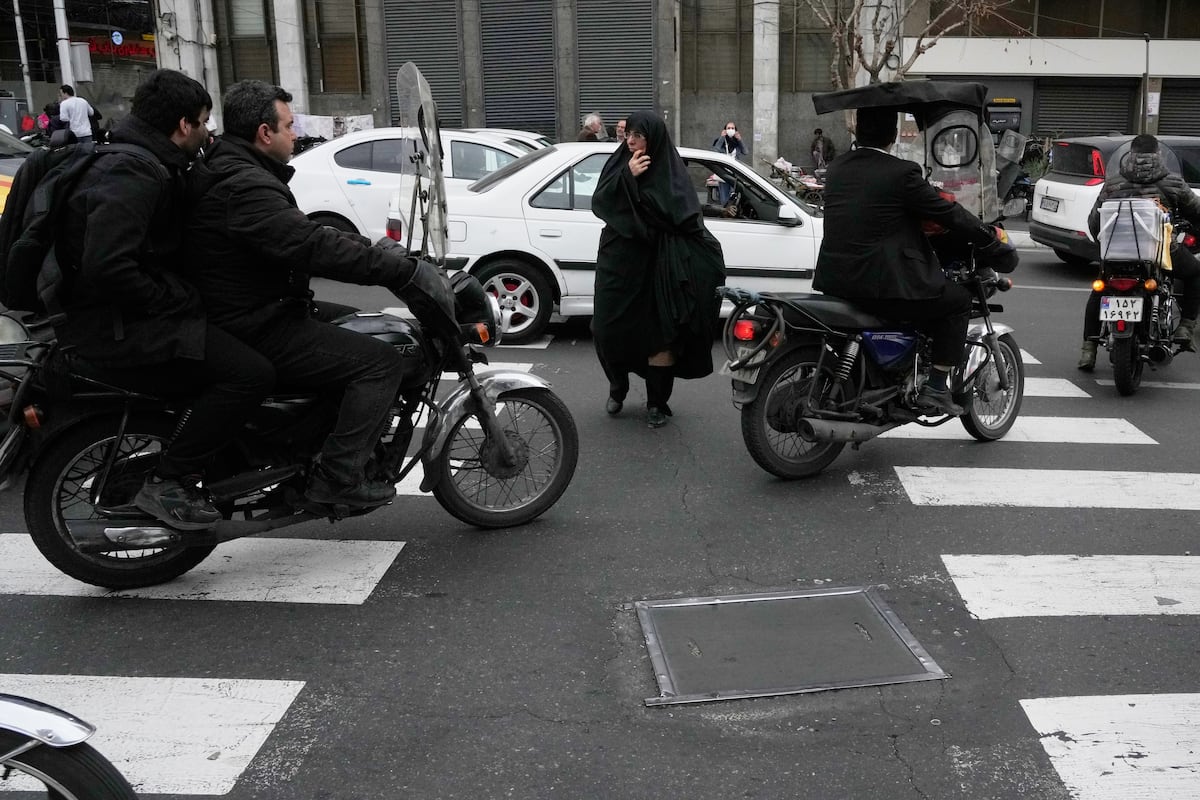
People drive their motorbikes in a square in downtown Tehran, Iran, Feb. 24, 2026. (Vahid Salemi/AP)
Iranians have been watching the buildup with growing concern, either by surreptitiously getting around internet restrictions or watching satellite news channels. Iranian state television has kept showing the country’s military running drills and its leaders threatening massive retaliation against any American assault.
Iranian state TV on Tuesday said the country’s Revolutionary Guard held a drill that included launching missiles, flying drones and firing guns at targets along its coast, without elaborating on the exact time or place of the exercise.
“I don’t know. I’m not so optimistic,” a passer-by told The Associated Press on Tuesday in Tehran, declining to give his name for fear of reprisals. ”It’s not an equal situation. One side has entered the talks with a lot of power, it has lot of equipment. On the other hand, Iran is in a weak position. They want total surrender, but I think that’s not viable.”
Steve Witkoff, the billionaire friend of Trump now serving as his special Mideast envoy, has said the president didn’t understand why Iran “hadn’t capitulated” given the forces arrayed against it in the region and beyond in Europe. Iranian Foreign Minister spokesman Esmail Baghaei dismissed Witkoff’s comments on Monday, saying “the word ‘capitulation’ does not exist in the Iranians’ dictionary.”
Even looking beyond the public statements, it remains unclear just what Iran could offer Trump. Tehran has insisted it wants to continue enriching uranium, something Trump has repeatedly said must stop. It also has refused to discuss its ballistic missile arsenal or its support of regional proxy forces, another Trump demand.
‘Everybody is worried’
It remains difficult to speak to people in Iran as the internet and telephone lines remain disrupted following last month’s nationwide protests. On the streets of Tehran, many people remain suspicious of talking to journalists, assuming reporters all work for the government. Iran’s theocracy controls all radio and TV stations in the country.
Those who did talk with the AP kept mentioning the 1980s war with Iraq, a cataclysmic event in the mind of those old enough to remember it.
“I remember many bad situations but even during Iran-Iraq war in 1980s it was not like this,” said Hassan Mirzaei, a 68-year-old taxi driver. “I am in shock without any hope — especially when there is word about war.”
He added: “I have two orphaned grandchildren, and I need to work to feed.”
“Everybody is worried because (of) the consequences of war with a country like America,” said the Tehran passer-by. “We once fought Iraq for eight years, but it was a country at the same level with us. Going to war with America, Israel and NATO will have very horrible and unpredictable consequences. ”
“What can we do,” he added. “We can’t leave our country. We have no choice but to adapt.”
However, not everyone is opposed to Iran’s government. Ami Mianji, a 33-year-old who runs an auto repair shop, described Iranians as a brave people who are not afraid of war.
“I do not care about threats by Trump and others, eventually Iranians will push back any warmonger,” Mianji said.
But for many young people, the crackdown on the demonstrations have broken whatever trust they had for the country’s government.
“I have no hope,” said one student who spoke to the AP on condition of anonymity also fearing reprisals. “Iran is refusing to back down from its positions for sure, because if it does, it would have officially given up its 40-year-old ideology.”
“I have no hope,” he added. “The leaders of both countries speak often and none of them is willing to concede to reach a deal. So the likelihood for war is high.”
阿联酋迪拜——随着美国在中东集结数十年来最强大的军事力量,伊朗人正警惕地等待着本周在日内瓦举行的下一轮与美国的谈判——许多人认为这是伊朗神权统治政权与美国总统唐纳德·特朗普达成协议的最后机会。
有人说,伊朗的处境令人绝望。数十年的制裁令伊朗雪上加霜,2018年特朗普决定退出伊朗与世界大国达成的核协议更是加剧了这种困境。此外,伊朗人民刚刚经历了该国现代史上最血腥的镇压异议事件:今年1月,安全部队杀害了数千人,并拘留了数万人。
现在,在等待周四日内瓦会谈结果之际,许多人担心爆发一场战争,其规模可能会超过伊朗在 20 世纪 80 年代与伊拉克发生的血腥冲突。
虽然那场冲突激发了伊朗志愿者的爱国热情,但与美国开战的前景却使伊朗民众四分五裂,其中既包括该国神权统治的强硬派支持者,也包括那些认为伊朗正在分崩离析的人。
“每天早上醒来,我的脑子里都乱成一团,”29岁的塞皮德·巴法拉尼说道,她在一家女装店工作。“一场可能的战争……以及持续糟糕的经济形势。”
居住在伊朗首都德黑兰的 54 岁居民 Rasool Razzaghi 对即将举行的会谈表达了类似的担忧。
“我预测,如果双方都言出必行,战争将会爆发,”他说。
特朗普的“舰队”越来越近了。
数周以来,特朗普一直在谈论一支目前已基本部署在伊朗沿海的“舰队”,其中包括“亚伯拉罕·林肯”号航空母舰。他还派遣了世界上最大的航空母舰“杰拉尔德·R·福特”号从加勒比海驶往中东。
根据位于华盛顿的战略与国际研究中心的分析,目前至少有 16 艘美国海军舰艇集结完毕。
这与1998年的“沙漠之狐”行动类似,当时美英军队因萨达姆·侯赛因拒绝遵守联合国安理会关于武器核查的决议而对伊拉克进行了为期四天的轰炸。除了部署在约旦的航母和地面飞机外,还有隐形F-35战斗机和其他能够对伊朗发动大规模袭击的战机。
与此同时,美国中央情报局在网上发布了波斯语版的说明,指导伊朗人如何安全地与该间谍机构联系。
2026年2月24日,人们在伊朗德黑兰市中心的一个广场上骑摩托车。(Vahid Salemi/AP)
伊朗民众密切关注着事态发展,忧心忡忡,他们或偷偷绕过网络限制,或收看卫星新闻频道。伊朗国家电视台不断播放该国军队进行军事演习的画面,其领导人也威胁要对任何美国的进攻进行大规模报复。
伊朗国家电视台周二报道称,该国革命卫队举行了一次演习,包括发射导弹、操控无人机和向沿海目标开火,但没有详细说明演习的具体时间和地点。
“我不知道。我不太乐观,”一位路人在周二于德黑兰告诉美联社,他因担心遭到报复而拒绝透露姓名。“双方实力并不对等。一方带着强大的实力和大量的装备进入谈判。而伊朗则处于弱势。他们想要彻底投降,但我认为这行不通。”
特朗普的亿万富翁朋友、现任中东特使史蒂夫·威特科夫表示,鉴于伊朗在中东地区乃至欧洲面临的强大阻力,总统不理解伊朗为何“没有投降”。伊朗外交部长发言人伊斯梅尔·巴盖伊周一驳斥了威特科夫的言论,称“伊朗人的字典里没有‘投降’这个词”。
即使抛开公开声明不谈,伊朗究竟能向特朗普提供什么,仍然不明朗。德黑兰一直坚持要继续进行铀浓缩活动,而特朗普则多次表示必须停止这种活动。伊朗也拒绝讨论其弹道导弹武库或其对地区代理人武装的支持,而这正是特朗普的另一项要求。
“大家都很担心”
由于上个月全国性抗议活动导致网络和电话线路中断,与伊朗民众沟通仍然十分困难。在德黑兰街头,许多人仍然对记者抱有戒心,认为所有记者都为政府效力。伊朗的神权政体控制着该国所有的广播和电视台。
那些接受美联社采访的人不断提到上世纪 80 年代的伊拉克战争,对于那些有幸经历过这场战争的人来说,那是一场灾难性的事件。
“我记得很多糟糕的情况,但即使是上世纪80年代的两伊战争,情况也远没有现在这样,”68岁的出租车司机哈桑·米尔扎伊说。“我感到震惊,看不到任何希望——尤其是在听到战争的消息时。”
他补充说:“我有两个孤儿孙子,我需要工作养活他们。”
“每个人都担心与美国这样的国家开战的后果,”一位路过的德黑兰市民说道。“我们曾经与伊拉克打了八年仗,但伊拉克和我们实力相当。与美国、以色列和北约开战将会带来非常可怕且难以预料的后果。”
他补充说:“我们能怎么办呢?我们不能离开自己的国家。我们别无选择,只能适应。”
然而,并非所有人都反对伊朗政府。33岁的阿米·米安吉经营着一家汽车修理店,他形容伊朗人是一个勇敢的民族,不惧战争。
米安吉说:“我不在乎特朗普和其他人发出的威胁,伊朗人最终会反击任何战争贩子。”
但对许多年轻人来说,镇压示威活动彻底摧毁了他们对国家政府仅存的一点信任。
“我毫无希望,”一位不愿透露姓名的记者告诉美联社,他也担心遭到报复。“伊朗肯定不会放弃自己的立场,因为一旦放弃,就等于正式放弃了它奉行了40年的意识形态。”
“我毫无希望,”他补充道。“两国领导人经常通话,但谁也不愿意做出让步达成协议。因此,战争爆发的可能性很高。”