Singapore government worried AI may break 'bottom rung' of career ladder for young workers: PM Wong新加坡政府担忧人工智能可能打破年轻劳动者职业阶梯的“底层”:总理黄循财
“AI will replace all of that routine work, but we should be careful not to automate away the learning that comes from it,” says Prime Minister Lawrence Wong.
“AI will replace all of that routine work, but we should be careful not to automate away the learning that comes from it,” says Prime Minister Lawrence Wong.
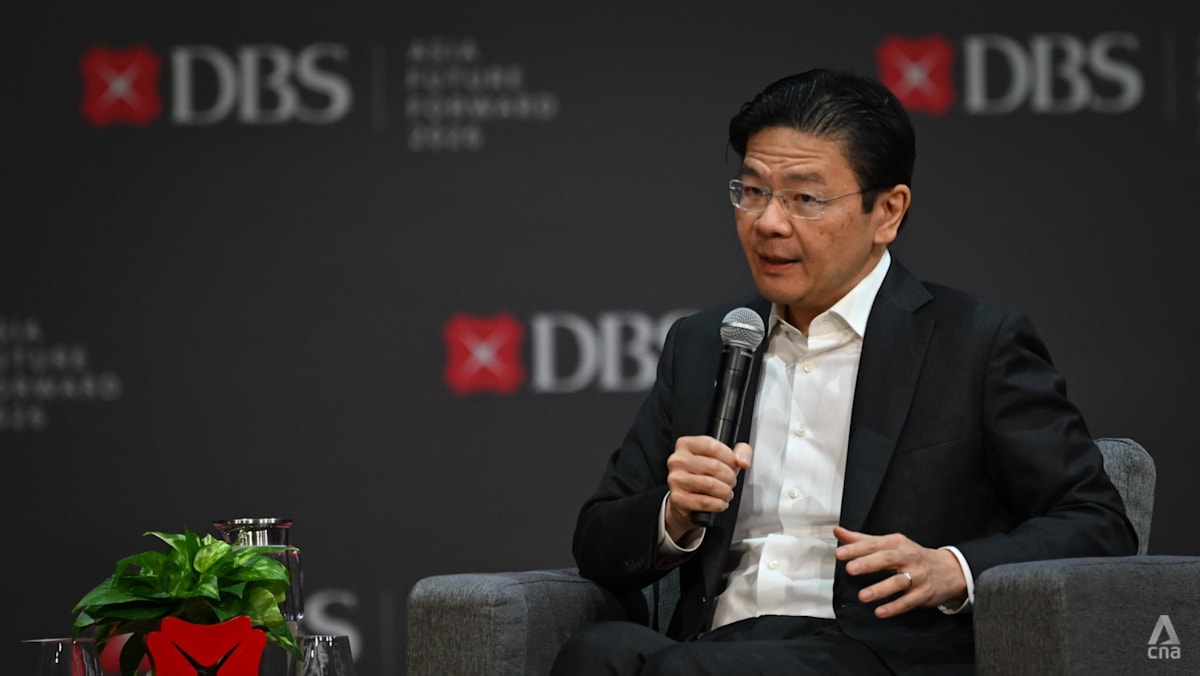
Prime Minister Lawrence Wong speaking at the DBS Asia Future Forward Conference on Oct 12, 2026. (Photo: CNA/Syamil Sapari)
This audio is generated by an AI tool.
SINGAPORE: The government is concerned that artificial intelligence may be breaking the “bottom rung” of the career ladder, leaving young workers with too little training, Prime Minister Lawrence Wong said on Monday (Oct 12).
Speaking in a dialogue with DBS Group chief executive Tan Su Shan at the bank’s Asia Future Forward conference, Mr Wong said the government is studying the training and mentoring of young workers across sectors. The two also discussed global market uncertainty, energy supply amid advances in the technology, and Singapore’s relevance to businesses and other countries.
Mr Wong recalled taking notes, drafting speeches and preparing slides for his superiors as a young civil servant, and said that there is value in this learning process.
“AI will replace all of that routine work, but we should be careful not to automate away the learning that comes from it,” he said, calling on employers to be more deliberate about training and mentoring young workers.
“We are concerned that there may be that bottom rung of the career ladder that’s broken and young people may not get sufficient training.”
The government is exploring whether new schemes are needed to get companies to pay attention to this, said Mr Wong, who is also finance minister.
A Ministry of Manpower report in April found that among Singapore companies that had adopted AI, 6.2 per cent reported reduced headcount and another 8.5 per cent reported lower hiring activity .
Most of the other companies said they had redesigned jobs, created new AI-related jobs or redeployed workers to new roles, among other moves.
The government wants employers to harness AI fully to enjoy the productivity benefits, said Mr Wong. “But we also want to make sure that employers pay attention to training and continue to nurture the next generation.”
WHAT SINGAPORE WILL NOT COMPROMISE ON
Asked about Singapore’s "non-negotiables" as it embraces technology, Mr Wong said AI and technology should benefit all Singaporeans.
“We are not doing technology at all costs,” he added. “We are not trying to be an AI-driven society. We are trying to be a better society enabled by AI.”
Singapore will also not compromise critical systems, sensitive information or human responsibility, said the prime minister, stressing that humans should ultimately make the critical decisions.
INTERNATIONAL STANDARDS FOR AI
Mr Wong also spoke about Singapore’s decision to back the international call for stronger safeguards for frontier AI amid greater scrutiny of the technology’s risks. He said such moves reflect a growing recognition that while AI can bring tremendous benefits for humanity, people are also more worried about losing control of these powerful systems.
On Sep 12, Anthropic’s Dario Amodei called on AI firms to slow down development, warning that building it too fast was "reckless". Top AI companies' executives, including OpenAI chief Sam Altman and xAI's Elon Musk, backed his push for a slowdown.
After meeting with top tech executives at the White House, US President Donald Trump said on Sep 29 that they had agreed to establish voluntary standards for AI.
Mr Wong welcomed the move on Monday, even though the leading AI labs do not all agree on what form the standards should take.
“Even if it’s voluntary at first, I think it’s a good start,” he said.
The standards could be built up progressively, he added, raising ideas such as an independently appointed international governing board and an independent audit process.
“If investors, customers and the marketplace also recognise these standards, then it will give even more incentive for the frontier labs to participate,” said Mr Wong.
Ideally, international rules on developing AI safely should be put in place, he said, noting that similar standards apply in other industries like aviation, finance and nuclear power.
“Can this happen with AI? Possibly, in theory, yes. Realistically in the near term? Not likely to happen.”
NEW REGIONAL FRAMEWORK
Mr Wong and Ms Tan also discussed the Digital Economy Framework Agreement (DEFA), which is set to be signed at the 49th Association of Southeast Asian Nations (ASEAN) Summit in November.
As the first such regional agreement, it sets out rules for data, payments, digital trade and AI across the 11 ASEAN member states.
Describing the agreement as “an attempt to make ASEAN’s digital economy work better”, Mr Wong pointed out that many businesses in the region know that it is currently fragmented, with different rules, systems and requirements across countries.
“It can be very frustrating,” he added. “Hopefully with DEFA, we can reduce the barriers, facilitate more data flows and allow more cross-border digital trade,” he said, noting that more will need to be done to translate the agreement into practical benefits for companies.
CNA Games Guess Word Crack the word, one row at a time Buzzword Create words using the given letters Mini Sudoku Tiny puzzle, mighty brain teaser Mini Crossword Small grid, big challenge Word Search Spot as many words as you can Show More Show Less
Get our pick of top stories and thought-provoking articles in your inbox
Stay updated with notifications for breaking news and our best stories
Join our channel for the top reads for the day on your preferred chat app
“人工智能将取代所有这些例行工作,但我们应该小心,不要让自动化消除从中汲取的经验教训,”总理黄循财说。
2026年10月12日,黄循财总理在星展银行亚洲未来展望大会上发表讲话。(图片:CNA/Syamil Sapari)
这段音频由人工智能工具生成。
新加坡:总理黄循财周一(10月12日)表示,政府担心人工智能可能会打破职业阶梯的“底层”,导致年轻员工缺乏足够的培训。
在星展银行举办的“亚洲未来展望”大会上,黄先生与星展集团首席执行官陈素珊展开对话。黄先生表示,政府正在研究各行业青年员工的培训和指导。双方还探讨了全球市场的不确定性、科技进步背景下的能源供应问题,以及新加坡对企业和其他国家的重要性。
黄先生回忆起自己年轻时当公务员时,曾为上级做笔记、起草演讲稿和准备幻灯片,并表示这种学习过程很有价值。
“人工智能将取代所有这些例行工作,但我们应该小心,不要让自动化消除从中获得的学习机会,”他说道,并呼吁雇主更加重视对年轻员工的培训和指导。
“我们担心职业阶梯的最底层可能出现了问题,导致年轻人无法获得足够的培训。”
黄之锋表示,政府正在探讨是否需要新的方案来促使企业重视这个问题。黄之锋同时也是财政部长。
新加坡人力部 4 月份的一份报告显示,在采用人工智能的新加坡公司中,6.2% 的公司报告员工人数减少,另有 8.5% 的公司报告招聘活动减少。
其他大多数公司表示,他们采取了包括重新设计工作岗位、创造新的人工智能相关工作岗位或将员工重新部署到新岗位等措施。
黄先生表示,政府希望雇主充分利用人工智能来提高生产力。“但我们也希望确保雇主重视培训,并继续培养下一代人才。”
新加坡绝不妥协的原则
当被问及新加坡在拥抱科技方面有哪些“不可妥协的原则”时,黄先生表示,人工智能和科技应该造福所有新加坡人。
他补充道:“我们并非不惜一切代价发展技术,也并非试图成为一个人工智能驱动的社会,而是试图成为一个借助人工智能而变得更美好的社会。”
新加坡总理表示,新加坡也不会在关键系统、敏感信息或人的责任方面做出妥协,并强调最终应该由人来做出关键决定。
人工智能国际标准
黄先生还谈到新加坡决定支持国际社会呼吁加强对前沿人工智能的监管,因为这项技术的风险正受到越来越严格的审查。他表示,这些举措反映出人们日益认识到,虽然人工智能可以为人类带来巨大的福祉,但人们也越来越担心会失去对这些强大系统的控制。
9月12日,Anthropic公司的达里奥·阿莫迪呼吁人工智能公司放慢研发速度,警告称开发速度过快是“鲁莽的”。包括OpenAI首席执行官萨姆·奥特曼和xAI创始人埃隆·马斯克在内的多家顶级人工智能公司高管都支持他提出的放慢研发速度的呼吁。
美国总统唐纳德·特朗普在白宫与顶尖科技公司高管会面后,于9月29日表示,他们已同意制定人工智能的自愿性标准。
黄先生周一表示欢迎这一举措,尽管领先的人工智能实验室对于标准应采取何种形式尚未达成一致。
“即使一开始是自愿的,我认为这也是一个好的开始,”他说。
他补充说,这些标准可以逐步建立起来,并提出了诸如设立独立任命的国际管理委员会和独立的审计程序等想法。
黄先生表示:“如果投资者、客户和市场也认可这些标准,那么这将更有动力激励前沿实验室参与其中。”
他表示,理想情况下,应该制定关于安全开发人工智能的国际规则,并指出类似的标准也适用于航空、金融和核电等其他行业。
“人工智能能做到这一点吗?理论上或许可以。但短期内实际发生的可能性不大。”
新的区域框架
黄先生和陈女士还讨论了数字经济框架协议(DEFA),该协议将于11月举行的第49届东南亚国家联盟(东盟)峰会上签署。
作为首个此类区域协议,它为东盟 11 个成员国的数据、支付、数字贸易和人工智能制定了规则。
黄先生将该协议描述为“旨在使东盟数字经济更好地运作的尝试”,并指出该地区的许多企业都知道,目前东盟数字经济处于分散状态,各国规则、系统和要求各不相同。
他补充说:“这可能会非常令人沮丧。”他表示:“希望通过DEFA协议,我们能够减少壁垒,促进更多数据流动,并允许更多跨境数字贸易。”他还指出,要将该协议转化为企业的实际利益,还需要做更多的工作。
CNA游戏 猜词游戏 逐行破解单词 流行词游戏 用给定的字母组成单词 迷你数独 小小谜题,挑战你的大脑 迷你填字游戏 小方格,大挑战 单词搜索 尽可能多地找出单词 显示更多 显示更少
订阅我们的邮件,即可获取精选热点新闻和引人深思的文章。
订阅通知,第一时间获取突发新闻和精彩报道。
加入我们的频道,即可在您常用的聊天应用上获取当日热门文章。