Govts must incentivise private sector to hire fresh grads amid declining entry roles: Tharman尚达曼:鉴于入门级职位减少,政府必须激励私营部门雇用应届毕业生。
Tertiary education systems must also shift towards applied learning, with work-study programmes, attachments and internships. Read more at straitstimes.com.
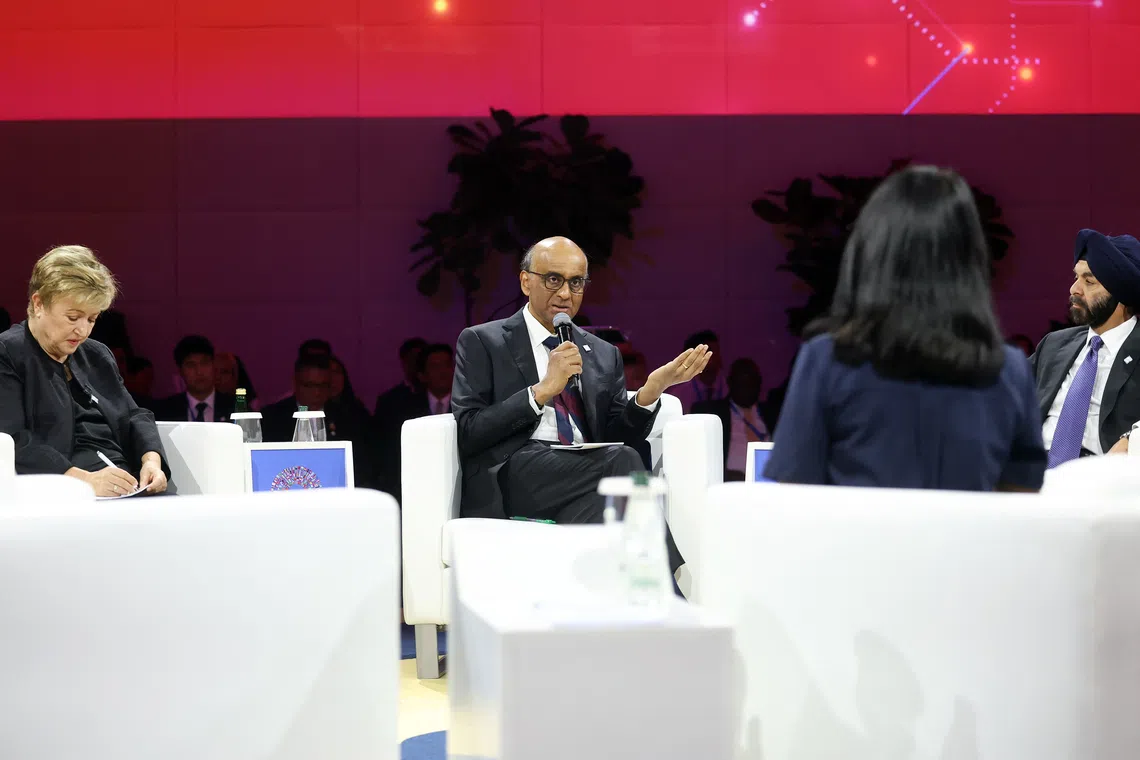
President Tharman Shanmugaratnam (centre) with IMF managing director Kristalina Georgieva (left), and World Bank Group president Ajay Banga at the panel discussion on jobs and AI on Oct 12.
Published Oct 12, 2026, 07:54 PM
Updated Oct 12, 2026, 07:56 PM
Governments must help private firms hire fresh graduates as AI cuts entry-level jobs. Tharman said this needs lasting public-private action, not short-term crisis measures.
Universities must shift from academic study to applied learning. He called for more work-study, internships and attachments to protect career paths and skills.
AI could both disrupt jobs and create new ones, especially through “Small AI”. Panellists said countries should act now on education, taxes and access to adapt to the “slow moving tsunami”.
BANGKOK – With global hiring for entry-level roles falling due to disruption by artificial intelligence, governments will have to partner the private sector to encourage the hiring of fresh graduates, said President Tharman Shanmugaratnam on Oct 12.
Tertiary education systems must also shift their academic focus towards applied learning through work-study programmes, attachments and internships, he added.
President Tharman was speaking during a panel discussion on AI and jobs on the sidelines of the annual International Monetary Fund (IMF) and World Bank Group meetings in Bangkok.
The discussion, which also featured IMF managing director Kristalina Georgieva and World Bank Group president Ajay Banga, focused on how developing countries can harness Small AI – affordable applications built for local languages, infrastructure and budgets – to drive growth and employment.
Noting that the advent of AI was in its early days , President Tharman said: “This is not a one-off shock. This is a whole new era.”
While economic growth remains critical to securing good jobs, growth alone will no longer be sufficient, as shown by the weak job creation in countries such as China and India which are growing quite well, he noted.
AI will widen this divergence between growth and job creation if the world is too passive about how it deals with the technology, he added.
“We’ve got to do everything we can to, first, use AI to create good jobs, and second, to create jobs that can be done well by humans despite AI,” he said.
An urgent task is for governments to address the issue of disappearing “first-rung” employment – the entry-level jobs where fresh graduates traditionally gain experience.
Such jobs have been declining, particularly in the most AI-exposed sectors such as technology and across other sectors, said President Tharman.
He urged governments to work with the private sector to ensure fresh graduates can land their first job and build a pathway to a career ladder.
These will have to be structural measures rather than temporary crisis responses like those rolled out during the Covid-19 pandemic and the Global Financial Crisis, he said.
Such public-private collaboration should give fresh graduates the first foothold in the labour market where they can learn on the job.
“We can’t afford to lose that. Because if you lose that, and a cohort of young people waits, say, a year before getting a job, you are not only then competing with the next cohort the following year, you also lose skills, you lose intangible aptitudes, and you lose trust in the future,” he said.
At the same time, universities and tertiary institutions, which are now “overwhelmingly academically focused”, will have to adapt to the shifts in the workplace.
President Tharman warned against a K-shaped economy where automation displaces the broad middle of the workforce.
The data already shows that the link between academic credentials and career prospects is weakening, he said , citing US data where demand for graduates fell for the first time in a century .
These early signals of the new era must be taken seriously, and education systems must shift towards more applied learnin g, with a greater emphasis on work as part of education, he said.
This issue is particularly crucial for developing countries where the applied education pathway still has to be developed, he added.
Small AI as an engine for developing nations
Banga, the World Bank Group president, said while AI is estimated to cause some degree of job disruption, especially in developed countries, Small AI presents enormous opportunities for creating jobs and improving productivity for middle to lower-income countries.
These are in infrastructure and construction, agriculture, primary healthcare, tourism and manufacturing, he said.
These sectors are critical in generating locally relevant jobs, rather than relying on the traditional model of outsourcing from developed countries, and are ripe for a boost from simple AI tools, he said.
In India, for instance, a platform is being built in cooperation with Google to connect small farmers and cooperatives to better fertilisers, seeds, crop insurance and credit, and help them sell their produce at better prices.
With such a system, an illiterate farmer can point a mobile phone at a diseased plant to procure the correct insecticide, without having to know the disease , he said.
The rise of the one-person company
President Tharman said AI will also blur the distinction between being an employee and an entrepreneur, and result in the rise of the one-person company.
He cited the example of Zhejiang province in China, where a service alliance for one-person companies was set up, providing shared access to computing power, AI models, and professional services.
Such companies may hire more people when they succeed, and this is a new growth sector in the job market that should be encouraged, he added.
Georgieva, the IMF managing director, said the next wave of AI would be in adoption, where everybody can participate.
She added that if the world works hard to ensure access to electricity, digital connectivity and protection against bad actors, this adoption phase can be “as democratic as the cell phone”.
During the discussion moderated by BBC World Service chief presenter Rajini Vaidyanathan, all three panellists agreed that AI was a tsunami coming for all countries.
Said Georgieva: “It is a slow moving tsunami, but tsunami nonetheless.”
They agreed that countries will have time to adapt if they act now to rethink education, employment, and even fiscal policies.
Job displacement will happen task by task, and that gives workers and workplaces time to pivot while people are still employed , said President Tharman.
“It takes time to be diffused through the economy, and what’s critical is to keep learning on the job,” he said.
He also called for humility in education planning. “Being clear-eyed means recognising that the future is fuzzy, and we just have to be agile. Not just within firms and industry, but in pathways within education itself,” he said.
Georgieva said with AI likely to change the structure of the labour market to one with less labour and more capital, governments will have to study how they tax and generate the much-needed revenues to help societies adapt.
“If revenues are shrinking, they would be in a tough spot,” she added.
“We cannot today imagine what exactly the world of work will be five years from now. But we can be disciplined and carefully assess what is happening and then draw lessons. But most importantly, act on them.”
Tharman Shanmugaratnam
AI/artificial intelligence
10 月 12 日,泰国总统尚达曼(中)与国际货币基金组织总裁克里斯塔利娜·格奥尔基耶娃(左)和世界银行集团行长阿贾伊·班加在关于就业和人工智能的小组讨论会上合影。
发布于 2026 年 10 月 12 日晚上 7:54
更新于2026年10月12日晚上7:56
人工智能导致入门级工作岗位减少,各国政府必须帮助私营企业招聘应届毕业生。尚达曼表示,这需要长期的公私合作行动,而非短期的危机应对措施。
大学必须从学术研究转向应用型学习。他呼吁增加勤工俭学、实习和实践机会,以保障学生的职业发展道路和技能。
人工智能既可能颠覆现有工作,也可能创造新的就业机会,尤其体现在“小型人工智能”领域。与会专家表示,各国应立即在教育、税收和机会获取等方面采取行动,以适应这场“缓慢袭来的海啸”。
曼谷——泰国总统尚达曼于10月12日表示,由于人工智能带来的冲击,全球入门级职位招聘人数下降,各国政府必须与私营部门合作,鼓励雇用应届毕业生。
他还补充说,高等教育系统也必须将学术重点转向应用型学习,通过工作学习计划、实习和见习来实现。
尚达曼总统在曼谷举行的国际货币基金组织(IMF)和世界银行集团年度会议期间,出席了一场关于人工智能和就业的小组讨论会并发表了讲话。
此次讨论还邀请了国际货币基金组织总裁克里斯塔利娜·格奥尔基耶娃和世界银行集团行长阿贾伊·班加,重点讨论了发展中国家如何利用小型人工智能(专为当地语言、基础设施和预算而构建的低成本应用程序)来推动经济增长和就业。
尚达曼总统指出人工智能尚处于发展初期,他说:“这并非一次性的冲击,而是一个全新的时代。”
他指出,虽然经济增长对于保障良好就业至关重要,但仅靠增长已不再足够,中国和印度等经济增长良好的国家就业增长乏力就证明了这一点。
他补充说,如果世界对人工智能技术过于被动,人工智能将会加剧经济增长与创造就业机会之间的差距。
他说:“我们必须尽一切努力,首先利用人工智能创造好的就业机会,其次创造即使有了人工智能,人类也能胜任的工作。”
各国政府亟需解决“第一梯队”就业岗位消失的问题——这些入门级工作通常是应届毕业生积累经验的途径。
尚达曼总统表示,这类工作岗位一直在减少,尤其是在人工智能应用最广泛的行业,例如科技行业,以及其他行业。
他敦促各国政府与私营部门合作,确保应届毕业生能够找到第一份工作,并为他们的职业发展铺平道路。
他表示,这些措施必须是结构性措施,而不是像新冠疫情和全球金融危机期间推出的那种临时性危机应对措施。
这种公私合作模式应该能让应届毕业生在劳动力市场中获得第一个立足点,让他们能够在工作中学习。
“我们不能失去这个机会。因为如果你失去了这个机会,比如说,让一批年轻人等上一年才去找工作,那么你不仅要在第二年与下一批年轻人竞争,你还会失去技能、失去无形的能力,还会失去对未来的信心,”他说。
与此同时,目前“以学术为主导”的大学和高等院校将不得不适应工作场所的变化。
尚达曼总统警告说,经济将呈现K型结构,自动化将取代广大中产阶级劳动力。
他表示,数据显示学历证书与职业前景之间的联系正在减弱,并引用美国的数据指出,美国对毕业生的需求在一个世纪以来首次下降。
他表示,必须认真对待这些新时代的早期信号,教育体系必须转向更注重应用型学习,更加强调将工作作为教育的一部分。
他补充说,这个问题对于发展中国家来说尤其重要,因为这些国家的应用型教育途径还有待发展。
小型人工智能作为发展中国家的引擎
世界银行集团行长班加表示,虽然人工智能预计会造成一定程度的就业混乱,尤其是在发达国家,但小型人工智能为中低收入国家创造了巨大的就业机会,并提高了生产力。
他说,这些领域包括基础设施和建筑、农业、初级医疗保健、旅游业和制造业。
他表示,这些行业对于创造与当地相关的就业机会至关重要,而不是依赖从发达国家外包的传统模式,而且很容易通过简单的人工智能工具得到推动。
例如,在印度,一个与谷歌合作的平台正在建设中,旨在将小农户和合作社与更好的化肥、种子、作物保险和信贷联系起来,并帮助他们以更高的价格出售农产品。
他说,有了这样的系统,即使是不识字的农民也可以用手机对准患病的植物,从而获得正确的杀虫剂,而无需了解病害是什么。
一人公司的兴起
尚达曼总统表示,人工智能还将模糊雇员和企业家之间的界限,并导致一人公司的兴起。
他以中国浙江省为例,该省成立了个人公司服务联盟,提供共享的计算能力、人工智能模型和专业服务。
他补充说,这类公司成功后可能会雇佣更多的人,这是就业市场中一个值得鼓励的新兴增长领域。
国际货币基金组织总裁格奥尔基耶娃表示,人工智能的下一波浪潮将是普及应用,每个人都可以参与其中。
她补充说,如果世界各国努力确保人们能够获得电力、数字连接和免受不法分子侵害,那么这一普及阶段就可以“像手机普及一样民主”。
在 BBC 世界服务首席主持人 Rajini Vaidyanathan 主持的讨论中,三位小组成员一致认为人工智能是一场即将席卷所有国家的海啸。
格奥尔基耶娃说:“这是一场移动缓慢的海啸,但它仍然是海啸。”
他们一致认为,如果各国现在就采取行动,重新思考教育、就业甚至财政政策,那么它们将有时间进行调整。
尚达曼总统表示,工作岗位的更替将逐个进行,这给了工人和工作场所时间进行调整,同时人们仍然有工作可做。
“这需要时间才能在经济中普及,关键是要在工作中不断学习,”他说。
他还呼吁在教育规划中保持谦逊。“保持清醒的头脑意味着要认识到未来充满不确定性,我们必须灵活应变。这不仅体现在企业和行业内部,也体现在教育本身的路径规划中。”他说道。
格奥尔基耶娃表示,人工智能可能会改变劳动力市场的结构,使劳动力减少,资本增多,各国政府将不得不研究如何征税和产生急需的收入,以帮助社会适应这种变化。
她补充说:“如果收入减少,他们的处境就会很艰难。”
“我们今天无法准确想象五年后的工作世界会是什么样子。但我们可以保持自律,认真评估正在发生的事情,然后从中吸取教训。但最重要的是,要根据这些教训采取行动。”
尚达曼
人工智能