The Underwater Pipelines That Supplied Fuel For The Allied Invasion Of Normandy为盟军诺曼底登陆提供燃料的海底管道
Operation PLUTO laid fuel pipelines under the English Channel in a bid to supply much-needed petroleum to Allied forces following the Invasion of Normandy.
Published Aug 15, 2024 7:22 PM EDT
During World War II, the British laid down underwater pipelines stretching across the English Channel to France. Operation PLUTO – an acronym for “Pipe Lines Under the Ocean” or, as it’s also been described, “Pipeline Underwater Transportation of Oil” – was designed to supply fuel from England and the Isle of Wight in support of the Allied invasion of Normandy.
Beginning with the D-Day landings on June 6, 1944, the invasion required vast quantities of fuel. As David Edgerton notes in his book Britain’s War Machine: Weapons, Resources, and Experts in the Second World War , Operation PLUTO was designed to supply around 4,000–5,000 tons of fuel a day – some 40-50 per cent of the Allied fuel requirement at D+12 (meaning 12 days after D-Day). But how successful was Operation PLUTO in helping to supply the necessary fuel for the Allies?
Landing ships putting cargo ashore on Omaha Beach at low tide during, June 1944. U.S. Coast Guard
Oil and Britain’s war
Securing oil, as well as having access to it, became a crucial aspect of how warfare was conducted in the twentieth century. Petroleum , a fossil fuel also known as crude oil, was required to both fuel and lubricate the modern weapons platforms which emerged during World War I, including submarines, aircraft, trucks, and tanks. By 1918, as Anand Toprani notes in his book Oil and the Great Powers: Britain and Germany, 1914 to 1945 , oil was essential to the functioning of the modern war economy – affecting sectors such as heavy industry, transportation, and agriculture. During World War II, the demand for oil only increased.
Prior to 1939, vast quantities of protected petroleum were stored across Britain in anticipation of the fuel demands of the Royal Air Force (RAF). As Tim Whittle explains in an academic paper on wartime fuel supply and Operation PLUTO, storage depots were constructed in rural areas from Newcastle in the north of England down to Southampton on the country’s southern coast. Plans to build smaller Air Force Distribution Depots (AFDD) were laid in July 1939, while the construction of main Air Force Reserve Depots (AFRD), which could typically hold around 4,400 tons (4,000 tonnes) of fuel, began in 1938.
When war broke out on September 3, 1939, a Petroleum Board was formed. This was a non-government organization consisting of all the major oil companies designed to coordinate petroleum supplies across the country. The government also had its own Secretary for Petroleum, a position filled by the Conservative member of parliament, Geoffrey Lloyd between 1940-1942. The construction of protected petroleum stores rapidly increased between 1940-1942, with most large installations camouflaged for safety.
The supply and movement of petroleum in Britain
Britain did not enjoy a plentiful domestic supply of crude oil during the period. As such, it needed to be obtained from elsewhere to meet the wartime demand. Britain drew on the resources of its empire here, notably the Middle East. An even greater supply of petroleum came from the U.S., particularly as a result of the Lend-Lease Act of March 1941. As Edgerton notes , by the middle of the war nearly all of Britain’s petroleum products were supplied by the U.S.
British soldiers loading a truck with drums of used oil for transit to a receiving depot, 1942. Copyright © IWM
The aerial bombardment of Britain by Germany between 1940-1941 placed a major strain on how petroleum was moved around the country once it arrived. With the repeated targeting of petroleum storage installations, particularly to the south and southeast of England, and the closure of England’s eastern and southern coastal ports, a vast pipeline network was constructed to supply fuel to the various RAF stations from the west of the country. This pipeline network, known as the Government Pipeline Storage System (GPSS) pipeline, formed the backbone of the PLUTO pipelines.
The starting point of the GPSS network was Avonmouth, a port and outer suburb of Bristol on England’s west coast.
Bristol, circled in red, to the west of England. Google Maps
Work on the Avonmouth/Thames pipeline, the first GPSS pipeline which connected the docks of Avonmouth with a new depot on the river Thames, started in June 1941. It was completed later that year, and measured just shy of 100 miles in length. Avonmouth was subsequently connected to the river Mersey, Liverpool, forming a South/North pipeline, and, from there, connections were made across mainland England bar the southwest.
Illustration of the GPSS pipeline, dated 1944. Photo credit: Brian Hughes / Historic UK
When Britain and the Allies began looking for fuel supply options ahead of an invasion of Nazi-occupied France, PLUTO was designed as an underwater extension of the GPSS pipeline. The PLUTO pipelines were not, it should be said, the main means by which petroleum was to be supplied to the continent in this scenario. Rather, PLUTO was meant to provide petroleum before a more abundant supply could be delivered via tankers.
Plans for PLUTO were laid in 1942. In April, Louis Mountbatten, then chief of the Combined Operations Command, asked the government minister in charge of the Petroleum Warfare Department, Geoffrey-Lloyd, whether a pipeline could be laid under the English Channel in preparation for an invasion of German-occupied France.
Working alongside Combined Operations Command, Royal Navy Captain John Hutchings was appointed the Senior Naval Officer in command of Operation PLUTO in July 1943, having already assisted Combined Operations Command since the end of 1942.
Captain John Hutchings (date unknown). Copyright © IWM
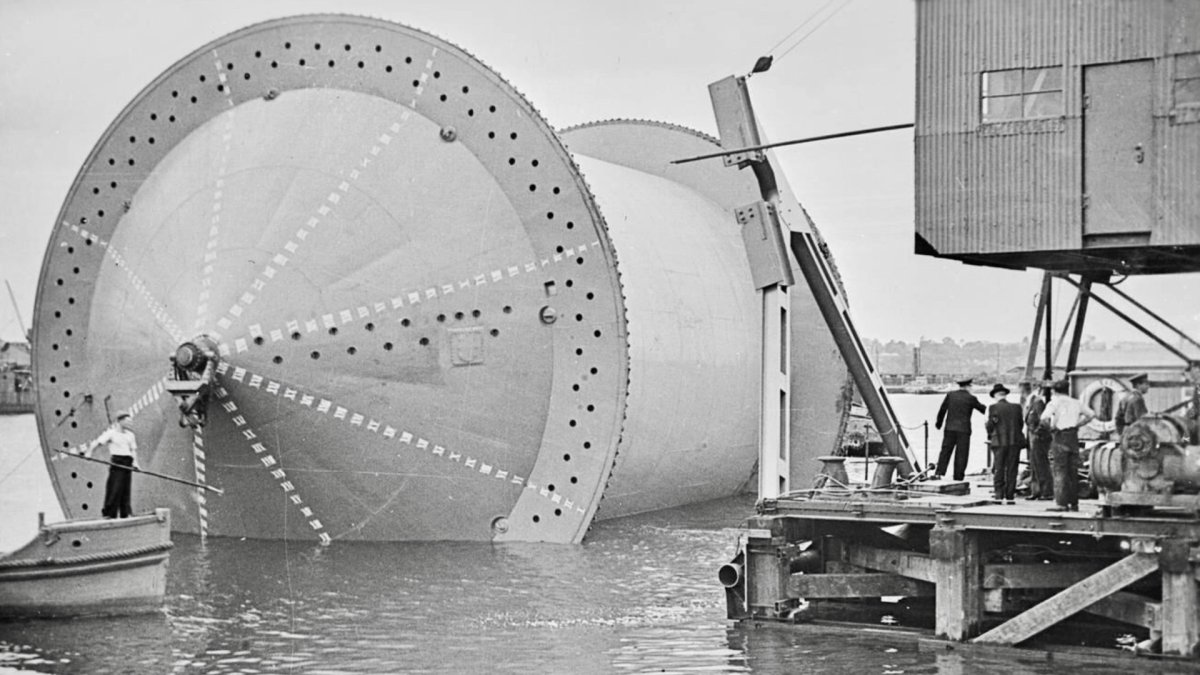
Two types of piping were used as part of Operation PLUTO. Cabling with lead tubing and armored steel wire, codenamed ‘HAIS,’ was one. The other, codenamed ‘HAMEL,’ took the form of welded steel piping that could be wound around a large diameter drum, referred to as a ‘conundrum.’ It was estimated that this type of pipe would be able to survive for up to six weeks within the Channel which, as Whittle indicates, was considered sufficient. HAIS and HAMEL pipes were each just three inches in diameter.
Pipe stored in three-quarter mile lengths before being wound onto the ‘conundrum’ (date unknown). Copyright © IWM
Petrol pipe for Operation PLUTO being wound onto a ‘conundrum’ pipe-laying device, June 1944. Copyright © IWM
Another ‘conundrum’ ready to be towed across the English Channel (date unknown). Copyright © IWM
The pipes needed to traverse a vast distance. PLUTO was planned on the assumption that the Allied invasion of France would occur in the Pas de Calais, northern France, some 31 miles (50 kilometers) from England’s south-eastern coast. However, in 1943 it was decided that the invasion would in fact occur at Normandy.
The new location for the pipeline from here connected Cherbourg in Normandy to the Isle of Wight off England’s southern coast.
A map of the PLUTO pipelines. BAMBI pipelines can be seen to the left; DUMBO pipelines can be seen to the right. Note, the locations given for Shanklin Chine on the Isle of Wight and Ambleteuse in France differ slightly from the description below, but provide an indication of where the pipelines began and ended. Library of Congress via Wikimedia Commons
It was not until August 12, 1944, that the first PLUTO pipeline, codenamed ‘BAMBI,’ was laid by the Royal Navy. As part of BAMBI, HAIS cable was laid from Cherbourg to the Isle of Wight. The pre-existing Reading/Southampton GPSS mainland pipeline was extended to the Isle of Wight especially for BAMBI.
Work on the PLUTO pipeline was scheduled to begin on June 24. Delays were caused in part because the pipes themselves were easily damaged when laid.
But more significantly, BAMBI was delayed because of the military chain of events after the D-Day landings. Work on the PLUTO pipeline relied on the Allies capturing Cherbourg harbor intact in only eight days. This was a tall order, and the harbor was not taken until June 27. For reference, the assault phase of the invasion, known as Operation Neptune, ended just a few days later on June 30.
A ‘conundrum’ being towed across the English Channel (date unknown). Copyright © IWM
How successful was Operation PLUTO?
BAMBI didn’t supply any petroleum until mid-September 1944. When it did, it only supplied around 275 tons (250 tonnes) of petroleum per day. The first laying of a HAMEL pipe took place in late September.
In early October, work began on laying a shorter pipeline, codenamed ‘DUMBO,’ from Boulogne-sur-Mer to Dungeness on the Kent coast. Dungeness wasn’t close to any of the GPSS pipelines, so a connecting pipeline, roughly 71 miles long, was used to ‘plug’ Dungeness into the main supply line. The Boulogne-sur-Mer to Dungeness pipeline was only partially operational by late October, supplying just over 848 tons (770 tonnes) of petroleum per day. DUMBO went on to deliver higher supply numbers than this. Citing the official postwar history of oil supply, Whittle suggests DUMBO reached a peak flow-rate of just under 2,000 tons a day after Victory in Europe Day on May 8, 1945. Edgerton has the figure at roughly 3,300 tons per day. Clearly, DUMBO was more successful than BAMBI, but this was well after the Allied invasion of Normandy.
One of the pump stations at Dungeness on the Kent coast, camouflaged to resemble the surrounding gravel quarry in which it was located (date unknown). Copyright © IWM
Much of Operation PLUTO’s allure no doubt comes from the ingenuity displayed by those who made it possible. In this sense, it mirrors the efforts of the Enigma code-breakers of Bletchley Park , notably the scientist Alan Turing, in making the seemingly impossible – or at least the improbable – a reality. In May 1945, Churchill himself suggested that Operation PLUTO was “a wholly British achievement and a piece of amphibious engineering skill of which we may well be proud.”
Ultimately, Operation PLUTO was less successful than the British authorities envisioned in 1942 and 1943. The average flow rate of PLUTO roughly equated to two large tankers a month.
As Whittle suggests, however, PLUTO should be seen within the wider context of the GPSS network. Throughout all of 1944, and for a short part of 1945, the largely unknown GPSS network carried more than 275,000 tons (250,000 tonnes) per month (tpm) – a quite astonishing volume.
Contact the author: oliver@thewarzone.com
Comments couldn’t be loaded. Please refresh the page.
发布于美国东部时间2024年8月15日晚上7:22
二战期间,英国铺设了横跨英吉利海峡通往法国的海底管道。这项名为“冥王星行动”(Operation PLUTO,全称为“海底管道”或“水下输油管道”)的计划旨在从英格兰和怀特岛向法国输送燃料,以支援盟军诺曼底登陆。
从1944年6月6日诺曼底登陆开始,这场入侵行动需要大量的燃料。正如大卫·埃杰顿在其著作《英国的战争机器:二战中的武器、资源和专家》中所指出的,“冥王星行动”旨在每天供应约4000至5000吨燃料——约占盟军在登陆后12天(D+12)燃料需求的40%至50%。但是,“冥王星行动”在帮助盟军获得所需燃料方面究竟取得了多大成功呢?
1944年6月,美国海岸警卫队在奥马哈海滩低潮时登陆舰艇卸货。
石油与英国的战争
在二十世纪,确保石油供应及其获取途径成为战争运作的关键因素。石油,一种化石燃料,也称原油,是第一次世界大战期间涌现的现代武器平台(包括潜艇、飞机、卡车和坦克)的燃料和润滑必需品。正如阿南德·托普拉尼在其著作《石油与列强:英国与德国,1914-1945》中所指出的,到1918年,石油已成为现代战争经济运转的必需品,影响着重工业、交通运输和农业等诸多领域。第二次世界大战期间,石油需求更是与日俱增。
1939年以前,英国各地储存了大量受保护的石油,以应对英国皇家空军(RAF)的燃料需求。正如蒂姆·惠特尔在一篇关于战时燃料供应和“冥王星行动”(Operation PLUTO)的学术论文中所述,从英格兰北部的纽卡斯尔到南部沿海的南安普顿,英国在乡村地区都修建了储油库。小型空军配送库(AFDD)的建设计划于1939年7月制定,而大型空军储备库(AFRD)的建设则始于1938年,这些储备库通常可储存约4400吨燃料。
1939年9月3日战争爆发后,石油委员会成立。这是一个由所有主要石油公司组成的非政府组织,旨在协调全国的石油供应。政府还设有自己的石油大臣,该职位由保守党议员杰弗里·劳埃德于1940年至1942年担任。1940年至1942年间,石油安全储备设施的建设迅速增加,大多数大型设施都进行了伪装以确保安全。
英国石油的供应和运输
英国在战争期间国内原油供应并不充足。因此,为了满足战时需求,英国需要从其他地方获取石油。英国动用了其殖民地的资源,特别是中东地区的资源。美国提供了更为丰富的石油供应,这主要得益于1941年3月的《租借法案》。正如埃杰顿所指出的,到战争中期,英国几乎所有的石油产品都来自美国。
1942年,英国士兵正在将装满废油的油桶装上卡车,准备运往接收站。版权所有 © 帝国战争博物馆
1940年至1941年间,德国对英国的空袭严重影响了石油的运输。由于石油储存设施,特别是英格兰南部和东南部地区的设施,屡遭轰炸,加上英格兰东部和南部沿海港口的关闭,英国修建了庞大的管道网络,从西部向各个皇家空军基地输送燃料。这个被称为政府管道储存系统(GPSS)的管道网络,构成了PLUTO管道的骨干。
GPSS 网络的起点是埃文茅斯,它是英格兰西海岸布里斯托尔的一个港口和郊区。
布里斯托尔(图中红色圆圈所示),位于英格兰西部。谷歌地图
连接埃文茅斯码头和泰晤士河畔新建储罐的首条全球管道输送系统(GPSS)管道于1941年6月开工建设,同年竣工,全长近100英里。随后,埃文茅斯与默西河和利物浦相连,形成南北向管道,并由此延伸至英格兰大陆(西南部除外)各地。
1944 年 GPSS 输油管道示意图。图片来源:Brian Hughes / Historic UK
在入侵纳粹占领的法国之前,英国及其盟军开始寻找燃料供应方案,PLUTO管道被设计为GPSS管道的水下延伸段。需要说明的是,PLUTO管道并非当时向欧洲大陆供应石油的主要途径。相反,PLUTO管道的目的是在更充足的石油供应通过油轮运输之前,提供临时的石油供应。
PLUTO 计划于 1942 年制定。4 月,时任联合行动司令部司令的路易斯·蒙巴顿询问负责石油战部的政府部长杰弗里·劳埃德,是否可以在英吉利海峡下铺设一条管道,为入侵德国占领的法国做准备。
皇家海军上校约翰·哈钦斯与联合作战司令部并肩作战,于 1943 年 7 月被任命为冥王星行动的高级海军指挥官,此前他已从 1942 年底开始协助联合作战司令部。
约翰·哈钦斯上尉(日期不详)。版权所有 © 帝国战争博物馆
在“冥王星行动”中,使用了两种类型的管道。一种是代号为“HAIS”的铅管和铠装钢丝绳。另一种代号为“HAMEL”的管道,是由焊接钢管组成,可以缠绕在一个被称为“谜题”的大直径圆筒上。据估计,这种管道可以在英吉利海峡中保存长达六周,正如惠特尔所指出的,这被认为足够了。HAIS和HAMEL管道的直径都只有三英寸。
管道以四分之三英里长的长度储存,然后缠绕到“谜题”上(日期不详)。版权所有 © 帝国战争博物馆
1944年6月,用于“冥王星行动”的汽油管道被缠绕到一台名为“谜题”的铺管装置上。版权所有 © 帝国战争博物馆
另一件“谜题”即将被拖过英吉利海峡(日期不详)。版权所有 © 帝国战争博物馆
这些管道需要跨越很远的距离。“冥王星”管道的规划是基于盟军入侵法国的设想,即入侵地点位于法国北部的加来海峡地区,距离英国东南海岸约50公里(31英里)。然而,1943年,盟军决定入侵地点实际上将设在诺曼底。
从这里开始,新的输油管道将诺曼底的瑟堡与英格兰南部海岸的怀特岛连接起来。
PLUTO输油管道地图。左侧为BAMBI输油管道,右侧为DUMBO输油管道。请注意,地图上标注的怀特岛尚克林海峡和法国昂布勒特斯的具体位置与下文描述略有不同,但大致反映了输油管道的起点和终点。图片来源:美国国会图书馆,经由维基共享资源。
直到1944年8月12日,英国皇家海军才铺设了第一条PLUTO输电管道,代号“BAMBI”。作为BAMBI项目的一部分,HAIS电缆从瑟堡铺设至怀特岛。原有的雷丁/南安普顿GPSS大陆输电管道专门为BAMBI项目延伸至怀特岛。
PLUTO输油管道的建设工作原定于6月24日开始。延误的部分原因是管道本身在铺设过程中很容易损坏。
但更重要的是,BAMBI项目的延误是由于诺曼底登陆后一系列军事事件造成的。PLUTO输油管道的建设依赖于盟军在短短八天内完好无损地夺取瑟堡港。这并非易事,而瑟堡港直到6月27日才被攻克。作为参考,代号为“海王星行动”的入侵突击阶段,在几天后的6月30日就结束了。
一艘名为“谜团”的船只被拖过英吉利海峡(日期不详)。版权所有 © 帝国战争博物馆
“冥王星行动”有多成功?
班比油田直到1944年9月中旬才开始供应石油。当时,其日供应量仅为275吨(250吨)左右。第一条哈梅尔管道的铺设工作于9月下旬进行。
10月初,一条代号为“DUMBO”的短输油管道开始铺设,连接滨海布洛涅和肯特郡海岸的邓杰内斯。由于邓杰内斯距离GPSS输油管道较远,因此使用了一条长约71英里的连接管道将邓杰内斯接入主输油管道。到10月下旬,滨海布洛涅至邓杰内斯的输油管道仅部分投入运营,日输油量略高于848吨(770吨)。DUMBO的输油量后来超过了这个数字。惠特尔援引战后石油供应的官方历史资料指出,在1945年5月8日欧洲胜利日之后,DUMBO的峰值输油量接近每天2000吨。埃杰顿则认为这个数字约为每天3300吨。显然,DUMBO比BAMBI更为成功,但这已经是盟军诺曼底登陆之后的事情了。
肯特郡海岸邓杰内斯的一座泵站,伪装成与周围砂石采石场融为一体(日期不详)。版权所有 © 帝国战争博物馆
冥王星行动的魅力无疑很大程度上源于那些促成其成功的人们所展现出的创造力。从这个意义上讲,它与布莱切利庄园的恩尼格玛密码破译者,特别是科学家艾伦·图灵的努力如出一辙,他们将看似不可能——或者至少是不太可能——的事情变成了现实。1945年5月,丘吉尔本人也曾表示,冥王星行动是“一项完全由英国人完成的成就,也是一项我们完全可以引以为豪的两栖工程技术”。
最终,“冥王星行动”的成功程度不及英国当局在 1942 年和 1943 年的预期。“冥王星行动”的平均流量大约相当于每月两艘大型油轮。
然而,正如惠特尔所建议的那样,应该将冥王星卫星置于全球定位系统卫星(GPSS)网络的更广泛背景下看待。在整个 1944 年以及 1945 年的一段时间里,这个鲜为人知的 GPSS 网络每月输送超过 275,000 吨(250,000 吨)的卫星——这是一个相当惊人的数量。
联系作者:oliver@thewarzone.com
评论加载失败,请刷新页面。