Pre-school teachers to get 2 hours of weekly protected time for non-teaching tasks from Nov 2027从2027年11月起,学前教师每周将享有2小时的受保护时间,用于非教学任务。
Centres that can offer more than two hours are encouraged to do so. Read more at straitstimes.com.
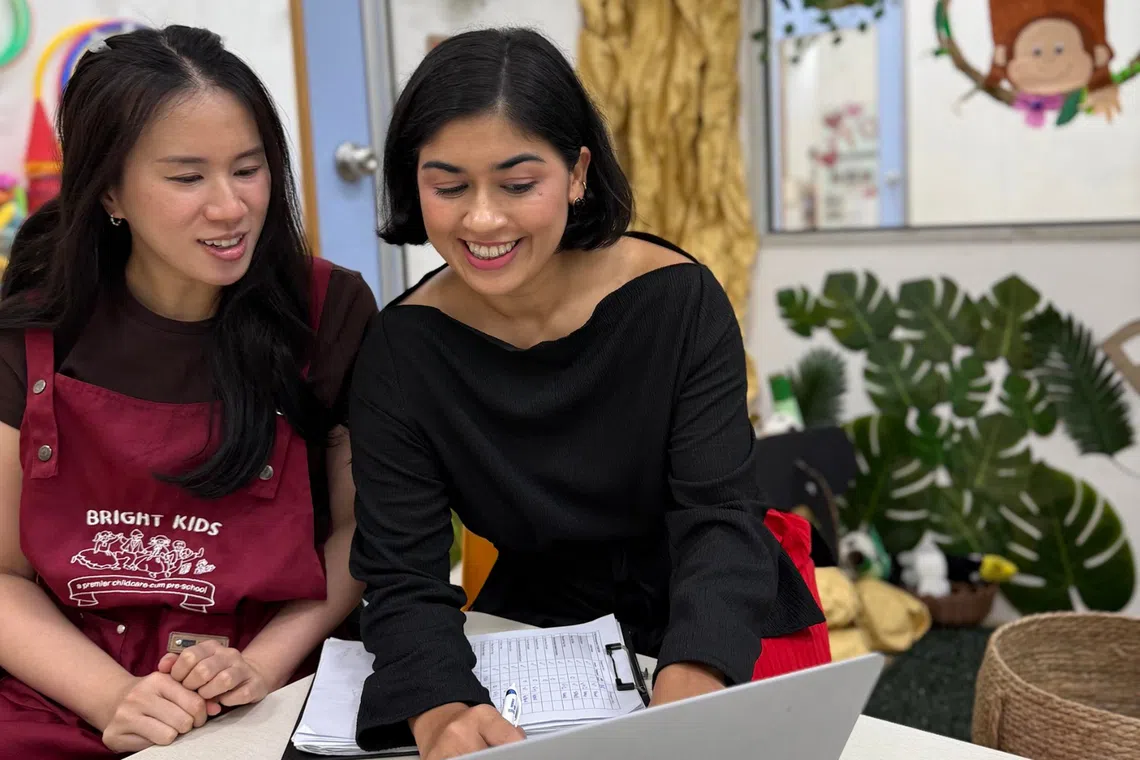
Playgroup teacher Angie Lee and Centre Principal Ayman Zaidi from Bright Kids School House use non-contact time to complete non-teaching tasks.
Photo: Bright Kids School House
Published Oct 13, 2026, 04:00 PM
Updated Oct 13, 2026, 04:00 PM
All full-time pre-school teachers will get at least two hours of protected non-teaching time a week from November 2027, under ECDA plans to improve working conditions and lesson planning.
Minister Masagos Zulkifli said the move sets a common minimum for quality and supports work beyond the classroom, while the Government has spent more than $75 million in five years on educator support.
Teachers and centre leaders welcomed the change, but said manpower shortages and careful rostering will be needed to make it work, especially during leave or in classes with greater needs.
SINGAPORE – All full-time pre-school teachers will get at least two hours of non- teaching time every week, from November 2027, to carry out duties such as planning their lessons and preparing resources.
The requirement is part of the Early Childhood Development Agency’s (ECDA) efforts to improve working conditions for pre-school teachers and give them more space away from direct teaching and care of children.
“We have heard educators ask for dedicated time to carry out these responsibilities sustainably,” said Minister for Social and Family Development Masagos Zulkifli, who made the announcement on Oct 13 at ECDA’s annual Scholarships and Training Awards Presentation Ceremony, held at the Suntec Convention Centre.
“ The work of an early childhood educator goes beyond the classroom. Educators plan learning experiences, document each child’s development, and work alongside parents, and all this to support our children’s learning and well-being. These responsibilities are integral to delivering quality pre-school education.”
These are all part of “non-contact time”, or time away from contact with the children.
While some pre-schools already carve out non-teaching time for their teachers, Masagos said “establishing a common minimum will ensure that every educator has protected time to carry out these essential responsibilities”, to support a more consistent quality of education for pre-school children.
Workload was the top factor that pre-school educators said impacted their well-being, according to a survey initially released in August. There are currently about 28,000 preschool educators in service in 2026.
Centres will have the flexibility to implement the new requirement according to their needs, while ensuring the two hours of non-teaching time are within teachers’ working hours.
Those that can offer more than two hours are encouraged to do so, Masagos added.
The minister also said the Government has invested more than $75 million over the past five years to create better working conditions for pre-school educators and support their professional development.
Through initiatives such as the Early Childhood Education Scholarship, Training Awards and Professional Development Programme, the educators are supported at different stages of their careers.
Latisah Salimen, 43, an infant toddler educator at Iyad Perdaus Jurong East, was among those who received an award at the ceremony for their achievements in the Professional Development Programme for educators.
She currently has one hour of non-contact time each week, mainly when the children take a nap.
This time is important for her to feel more organised and prepared, so that she can be more present and responsive when interacting with the children. She uses the time to prepare resources, and review and document children’s evaluations based on her daily observations.
Latisah Salimen, infant-toddler educator at Iyad Perdaus Jurong, pictured on Oct 13. ST PHOTO: JASON QUAH
Latisah Salimen, infant-toddler educator at Iyad Perdaus Jurong, pictured on Oct 13.
ST PHOTO: JASON QUAH
Though the new non-contact time requirement allows her only one more hour for non-teaching tasks, Latisah told The Straits Times it still makes a difference as it gives her more room to have a breather and complete administrative tasks.
“One hour is actually quite a limited time, you can’t do much except to catch up with whatever you have left off. But with the change next year, I feel I can do a little bit more. At the same time, you are away from the children, so you have more time for yourself,” said Latisah, who has nearly 10 years’ experience in the early childhood sector.
She said that although it can be a challenge to provide each teacher with two hours of contact time weekly due to manpower issues, centre leaders can do so with careful rostering.
Keefe Wayne Teo, 29, director of Bright Kids School House said the centre sees non-contact time as an opportunity to support more intentional lesson planning and preparation. This creates better learning experiences for children.
Across its five centres, Bright Kids’ teachers currently have between one and two hours of non-contact time. Full-time teachers work approximately 8½ to 9 hours daily, totalling 44 hours weekly.
With about 80 educators on staff, Bright Kids can accommodate all teachers’ two hours of protected non-teaching time a week. Nonetheless, Teo said the centre will adopt stricter rostering and monitoring to successfully implement this minimum requirement.
Even so, a manpower crunch may be unavoidable occasionally.
“If a teacher goes on maternity leave, it is manpower shortage for quite a long duration... If a particular class or group of students has more needs, it’s harder to sustain operations for that class with ECDA’s teacher-pupil ratio (requirements), as more teachers will be needed,” he said.
Bright Kids is currently seeking partnerships with external specialists to support classrooms with more diverse needs, like special education needs. Teo said this is in efforts to free up their teachers’ time and support them in this area.
Elisha Tushara is a correspondent at The Straits Times, specialising in Singapore’s education landscape.
来自 Bright Kids School House 的学前班老师 Angie Lee 和中心校长 Ayman Zaidi 利用非教学时间完成非教学任务。
照片:明亮儿童学校
发布于2026年10月13日下午4:00
更新于2026年10月13日下午4:00
根据幼儿培育署改善工作条件和课程计划的计划,从 2027 年 11 月起,所有全职学前教师每周将至少获得两个小时的受保护的非教学时间。
教育部长马善高表示,此举设定了质量的共同最低标准,并支持课堂以外的工作,同时政府在五年内已花费超过7500万美元用于支持教育工作者。
教师和中心负责人对这一变化表示欢迎,但他们表示,要使之奏效,需要人手短缺和精心安排轮班,尤其是在休假期间或需求较大的班级。
新加坡——从 2027 年 11 月起,所有全职学前教师每周将至少有两小时的非教学时间,用于履行诸如计划课程和准备资源等职责。
这项要求是幼儿培育署 (ECDA) 为改善学前教师的工作条件,并让他们有更多时间远离直接教学和照顾儿童而采取的措施之一。
“我们听到教育工作者要求有专门的时间来可持续地履行这些职责,”社会及家庭发展部长马善高在10月13日于新达城会展中心举行的幼儿培育署年度奖学金和培训奖颁奖典礼上宣布了这一消息。
“幼儿教育工作者的工作远不止于课堂。他们规划学习活动,记录每个孩子的成长发育,并与家长密切合作,所有这些都是为了支持孩子的学习和身心健康。这些职责对于提供高质量的学前教育至关重要。”
这些都是“非接触时间”,也就是与孩子保持距离的时间。
虽然有些幼儿园已经为教师安排了非教学时间,但马萨戈斯表示,“制定共同的最低标准将确保每位教育工作者都有受保护的时间来履行这些必要的职责”,从而支持为学前儿童提供更一致的高质量教育。
根据8月份发布的一项调查,工作量是学前教育工作者认为影响其身心健康的首要因素。预计到2026年,全球约有28000名学前教育工作者。
各中心可根据自身需要灵活实施新要求,同时确保两小时非教学时间在教师的工作时间内。
马萨戈斯补充说,鼓励那些能够提供两个多小时时间的人这样做。
部长还表示,政府在过去五年中投资超过 7500 万美元,为学前教育工作者创造更好的工作条件,并支持他们的职业发展。
通过诸如幼儿教育奖学金、培训奖励和专业发展计划等举措,教育工作者在其职业生涯的不同阶段都能得到支持。
43 岁的 Latisah Salimen 是 Iyad Perdaus Jurong East 的一名婴幼儿教育工作者,她因在教育工作者专业发展计划中取得的成就而在颁奖典礼上获得表彰。
她目前每周有一小时的非接触时间,主要是在孩子们午睡的时候。
这段时间对她来说很重要,让她感觉更有条理、准备更充分,这样在与孩子们互动时才能更加专注、更及时地回应他们。她利用这段时间准备教学资源,并根据每日观察结果回顾和记录孩子们的评估结果。
图为裕廊伊亚德珀道斯幼儿园的婴幼儿教育工作者拉蒂莎·萨利门,摄于10月13日。(海峡时报摄影:杰森·夸)
10 月 13 日,Iyad Perdaus Jurong 的婴幼儿教育工作者 Latisah Salimen 被拍到。
《海峡时报》摄影:JASON QUAH
尽管新的非接触时间要求只允许她多出一个小时用于非教学任务,但拉蒂莎告诉《海峡时报》,这仍然意义重大,因为它让她有更多的时间喘口气并完成行政任务。
“一个小时其实很有限,除了补上落下的工作,你做不了太多事。但明年情况有所改变,我觉得我可以做更多的事情了。同时,你也能暂时离开孩子们,拥有更多属于自己的时间,”在幼儿教育领域拥有近十年经验的拉蒂莎说道。
她表示,虽然由于人手不足,每周为每位教师提供两小时的授课时间可能是一个挑战,但中心负责人可以通过精心安排轮班来实现这一点。
29岁的Bright Kids School House校长Keefe Wayne Teo表示,该中心将非教学时间视为支持更有针对性课程计划和备课的契机,从而为孩子们创造更好的学习体验。
Bright Kids的五个中心,每位教师目前每天有1到2小时的非教学时间。全职教师每天工作约8.5到9小时,每周共计44小时。
Bright Kids拥有约80名教师,可以满足所有教师每周两小时的受保护非教学时间。尽管如此,Teo表示,中心将采取更严格的排班和监督措施,以确保这一最低要求得到有效落实。
即便如此,人手短缺的情况偶尔也难以避免。
“如果一名教师休产假,就会出现相当长时间的人手短缺……如果某个班级或学生群体有更多需求,按照幼儿培育署的师生比例(要求)就很难维持该班级的正常运转,因为需要更多的教师,”他说。
Bright Kids目前正在寻求与外部专家合作,以支持有更多不同需求的课堂,例如特殊教育需求的课堂。Teo表示,此举旨在解放教师的时间,并为他们提供这方面的支持。
Elisha Tushara 是《海峡时报》的记者,专门报道新加坡的教育领域。