Epic Fury has Navy rethinking carrier deployment tempo《史诗狂怒》促使海军重新思考航母部署节奏
The record-breaking deployment of the USS Gerald R. Ford has reopened the debate about how the Navy should structure deployments and time at home.
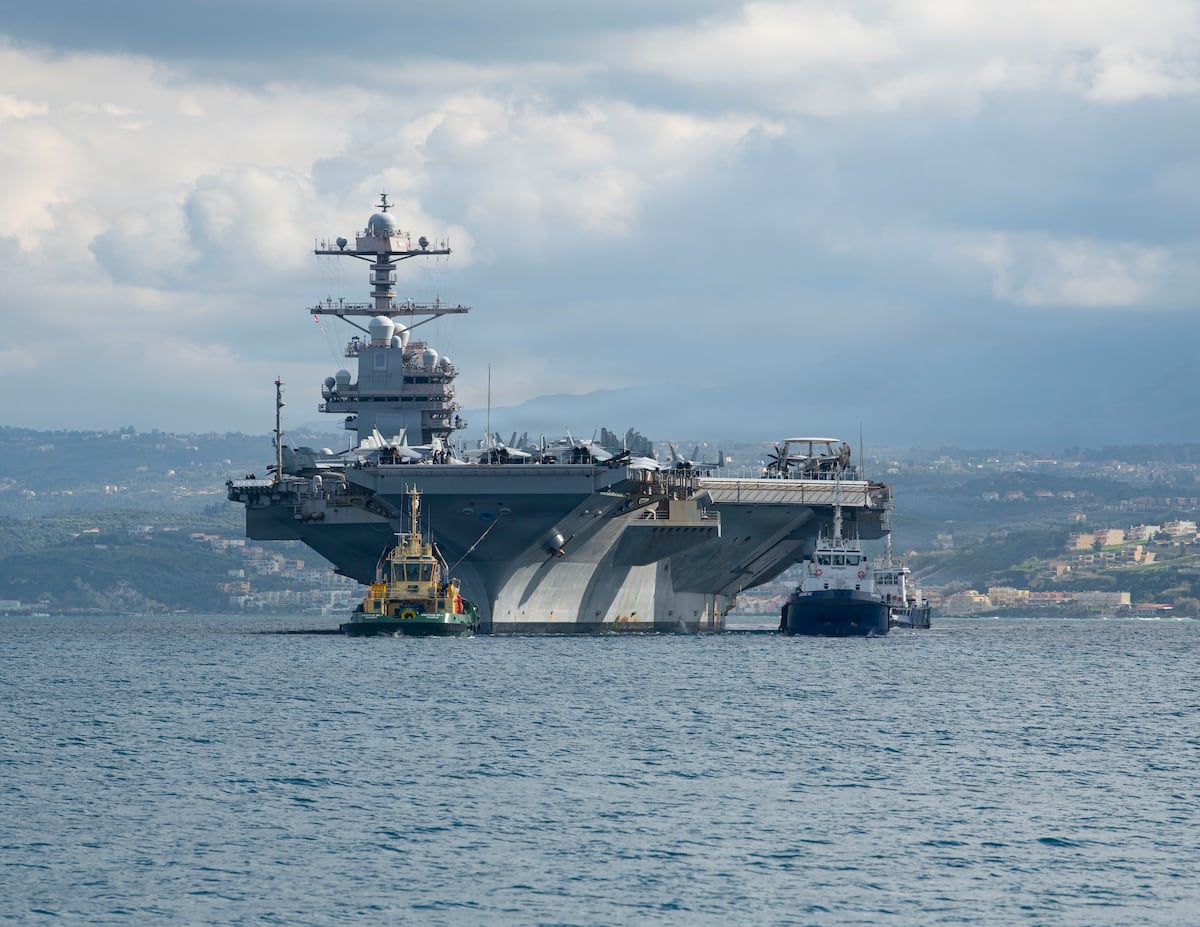
With the aircraft carrier USS Gerald R. Ford en route home from what has become the longest U.S. Navy float since Vietnam , the service is reconsidering how to sustain a wartime fighting force.
That’s according to Master Chief Petty Officer of the Navy John Perryman, who addressed service needs and quality of life concerns at a forum hosted by Military Officers Association of America this month.
With the back-to-back operational demands of the military intervention to capture and extract Venezuelan president Nicolas Maduro in January, followed by the airstrikes on and subsequent naval blockade of Iran, and amid ongoing drug interdiction operations around South and Central America, older force generation models are proving less effective, he said.
“So, one of the things we’ve learned is we’re going to have to come up with a different force generation model,” Perryman said. “... And so we think we can do better in our force generation model to generate the readiness that we know the department is going to consume. And so … let’s take a step back and really evaluate what that should look like.”
Throughout his career, he said, the force generation model had largely been based on a peacetime mindset.
“It’s like this conveyor belt that’s very prescriptive, and it executes on time,” he said.
For example, Perryman said, carrier strike groups deploy on three-year centers, meaning they cycle through training, deployment and maintenance every three years.
As recently as 2020, then-Chief of Naval Operations Adm. Michael Gilday defended this structure amid proposals for change from then-Defense Secretary Mark Esper, saying the Navy had “made and are projecting into the future to continue to meet every commitment, every deployment that we’ve been directed to do.”
But the deployment of the Ford, which will have been deployed for more than 330 days when it’s slated to pull into port in Norfolk, Va., at the end of this month, has reopened the debate about how the Navy, which has historically had five- to seven-month pumps, should structure deployments and time at home, Perryman said.
The Navy, he said, was considering challenges ranging from acquiring enough spare parts, to building in appropriate time for reset and training.
“So really that’s what we’re taking away from this. And we’ve started to do, I think, some pretty transformative work in that area,” he said.
The Navy in late April marked a first in more than two decades with three aircraft carriers operating simultaneously in the waters surrounding the Middle East.
Perryman’s comments advance a proposition by Chief of Naval Operations Adm. Daryl Caudle in late April at the Modern Day Marine Symposium. Caudle suggested transitioning amphibious ships, also on a 36-month deployment cycle, to a 50- or 52-month cycle that would incorporate two deployments.
By getting two deployments out of the same training and maintenance phase, Caudle suggested the Navy could “reduce the overhead … [and] gain some efficiency,” Breaking Defense reported.
Army, Air Force reevaluate demands
Other senior enlisted leaders who spoke alongside Perryman also described the difficulty of adapting to operational demands and an uncertain timeline.
Sergeant Major of the Army Michael Weimer said his service was working to develop “true readiness measurements” while also “trying to manage the current op tempo.”
At home, he said, the Army was working to modernize training ranges and align training more closely with current threats.
Chief Master Sergeant of the Air Force David Wolfe said months of air sorties had left the service with “tired folks out there and some tired equipment that needs our attention.”
“Another thing we’ve learned is that when you put the resources and the parts forward with the aircraft, the aircraft fly at an amazingly high rate, right,” he said.
“So we’ve got some work to do in that department with, you know, stable and predictable budgets and making sure that we’ve got the parts and the resources that we need in the places that we need them,” Wolfe added. “We need to do a better job of that in garrison, when we’re getting ready for whatever is to come, whatever we’re asked to do.”
But all the enlisted leaders emphasized their troops were performing well. The senior enlisted adviser to the Chairman of the Joint Chiefs of Staff, David Isom, said the number of troops who had returned to duty after combat injuries was “off the charts.”
Isom added that he’d visited the sailors onboard the deployed carrier Ford and found them “motivated, excited, mission-focused.”
“I think that kind of inspiration keeps people coming back and inspires the next generation,” he said. “And we do see a lot of propensity to serve.”
随着“杰拉尔德·R·福特”号航空母舰结束自越南战争以来美国海军最长的海上航行返回家乡,海军正在重新考虑如何维持一支战时作战部队。
这是海军总军士长约翰·佩里曼在本月由美国军官协会主办的论坛上发表的讲话,他谈到了军人的需求和生活质量问题。
他表示,由于一月份军事干预抓捕和撤离委内瑞拉总统尼古拉斯·马杜罗、随后对伊朗进行空袭和海上封锁,以及在南美洲和中美洲持续开展禁毒行动,传统的兵力生成模式正变得越来越不有效。
佩里曼说:“所以,我们学到的一点是,我们必须制定一套不同的兵力生成模式。……因此,我们认为我们可以改进现有的兵力生成模式,以满足部门所需的战备需求。所以……让我们退一步,认真评估一下这套模式应该是什么样子。”
他表示,在他的整个职业生涯中,兵力生成模式在很大程度上是基于和平时期的思维方式。
他说:“这就像一条传送带,执行起来非常有条理,而且准时完成。”
例如,佩里曼说,航母打击群每三年进行一次部署,这意味着它们每三年轮换一次训练、部署和维护。
就在 2020 年,时任海军作战部长迈克尔·吉尔迪海军上将还在时任国防部长马克·埃斯珀提出改革方案时为这一结构辩护,称海军“已经做出并将继续展望未来,以继续履行我们被指示执行的每一项承诺和每一次部署”。
但佩里曼表示,福特号的部署(预计将于本月底抵达弗吉尼亚州诺福克港,届时该舰已部署超过 330 天)重新引发了关于海军(历史上海军的轮换周期为五到七个月)应该如何安排部署和回国时间的辩论。
他说,海军正在考虑各种挑战,包括获取足够的备件,以及为重置和训练预留适当的时间。
“所以,这才是我们从中真正得到的启示。而且我认为,我们已经开始在这个领域开展一些具有变革意义的工作,”他说。
四月下旬,美国海军在中东周边海域同时派出三艘航空母舰,这是二十多年来的首次。
佩里曼的评论推进了海军作战部长达里尔·考德尔海军上将在4月下旬举行的现代海军陆战队研讨会上提出的建议。考德尔建议将两栖舰艇的部署周期从36个月改为50或52个月,其中包括两次部署。
据《防务新闻》报道,考德尔表示,通过在同一训练和维护阶段完成两次部署,海军可以“减少开支……[并]提高效率”。
陆军、空军重新评估需求
与佩里曼一同发言的其他高级士官也描述了适应作战需求和不确定时间表的困难。
陆军军士长迈克尔·韦默表示,他的部队正在努力制定“真正的战备衡量标准”,同时也在“努力控制当前的作战节奏”。
他说,在国内,陆军正在努力实现训练场的现代化,并使训练与当前的威胁更加紧密地结合起来。
空军首席军士长戴维·沃尔夫表示,数月的空中出击让空军“人员疲惫不堪,一些老旧的设备也需要我们关注”。
“我们还了解到,当你把资源和零部件投入到飞机上时,飞机的飞行效率会非常高,对吧?”他说道。
沃尔夫补充道:“所以我们在那方面还有一些工作要做,比如确保预算稳定可预测,并确保我们需要的零部件和资源能够及时送达需要的地方。在驻军方面,我们需要做得更好,为即将到来的任何情况、任何被要求做的事情做好准备。”
但所有士官长都强调,他们的部队表现出色。参谋长联席会议主席的高级士官顾问戴维·伊索姆表示,战斗负伤后重返岗位的士兵人数“远超预期”。
伊索姆补充说,他曾探望过部署在福特号航母上的水兵,发现他们“积极向上、充满热情、目标明确”。
“我认为这种激励能够让人们不断回来,并激励下一代,”他说。“而且我们确实看到了很多乐于助人的意愿。”