French-British underwater drone proves de-mining ability, says Thales泰雷兹公司称,法英联合研制的水下无人机证明了其排雷能力。
The MMCM system is meant to detect, identify and neutralize mines up to 300 meters deep, compared to 120 meters today.
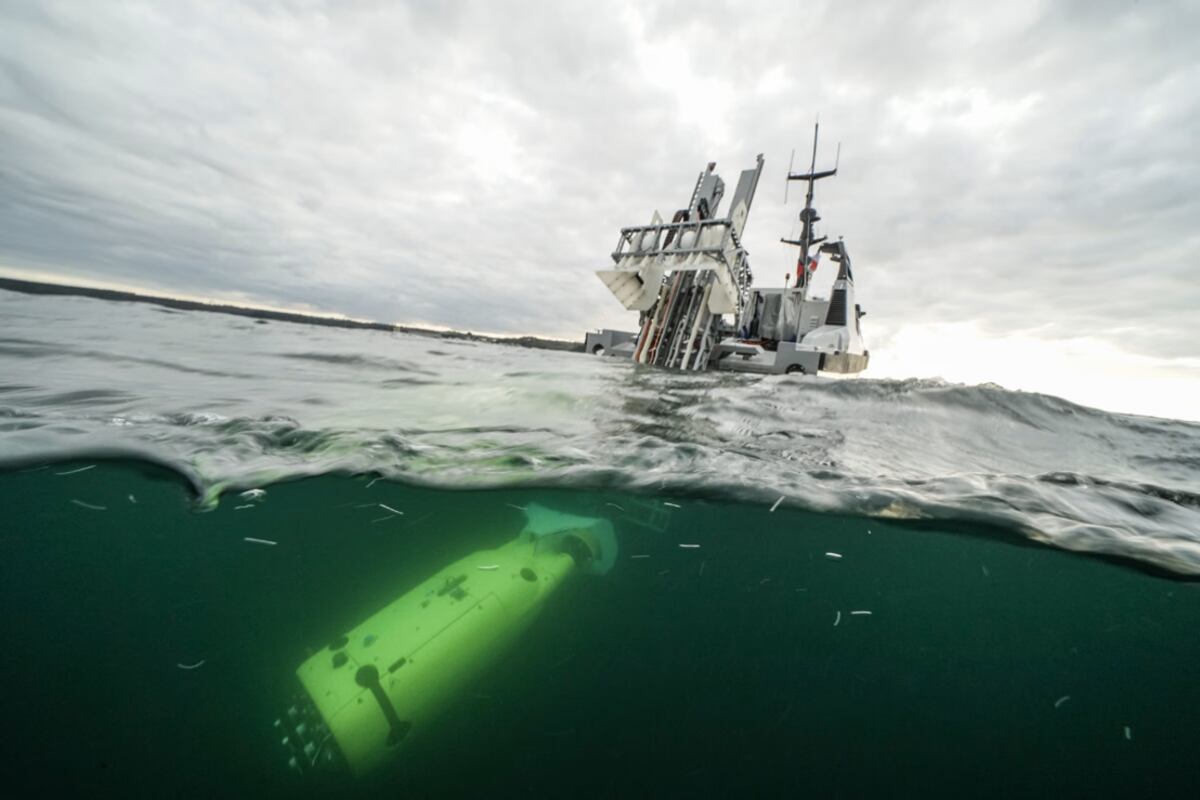
STUTTGART, Germany — Recent sea trials of a remotely operated underwater vehicle proved it is capable of neutralizing naval mines, a new milestone for the Franco-British Maritime Mine Countermeasures program, French firm Thales announced Wednesday.
The program’s prime contractor and lead system integrator successfully demonstrated this final component of its system for the MMCM program, dubbed SLAM-F in France.
The sea trials took place remotely from the company’s command center in Brest, France, alongside representatives of the French Navy, the French defense procurement agency DGA, the British Royal Navy and the U.K. Defence Ministry, as well as the Organisation for Joint Armament Co-operation, according to a Thales news release. OCCAR is an international weapons management group.
The Thales operations center controlled the systems with the support of French Navy personnel.
The trials, which were “recently” held, demonstrated the ability of Thales’ M-Cube mission management system to relocate and identify mines at sea, after which the underwater drone successfully installed exercise charges on a bottom mine and a moored mine; the latter are deployed when the water is too deep for bottom mines.
France and Britain first launched the MMCM program in 2015 with a contract signing between Thales and OCCAR, intending to demonstrate and qualify a novel, fully integrated, unmanned mine countermeasures system of systems. The goal is for MMCM to replace all current mine warfare platforms, including Tripartite-class mine hunters, sonar towing vessels and diver support vessels.
Per the French Armed Forces Ministry, one MMCM system architecture comprises two surface drones — one of which is equipped with a towed sonar and the other with a remotely operated robot — and two underwater drones responsible for detecting, classifying and localizing the mines. The remotely operated robot makes it possible to identify and neutralize mines.
Thales serves as the overall project manager of the system as well as the sonar manufacturer, while ECA Group — which now operates as Exail — developed the underwater drones.
Those drones will be capable of recognizing submerged objects with very high resolution thanks to Thales’ “multi-aspect sonar,” the ministry previously said.
The sonar can take images from three different angles in one pass, allowing the operator to more easily and quickly characterize an object.
The MMCM system will also be able to detect, identify and neutralize mines up to 300 meters (984 feet) deep, compared to 120 meters (394 feet) today, the ministry has said.
The first two prototype MMCM systems were delivered to the French and British navies in 2021 and 2022, according to Thales. The two services will take delivery of the six series-produced systems in 2024 and 2025, for a total of eight systems split between the two nations.
At the 2022 Euronaval conference held outside of Paris, French military officials announced the MMCM program will align itself with a separate Belgian-Dutch de-mining program meant to deliver new mine hunter vessels and unmanned systems, dubbed the Belgian-Dutch Mine Countermeasures system.
Vivienne Machi is a reporter based in Stuttgart, Germany, contributing to Defense News' European coverage. She previously reported for National Defense Magazine, Defense Daily, Via Satellite, Foreign Policy and the Dayton Daily News. She was named the Defence Media Awards' best young defense journalist in 2020.
德国斯图加特——法国泰雷兹公司周三宣布,最近一次遥控水下航行器的海上试验证明,它能够清除水雷,这是法英海上水雷对抗计划的一个新里程碑。
该项目的主承包商和首席系统集成商成功演示了其 MMCM 项目的系统最后一个组件,在法国被称为 SLAM-F。
据泰雷兹公司新闻稿称,此次海上试验是在该公司位于法国布雷斯特的指挥中心远程进行的,法国海军、法国国防采购局(DGA)、英国皇家海军和英国国防部以及联合军备合作组织(OCCAR)的代表也参与其中。OCCAR是一个国际武器管理组织。
泰雷兹运营中心在法国海军人员的支持下控制系统。
最近进行的试验表明,泰雷兹公司的 M-Cube 任务管理系统能够重新定位和识别海上水雷,之后水下无人机成功地在底雷和系泊水雷上安装了演习炸药;后者是在水太深而无法放置底雷时部署的。
法国和英国于2015年首次启动了MMCM项目,泰雷兹公司与OCCAR签署合同,旨在演示和验证一种新型的、完全集成的无人水雷对抗系统。MMCM的目标是取代所有现有的水雷战平台,包括三方级扫雷艇、声呐拖曳船和潜水员支援船。
根据法国国防部的说法,一套水雷清除系统架构包括两艘水面无人机——其中一艘配备拖曳式声呐,另一艘配备遥控机器人——以及两艘水下无人机,负责探测、识别和定位水雷。遥控机器人能够识别并排除水雷。
泰雷兹公司担任该系统的总项目经理和声呐制造商,而 ECA 集团(现以 Exail 的名义运营)则开发了水下无人机。
该部此前表示,得益于泰雷兹公司的“多方向声呐”,这些无人机将能够以非常高的分辨率识别水下物体。
声呐一次扫描即可从三个不同的角度拍摄图像,使操作员能够更轻松、更快速地对物体进行表征。
该部表示,MMCM系统还将能够探测、识别和清除深达300米(984英尺)的地雷,而目前该系统只能探测到120米(394英尺)深的地雷。
据泰雷兹公司称,首批两套MMCM原型系统已于2021年和2022年交付给法国和英国海军。两国海军将于2024年和2025年接收六套量产型系统,届时两国将共接收八套系统。
在巴黎郊外举行的 2022 年欧洲海军会议上,法国军方官员宣布,MMCM 计划将与比利时-荷兰的一项独立排雷计划保持一致,该计划旨在提供新的猎雷船和无人系统,被称为比利时-荷兰水雷对抗系统。
薇薇安·马奇是驻德国斯图加特的一名记者,主要负责《防务新闻》的欧洲报道。她此前曾为《国家防务杂志》、《防务日报》、《卫星通讯》、《外交政策》和《代顿每日新闻》撰稿。2020年,她荣获防务媒体奖最佳青年防务记者称号。