Bass warns airmen to prepare for asymmetric warfare巴斯警告空军人员做好应对非对称战争的准备
The chief master sergeant of the Air Force warned airmen not to underestimate the cyber and information domains as drivers and amplifiers of conflict.
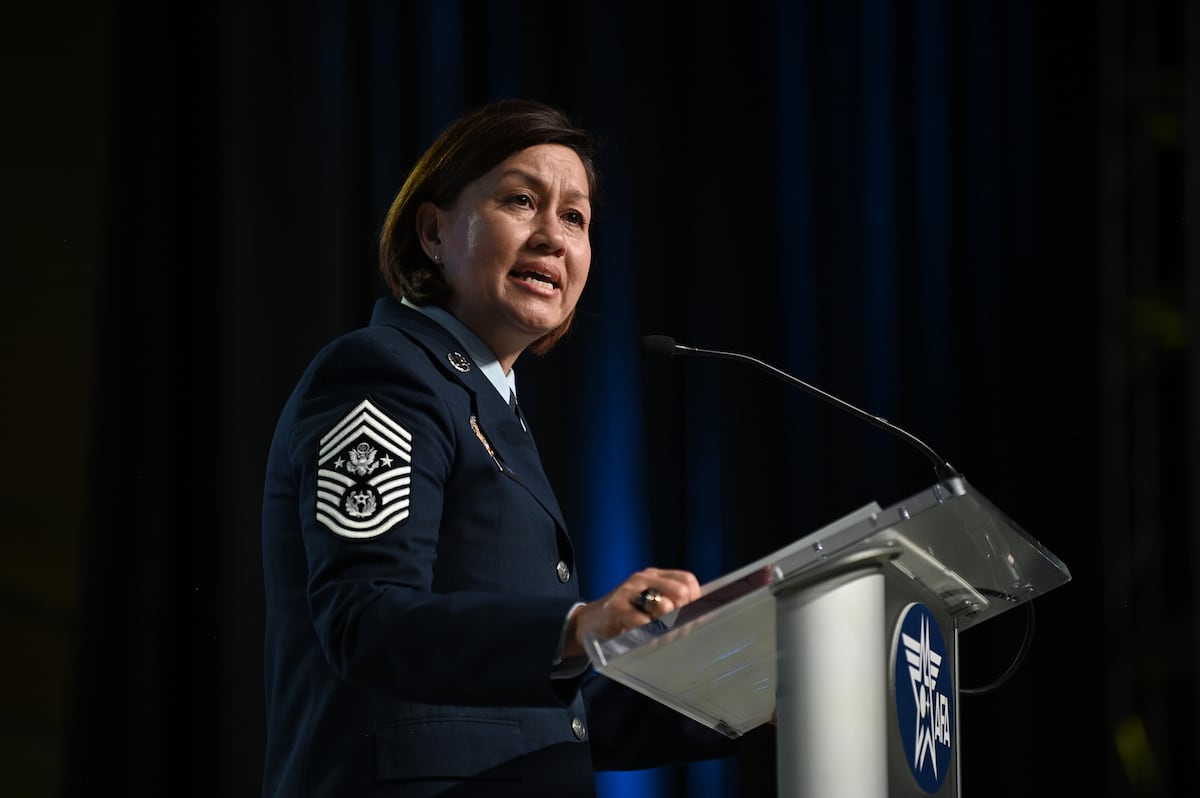
NATIONAL HARBOR, Md. — A new era of war fought in the digital realm, touching all aspects of combat and rife with disinformation, will require the Air Force to redefine its jobs and reinforce its rigor, the service’s top enlisted airman said here Wednesday.
In what may be her last major speech to the force while in the job, Chief Master Sergeant of the Air Force JoAnne Bass cautioned airmen not to “underestimate the cyber and the information domains” as major drivers and amplifiers of conflict.
“Warfare has taken on a new dimension,” Bass told a packed room at the Air and Space Forces Association’s annual Air, Space and Cyber Conference.
“Our adversaries understand the power of information, and they seek to exploit it, weaponize it and use it against us,” she said. “They aim to sow discord, erode trust and destabilize nations through the spread of disinformation and propaganda through emerging technology.”
She warned that “armies of bots, swarms of trolls and legions of ‘sock puppets’” run by nefarious parties are manipulating information online to distort perceptions of reality and shape society to their advantage.
That can look like Russian-linked social media operations to influence American voters in U.S. elections, phishing and hacking campaigns, or fake text and images generated by artificial intelligence.
Without naming specific social media, Bass said the service must educate airmen on the difference between “using these platforms and being used by them.” To prove her point, Bass said she had used the artificial intelligence language model ChatGPT to generate part of her speech.
Air Force leaders often raise concerns about falling behind in an age of digitally driven asymmetric warfare, and the changes that keeping up will require. The service in 2019 pulled information operations under the same umbrella as its intelligence and cyber divisions to begin bridging those gaps, but has struggled to recruit and retain the workforce to handle those missions.
Chief Master Sergeant of the Air Force JoAnne Bass becomes emotional as she reflects on her 30 years of service. (Mike Tsukamoto/Air & Space Forces Magazine)
In an exclusive interview with Air Force Times on Aug. 28, Bass said she believes the Air Force has too many career fields overall, and too few in the areas that will matter most in tomorrow’s wars.
“We have to take a strong look at our weapon systems, our platforms, the [jobs] that fill our Air Force,” Bass said. “Probably where we need to expand is in information, cyber and space.”
She declined to specify which Air Force specialty codes could be on the chopping block, or how many airmen the service might need to fill cyber and information ops jobs.
“I am not the best person to be able to say, ‘Here’s what we have too much of,’” she said. “What I’ve asked is [for] the career field managers to think deeply about their career fields, think deeply about what our Air Force is going to look like 10 years from now.”
She pointed to teams of airmen who are exploring what the future force could look like and said data analysis is underway to illuminate the way forward.
“We will continue as an Air Force to iterate to what we need to look like,” she added. “But we’re doing a lot of the groundwork and the homework right now.”
During her keynote, Bass reminded airmen that falling short of the Air Force’s conduct and appearance standards ultimately hurts the larger objective: presenting a unified front against America’s adversaries.
In June, she published an open letter to the force that pushed airmen to hold each other to high standards of professionalism to avoid damaging the service’s reputation and abilities.
“History shows that when standards erode, military capabilities and readiness decline,” she wrote. “We can’t afford to let this happen and still expect to keep pace with the rapid expansion of the Chinese military, Russian aggression, and other emerging global challenges.”
The Air Force has tried to implement more common-sense regulations for hairstyles, clothing and more that allow flexibility without hindering combat capability or unit cohesion. But Bass warned of taking it too far.
“If we are more focused on … ourselves, instead of the greater good of the force, then we are probably off-target,” she said.
Reflecting on her 30 years of service, Bass began to cry.
“I have greatly loved four things in life: my faith, my family, my country and this Air Force,” she said. “This is more than just a job. … This is our higher calling.”
Rachel Cohen is the editor of Air Force Times. She joined the publication as its senior reporter in March 2021. Her work has appeared in the Washington Post, the Frederick News-Post (Md.), Air and Space Forces Magazine, Inside Defense, Inside Health Policy and elsewhere.
马里兰州国家港——美国空军最高级别士官周三在此表示,一场在数字领域展开的新时代战争,涉及战斗的各个方面,并且充斥着虚假信息,这将要求空军重新定义其职责并加强其严谨性。
空军首席军士长乔安妮·巴斯在她任职期间可能最后一次向部队发表的重要讲话中,告诫空军官兵不要“低估网络和信息领域”,因为它们是冲突的主要驱动因素和放大因素。
“战争已经呈现出新的维度,”巴斯在空军和太空部队协会年度空军、太空和网络会议上对挤满房间的听众说道。
“我们的对手深谙信息的力量,他们企图利用信息、将信息武器化并用来对付我们,”她说。“他们旨在通过新兴技术传播虚假信息和宣传,从而制造不和、破坏信任并动摇国家稳定。”
她警告说,由不法分子操控的“机器人大军、网络喷子群和无数的‘傀儡账号’正在操纵网络信息,扭曲人们对现实的认知,并按照他们的意愿塑造社会。
这可能看起来像是与俄罗斯有关的社交媒体行动,旨在影响美国选民在美国大选中的投票、网络钓鱼和黑客攻击活动,或者人工智能生成的虚假文本和图像。
巴斯没有点名具体的社交媒体平台,但她表示,空军必须对官兵进行教育,让他们明白“使用这些平台”和“被这些平台利用”之间的区别。为了佐证自己的观点,巴斯说她曾使用人工智能语言模型 ChatGPT 生成部分语音。
空军领导人经常担忧在数字化驱动的非对称战争时代落后,以及跟上时代步伐所需的变革。2019年,空军将信息作战部门与情报和网络部门整合到同一体系下,试图弥合这些差距,但在招募和留住执行这些任务所需的人员方面却举步维艰。
空军首席军士长乔安妮·巴斯在回顾自己30年的服役生涯时,不禁潸然泪下。(迈克·冢本/《空军与太空部队》杂志)
8 月 28 日,巴斯在接受《空军时报》独家采访时表示,她认为空军的职业领域总体上太多,而在未来战争中最关键的领域却太少。
巴斯说:“我们必须认真审视我们的武器系统、平台以及空军的岗位配置。我们可能需要在信息、网络和太空领域进行扩张。”
她拒绝具体说明哪些空军专业代码可能会被裁撤,或者空军可能需要多少空军人员来填补网络和信息作战职位。
“我不是最适合说‘我们哪些方面过剩’的人,”她说。“我要求的是,各职业领域负责人深入思考各自的职业领域,深入思考我们空军十年后的发展方向。”
她指出,一些空军人员团队正在探索未来部队的形态,并表示正在进行数据分析,以指明前进的方向。
她补充说:“作为一支空军,我们将继续不断迭代,直至达到我们所需的水平。但我们现在正在做大量的准备工作和前期准备。”
巴斯在主题演讲中提醒空军官兵,如果达不到空军的行为和仪容标准,最终会损害更大的目标:在对抗美国敌人的斗争中展现统一战线。
6 月,她向空军发表了一封公开信,敦促空军官兵互相督促保持高标准的专业精神,以避免损害空军的声誉和能力。
她写道:“历史表明,当标准下降时,军事能力和战备水平就会下降。我们不能让这种情况发生,否则我们仍将指望跟上中国军力快速扩张、俄罗斯侵略以及其他新兴全球挑战的步伐。”
空军试图推行更符合常理的发型、服装等方面的规定,既要保证灵活性,又不能影响作战能力或部队凝聚力。但巴斯警告说,这样做可能会矫枉过正。
“如果我们更关注……我们自己,而不是部队的整体利益,那么我们可能就偏离了目标,”她说。
回想起自己30年的服务生涯,巴斯开始哭泣。
“我一生中最热爱的有四样东西:我的信仰、我的家人、我的国家和空军,”她说。“这不仅仅是一份工作……这是我们崇高的使命。”
瑞秋·科恩是《空军时报》的编辑。她于2021年3月加入该刊物,担任高级记者。她的作品曾发表在《华盛顿邮报》、《弗雷德里克新闻邮报》(马里兰州)、《空军与太空部队杂志》、《国防内幕》、《卫生政策内幕》等刊物上。