The US Army is back in the jungle. Panamanians are showing soldiers the way.美军重返丛林。巴拿马人正在为士兵们指引方向。
Panamanian service members have trained, lived — and in some cases, fought — in the jungle. Now, they are teaching U.S. service members.
Gunshots erupted from solid ground towards a boat that ferried Panamanian soldier Albis Fajardo and his team during a counter-drug mission along the country’s Pacific coastline.
The team attempted to return fire as they pulled back from a harrowing effort to target a cartel leader. Fajardo, then early into his military career, felt his adrenaline surge as he realized the team had been unsuccessful: A bullet had torn through the flesh of his friend.
Over a decade later, with the early autumn sun sinking over Panamanian base Aeronaval Cristóbal Colón, the 47-year-old, now a first sergeant, recounted the ordeal. His friend survived, but the horror changed Fajardo’s life.
The brush with death, he said, fueled him to learn as much as he could, militarily, and eventually led him to become an instructor at the U.S. Army’s Jungle Operations Training Course in Panama.
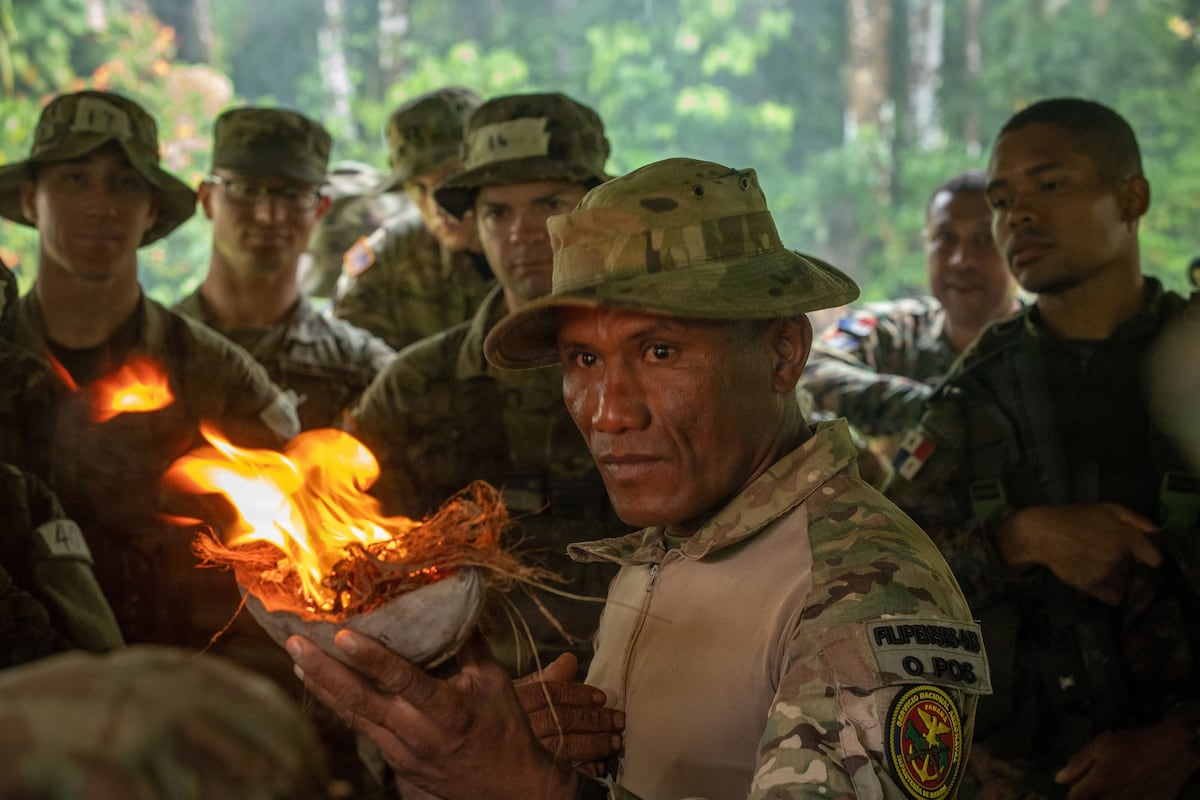
Albis Fajardo, a Panamanian instructor, teaches U.S. troops at the Army's jungle school in Panama. (Eve Sampson/staff)
The class, offered for decades in the Central American nation before it was shuttered in 1999, has resumed in partnership between U.S. and Panamanian forces, with Panamanian service members teaching and attending the 18-day course.
As Panama’s troops have trained, lived — and in some cases, fought — in such environments, they are largely seen by U.S. personnel as the ultimate masters of the terrain.
Lt. Col. Andrew Eagen, who heads the U.S. Jungle Operations Training Center in Panama, said that as U.S. forces developed the course, they became quickly attuned to the deft tactics their Panamanian counterparts had developed for survival.
“They are the experts of this environment. We will never catch up,” he told Military Times in a mosquito-riddled interview at the jungle school.
“This does not exist in the continental United States,” he said, gesturing to the lush canopy, which was twinkling with the day’s last glimmers of sun and abuzz with the evening hum of jungle creatures. “We do not have an exposure to it. They do, and they have incredible techniques and an incredible level of comfort that the average American [does not].”
Fajardo is one of nine Panamanian instructors — from three branches of the country’s armed forces — who teach at the reestablished school.
The instructors assist in some parts of the course, but lead in areas where students learn about jungle survival, Eagen said.
Two Panamanian instructors demonstrate how to clear brush with machetes at the U.S. Army's Jungle Operations Training Course in Panama in September 2026. (Eve Sampson/Staff)
In addition to the leading group, more than 10 Panamanian service members attended the course in which Military Times took part, according to Eagen.
Throughout each exercise, Panamanian troops sat interspersed with U.S. personnel and were placed in squads with a Spanish-speaking U.S. participant for course assignments.
Though the language barrier admittedly made some tactical movements difficult, U.S. personnel seemingly learned just from observing their Panamanian counterparts.
During one practical exercise, one squad had to hide in the jungle, cover their tracks to erase any disturbance to the foliage, and position themselves so they would be alerted to any incoming intruders.
The other squad’s job was to hunt down the hiding squad using tracking clues, the activity forming a tense game of tactical hide-and-seek.
The hunters ultimately won, thanks to one Panamanian squadmate who spotted a tiny vine that appeared slightly too parallel to the ground.
One rule of the jungle? Nothing is a straight line. The Panamanian student correctly identified the trailing plant, hovering inches above the muddy ground, as a hasty trip wire. Made using a vine and a piece of trash, it would have alerted the hiding squad to the hunters’ presence.
When the two groups gathered to discuss the interaction, the lanewalker found that the Panamanian student in the other squad had set up the tripwire; a particularly impressive development, considering a tripwire class was scheduled for later in the day.
During that class, an American instructor showed students how to create different forms of tripwires that could act as early warning systems. Some set off rattling cans. Others used fauna.
Before letting students practice, the instructor shared stories from Panamanian cadres who once operated in the Darién Gap, a roadless land bridge of brutally dense, remote jungle that spans 60-plus miles between Panama and Colombia and has been notoriously rife with human and drug trafficking.
Trip wires there are not historical relics of warfare from decades ago, the instructor said. Cartel members are using them now.
Several instructors, including Fajardo, have attended Panama’s own jungle school, called Panajungla.
Fajardo shook his head and shivered as he recounted the intense course in which participants were forced to survive on their own in the Teribe region of Panama’s Bocas del Toro province.
Students of the Panamanian course must shop at the “supermarket de la selva” — the jungle supermarket — to eat, using machetes to prepare or kill any nourishment they can find, Fajardo said.
Fajardo’s prized jungle delicacy is ñame, a tropical root vegetable similar to a yam. He also appreciates the taste of grubs, he said, which he likens to butter.
Tucked neatly into each Panamanian instructor’s backpack, razor-sharp machetes sat nestled in intricately carved leather coverings.
The U.S. Army teaches machete training in its jungle school, but some Panamanian instructors have attended a separate, more intensive course on using the long, daunting blade. It can clear brush, help prepare food, carve shelter and even help start a fire.
To Fajardo, it is the single most important tool for survival in the jungle. And with a smile, he jokingly referred to the machete as “mi esposa,” or my wife, in English.
The machetes of two Panamanian instructors at the U.S. Army's Jungle Operations Training Course in Panama. (Eve Sampson/Staff)
To date, the U.S. Army is developing the course to dedicate at least 20 of its 120 spots to partner forces and at least 15 to Panamanians.
Though no other countries have sent soldiers yet, Eagen is confident that the school is close to having Colombian students join.
The U.S. has partnered with Colombia’s Lancero course, which is similar to Ranger School, and all three countries exchange information. Panama supports hosting Colombian forces, Eagen added, as “they have a direct relationship with the country.
“They have a lot of shared bilat right there at the Darién,” Eagen said, “so both Panamanian leaders and Colombian leaders want them to be first.”
Panama’s expertise in navigating such unforgiving terrain, meanwhile, has also prompted other countries, like Costa Rica and Brazil, to express interest in the course, Eagen said.
Other jungle courses worldwide have so far informed the new U.S. Army jungle school’s curriculum, and Eagen said the Army is designing a scenario construct for the school using threat characteristics seen by Panamanian service members.
And while Panamanian forces often confront small-team drug trafficking operations attempting to establish supply lines, Eagen was clear that the Army endeavored to replicate a potential combat environment, not the country’s security situation.
“That is not the premise of us being in Panama,” he said. “We try to make sure there are clear boundaries of understanding for the students that this is about the skills required of the environment, not about the situation in Panama.”
Though public sentiment between the countries has ebbed and flowed in the decades that followed Panama’s 1994 formal abolishment of its standing army — several years after a U.S. military invasion ousted military dictator Manuel Noriega — those tensions were absent from interactions Military Times observed among the service members during the course.
Eagen said the U.S. is mindful of the pride Panamanians take in their nation’s sovereignty. The Army, he added, has been purposeful in approaching the course’s renewed partnership with an emphasis on learning from — rather than simply teaching — its Panamanian counterparts.
Eve Sampson is a reporter and former Army officer. She has covered conflict across the world, writing for The New York Times, The Washington Post and The Associated Press.
枪声从坚实的地面传来,朝着一艘载着巴拿马士兵阿尔比斯·法哈多和他的团队的船只袭来,当时他们正在该国太平洋沿岸执行缉毒任务。
在一次惊心动魄的行动中,小队试图击毙一名贩毒集团头目,随后撤退。法哈多当时军旅生涯尚浅,当他意识到小队行动失败时,肾上腺素飙升:一颗子弹穿透了他朋友的血肉。
十多年后,初秋的夕阳西下,巴拿马克里斯托瓦尔·科隆海军航空基地上空一片昏暗,这位现年47岁、已晋升为一级军士长的男子回忆起那段可怕的经历。他的朋友幸存了下来,但这场恐怖事件改变了法哈多的一生。
他说,这次与死神擦肩而过的经历激励他尽可能多地学习军事知识,最终使他成为美国陆军在巴拿马丛林作战训练课程的教官。
巴拿马籍教官阿尔比斯·法哈多在巴拿马陆军丛林学校为美军士兵授课。(伊芙·桑普森/摄)
该课程曾在中美洲国家巴拿马开设数十年,但在 1999 年关闭。如今,该课程已在美国和巴拿马军队的合作下恢复,巴拿马军人将教授和参加为期 18 天的课程。
由于巴拿马军队在这样的环境中接受过训练、生活过,甚至在某些情况下还打过仗,因此美国人员普遍认为他们是这片地形的最终主人。
驻巴拿马美国丛林作战训练中心负责人安德鲁·伊根中校表示,随着美军制定课程,他们很快就适应了巴拿马同行为生存而开发的巧妙战术。
“他们才是这片环境的专家。我们永远也赶不上他们,”他在丛林学校接受《军事时报》采访时说道,当时学校里蚊虫肆虐。
“这在美国大陆并不存在,”他一边说着,一边指向郁郁葱葱的树冠,夕阳的余晖在树冠上闪烁,丛林生物的嗡嗡声在耳边回荡。“我们没有机会接触到这种环境。他们有,而且他们掌握着令人难以置信的技巧,享受着普通美国人无法企及的舒适感。”
法哈多是九名巴拿马籍教官之一,他们来自该国武装部队的三个分支,在这所重建的学校任教。
伊根说,教练会在课程的某些部分提供协助,但在学生学习丛林生存技能的领域,教练会进行指导。
2026年9月,两名巴拿马籍教官在巴拿马举行的美国陆军丛林作战训练课程上演示如何用砍刀清理灌木丛。(Eve Sampson/Staff摄)
据伊根称,除了主要学员外,还有 10 多名巴拿马军人参加了《军事时报》参与的课程。
在每次演习中,巴拿马军队与美国人员交错就坐,并被安排与一名讲西班牙语的美国学员组成小队,以完成课程任务。
虽然语言障碍确实给一些战术行动带来了困难,但美国人员似乎仅仅通过观察巴拿马同行就学会了如何进行战术行动。
在一次实战演习中,一个小队必须藏身于丛林中,掩盖行踪,消除对植被的任何干扰,并占据有利位置,以便对任何入侵者发出警报。
另一支小队的任务是利用追踪线索追捕躲藏的小队,这项活动形成了一场紧张刺激的战术捉迷藏游戏。
多亏一名巴拿马队员发现了一根看起来与地面略微平行的小藤蔓,猎人们最终取得了胜利。
丛林法则之一?世上没有直线。这位巴拿马学生正确地辨认出,那株悬在泥泞地面几英寸外的垂吊植物,是一根简易的绊线。它由藤蔓和一块垃圾制成,一旦被埋伏起来,就会暴露猎人的行踪,让藏匿的小队察觉到他们的存在。
当两组人聚在一起讨论这次互动时,巡视员发现对方队伍中的巴拿马学生设置了绊线;考虑到当天晚些时候还安排了绊线课程,这真是一个令人印象深刻的发现。
在那堂课上,一位美国讲师向学生们展示了如何制作不同类型的绊线,这些绊线可以作为预警系统。有些绊线会触发发出沙沙声的罐子,有些则利用了动物。
在让学生练习之前,教官分享了巴拿马干部的故事,他们曾经在达连地堑活动。达连地堑是一条没有道路的陆桥,由极其茂密、偏远的丛林组成,横跨巴拿马和哥伦比亚之间 60 多英里,长期以来以人口贩运和毒品走私猖獗而臭名昭著。
教官说,这些绊线并非几十年前战争遗留下来的历史文物,而是贩毒集团成员现在仍在使用的装置。
包括法哈多在内的几位教练都曾在巴拿马自己的丛林学校——Panajungla——学习过。
法哈多一边摇头一边颤抖着,讲述着那场艰苦的训练,训练中参与者被迫在巴拿马博卡斯德尔托罗省特里贝地区独自求生。
法哈多说,巴拿马课程的学生必须在“丛林超市”购买食物,用砍刀准备或猎杀他们能找到的任何食物。
法哈多最珍视的丛林美食是ñame,一种类似山药的热带根茎类蔬菜。他还说,自己很喜欢吃幼虫,觉得味道像黄油。
每位巴拿马教练的背包里都整齐地装着一把把锋利的砍刀,刀柄用精雕细琢的皮革包裹着。
美国陆军在其丛林学校教授砍刀训练,但一些巴拿马教官还参加过一个单独的、更为密集的课程,学习如何使用这种又长又锋利的刀刃。它可以用来清理灌木丛、准备食物、搭建庇护所,甚至还能生火。
对法哈多来说,它是丛林生存最重要的工具。他笑着开玩笑地把这把砍刀称为“mi esposa”,也就是英语里的“我的妻子”。
两名巴拿马籍教官在巴拿马参加美国陆军丛林作战训练课程时使用的砍刀。(伊芙·桑普森/摄)
迄今为止,美国陆军正在制定课程计划,将 120 个名额中的至少 20 个分配给伙伴部队,至少 15 个分配给巴拿马人。
虽然其他国家还没有派遣士兵,但伊根相信,哥伦比亚学生很快就会加入这所学校。
美国与哥伦比亚的兰塞罗训练营建立了合作关系,该训练营类似于游骑兵学校,三国之间会进行信息交流。伊根补充说,巴拿马支持哥伦比亚军队驻扎,因为“他们与该国有着直接的联系”。
“他们在达连地区有很多共同利益,”伊根说,“所以巴拿马领导人和哥伦比亚领导人都希望他们能成为第一。”
伊根表示,巴拿马在应对这种严酷地形方面的专业知识也促使哥斯达黎加和巴西等其他国家对该航线表示了兴趣。
到目前为止,世界各地的其他丛林课程都为美国陆军新丛林学校的课程提供了参考,伊根表示,陆军正在利用巴拿马军人所看到的威胁特征,为该学校设计一个场景结构。
尽管巴拿马军队经常与试图建立补给线的小规模贩毒团伙作战,但伊根明确表示,陆军努力复制的是潜在的作战环境,而不是该国的安全形势。
他说:“这并非我们来巴拿马的初衷。我们努力确保学生们清楚地理解,我们关注的是适应环境所需的技能,而不是巴拿马的局势。”
尽管在巴拿马于 1994 年正式废除常备军之后的几十年里,两国之间的公众情绪时而高涨时而低落(此前几年,美国军事入侵推翻了军事独裁者曼努埃尔·诺列加),但在《军事时报》观察到的军人课程期间的互动中,这些紧张局势并不存在。
伊根表示,美国深知巴拿马人民对国家主权的自豪感。他还补充说,陆军在推进与巴拿马的合作项目时,一直秉持着向巴拿马同行学习而非单方面传授知识的原则。
伊芙·桑普森是一名记者,也是一名前陆军军官。她曾报道过世界各地的冲突,为《纽约时报》、《华盛顿邮报》和美联社撰稿。