Tax grab targeted at outbound passengers is opposed by travel industry as ministry pushes a new agenda旅游业反对政府推行针对出境旅客的税收政策,与此同时,政府也在积极推进一项新议程。
Tourism revolt in Thailand. Three industry groups oppose a ฿1,000 airport departure tax, warning of higher airfares and weaker demand. Minister Surasak was unaware that… Read More ›
新闻视频
October 13, 2026 at 12:18 pm
in Economy , Living , Media , Politics , Thailand
Thailand’s Finance Ministry is pushing ahead with a controversial departure tax despite mounting opposition from tourism and aviation leaders. The proposed ฿1,000 levy would hit Thais and foreign visitors alike, with the power to raise it to ฿5,000. Yet Tourism Minister Surasak Phancharoenworakul admits he was unaware foreigners would be charged. Meanwhile, Finance Minister Ekniti Nitithanpraphas wants to discourage Thais from holidaying abroad. Three major tourism associations have formally objected, warning of higher airfares, lost business and reduced flights. The dispute comes as Thailand faces a staggering ฿898.8 billion fiscal deficit, missed tax targets and mounting public debt. Some African countries already impose combined departure charges approaching $300. Now, with a separate ฿450 tourist entry levy also planned, Thailand faces a growing battle over taxation, tourism and its deteriorating public finances.
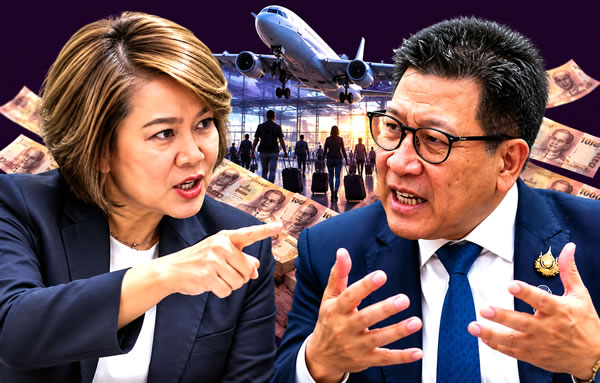
Deputy Prime Minister and Minister of Finance Ekniti Nitithanprapas pushes a ฿1,000 departure tax on Thais and foreign visitors, with scope to raise it to ฿5,000. Thai Travel Agents Association (TTAA) President Kalayanee Asanee leads objections, warning of higher airfares, reduced flights and damage to tourism. ( Source: Thansettaki )
Thailand’s Finance Ministry faces growing opposition to its proposed ฿1,000 departure tax on international air passengers. Three major tourism associations have formally challenged the plan, warning of damage to travel demand and airline connectivity.
Meanwhile, Tourism Minister Surasak Phancharoenworakul has revealed he was unaware foreign visitors would also be taxed. Finance Minister Ekniti Nitithanpraphas remains determined, arguing that the levy could discourage Thais from holidaying overseas.
Crucially, the proposed law permits the tax to rise fivefold to ฿5,000 per passenger. The initiative comes amid mounting budget deficits, missed revenue targets, weak economic growth and rising public debt.
Thailand proposes ฿1,000 air departure tax with power to raise levy fivefold to ฿5,000 per passenger
The Revenue Department opened public consultation on the proposed Departure Tax Act on September 30. The consultation closes on October 29. Under the draft, Thai citizens and foreign nationals would initially pay ฿1,000 whenever departing Thailand by air.
The charge would apply regardless of travel purpose. Consequently, holidaymakers, business travellers, students and overseas workers would all face the new expense, subject to specified exemptions.
Airlines and ticket agents would collect the levy through ticket sales. Land and sea departures would initially remain exempt. Additionally, children under two, qualifying transit passengers and certain official government guests would not pay. The draft also provides enforcement powers, financial penalties and surcharges for non-payment.
However, the legislation goes considerably further than the initial ฿1,000 charge. Section 8 establishes a maximum departure tax of ฿5,000 per passenger. Moreover, the government could adjust the rate through ministerial regulations. Future increases within that ceiling would therefore not require another Act of Parliament. If enacted, the legislation would take effect 180 days after publication in the Royal Gazette.
Finance Ministry revives departure tax after 35 years as Ekniti seeks to keep Thai spending at home
For now, the proposal remains under consideration. Cabinet approval has not been confirmed, and no implementation date has been announced. Nevertheless, the Finance Ministry continues the consultation process despite widening opposition from tourism businesses and aviation representatives.
The initiative would revive departure taxation under legislation introduced more than four decades ago. Thailand originally established the framework in 1983. Subsequently, land and sea departures received exemptions in May 1986. International air travel was exempted in July 1991. The latest proposal would therefore restore departure taxation for air passengers after 35 years.
Notably, the new legislation would extend coverage to travellers of every nationality. The earlier framework covered Thai citizens and foreign permanent residents. The Finance Ministry has presented the proposal as a means of strengthening government revenue and improving fiscal flexibility. However, Finance Minister Ekniti has identified another objective: encouraging Thai citizens to spend their holidays domestically.
On October 7, Ekniti publicly defended the proposal. He argued that discouraging overseas holidays could retain more Thai spending within the country. In turn, that spending would support domestic tourism, local businesses and communities. The Deputy Prime Minister therefore presented the levy as both a revenue measure and an instrument influencing travel choices.
Tourism Minister Surasak says he was unaware foreign visitors would face the proposed departure tax
Yet the proposed tax would not distinguish between overseas holidays and other international journeys. Thai citizens travelling for employment, education, business or family commitments would face the same initial charge. Equally, foreign tourists leaving Thailand would be required to pay. This wider application has become a central point of contention.
Indeed, the minister responsible for tourism was unaware that foreign visitors were included. On October 8, Tourism and Sports Minister Surasak Phancharoenworakul publicly questioned the Finance Ministry’s proposal. Speaking to Thai media outlet Thansettakij, he explained that he understood the measure to concern Thai citizens travelling overseas.
Surasak believed the revenue might support domestic tourism programmes, reducing the need for direct government subsidies. However, he had not previously been informed about the proposed tax on foreign tourists. In response, he said he intended to obtain the draft legislation and discuss the matter directly with Ekniti.
The Tourism Minister also questioned the wisdom of charging foreign visitors when another tourist levy was already under consideration. That separate proposal would impose a ฿450 entry charge on eligible foreign arrivals, initially targeting air passengers. Furthermore, Thailand already collects airport passenger service charges from international travellers.
Surasak questions overlapping tourist charges as travel agents launch formal opposition to departure levy
Surasak questioned whether foreign visitors should face additional charges both when entering and leaving Thailand. Instead, he suggested considering one collection mechanism rather than imposing overlapping fees.
No agreement between the two ministers has been confirmed. The intervention exposed differences between the Finance Ministry’s taxation plans and the concerns of the Tourism and Sports Ministry.
Meanwhile, private sector criticism has developed into organised opposition. The Association of Thai Travel Agents (ATTA) was among the first major organisations to challenge the draft legislation. Its secretary-general, Dr Adith Chairattananon, confirmed that the association had adopted a formal position against the proposal. The organisation, led by president Thanapol Cheewarattanaporn, prepared an objection addressed to Ekniti.
On October 8, local media reported six principal arguments raised by ATTA. The association first challenged the treatment of international departures as discretionary holiday spending. Thai citizens also travel overseas for education, employment, trade, investment and other economic activities. Accordingly, the proposed levy would affect people whose journeys had no connection with holidays.
Travel agents warn new tax could raise fares, cut airline routes and hit businesses recovering from floods
A second objection concerned the accumulation of travel charges. ATTA warned that passengers already faced higher airport fees, with another foreign tourist entry charge under consideration. The proposed departure tax would therefore increase costs across several categories of international travel.
The association also questioned the timing. Households and small businesses were still recovering from serious flooding, while economic conditions remained difficult. Against that background, ATTA warned that another charge would increase pressure on businesses and consumers.
A fourth objection concerned airlines. Higher ticket prices could weaken passenger demand and reduce aircraft load factors. Consequently, some international routes might become less commercially attractive. Airlines could respond by reducing flight frequencies, available seats or planned services.
ATTA also highlighted the wider economic importance of outbound travel. The association cited more than 13 million Thai outbound travellers and emphasised international commercial relationships. Overseas journeys support trade, investment, education and business cooperation. Therefore, the association argued that their economic importance extended beyond holiday spending.
Finally, ATTA demanded a comprehensive assessment of the measure’s economic consequences. It argued that projected tax receipts should not be considered separately from wider costs. The association urged the Finance Ministry to suspend progress while consulting tourism, transport and business representatives.
Thai Hotels Association opposes departure tax over risks to foreign tourism and international flights
On another front, the Thai Hotels Association (THA) joined the opposition on October 9. THA president Thienprasit Chaiyapatranun confirmed that the association had written to the Revenue Department’s director-general. Its submission opposed the draft legislation and warned about Thailand’s competitiveness against other regional tourism destinations.
The association identified potential consequences for hotels, restaurants, retailers, tour operators and smaller businesses dependent on foreign visitors. In particular, it warned that higher travel costs could weaken demand. The concerns also extended to international airline connectivity, which supports Thailand’s inbound tourism industry.
Airlines depend on passengers travelling in both directions when assessing international routes. Accordingly, weaker Thai outbound demand could affect services bringing foreign tourists into Thailand. The THA warned that reduced passenger volumes might eventually lead to lower flight frequencies or capacity.
Its objections therefore extended beyond the direct cost of the proposed tax. The association warned that airlines, hotels and other businesses could face consequences from weaker international connectivity. It requested withdrawal of the proposal or a comprehensive economic impact assessment before further consideration.
Aviation industry warns flat ฿1,000 departure tax could hit low-cost passengers and airline route demand
Separately, senior aviation industry sources criticised the measure in reporting published by The Standard on October 9. One source characterised the proposal as an easy way to raise revenue while imposing wider costs on tourism. Another warned that airlines were unlikely to absorb the additional expense. Instead, passengers would ultimately face higher ticket prices.
The potential impact is particularly significant for short-haul and low-cost travel. An additional ฿1,000 represents a larger proportion of a cheap regional ticket than an expensive intercontinental fare. Yet the draft makes no distinction between short and long journeys. Nor does it differentiate between economy and premium-class passengers.
As a result, passengers using low-cost regional services would face the same flat tax as long-haul business-class travellers. Aviation representatives also warned about the consequences for international route planning. Airlines assess passenger demand in both directions when determining commercial viability.
If outbound traffic weakened, some international services could become less profitable. Reduced frequencies or capacity could then affect inbound tourism. These remain industry forecasts rather than established effects. The proposed tax has not been implemented, and no resulting passenger decline has been measured.
Outbound travel operators challenge departure tax and warn of damage to Thailand’s aviation ambitions
Opposition intensified further when the Thai Travel Agents Association (TTAA) entered the dispute. On October 11, president Kalayanee Asanee confirmed that the organisation had written directly to Ekniti. The association represents businesses arranging overseas travel for Thai customers. Its submission opposed the proposed ฿1,000 charge on Thai citizens.
TTAA argued that the levy would impose a burden regardless of travellers’ financial circumstances or reasons for departure. Furthermore, it challenged the assumption that international travel simply removed consumer spending from Thailand. The association identified trade, investment and human resource development as important reasons for overseas journeys.
The organisation also warned about consequences for aviation and inbound tourism. According to TTAA, airlines depend on sufficient traffic in both directions to sustain international services. Lower outbound demand could therefore weaken the commercial case for maintaining routes. Operators might reduce frequencies, seating capacity or investment in new services.
TTAA argued that such consequences would conflict with Thailand’s ambition to become a regional aviation hub. It also identified unresolved taxation problems already affecting outbound tour operators. In particular, the association raised longstanding concerns about value-added tax on overseas travel services.
Thai travel agents challenge overseas tour VAT rules and question Revenue Department consultation process
Thai tour operators purchase accommodation, meals and other services in foreign destinations. Those purchases can already include taxes imposed where the services are consumed. However, TTAA argued that operators also face Thai VAT complications involving those overseas costs.
Some expenses cannot be used to claim corresponding Thai input tax credits, according to the association. Consequently, operators may face cumulative taxation on elements of their international tour packages. TTAA has repeatedly called for the government to review this treatment.
The association argued that taxation should reflect where goods and services are consumed. It therefore opposed introducing another international travel tax before resolving the existing VAT problem. These concerns added a separate business taxation dispute to the widening campaign against the departure levy.
TTAA also criticised aspects of the Revenue Department’s public consultation. Specifically, it questioned the reliability of responses collected through the online questionnaire. The association raised concerns about limitations in verifying respondents’ identities and the wording of certain questions.
One objection concerned the distinction between taxing Thai citizens and taxing foreign visitors. Respondents might oppose a tax on Thai nationals while holding different views about foreign travellers. However, TTAA argued that the questionnaire did not clearly accommodate those differences.
Three tourism groups oppose departure tax as airport charges and proposed tourist fees mount for visitors
The association requested additional opportunities for directly affected businesses to submit detailed responses. It also demanded an economic assessment covering citizens, businesses, airline connectivity and tourism competitiveness. By October 12, three major tourism associations had formally challenged the proposed legislation.
ATTA focused on wider economic consequences and international travel costs. The THA highlighted inbound tourism, hotel businesses and aviation connectivity. Meanwhile, TTAA raised outbound travel, aviation policy, VAT complications and the consultation process. Despite these objections, the Finance Ministry has not withdrawn the proposal.
The dispute comes after Thailand substantially increased existing airport charges. On June 20, Airports of Thailand raised its international passenger service charge from ฿730 to ฿1,120. That represented an increase of ฿390, or approximately 53.4%. Consequently, the proposed ฿1,000 departure tax would bring combined departure charges at AOT airports to ฿2,120.
For eligible foreign visitors, another proposed charge remains under consideration. The government is separately examining a ฿450 tourist entry fee, initially applying to air arrivals. If both measures proceeded, eligible visitors would face three separate travel-related charges.
These comprise the existing ฿1,120 airport fee, the proposed ฿1,000 departure tax and the proposed ฿450 entry charge. Together, they would total ฿2,570 per eligible passenger. For a family of four, the combined amount would reach ฿10,280. Of that total, ฿5,800 would arise from the two proposed new measures.
Draft tax ceiling of ฿5,000 would push combined passenger charges higher as Africa provides comparison
However, only the higher airport passenger service charge is currently in force. Neither the new departure tax nor the separate tourist entry charge has been implemented. The distinction is important because the government’s combined charging plans remain subject to separate decisions.
More significantly, the draft Departure Tax Act permits a much higher rate than the proposed initial ฿1,000. At the statutory ceiling of ฿5,000, the departure tax and existing AOT fee would total ฿6,120. Adding the proposed ฿450 tourist entry charge would increase the combined amount to ฿6,570 for an eligible visitor.
The maximum departure tax would therefore be five times the initial rate. Furthermore, the government could make increases through ministerial regulations within the proposed statutory ceiling. This would provide substantial flexibility to raise collections without passing another Act.
International comparisons show that several countries already impose substantial charges on departing air passengers. Notably, some of the highest combined taxes and airport fees are found in Africa. The African Airlines Association (AFRAA) examined passenger charges using data collected in September 2024. Its findings were published in June 2025.
Gabon and Sierra Leone approach $300 in combined air departure charges as regional differences widen
Gabon recorded the highest combined international departure charges in the African study, at $297.70 per passenger. Sierra Leone followed at $294, while Nigeria ranked third at $180. Djibouti recorded $168.70, placing it fourth among the countries examined.
Niger followed at $130.70, Benin at $123.40 and Senegal at $122.60. Liberia recorded $115, Ghana $111.50 and the Democratic Republic of Congo $109.90. Chad’s combined charges reached $105.70.
Importantly, these figures include government taxes, airport fees and other passenger charges. They are not standalone departure taxes directly comparable with Thailand’s proposed levy. Nevertheless, they establish the substantial costs attached to international departures in several African countries.
Sierra Leone’s combined figure had more than doubled from $139 in 2022. That represented an increase of approximately 111.5%. Nigeria’s charges also rose sharply, increasing from $120 in 2022 to $180 in 2024.
By contrast, Djibouti recorded a reduction from $184.40 to $168.70. Niger’s charges also declined, falling from $148.30 to $130.70. The figures show considerable differences between individual African countries and changes over the two-year period.
AFRAA also identified substantial regional variations. West Africa recorded the continent’s highest average international departure charges, at approximately $110 per passenger. Central Africa followed at $107, while Eastern Africa averaged $63. Southern Africa recorded $35 and Northern Africa $25.
African departure charges vary sharply as IATA study finds substantial aviation taxes in other countries
Across the continent, combined international departure taxes and charges averaged $68 in 2024. That compared with $66 in 2022. The figures include multiple passenger charges rather than government departure taxes alone.
Separate research by the International Air Transport Association examined specific aviation taxes across 55 countries. Argentina recorded the highest average among those studied, at approximately $138 per departing passenger. Mauritius followed at $64, while Mexico averaged approximately $50.
Britain averaged $37, the United States $29, Egypt $28 and Germany $20. However, individual British departure taxes can be substantially higher than the national average. The country’s Air Passenger Duty varies according to journey distance and travel class.
From April 2026, Britain’s long-haul economy rate reached £106 per passenger. Premium-class passengers on comparable routes faced charges of £253. Meanwhile, the highest rate reached £1,141 for passengers travelling on qualifying larger private aircraft.
The Netherlands imposes a flat departure tax of €30.25 in 2026. Australia also collects a Passenger Movement Charge of A$70. Thailand’s proposed initial ฿1,000 levy is equivalent to approximately $30.
However, the proposed ฿5,000 ceiling represents approximately $150. At that level, Thailand’s standalone tax would exceed Argentina’s $138 average in the IATA study. It would also exceed the averages reported for Mauritius, Mexico, Britain, the United States, Egypt and Germany.
Finance Ministry pursues new tax as Thailand faces ฿898.8 billion deficit and mounting public debt
By comparison, Gabon and Sierra Leone already record combined international departure charges approaching $300. Those African figures include airport charges as well as taxes. Nevertheless, they demonstrate the scale of passenger charges imposed in some international aviation markets.
The Finance Ministry’s determination to pursue another tax comes amid mounting pressure on Thailand’s public finances. The country’s fiscal 2025 accounts recorded a deficit of approximately ฿898.8 billion. That represented an increase of 20.6%. In addition, all three major tax collection departments missed their revenue targets.
Public debt reached approximately 65.08% of gross domestic product. Consequently, Thailand has limited headroom beneath its existing 70% public debt ceiling. Weak economic growth is also restricting the expansion of the government’s revenue base.
At the same time, expenditure commitments continue to place pressure on public finances. The combination leaves the Finance Ministry facing substantial financing requirements and limited fiscal flexibility. Additional revenue sources have therefore become increasingly important to the government’s financial position.
The proposed departure tax forms part of that broader fiscal picture. The Finance Ministry has presented the legislation as a means of strengthening government resources. Separately, Ekniti has argued that discouraging overseas holidays could retain more Thai spending within the domestic economy.
Departure tax targets all passengers despite Finance Minister’s aim to discourage Thai overseas holidays
However, those objectives affect different groups of travellers. The revenue measure would apply to all departing passengers covered by the legislation. By contrast, the domestic tourism argument principally concerns Thai residents choosing between overseas and domestic holidays.
Foreign visitors would also pay the tax, despite their spending already contributing to Thailand’s tourism economy. The legislation would therefore collect revenue from travellers whose journeys had no connection with the Finance Minister’s domestic holiday objective.
Moreover, the proposed ฿5,000 ceiling would give the government considerable scope for future increases. The initial ฿1,000 charge could rise fivefold without another Act of Parliament. That provision carries particular significance amid growing pressure on government revenue.
Thailand faces a deficit approaching ฿900 billion, missed tax collection targets and rising public debt. Furthermore, weak growth limits the expansion of revenue collections while spending commitments continue. These conditions have raised concerns about the country’s fiscal position in the coming years.
The figures establish mounting fiscal pressure, although they do not demonstrate that a fiscal crisis is inevitable. Nor does the supplied reporting identify a verified official revenue forecast for the proposed departure tax. The wider economic consequences identified by tourism associations also remain projections rather than measured outcomes.
Rising fiscal pressure fuels departure tax dispute as tourism groups warn of costs to international travel
Nevertheless, the fiscal pressures facing the Finance Ministry are substantial. A deficit approaching ฿900 billion creates significant financing requirements. Meanwhile, public debt is moving closer to the statutory ceiling. Weak economic growth further restricts the government’s ability to increase revenue through economic expansion.
Against this background, the departure tax has become a dispute over both government revenue and tourism competitiveness. The Finance Ministry would gain another source of revenue and the ability to increase rates. Tourism businesses, however, warn that higher travel costs could damage demand and international airline connectivity.
The political differences are equally clear. Ekniti has publicly defended the levy as a means of retaining Thai holiday spending domestically. Surasak, meanwhile, has questioned its application to foreign visitors and the prospect of overlapping entry and departure charges.
Three major tourism associations have now formally opposed the measure. Their submissions raise concerns about airline capacity, hotel demand, international business travel and existing taxation problems. Aviation industry representatives have added warnings about higher ticket prices and weaker route profitability.
Consultation closes October 29 with tax still unapproved and questions over foreign visitors unresolved
The next deadline is October 29, when the Revenue Department’s public consultation closes. Afterwards, the government must decide whether to advance, amend or abandon the legislation. Cabinet approval has not been confirmed, and no implementation date has been announced.
Several questions remain unresolved. The Finance Ministry has not confirmed whether it will reconsider charging foreign tourists following Surasak’s intervention. Similarly, the supplied reporting identifies no comprehensive economic impact assessment or verified official revenue forecast.
The government has also not confirmed whether additional exemptions will be considered. Nor has it established how the departure tax would operate alongside the separate ฿450 tourist entry charge.
For now, the Finance Ministry continues to pursue the proposal despite increasingly organised opposition. Its draft would initially collect ฿1,000 from international air passengers, with legal scope to increase the charge to ฿5,000.
Meanwhile, the government faces weak revenue performance, a widening deficit and public debt approaching its statutory limit. The departure tax would introduce another revenue source as those pressures intensify. However, its final scope and rate remain undecided ahead of the October 29 consultation deadline.
Failing foreign tourism sector at war over tourist levy and exactly who benefits from the billions raised
New taxes simply for going in and out of Thailand in addition to higher airport tax already implemented
New tourist tax of 450 baht a step closer with officials targeting early 2027 after cabinet approval is obtained
End of 2026 or early 2027 for tourist levy which has risen to 450 baht and will apply to incoming air passengers
6th Minister of Tourism and Sports in 3 years promises a tourist levy, a policy first proposed in 2015
Hardline foreign tourism confirmed by new minster. More charges, shorter visas and mandatory insurance
Visa entry period to go from 60 to 30 days. Agreement in principle as foreign tourism numbers fall by 10%
60-day visa regime to be ended confirms Minister responding to rising industry security concerns
Tourism boss warns Thailand it is facing a Chinese blacklist if another security controversy erupts
Ung Ing finally gives the order. Thailand pulls the plug on scam centre electricity in Burma. Cut at 9 am
PM on a mission to China to ask President Xi Jinping to help rein in heavy online criticism of the kingdom
Joseph Anthony is an expat from Ireland who has lived in Thailand for the last decade. He has worked extensively in the media including editorial positions in Ireland and Thailand. He is focused on economic and business stories in Thailand as well as the expat lifestyle.
All posts by Joseph O' Connor
Eleven arrested in Saturday property raids linked to foreigners with links to criminality across Bangkok October 10, 2026 Police raid Bangkok’s luxury estates, targeting
Burmese drug kingpin with multiple identities and lives linked to massive cash seizure in Chiang Rai October 10, 2026 Dead in 2022. Arrested in South Korea in 2026. Noo
Thailand reels at story of mother taken against her will to a prison like nursing home with caged beds for inmates October 9, 2026 Police probe a family nightmare as Mother Phat, 63,
51 year old Frenchman arrested in Chiang Mai for running a tourist hostel through a nominee company October 9, 2026 Frenchman arrested after police raid a Chiang Mai
Queen is first Thai woman to fly a Swedish Gripen fighter jet. King in Surat Thani to congratulate her October 9, 2026 From Boeing jets to a supersonic fighter: Queen
Justice Minister and other cabinet members lead raids on Jewish centres in Bangkok as financial case grows October 8, 2026 A tiny Bangkok office registered to six entities, 61
Licenced online gambling site abroad linked to the husband of a government MP raises legal quandary October 8, 2026 A ฿1.9bn wealth controversy threatens to engulf
Horror care centre closed in Kanchanaburi where patients were locked into caged beds and prison cells October 7, 2026 Steel cage beds, barred rooms and psychiatric patients
New tourist tax of 450 baht a step closer with officials targeting early 2027 after cabinet approval is obtained October 7, 2026 Foreign tourists face a ฿450 Thai entry charge from
Corruption and crime crusader carted off to Bangkok Remand Prison after court refused last minute bail October 5, 2026 Atchariya is behind bars after losing bail as cyber
Vietnam’s economic growth races ahead of Thailand’s putting it on track to overtake its net GDP by 2029 October 5, 2026 Thailand’s economic lead is under pressure as
America reached out to Thais in Korat last weekend with a county fair show hosted by Ambassador O’ Neill October 5, 2026 Freedom, jazz and enterprise take centre stage in
Two Germans killed on Khao Lak died on a road that had already claimed foreign lives and seen carnage October 4, 2026 German couple killed at a Khao Lak crossing join a
Harrowing moments for husband in Chonburi who saw his wife killed by an angry elephant early Sunday October 4, 2026 Wild elephant pursues and kills Wanna Sridachama, 36,
Drunk driver mowed down a Thai woman and her German friend in Saturday’s early hours. Both died October 4, 2026 Double tragedy on Bangkok’s Thong Lor Road as Thai
Top anti corruption crusader arrested and charged by police in online gambling probe linked to boxing October 3, 2026 Thailand’s top crime fighter Atchariya is jailed
US raises the stakes on industrial capacity and transshipments posing trade barriers to Thai exports October 3, 2026 Bangkok’s US trade bargain faces a tariff
Counterfeiting racket selling on TikTok and Lazada busted in Samut Sakhon. Six foreigners arrested on site October 10, 2026
PM says he can explain. Denies power over impartial agencies as a no confidence motion is filed in House October 10, 2026
Murder in Trang over meth tablet dealing. Two men arrested after burned remains found near reservoir October 9, 2026
Commerce Minister says that a November signing of a US Thai trade deal is in sight as exporters stand by October 9, 2026
Armed police action in Nonthaburi as man wanted for attempted murder sought to evade an arrest warrant October 9, 2026
Thailand struggles economically even with revised World Bank GDP growth for 2026 coming in at 2% for 2026 October 8, 2026
New taxes simply for going in and out of Thailand in addition to higher airport tax already implemented October 8, 2026
Thaksin comes to Tax Court in Bangkok seeking temporary injunction to halt Revenue Department’s enforcement October 7, 2026
Senators from the ‘blue’ camp move against dissident Election Commissioner Sitthichot Intrawises October 6, 2026
Thai Airways defeats flood crisis but finds itself in a brewing crisis of confidence over its management October 5, 2026
Grab delivery driver strikes rich in Phuket by using trade to burgle 2 homes netting 3.69 million baht October 5, 2026
USS George HW Bush arrives in Phuket one day early and berths 3.3km offshore. Sailors landing ashore in holiday mode October 5, 2026
Police investigate a Burmese kingpin who entered Thailand by plane from India and had access to wealth October 4, 2026
Thai industrial base hammered by flooding crisis. Over 4k firms report a need for financial assistance October 4, 2026
House Committee chair Rome to call Bhumjaithai MP and Australian husband on Wednesday over wealth October 4, 2026
Two German tourists killed at Phang-nga zebra crossing. Pickup driver tore into them on Friday night October 3, 2026
Storm clouds gathering again as Thailand races to bolster its flood defences after last week’s deluge October 3, 2026
Bhumjaithai MP files police report against People’s Party’s Rangsiman Rome over scammer link remarks October 2, 2026
Thai Airways boss fired by the board chaired by Finance Ministry chief on Friday over baggage crisis October 2, 2026
Elderly woman seriously injured after an old man drove EV car at speed into a crowded Bangkok shrine October 2, 2026
Tuk Tuk driver in Phuket assaulted by Middle Eastern looking tourist who failed to pay his fare to a hotel October 2, 2026
Naturalised citizenship scrutinised as PM scraps Israeli’s Thai status over ongoing home passport use October 1, 2026
© 2026 Thai Examiner. All rights reserved.
2026年10月13日下午12:18
经济、生活、媒体、政治、泰国
尽管旅游业和航空业领袖的反对声浪日益高涨,泰国财政部仍执意推进一项备受争议的离境税。这项拟议的1000泰铢税款将同时针对泰国公民和外国游客,并有权将其提高至5000泰铢。然而,旅游部长素拉萨·潘查伦沃拉库尔承认,他此前并不知晓外国人也需缴纳此税。与此同时,财政部长埃克尼提·尼提坦普拉帕斯则希望借此抑制泰国人出国度假的意愿。三大旅游协会已正式提出反对意见,并警告称此举将导致机票价格上涨、业务损失和航班减少。这场争议正值泰国面临高达8988亿泰铢的财政赤字、税收目标未能达成以及公共债务不断攀升之际。一些非洲国家已经征收了接近300美元的离境税。如今,泰国又计划征收一项450泰铢的入境旅游税,这使得泰国在税收、旅游业及其日益恶化的公共财政状况方面面临着愈演愈烈的困境。
泰国副总理兼财政部长埃克尼提·尼提坦帕帕斯力推对泰国公民和外国游客征收1000泰铢的离境税,并有可能将其提高至5000泰铢。泰国旅行社协会(TTAA)主席卡拉亚妮·阿萨妮带头反对,警告称此举将导致机票价格上涨、航班减少,并损害旅游业。(来源:Thansettaki)
泰国财政部拟对国际航空旅客征收1000泰铢离境税,但这一提议遭到越来越多的反对。三大旅游协会已正式对该计划提出质疑,警告称此举将损害旅游需求和航空连通性。
与此同时,旅游部长素拉萨·潘查伦沃拉库尔透露,他此前并不知晓外国游客也将被征税。财政部长埃克尼提·尼提坦普拉帕斯则坚持己见,认为这项税收可能会阻碍泰国人出国度假。
至关重要的是,拟议的法律允许将税额提高五倍,达到每位乘客5000泰铢。这项举措出台之际,正值预算赤字不断攀升、财政收入目标未能实现、经济增长乏力以及公共债务不断增加之时。
泰国提议对每位乘客征收1000泰铢的离境税,并有权将税率提高五倍至5000泰铢。
泰国税务局于9月30日就拟议的《离境税法》启动公众咨询,咨询将于10月29日结束。根据草案,泰国公民和外国公民每次乘飞机离开泰国时,最初都需缴纳1000泰铢的离境税。
无论旅行目的如何,都将收取这笔费用。因此,度假者、商务旅客、学生和海外务工人员都将面临这项新的支出,但特定豁免情况除外。
航空公司和票务代理商将通过机票销售收取该项税费。陆路和海路离境航班初期将免征该税。此外,两岁以下儿童、符合条件的过境旅客以及某些政府官员来宾也无需缴纳该税。草案还规定了执法权力、罚款以及对未缴纳税款的附加费。
然而,该法案的力度远超最初的1000泰铢收费标准。第8条规定每位乘客的最高离境税为5000泰铢。此外,政府可以通过部长级条例调整税率。因此,未来在该上限范围内的任何税率上涨都无需另行立法。该法案一旦通过,将在皇家公报上公布180天后生效。
财政部在35年后恢复离境税,Ekniti 试图以此鼓励泰国国内消费。
目前,该提案仍在审议中。内阁尚未批准,实施日期也未公布。尽管旅游业和航空业代表的反对声浪日益高涨,财政部仍继续推进磋商进程。
该提案旨在恢复四十多年前颁布的离境税法。泰国最初于1983年设立了该框架。随后,陆路和海路离境于1986年5月获得免税。国际航空旅行于1991年7月获得免税。因此,最新的提案将在35年后恢复对航空旅客的离境税。
值得注意的是,新法案将把适用范围扩大到所有国籍的旅行者。此前的框架仅涵盖泰国公民和外国永久居民。财政部提出这项提案是为了增加政府收入并提高财政灵活性。然而,财政部长埃克尼提还提出了另一个目标:鼓励泰国公民在国内度假。
10月7日,埃克尼蒂公开为该提案辩护。他认为,抑制出国旅游可以使更多泰国人在国内消费。反过来,这些消费将支持国内旅游业、当地企业和社区的发展。因此,这位副总理将这项税收既视为一项财政收入措施,也视为影响人们出行选择的工具。
旅游部长素拉萨克表示,他此前并不知晓外国游客将面临拟议的离境税。
然而,拟议的税收并未区分海外度假和其他国际旅行。因工作、教育、商务或家庭事务出国的泰国公民将面临同样的初始费用。同样,离开泰国的外国游客也需要缴纳此税。这种更广泛的适用范围已成为争议的焦点。
事实上,负责旅游事务的部长并不知道外国游客也包含在内。10月8日,旅游与体育部长素拉萨·潘查伦沃拉库尔公开质疑财政部的这项提议。他在接受泰国媒体Thansettakij采访时解释说,他理解这项措施是针对出国旅行的泰国公民的。
苏拉萨克认为,这笔税收或许能够支持国内旅游项目,从而减少政府直接补贴的需求。然而,他此前并未被告知这项针对外国游客的税收提案。对此,他表示打算获取相关立法草案,并直接与埃克尼蒂讨论此事。
旅游部长还质疑,既然另一项旅游税已经在考虑之中,为何还要向外国游客收费。这项单独的提案将对符合条件的外国入境者征收450泰铢的入境费,初期主要针对航空旅客。此外,泰国目前已经向国际旅客收取机场旅客服务费。
Surasak质疑旅游收费重叠问题,旅行社正式反对离境税
苏拉萨克质疑外国游客在入境和出境泰国时是否应该分别支付额外费用。他建议采用统一的收费机制,而不是重复收费。
两位部长之间尚未达成任何协议。此次干预暴露了财政部税收计划与旅游和体育部关切之间的分歧。
与此同时,私营部门的批评已发展成为有组织的反对行动。泰国旅行社协会(ATTA)是最早对该立法草案提出质疑的主要组织之一。其秘书长阿迪特·柴拉塔纳农博士证实,该协会已正式表明反对立场。在主席塔纳蓬·切瓦拉塔纳蓬的领导下,该协会准备了一份提交给泰国议会(Ekniti)的反对意见书。
10月8日,当地媒体报道了泰国旅游协会(ATTA)提出的六项主要论点。该协会首先质疑将国际出境旅行视为可自由支配的度假消费的做法。泰国公民出国旅行的目的还包括教育、就业、贸易、投资和其他经济活动。因此,拟议的税收将影响那些与度假无关的旅行。
旅行社警告称,新税项可能导致机票上涨、航线削减,并打击正在从洪灾中恢复的企业。
第二个反对意见涉及旅行费用的累积。ATTA警告说,乘客已经面临较高的机场费用,而且政府还在考虑征收另一项外国游客入境费。因此,拟议的离境税将增加多类国际旅行的成本。
该协会还对征收新税的时机提出了质疑。当时,居民和小企业仍在从严重的洪灾中恢复,经济形势依然严峻。在此背景下,ATTA警告说,再征收一项税款将加大企业和消费者的压力。
第四个反对意见与航空公司有关。机票价格上涨可能会削弱乘客需求,降低飞机客座率。因此,一些国际航线的商业吸引力可能会下降。航空公司可能会通过减少航班频次、座位供应或计划服务来应对。
泰国旅游协会(ATTA)还强调了出境旅游更广泛的经济重要性。该协会指出,泰国每年有超过1300万出境游客,并强调了国际商业关系的重要性。海外旅行有助于贸易、投资、教育和商业合作。因此,该协会认为,出境旅游的经济重要性远不止于度假消费。
最后,ATTA要求对该措施的经济后果进行全面评估。该协会认为,预计的税收收入不应与更广泛的成本割裂开来考虑。ATTA敦促财政部在与旅游、交通和商业代表磋商期间暂停推进该项目。
泰国酒店协会反对征收离境税,认为这会影响外国游客和国际航班。
另一方面,泰国酒店协会(THA)于10月9日加入反对行列。THA主席Thienprasit Chaiyapatranun证实,该协会已致函税务局局长。信中反对该立法草案,并警告称这将损害泰国与其他区域旅游目的地的竞争力。
该协会指出,酒店、餐厅、零售商、旅行社以及其他依赖外国游客的小型企业可能面临潜在风险。协会特别警告称,旅行成本上涨可能会削弱需求。此外,协会还担忧国际航空连通性,因为国际航空连通性是泰国入境旅游业的支柱产业。
航空公司在评估国际航线时,会依赖双向客运量。因此,泰国出境需求疲软可能会影响外国游客入境泰国的服务。泰国旅游局警告称,客运量减少最终可能导致航班频次或运力下降。
因此,该协会的反对意见不仅限于拟议税收的直接成本。该协会警告称,国际互联互通减弱可能会对航空公司、酒店和其他企业造成影响。该协会要求撤回该提案,或在进一步审议前进行全面的经济影响评估。
航空业警告称,1000泰铢的固定离境税可能会打击低成本航空公司乘客和航线需求。
另据《英文虎报》10月9日报道,多位航空业资深人士对该措施提出批评。一位消息人士称,该提案看似是增加收入的捷径,实则会给旅游业带来更大的负担。另一位消息人士警告说,航空公司不太可能承担这笔额外支出,最终乘客将面临更高的机票价格。
这项政策的潜在影响对短途和低成本旅行尤为显著。额外增加的1000泰铢对于一张廉价的区域机票而言,其比例远高于一张昂贵的洲际机票。然而,该草案并未区分短途和长途旅行,也未区分经济舱和高级舱位乘客。
因此,乘坐低成本区域航班的乘客将面临与长途商务舱旅客相同的固定税费。航空业代表还警告称,这将对国际航线规划产生影响。航空公司在评估商业可行性时,会同时考虑双向客运需求。
如果出境客流量减弱,部分国际航线的盈利能力可能会下降。航班频次或运力的减少可能会影响入境旅游。这些目前仍是行业预测,而非已证实的影响。拟议的税收尚未实施,也未造成客流量下降。
出境旅游运营商对离境税提出质疑,并警告称此举将损害泰国的航空发展雄心。
泰国旅行社协会(TTAA)的介入进一步加剧了反对声浪。10月11日,协会主席卡拉亚妮·阿萨妮证实,该协会已直接致函Ekniti公司。该协会代表为泰国客户安排海外旅行的旅行社。其提交的意见反对向泰国公民收取1000泰铢的费用。
泰国旅游协会(TTAA)认为,无论旅客的经济状况或出境原因如何,这项征税都会给他们带来负担。此外,该协会还质疑国际旅行只会减少泰国国内消费的假设。协会指出,贸易、投资和人力资源发展才是人们出国旅行的重要原因。
该组织还警告称,这将对航空业和入境旅游业产生影响。据TTAA称,航空公司需要充足的双向客流量才能维持国际航线服务。因此,出境需求下降可能会削弱维持航线的商业价值。航空公司可能会减少航班频次、座位容量或减少对新航线的投资。
泰国旅游协会(TTAA)认为,此类后果将与泰国成为区域航空枢纽的雄心相悖。该协会还指出,目前已有一些尚未解决的税收问题影响到出境旅游运营商。特别是,该协会对海外旅游服务的增值税问题提出了长期以来的担忧。
泰国旅行社对海外旅游增值税规则提出质疑,并对税务部门的咨询程序提出异议。
泰国旅行社在海外目的地采购住宿、餐饮和其他服务。这些采购可能已经包含了服务消费地征收的税费。然而,泰国旅游协会(TTAA)指出,旅行社在采购这些海外费用时,还需承担泰国增值税方面的复杂问题。
该协会表示,部分支出不能用于申请相应的泰国进项税抵免。因此,旅游运营商可能需要就其国际旅游套餐中的部分项目缴纳累积税款。TTAA已多次呼吁政府重新审视这一规定。
该协会认为,税收应反映商品和服务的消费地。因此,它反对在解决现有的增值税问题之前引入另一项国际旅行税。这些担忧使得原本就日益扩大的反对离境税的运动又增添了一项独立的商业税收争议。
TTAA还对税务局的公众咨询工作提出了批评。具体而言,该协会质疑通过在线问卷收集到的回复的可靠性。该协会对核实男性身份的局限性以及某些问题的措辞表示担忧。
其中一项反对意见涉及对泰国公民征税和对外国游客征税的区别。受访者可能反对对泰国公民征税,但对外国游客则持有不同看法。然而,泰国旅游协会(TTAA)认为,问卷并未清晰地体现这些差异。
三个旅游团体反对征收离境税,因为机场收费和拟议的旅游费用不断增加,加重了游客的负担。
该协会要求为直接受影响的企业提供更多机会提交详细答复。它还要求进行一项经济评估,涵盖公民、企业、航空连通性和旅游业竞争力。截至10月12日,三大旅游协会已正式对该项拟议立法提出质疑。
ATTA 关注更广泛的经济影响和国际旅行成本。THA 则强调入境旅游、酒店业和航空连通性。与此同时,TTAA 提出了出境旅游、航空政策、增值税复杂性和磋商程序等问题。尽管存在这些反对意见,财政部仍未撤回该提案。
此次争议源于泰国大幅提高现有机场收费。6月20日,泰国机场管理局(Airports of Thailand,简称AOT)将国际旅客服务费从730泰铢上调至1120泰铢,涨幅达390泰铢,约占总收费的53.4%。因此,拟议的1000泰铢离境税将使AOT旗下机场的离境总费用达到2120泰铢。
对于符合条件的外国游客,另一项拟议收费仍在考虑之中。政府正在单独研究一项450泰铢的游客入境费,该费用最初将适用于乘飞机抵达的游客。如果这两项措施都得以实施,符合条件的游客将面临三项不同的旅行相关费用。
这些费用包括现行的1120泰铢机场费、拟议的1000泰铢离境税和拟议的450泰铢入境费。符合条件的旅客合计需缴纳2570泰铢。对于一个四口之家来说,总费用将达到10280泰铢。其中,两项拟议的新措施将增加5800泰铢。
拟议的5000泰铢税收上限将推高乘客综合收费,非洲的情况可供参考。
然而,目前仅实施了更高的机场旅客服务费。新的离境税和单独的游客入境费均尚未实施。区分这两项收费至关重要,因为政府的综合收费方案仍需另行决定。
更重要的是,《离境税法》草案允许的税率远高于最初提议的1000泰铢。按照5000泰铢的法定上限计算,离境税和现有的AOT费用总计将为6120泰铢。加上拟议的450泰铢游客入境费,符合条件的游客的总费用将增加到6570泰铢。
因此,最高离境税将是初始税率的五倍。此外,政府可以在拟议的法定上限范围内,通过部长级规章提高税率。这将为政府在不通过另一项法案的情况下增加税收提供相当大的灵活性。
国际比较显示,一些国家已经对离境旅客征收高额费用。值得注意的是,非洲一些国家的税费和机场收费总额位居世界前列。非洲航空公司协会(AFRAA)利用2024年9月收集的数据对旅客收费情况进行了调查,调查结果于2025年6月发布。
加蓬和塞拉利昂的航空离境费用合计接近300美元,地区差异日益扩大。
在本次非洲研究中,加蓬的国际离境费用最高,每位乘客需支付297.70美元。塞拉利昂紧随其后,为294美元,尼日利亚位列第三,为180美元。吉布提的费用为168.70美元,在所调查的国家中排名第四。
尼日尔紧随其后,报130.70美元,贝宁报123.40美元,塞内加尔报122.60美元。利比里亚报115美元,加纳报111.50美元,刚果民主共和国报109.90美元。乍得的综合报105.70美元。
需要注意的是,这些数据包含了政府税、机场费和其他旅客费用。它们并非与泰国拟议的离境税直接可比的独立离境税。尽管如此,这些数据仍然反映了非洲一些国家国际旅客离境所产生的高昂成本。
塞拉利昂的综合费用从2022年的139美元翻了一番还多,增幅约为111.5%。尼日利亚的费用也大幅上涨,从2022年的120美元增至2024年的180美元。
相比之下,吉布提的费用从184.40美元降至168.70美元。尼日尔的费用也有所下降,从148.30美元降至130.70美元。这些数据表明,非洲各国之间的费用差异显著,且两年间费用变化较大。
非洲机场管理局(AFRAA)还发现各地区收费存在显著差异。西非的平均国际离境费用最高,约为每位乘客110美元。中非紧随其后,为107美元,东非平均为63美元。南部非洲为35美元,北部非洲为25美元。
国际航空运输协会(IATA)的研究发现,非洲各国的离境费用差异很大,其他国家也征收高额航空税。
2024年,整个非洲大陆的国际离境税费平均为68美元,而2022年为66美元。这些数据包括多项乘客费用,而不仅仅是政府征收的离境税。
国际航空运输协会的另一项研究调查了55个国家的航空税。阿根廷的平均航空税最高,约为每位离境旅客138美元。毛里求斯紧随其后,为64美元,而墨西哥的平均航空税约为50美元。
英国平均离境税为37美元,美国为29美元,埃及为28美元,德国为20美元。然而,英国个人离境税可能远高于全国平均水平。该国的航空旅客税根据航程距离和舱位等级而有所不同。
自2026年4月起,英国长途经济舱机票价格将达到每位乘客106英镑。同等航线的头等舱和商务舱乘客则需支付253英镑。与此同时,乘坐符合条件的大型私人飞机的乘客最高票价可达1141英镑。
荷兰将于2026年征收30.25欧元的固定离境税。澳大利亚也征收70澳元的旅客流动费。泰国提议的初始税费为1000泰铢,约合30美元。
然而,拟议的5000泰铢上限约合150美元。按此标准计算,泰国的独立税将超过国际航空运输协会(IATA)研究中阿根廷138美元的平均水平,也将超过毛里求斯、墨西哥、英国、美国、埃及和德国的平均水平。
泰国财政部正寻求开征新税,以应对高达8988亿泰铢的财政赤字和不断攀升的公共债务。
相比之下,加蓬和塞拉利昂的国际离境费用合计已接近300美元。这些非洲国家的数据包含了机场收费和税费。尽管如此,它们仍然反映了某些国际航空市场对旅客收取费用的规模之大。
泰国财政部决心征收新税之际,泰国公共财政面临越来越大的压力。该国2025财年预算显示,财政赤字约为8988亿泰铢,较上年同期增长20.6%。此外,泰国三大税务部门均未完成既定的税收目标。
公共债务已达到国内生产总值的约65.08%。因此,泰国在现有的70%公共债务上限下,可支配空间有限。疲软的经济增长也限制了政府收入基础的扩大。
与此同时,支出承诺持续给公共财政带来压力。这两种因素叠加,使得财政部面临巨大的融资需求和有限的财政灵活性。因此,增加收入来源对政府的财政状况变得日益重要。
拟议的离境税是更广泛的财政政策的一部分。财政部将该立法视为增强政府财政资源的一种手段。另一方面,Ekniti 则认为,抑制出国旅游可以使更多泰国人的消费留在国内。
尽管财政部长旨在抑制泰国人出国度假,但离境税却针对所有旅客征收。
然而,这些目标影响的是不同的旅客群体。税收措施将适用于所有受该法规约束的离境旅客。相比之下,国内旅游的考量主要涉及泰国居民在出国度假和国内度假之间的选择。
尽管外国游客的消费已经对泰国旅游经济做出了贡献,但他们也需要缴纳这项税款。因此,这项立法将从那些与财政部长提出的国内度假目标毫无关联的旅行者身上征收税款。
此外,拟议的5000泰铢上限将为政府未来的增税留出相当大的空间。最初的1000泰铢收费无需国会另行立法即可上涨五倍。在政府财政收入面临日益增长的压力之际,这一条款尤为重要。
泰国面临近9000亿泰铢的财政赤字、税收目标未能达成以及公共债务不断攀升。此外,经济增长乏力限制了税收收入的增长,而支出承诺却仍在继续。这些情况引发了人们对泰国未来几年财政状况的担忧。
这些数据表明财政压力日益加剧,但并未证明财政危机不可避免。所提供的报告也未提供拟议离境税的经核实的官方收入预测。旅游协会所指出的更广泛的经济后果也仍停留在预测阶段,而非实际结果。
财政压力不断上升,引发离境税争议,旅游团体警告称此举将增加国际旅行成本
然而,财政部面临的财政压力巨大。接近9000亿泰铢的赤字造成了巨大的融资需求。与此同时,公共债务正逼近法定上限。疲软的经济增长进一步限制了政府通过经济扩张增加财政收入的能力。
在此背景下,离境税已成为政府财政收入和旅游业竞争力两方面的争议焦点。财政部希望借此获得新的收入来源,并有能力提高税率。然而,旅游企业警告称,更高的旅行成本可能会损害需求和国际航空连通性。
双方的政治分歧同样显而易见。埃克尼蒂公开支持征收这项税费,认为这是将泰国游客的假期消费留在国内的一种手段。而苏拉萨则质疑这项税费是否适用于外国游客,以及入境和出境税费重叠的可能性。
三大旅游协会已正式反对这项措施。他们的意见书中表达了对航空公司运力、酒店需求、国际商务旅行以及现有税收问题的担忧。航空业代表也警告称,机票价格上涨和航线盈利能力下降也会带来不利影响。
咨询将于10月29日结束,但税收提案仍未获得批准,有关外国游客的问题也尚未解决。
下一个截止日期是10月29日,届时税务部门的公众咨询将结束。之后,政府必须决定是否推进、修改或放弃该项立法。目前尚未确认内阁批准,也未公布实施日期。
一些问题仍未得到解答。财政部尚未确认在苏拉萨克介入后是否会重新考虑向外国游客收费。同样,现有报告也未提及全面的经济影响评估或经核实的官方收入预测。
政府尚未确认是否会考虑额外的豁免措施,也未说明离境税将如何与单独的450泰铢游客入境费并行运作。
目前,尽管反对声浪日益高涨,财政部仍在继续推进这项提案。提案草案最初将向国际航空旅客收取1000泰铢,并保留将收费提高至5000泰铢的法律权限。
与此同时,政府面临财政收入疲软、赤字不断扩大以及公共债务接近法定上限的困境。随着这些压力的加剧,离境税将开辟新的收入来源。然而,在10月29日公众咨询截止日期前,离境税的最终征收范围和税率仍未确定。
外国旅游业举步维艰,双方就旅游税问题争执不下,究竟谁能从筹集的数十亿美元中获益。
除了已经实施的更高机场税之外,泰国还将新增出入境税。
新旅游税450泰铢的实施计划又向前迈进了一步,官员们计划在获得内阁批准后于2027年初实施。
旅游税将于2026年底或2027年初开始征收,目前已上调至450泰铢,并将适用于入境航空旅客。
三年内第六位旅游和体育部长承诺征收旅游税,这项政策最早于2015年提出。
新任部长确认将对外国旅游采取强硬措施。增加收费、缩短签证期限并强制购买保险。
签证入境期限由60天缩短至30天。鉴于外国游客数量下降10%,该提议已原则上达成一致。
部长确认将取消60天签证制度,以回应日益增长的行业安全担忧
泰国旅游业负责人警告称,如果再次爆发安全争议,泰国将面临被中国列入黑名单的风险。
翁英终于下达了命令。泰国切断了缅甸诈骗中心的电力供应。上午9点结束
首相奉命访问中国,请求习近平主席帮助遏制网络上对沙特阿拉伯王国的猛烈批评。
约瑟夫·安东尼是一位来自爱尔兰的侨民,过去十年一直居住在泰国。他曾在爱尔兰和泰国的媒体行业担任过编辑职务,拥有丰富的媒体从业经验。他主要关注泰国的经济和商业新闻,以及侨民的生活方式。
约瑟夫·奥康纳的所有帖子
2026年10月10日,曼谷警方周六突击搜查多处房产,逮捕11名与涉嫌犯罪活动有关联的外国人。警方突击搜查了曼谷的豪华住宅区,目标是……
缅甸毒枭,拥有多个身份和多条人命,与2026年10月10日清莱发生的巨额现金查获案有关。2022年死亡。2026年在韩国被捕。Noo
泰国震惊于一名母亲被强行送往如同监狱般的养老院,院内床位如同笼子一般,病人被关在笼子里。2026年10月9日,警方调查这起家庭噩梦:63岁的帕特母亲被强行送往养老院,院内床位如同笼子。
2026年10月9日,一名51岁的法国男子在清迈因通过代理公司经营旅游旅馆被捕。警方突袭清迈一家旅馆后,该法国男子被捕。
泰国王后成为首位驾驶瑞典鹰狮战斗机的泰国女性。国王于2026年10月9日前往素叻他尼府祝贺她。从波音喷气式飞机到超音速战斗机:王后
2026年10月8日,司法部长和其他内阁成员突击搜查曼谷的犹太中心,财务案件不断扩大。一家位于曼谷的小型办公室注册在六个实体名下,涉案金额达61美元。
一家与政府议员丈夫有关联的海外持牌在线赌博网站引发法律难题 2026年10月8日 19亿泰铢的财富纠纷或将席卷整个行业
2026年10月7日,北碧府一家恐怖的护理中心被关闭,该中心曾将病人锁在笼状床铺和牢房中。照片显示,该中心内有钢笼床、铁栅栏房间和精神病患者。
泰铢450泰铢的新旅游税计划在获得内阁批准后,于2027年初正式实施,距离实施又近了一步。2026年10月7日,外国游客将面临450泰铢的入境费。
反腐败和打击犯罪斗士阿查里亚(Atchariya)因网络犯罪被法院拒绝保释,于2026年10月5日被送往曼谷拘留监狱。
越南经济增长速度超过泰国,有望在2029年净GDP超过泰国(2026年10月5日)。泰国的经济领先地位正面临压力。
上周末,美国在呵叻府举办了一场由美国驻泰国大使奥尼尔主持的乡村集市演出,以此拉近了与泰国民众的距离。2026年10月5日,自由、爵士乐和创业精神成为焦点。
2026年10月4日,两名德国人在考拉遇难,他们死于一条此前已夺走多条外国人生命并造成惨重伤亡的道路上。这对德国夫妇在考拉的一个过境点被撞身亡。
2026年10月4日星期日清晨,春武里府一名丈夫亲眼目睹妻子被愤怒的大象咬死,经历了令人痛心的时刻。野生大象追逐并杀死了36岁的Wanna Sridachama。
周六凌晨,一名醉酒司机驾车撞倒了一名泰国女子和她的德国朋友。两人于2026年10月4日在曼谷通罗路不幸身亡。
泰国顶级反腐斗士因涉嫌参与与拳击相关的网络赌博案被警方逮捕并起诉 2026年10月3日 泰国顶级反腐斗士阿查里亚被判入狱
美国提高工业产能和转运方面的门槛,对泰国出口设置贸易壁垒 2026年10月3日 曼谷与美国达成的贸易协议面临关税威胁
沙没沙空府警方捣毁了一个在TikTok和Lazada上销售假冒商品的团伙。2026年10月10日,六名外国人在现场被捕。
首相表示他可以解释。他否认对公正机构拥有权力,此前众议院于2026年10月10日提交了不信任动议。
董里府因冰毒片剂交易发生谋杀案。2026年10月9日,两名男子在水库附近发现被焚烧的尸体后被捕。
商务部长表示,美泰贸易协议有望在11月签署,出口商已做好准备。(2026年10月9日)
2026年10月9日,暖武里府警方对一名因涉嫌谋杀未遂而被通缉的男子采取武装行动,该男子试图逃避逮捕令。
即使世界银行将泰国2026年的GDP增长率修正为2%,泰国经济依然举步维艰。(2026年10月8日)
除了已经实施的更高机场税之外,泰国还将对进出境征收新的税费,该税项已于2026年10月8日生效。
他信于2026年10月7日向曼谷税务法庭申请临时禁令,以阻止税务部门的执法行动。
来自“蓝营”的参议员们对持不同政见的选举专员西提乔特·因特拉怀斯采取行动 2026年10月6日
泰国航空克服了洪灾危机,但却发现自己正面临着管理层信任危机(2026年10月5日)
2026年10月5日,一名Grab外卖员在普吉岛利用行窃机会入室盗窃两户人家,共盗走369万泰铢。
“乔治·H·W·布什”号航空母舰提前一天抵达普吉岛,停泊在离岸3.3公里处。水兵们于2026年10月5日以度假模式上岸。
警方正在调查一名缅甸黑帮头目,他于2026年10月4日从印度乘飞机进入泰国,并拥有雄厚的财力。
泰国工业基础遭受洪灾重创。超过4000家企业表示需要财政援助。(2026年10月4日)
众议院委员会主席罗姆将于2026年10月4日星期三致电泰国议员布姆贾伊泰及其澳大利亚籍丈夫,讨论财富问题。
两名德国游客在攀牙府斑马线被撞身亡。2026年10月3日星期五晚,一辆皮卡车撞向他们。
上周泰国遭遇洪灾后,暴雨云团再次聚集,泰国正加紧加强防洪措施。(2026年10月3日)
泰自豪党议员就人民党议员兰西曼·罗姆涉嫌诈骗言论向警方报案 2026年10月2日
泰国航空公司首席执行官因行李危机于2026年10月2日(星期五)被财政部长主持的董事会解雇。
2026年10月2日,一名老人驾驶电动汽车高速冲入曼谷一座拥挤的寺庙,导致一名老妇重伤。
2026年10月2日,普吉岛一名嘟嘟车司机因未支付前往酒店的车费而被一名看起来像中东人的游客殴打。
2026年10月1日,总理因以色列人持续使用本国护照而取消其泰国公民身份,入籍公民身份受到审查。
© 2026 Thai Examiner。版权所有。