Ukraine says Russian military trucks are at Zaporizhzhia power plant乌克兰方面称,俄罗斯军用卡车停在扎波罗热发电厂。
Defense News was able to independently geolocate the video to the Zaporizhzhia nuclear power plant in the city of Enerhodar, occupied by Russia.
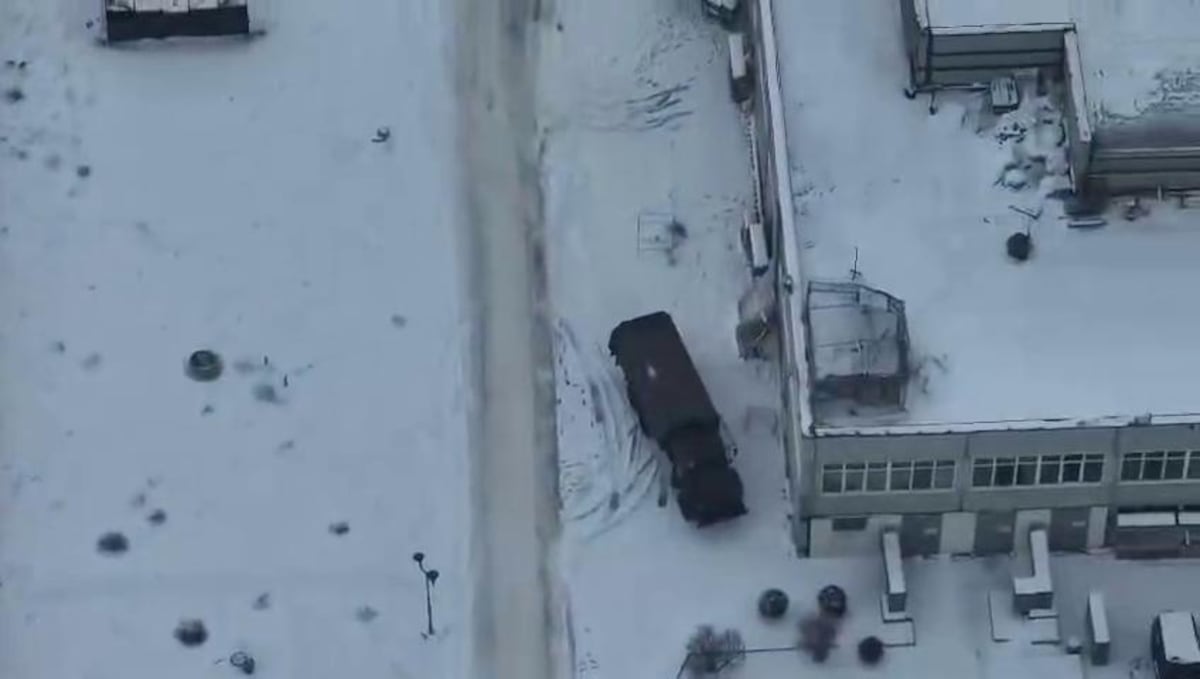
BERLIN — An aerial video from Zaporizhzhia Nuclear Power Plant in Russian-occupied Ukraine appears to show Russian military trucks parked in the facility, in what would likely be a breach of international law.
Defense News was able to independently geolocate the video to the Zaporizhzhia nuclear power plant in the city of Enerhodar, which has been occupied by Russian forces since the full-scale invasion of Ukraine in early 2022. The aerial video, which appears to have been taken from a drone, first appeared online on Wednesday, mid-morning European time. It has since widely been shared in Ukrainian Telegram groups devoted to covering the war and sharing footage of combat.
Several vehicles in military-style paint schemes are visible in the video, parked under a bridge connecting the nuclear reactors and radioactive waste treatment buildings of the power plant, as well as a larger truck parked near a laboratory and services building. It appears to be a KamAZ military truck, though the low quality of the video makes it difficult to identify with confidence.
The snow cover visible in the video is consistent with current conditions on the ground, Defense News confirmed using historic satellite imagery and weather data. Zaporizhia has remained largely snow-cover-free this winter until early this week, indicating that the claims of the video’s recentness are accurate.
Among the accounts that have shared the video is Vladyslav Voloshyn, a spokesperson for the Defence Forces of Ukraine. “Knowing that we will not fire at the nuclear power plant, the Russians hide their military equipment here,” he said in his post. “They use the territory and facilities of the ZNPP as a training ground for their UAV operators. There is even evidence that MLRS attacks on Zaporizhia were carried out from here several times.”
Defense News was unable to independently verify these claims.
The Zaporizhzhia power plant, Europe’s largest nuclear generating station, remains in a cold shutdown, meaning the nuclear chain reaction has been halted, and no electricity is being generated. However, the nuclear fuel remains on site and must be cooled in order to avoid a potentially catastrophic meltdown. For this, the plant’s pumps require a reliable supply of electricity, which comes from the outside power grid and backup generators.
Militaries are generally prohibited from storing military logistics vehicles and equipment at nuclear power plants under international humanitarian law. Article 56 of Additional Protocol I to the Geneva Conventions specifically requires parties to armed conflict to “endeavor to avoid placing military objectives, such as troops, weapons or military vehicles, in or near nuclear power plants.”
Nuclear power plants also are afforded special protections and must not be attacked “if such attack may cause the release of dangerous forces and consequent severe losses among the civilian population,” as is prescribed in the Geneva Conventions.
Throughout the war, Russia has been accused repeatedly of misusing the premises of the nuclear power plant to station military equipment and store ammunition.
Following a September 2022 inspection mission, the International Atomic Energy Agency, the international nuclear watchdog, explicitly stated that “the team observed the presence of Russian military personnel, vehicles and equipment at various places at the [power plant], including several military trucks on the ground floor of the unit 1 and unit 2 turbine halls,” as well as parked under the overpass connecting the reactor units.
The IAEA has maintained its mission presence at the power plant and continued documenting violations, although its efforts have been hampered by Russian chicanery. In July 2024, when the IAEA sought to confirm reports of land mines and explosives at the nuclear station, Russia specifically denied access to the rooftops of reactor blocks 3 and 4 and parts of the cooling system where military presence had been previously reported.
The power plant has also seen combat action and shelling in its vicinity, which has on several occasions disconnected it from the power grid and forced the use of backup generators.
Linus Höller is Defense News' Europe correspondent and OSINT investigator. He reports on the arms deals, sanctions, and geopolitics shaping Europe and the world. He holds master’s degrees in WMD nonproliferation, terrorism studies, and international relations, and works in four languages: English, German, Russian, and Spanish.
柏林——一段来自俄罗斯占领的乌克兰扎波罗热核电站的航拍视频显示,俄罗斯军用卡车停放在该设施内,这很可能违反了国际法。
《防务新闻》独立定位了这段视频,发现其拍摄地点位于乌克兰恩涅尔霍达尔市的扎波罗热核电站。自2022年初俄罗斯全面入侵乌克兰以来,该核电站一直被俄罗斯军队占领。这段航拍视频似乎是由无人机拍摄的,于欧洲时间周三上午首次出现在网上。此后,该视频在乌克兰一些专门报道战争和分享战斗画面的Telegram群组中被广泛传播。
视频中可以看到几辆涂有军用涂装的车辆停放在连接核电站核反应堆和放射性废物处理设施的桥下,此外还有一辆大型卡车停在实验室和服务楼附近。这辆卡车看起来像是卡玛兹(KamAZ)军用卡车,但由于视频质量较低,难以准确辨认。
《防务新闻》利用历史卫星图像和气象数据证实,视频中可见的积雪与目前地面的实际情况相符。扎波罗热今年冬季大部分地区都未见积雪,直到本周初才出现积雪,这表明视频拍摄时间的说法是准确的。
分享这段视频的账号中包括乌克兰国防军发言人弗拉迪斯拉夫·沃洛申。他在帖子中写道:“俄罗斯人知道我们不会攻击核电站,所以把军事装备藏在这里。他们把扎波罗热核电站的场地和设施当作无人机操作员的训练场。甚至有证据表明,他们曾多次从这里发动对扎波罗热的多管火箭炮袭击。”
《防务新闻》无法独立核实这些说法。
扎波罗热核电站是欧洲最大的核电站,目前仍处于冷停堆状态,这意味着核反应链已停止,不再发电。然而,核燃料仍留在厂内,必须进行冷却以避免可能发生的灾难性堆芯熔毁。为此,电站的泵需要可靠的电力供应,这些电力来自外部电网和备用发电机。
根据国际人道主义法,军队通常被禁止在核电站存放军事后勤车辆和装备。《日内瓦公约第一附加议定书》第56条明确要求武装冲突各方“努力避免在核电站内或附近部署军事目标,例如部队、武器或军用车辆”。
核电站也享有特殊保护,根据《日内瓦公约》的规定,不得攻击核电站,“如果此类攻击可能导致危险力量的释放,并造成平民人口的严重损失”。
战争期间,俄罗斯屡次被指控滥用核电站场地,用于存放军事装备和储存弹药。
在 2022 年 9 月的一次检查任务之后,国际原子能机构(国际核监督机构)明确表示,“该小组观察到俄罗斯军事人员、车辆和设备出现在(核电站)的各个地方,包括 1 号机组和 2 号机组汽轮机大厅一楼的几辆军用卡车”,以及停放在连接反应堆机组的立交桥下的卡车。
尽管受到俄罗斯的阻挠,国际原子能机构仍维持了在核电站的驻守,并继续记录违规行为。2024年7月,当国际原子能机构试图核实有关核电站存在地雷和爆炸物的报道时,俄罗斯明确拒绝其进入3号和4号反应堆机组的屋顶以及此前有报道称存在军事存在的部分冷却系统区域。
该发电厂附近也曾发生过战斗和炮击,这导致其多次与电网断开,并被迫使用备用发电机。
林努斯·霍勒是《防务新闻》的欧洲记者和开源情报调查员。他报道影响欧洲乃至全球的军火交易、制裁和地缘政治。他拥有大规模杀伤性武器不扩散、恐怖主义研究和国际关系三个硕士学位,并精通英语、德语、俄语和西班牙语四种语言。