Pig’s blood is back on the menu. But is Singapore hungry for it?猪血又重回餐桌了。但新加坡人真的需要它吗?
Explore how Singapore's food safety laws and culture shaped attitudes towards pig's blood and offal, affecting traditional dishes and evolving tastes. Read more at straitstimes.com.
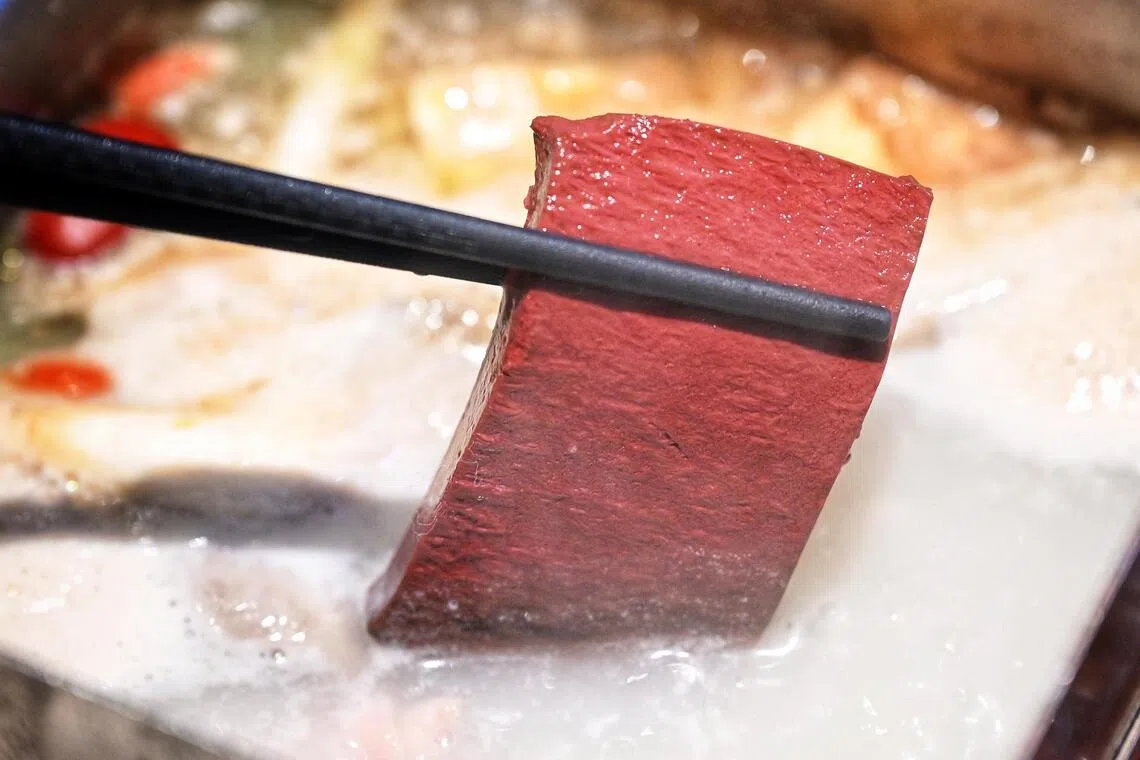
Its return after 27 years reveals how regulation, memory and changing ideas about what is disgusting can reshape what a nation eats.
Pig’s blood was banned in Singapore in 1999 following the Nipah virus outbreak.
ST PHOTO: CHONG JUN LIANG
Published Sep 06, 2026, 02:00 PM
Updated Sep 06, 2026, 02:00 PM
Thomas Koh was 11 years old in 1999 when he watched his grandfather’s world collapse. Since the 1950s, the Koh family has run Koh Brother Pig’s Organ Soup stall at Tiong Bahru Market. Its signature dish was a clear Teochew-style broth simmered with pork bones, offal and salted greens. At its centre were dark, jelly-like cubes of pig’s blood.
Koh remembers the routine. Every morning, buckets of fresh blood would arrive at the stall.
Left to set, the blood became soft, curd-like blocks. When customers ordered, the blocks were sliced, blanched and added to the soup.
Thomas Koh, a third-generation hawker at Koh Brother Pig’s Organ Soup. He was 11 years old when pig’s blood consumption was banned in Singapore in 1999. ST PHOTO: MARK CHEONG
Thomas Koh, a third-generation hawker at Koh Brother Pig’s Organ Soup. He was 11 years old when pig’s blood consumption was banned in Singapore in 1999.
ST PHOTO: MARK CHEONG
“It’s rich, and full of umami. The texture is similar to tofu,” recalls the 38-year-old, who took over his parents’ stall in 2018.
For him, pig’s blood was not an exotic ingredient. It was comfort food, and his family’s legacy.
Then, almost overnight in 1999, it disappeared.
Across the Causeway, the Nipah virus , which spread from infected pigs to humans, caused severe neurological illness, and in the worst cases, even led to paralysis and death.
On March 13, 1999, Singapore recorded its first patient with Nipah virus. Over the week that followed, more people here developed high fevers and severe neurological symptoms. Investigators quickly discovered that every single patient worked in the pig industry, and they traced the outbreak directly to sick pigs imported from Malaysia.
That same month, the then Primary Production Department suspended all imports of live pigs into Singapore . A serious blow, since Singapore had relied entirely on imported pork after its last local pig farms closed in 1989.
According to a 1999 article in the Singapore Medical Journal, this total ban appears to have been the decisive step that brought the outbreak to an end.
Pig imports resumed at the end of April 1999, but only from a single accredited farm in Indonesia that had tested negative for the virus.
Even though experts emphasised that the virus could not spread from human to human, or through eating pork, panic spread anyway. According to reports in The Straits Times at the time, pork consumption in Singapore dropped by 40 per cent.
Animal blood products became a particular concern. When an animal is infected, viruses like Nipah – along with bacteria – can be present in the bloodstream .
Traditional blood curd posed an added risk because raw blood was left to set at room temperature, then only lightly heated, not always enough to kill harmful pathogens. This also made it vulnerable to contamination during preparation.
As a precaution, Singapore also halted the supply and consumption of blood from locally slaughtered pigs .
For Grandfather Koh, this meant the removal of a defining ingredient from the family recipe. He closed the stall for three months to rework it.
“He added meatball, stomach, pig’s heart into the soup,” Thomas recalls.
For almost three decades, one key traditional ingredient has been missing from Koh Brother Pig’s Organ Soup’s bowl – pig’s blood curd. ST PHOTO: MARK CHEONG
For almost three decades, one key traditional ingredient has been missing from Koh Brother Pig’s Organ Soup’s bowl – pig’s blood curd.
Customers reacted warily, not least because offal was seen as high in cholesterol and unhealthy. But the hawker persevered. The business survived, and to this day, long queues still form at the stall. What vanished from the bowl was the pig’s blood.
Nearly three decades later, that ingredient is making a comeback .
A Singapore Food Agency spokesman tells ST: “Following this cessation, there was periodic interest from industry stakeholders to resume pig blood product supply through imports.”
Risk assessments were also conducted in 2018 , leading to new requirements for the safe collection and processing of blood for food purposes.
In April 2026, the SFA approved heat-treated pork blood imports from Thailand’s Bangkhla Pig Slaughterhouse, the first application received and approved since the new requirements were introduced.
The approval does not revive the old system Koh remembers. It authorises a very different product: one made under controlled industrial conditions and subject to approval, export documentation and health certification.
At the slaughterhouse, blood is collected through a closed pipeline immediately after slaughter, filtered, poured into trays and steam-cooked for 45 minutes to kill pathogens.
The finished curds are then chilled and packaged for export. Bangkhla Pig Slaughterhouse produces CP Foods’ pasteurised pig’s blood curd.
Unlike the buckets of raw blood Thomas remembers from his childhood, this updated product arrives neatly packaged like boxed tofu.
Packs of CP Foods' Pig Blood Curd on display at FairPrice Xtra in Ang Mo Kio Hub on June 4. ST PHOTO: GIN TAY
Packs of CP Foods' Pig Blood Curd on display at FairPrice Xtra in Ang Mo Kio Hub on June 4.
“CP has been selling pig’s blood in Thailand for six years, and we are confident our technology and processes meet SFA requirements,” says Joyce Yap, director of CP Foods Singapore.
The pasteurised blood curd is now available in Singapore in supermarkets, hawker stalls and popular hotpot chains, including Haidilao. Whether Singaporeans still have an appetite for it remains uncertain.
The state and the palate
Pig’s blood became unavailable during a public-health crisis. Its long disappearance also raises a broader question: How do food-safety rules shape what a society comes to regard as normal, clean or edible?
Food historian Nicole Tarulevicz traces the roots of Singapore’s food safety laws to the late 19th and early 20th centuries.
In a 2025 study published in the Journal Of Social History, she argues that these laws were never simply about protecting public health. They also served colonial interests, regulating trade, commercial practices and local food cultures.
“The British Empire was preoccupied with specific kinds of hygiene,” Tarulevicz explains.
But “hygiene”, she says, was not a neutral concept. It often carried racial and ideological assumptions that gave colonial authorities a rationale for intervening in local practices.
The 1894 municipal abattoir offers a telling example. The authorities regulated the slaughter of cattle and pigs but largely ignored poultry, despite its importance to the local diet.
Cattle received careful inspection to ensure a reliable supply of fresh beef for British elites, who associated it with strength and status.
Pork proved more contentious. When the authorities tried to force Chinese butchers to slaughter pigs at the state facility, the butchers responded with a boycott.
The government retaliated with fines and prison sentences. In one instance, officials even seized a dead pig hidden inside a rickshaw.
The rules were enforced most heavily against non-white residents, even as serious public health problems such as dysentery among poor coolies received far less attention.
Part of the reason was cost. Improving sanitation meant investing in public infrastructure. Policing food sellers, punishing adulteration and controlling who could handle food were cheaper and gave the colonial state greater control over commerce and everyday life.
Food safety, in other words, became a way to decide not only what was “clean”, but who was allowed to participate in the food economy.
Singapore inherited this regulatory logic at independence. Tarulevicz notes that its colonial-era framework reflected “specific British Empire ways” of defining and regulating food.
The food historian adds: “It is more complex than drawing a straight line from colonial legislation to post-independence bans on specific foods.”
Still, that history offers useful context. Food regulation is not only about protecting public health – it also shapes which practices are considered acceptable, manageable and compatible with the society a government wants to build.
Singapore’s modern food-control system evolved in response to its own circumstances: land scarcity, heavy reliance on imports, dense urban living and the need to prevent disease outbreaks. Yet older ideas about hygiene, inspection and control remained embedded in the regulatory landscape.
By 1999, when the Nipah virus outbreak prompted Singaporeans to give up pig’s blood, a broader transformation was already well under way.
The country was burnishing its image as a clean, modern First World destination for investors and tourists. In June 1997, the Government introduced a public grading system for hawker stalls based on cleanliness and hygiene.
That same year, French retailer Carrefour opened Singapore’s first hypermarket at Suntec City, signalling the arrival of a new era of large-scale, modern food retail.
The strict regulation of blood products addressed a genuine public-health risk. But it also reflected Singapore’s preference for clear, enforceable food-safety rules, especially for highly perishable products that are difficult to monitor across many small businesses.
“Governments use food policy as a form of soft power to shape social behaviour,” says food researcher Jenny Dorsey, a Fulbright scholar and National Geographic explorer who spent two years with the National University of Singapore studying how government policy affected hawker centres.
Neighbouring countries also experienced the same Nipah outbreak, yet pig’s blood remained readily available in their markets, even during the crisis.
“Singapore draws a strict line in the sand,” says Dorsey.
Another reason for the ban was a different approach to risk management.
Taiwan and China faced similar public health threats in 1999, yet they chose a different path. In places where blood and organ dishes are deeply woven into everyday food culture, the authorities opted to test and manage the blood supply rather than eliminate it altogether.
“Singapore is multicultural,” explains Ivy Yeh, an anthropology professor at Nanyang Technological University.
“Unlike Taiwan, where eating organs and blood is so deeply embedded in the dominant culture that people refuse to give it up, the Singapore Government prioritised risk management.”
In a dense city-state, an outright ban was simply easier to enforce than regulating a perishable product across hundreds of hawker stalls, says Yeh.
But the decision did more than address an immediate health risk. It also changed what Singaporeans grew up eating.
Research suggests children may need repeated exposure to unfamiliar flavours before learning to enjoy them.
By not allowing pig’s blood – and later ending the sale and slaughter of live turtles and frogs at wet markets in 2020 – Singapore also reduced opportunities for younger generations to encounter and develop a taste for such foods.
Traditional staples can become unfamiliar not because they taste bad, but because fewer people grow up seeing, smelling and eating them.
The shift is visible across Singapore’s food landscape.
The government is positioning itself as a global hub for alternative proteins and cultured meat, pouring over $300 million into sustainable food research and development.
In 2020, Singapore made global headlines as the first nation to approve lab-grown meat for commercial sale.
By March 2026, the SFA had published a formal list of 14 approved novel foods: lab-grown chicken, algae biomass and precision-fermented ingredients, all cleared for local import and sale.
Tarulevicz says high-tech food innovation could inadvertently narrow the local palate. She also raises a question: Which parts of the animal are likely to be reproduced, and which will be left behind?
“The economics of lab-grown meat tend to focus on prime cuts – eye fillet, chicken breast,” she notes. “Does it make sense to lab-grow tendons, tripe or intestines? Probably not.”
By prioritising premium Western cuts, Singapore’s futuristic food agenda risks accelerating the loss of traditional offal and organ dishes
Brain masala, anyone?
Yet Singapore has not stopped eating foods that unsettle many diners.
One of the big draws at Bar B Q Tonight, a Pakistani restaurant in Little India operating since 2011, is brain masala, a rich, intensely spiced dish made with goat brains.
Bar B Q Tonight restaurant manager Zakir Khan, 42, on Sept 3 holding a dish of brain masala made up of goat brain stir-fried with tomatoes, browned onions, spices and green chillies. It costs $20. ST PHOTO: LIM YAOHUI
Bar B Q Tonight restaurant manager Zakir Khan, 42, on Sept 3 holding a dish of brain masala made up of goat brain stir-fried with tomatoes, browned onions, spices and green chillies. It costs $20.
ST PHOTO: LIM YAOHUI
Restaurant manager Zakir Khan does not regard the ingredient as alarming. It simply requires careful and meticulous handling.
Goat brain and some of the other ingredients used by Bar B Q Tonight in brain masala. ST PHOTO: LIM YAOHUI
Goat brain and some of the other ingredients used by Bar B Q Tonight in brain masala.
Kitchen staff first parboil the brain with turmeric for 10 minutes before removing the internal nerves by hand. It is then chopped and quickly fried in olive oil with fresh ginger, garlic and house-ground garam masala.
“The texture feels exactly like tofu,” Khan says, describing it as velvety, rich and deeply savoury.
Brain masala is made up of goat brain stir-fried with tomatoes, browned onions, spices and green chillies. ST PHOTO: LIM YAOHUI
Brain masala is made up of goat brain stir-fried with tomatoes, browned onions, spices and green chillies.
The dish is a delicacy. Each goat yields only one brain, and limited supply can push wholesale prices to $40 a kg. During the Covid-19 pandemic, when supply chains were disrupted, customers repeatedly called the restaurant asking when it would return.
Mid-conversation, Khan’s phone buzzes with a message from a diner reserving a portion for evening pick-up.
In addition to South Asian expatriates, his regulars include Malay, Indian and Chinese Singaporeans. Some of his most loyal customers are local medical staff from the nearby Farrer Park Hospital, who frequently stop by to scoop up spiced goat brain with hot naan.
Their appetite complicates any easy story about inevitable aversion to offal.
If brain masala shows an organ dish sustained through cultural familiarity, Dirty Supper in Tiong Bahru reveals what happens when similar ingredients are presented for contemporary dining.
Chef Peter Smit of Dirty Supper preparing a duck on Aug 18. ST PHOTO: JASON QUAH
Chef Peter Smit of Dirty Supper preparing a duck on Aug 18.
ST PHOTO: JASON QUAH
Chef Peter Smit – who grew up in Australia and has worked in London kitchens – opened the restaurant in 2024 as a whole-animal operation. He is committed to “whole animal” cooking, the philosophy of using every part of the animal.
“We had a farm in Cornwall where we reared our own pigs. We knew all the butchers; we knew all the farmers,” he says.
The kitchen breaks down whole lambs, ducks and sides of pork. The results land on an ever-changing blackboard menu: grilled pork heart and kidney treated like steak, smoked pork tongue, duck heads and feet, duck-neck sausages stuffed with liver and heart, and house-cured lamb ham.
There is usually just one beef steak, from a secondary cut to “please the masses”.
Supply cost and the skill required discourage most restaurants from committing to such a menu. Smit does so out of “pure stubbornness”. He also keeps “fun cuts” like hearts and kidneys under $10 to encourage diners to take a chance on them.
“I would rather people try this stuff and go, ‘Oh, this is actually really good,’” he says. By his account, around 95 per cent of diners do.
One of the dishes offered at Dirty Supper is pig snout. ST PHOTO: JASON QUAH
One of the dishes offered at Dirty Supper is pig snout.
But he sees a double standard. Duck head, pork kidney or pork heart can appear cool and adventurous when served at a “sustainable whole-animal dining experience” for $80 alongside natural wine. “But if you go to a Chinese restaurant, it’s everywhere, and everyone is eating it. So the only difference is it’s a white boy cooking it.”
Chef Peter Smit of Dirty Supper pictured holding a duck head. ST PHOTO: JASON QUAH
Chef Peter Smit of Dirty Supper pictured holding a duck head.
Yeh agrees: “It completely depends on how you present the exact same thing. If you brand it well, the price, and the psychology of disgust, changes entirelyore than biology.
More than just biology, that psychology is shaped by class, setting, memory and aspiration.
In postwar Singapore, offal, animal blood, and even reptiles were ordinary foods. Poverty and wartime shortages made intestines, tripe, and frog meat affordable sources of protein, not exotic choices.
As incomes rose, wet markets and butcher stalls gave way to supermarkets and neatly packaged cuts of meat, putting more distance between consumers and the whole animal. Ingredients once valued for their affordability gradually acquired a stigma as “peasant food.”
The reverse can happen, too: Foods once associated with wealth can become unfamiliar or even unappealing.
Allan Tan (left), 35, and his sister Vivian Tan, 49 are the third-generation owners of Tan Ser Seng Herbal Soup in Geylang. ST PHOTO: GIN TAY
Allan Tan (left), 35, and his sister Vivian Tan, 49 are the third-generation owners of Tan Ser Seng Herbal Soup in Geylang.
At Tan Ser Seng Herbal Soup in Geylang, third-generation owners Allan and Vivian Tan are preserving their grandfather’s turtle soup recipe.
A Teochew immigrant, Tan Ah Sai began selling turtle soup after World War II. He would carry the soup pots on a shoulder pole through the streets.
“He wanted to be different from other chefs,” Vivian says.
His turtle soup – a herbal broth slow-cooked with a blend of Chinese herbs and freshwater turtles – quickly attracted everyone from labourers to wealthy businessmen.
In China, Vivian says, turtle soup was traditionally served at banquets and weddings as a sign of prosperity.
For Allan, turtle was never unusual. “I grew up eating turtle. It’s just another meat. It tastes just like pork,” he says.
A bowl of claypot turtle soup from Tan Ser Seng Herbs Restaurant in Geylang. ST PHOTO: GIN TAY
A bowl of claypot turtle soup from Tan Ser Seng Herbs Restaurant in Geylang.
But he understands why first-timers hesitate. When the restaurant sold only turtle soup, some diners brought friends or family who refused to try it, and sometimes left without eating.
The family eventually expanded the menu with other soups and dishes, including ginseng black chicken soup. Even that can prompt hesitation.
“Some people think chicken shouldn’t be black,” Allan says.
Vivian recalls children who happily ate turtle meat until their parents told them what it was.
“It tastes like pork. It’s just scarier in your mind,” she says.
Today, the restaurant has a steady base of local regulars and tourists, mostly from China and Indonesia, even if the long queues of its heyday are gone.
Dorsey sees a generational shift: Millennials embraced photogenic food, while Gen Z places greater value on experiences that are “real” and “ unglamorous ”, making once-shunned ingredients fashionable again.
For younger diners, eating organ meat can be both private enjoyment and a public signal: evidence of curiosity, adventurousness or cultural fluency.
“How we eat is an expression of what we feel comfortable with, but also what we aspirationally want to be,” Dorsey says. For younger diners, ordering organ meat can signal identity – “wanting to eat it publicly because they want to be seen as adventurous”.
Take baker Jeslyn Chow. The 32-year-old enjoys offal and pig’s blood; her favourite local dish is kway chap, flat rice sheet served in a broth and with an assortment of pork cuts including offal, intestines, and ears.
For years, her access to pig’s blood was limited to trips abroad to Malaysia, Thailand, and Taiwan. Now that it’s making a return to Singapore’s food scene, she’s eager to enjoy it closer to home.
“I’m a strong proponent of using every part of an animal or even fruit or vegetable,” Chow says. “Since it’s already there for us to eat – the farmer already grew the veggie or slaughtered the pig – why should some parts be considered ‘disgusting’?”
Disgust can be durable, but it is not fixed. A travel experience, a trusted recommendation or a single unexpectedly good meal can change a diner’s mind.
Thomas Koh (right), a third-generation hawker at Koh Brothers Pig’s Organ Soup stall. ST PHOTO: MARK CHEONG
Thomas Koh (right), a third-generation hawker at Koh Brothers Pig’s Organ Soup stall.
Koh sees this firsthand at his pig-organ soup stall. When young customers play it safe with lean meat and meatballs, he encourages them to try the intestines, recommending them as the house speciality.
“We clean our intestines really well. It might be different from others you’ve tasted before,” he tells them.
As Yeh puts it: “In childhood, we might be taught to dislike something. But when we mature and gain the ability to explore, we realise, ‘Oh, this is actually so tasty.’”
The question is whether Singapore’s food culture will give younger diners enough opportunities to make that discovery.
Pig intestines at Koh Brothers Pig’s Organ Soup stall at Tiong Bahru Market The Straits Times
Pig intestines at Koh Brothers Pig’s Organ Soup stall at Tiong Bahru Market
The challenge extends beyond pig’s blood. Hawker culture is already losing the workers and businesses that keep its more unusual dishes alive. The median age of a hawker is 59, while rising costs, long hours, and a shortage of younger successors are forcing many famous stalls to close.
Government efforts to bring in new hawkers have had limited success. Of the 566 aspiring entrepreneurs who completed the 2020 Hawkers’ Development Programme, only 16 stalls remained operational by April 2024.
For those who do enter the trade, economics can also push tradition aside. As Makansutra founder K.F. Seetoh notes, hawkers have to make a living, and labour-intensive heritage dishes are often harder to justify.
The change is already visible in newer hawker centres: Stalls serving offal, turtle soup, or beef lung are increasingly replaced by Chinese mala, Japanese donburi and Korean hot-plate dishes.
Thomas Koh (right), a third-generation hawker at Koh Brothers Pig’s Organ Soup. ST PHOTO: MARK CHEONG
Thomas Koh (right), a third-generation hawker at Koh Brothers Pig’s Organ Soup.
The result is a narrowing food landscape. Some diners still seek out traditional flavours, but the mainstream is moving toward dishes that are more familiar, standardised, and easier to produce.
Magazine editor Lynette Koh, 45, is nonchalant about pig’s blood making a comeback.
She had never tried it in Singapore, having been barely a teenager when it disappeared from menus. Her first taste came years later on a trip to Taipei, when she decided to see what she had been missing.
“What’s the big deal? It doesn’t even taste like anything, aside from tofu. Then I might as well eat tofu since it’s actually healthy,” she says, adding that she has not been tempted to try it again since its return to Singapore.
It is one reason why, despite requests from older customers, Koh hesitates to add it back into his family’s recipe.
A big hurdle is cost. Buying a box of pig’s blood for around $7 – with each bowl needing half a portion – would push his prices up significantly. He also doubts younger diners would eat it.
“After 30 years, it’s hard to reintroduce it,” Koh explains. “If I add it now, people might react poorly and go, ‘Ew, what is this in my soup?’”
He may be right. Thirty years is long enough for an ingredient not just to disappear from menus but from collective memory.
But Koh has also watched a table of young customers leave having ordered intestines for the first time, and come back the next week to order them again.
时隔 27 年重返市场,揭示了监管、记忆以及人们对什么是令人作呕的观念的改变如何重塑一个国家的饮食习惯。
1999年尼帕病毒爆发后,新加坡禁止使用猪血。
《海峡时报》照片:梁崇俊
发布于 2026 年 9 月 6 日下午 2:00
更新于2026年9月6日下午2:00
1999年,11岁的许志强亲眼目睹了祖父的世界崩塌。自上世纪50年代起,许氏家族就在中峇鲁市场经营着“许氏兄弟猪杂汤”摊位。他们的招牌菜是用猪骨、内脏和咸菜熬制的清澈潮州风味汤底,汤中心点缀着深色的、类似果冻的猪血块。
Koh还记得当时的情景。每天早上,都会有几桶桶新鲜血液运到献血摊。
静置后,血凝固成柔软的凝乳状块状物。顾客点餐时,将这些凝乳块切片、焯水后加入汤中。
Thomas Koh是Koh Brother Pig's Organ Soup的第三代小贩。1999年新加坡禁止食用猪血时,他只有11岁。(海峡时报摄影:MARK CHEONG)
Thomas Koh是Koh Brother Pig's Organ Soup的第三代小贩。1999年新加坡禁止食用猪血时,他只有11岁。
《海峡时报》照片:张马克
“它味道浓郁,鲜味十足。口感类似于豆腐,”这位38岁的男子回忆道,他于2018年接管了父母的摊位。
对他来说,猪血不是什么稀奇古怪的食材,而是家常菜,也是他家族的传承。
然后,几乎在1999年的一夜之间,它就消失了。
在堤道的另一边,尼帕病毒从受感染的猪传播到人类,导致严重的神经系统疾病,在最严重的情况下,甚至导致瘫痪和死亡。
1999年3月13日,新加坡确诊首例尼帕病毒感染病例。随后一周内,更多新加坡人出现高烧和严重的神经系统症状。调查人员很快发现,所有患者都从事养猪业,并将疫情源头追溯到从马来西亚进口的病猪。
同月,当时的初级生产部暂停了所有活猪进口到新加坡。这对新加坡来说是一个沉重的打击,因为自1989年最后一批本地养猪场关闭后,新加坡就完全依赖进口猪肉。
根据 1999 年《新加坡医学杂志》的一篇文章,这项全面禁令似乎是结束疫情的决定性步骤。
1999 年 4 月底,生猪进口恢复,但仅从印度尼西亚一家经认证的农场进口,该农场的病毒检测结果呈阴性。
尽管专家强调病毒不会在人与人之间传播,也不会通过食用猪肉传播,但恐慌情绪仍然蔓延开来。据当时《海峡时报》报道,新加坡的猪肉消费量下降了40%。
动物血液制品尤其令人担忧。当动物感染时,尼帕病毒等病毒以及细菌都可能存在于血液中。
传统血凝块存在额外的风险,因为生血在室温下凝固后仅进行轻微加热,这种加热方式往往不足以杀死有害病原体。这也使得血凝块在制作过程中容易受到污染。
作为预防措施,新加坡也停止了本地屠宰猪的血液供应和消费。
对高爷爷来说,这意味着要从家传秘方中去掉一种关键成分。他关了摊位三个月,重新调整配方。
“他在汤里加了肉丸、猪肚和猪心,”托马斯回忆道。
近三十年来,许氏兄弟猪杂汤里一直缺少一种关键的传统食材——猪血豆腐。海峡时报摄影:张马克
近三十年来,高氏兄弟猪杂汤里一直缺少一种关键的传统配料——猪血豆腐。
顾客们反应谨慎,尤其因为内脏被认为胆固醇含量高,不健康。但小贩坚持了下来。生意维持了下来,直到今天,摊位前仍然排着长队。而从碗里消失的,是猪血。
近三十年后,这种成分又重新流行起来。
新加坡食品局发言人告诉《海峡时报》:“在停止供应猪血制品之后,业内利益相关者不时表示有兴趣通过进口恢复猪血制品的供应。”
2018 年也进行了风险评估,从而对安全采集和处理用于食品的血液提出了新的要求。
2026 年 4 月,泰国食品局批准从泰国邦卡拉猪屠宰场进口热处理猪血,这是自新要求出台以来收到并批准的第一份申请。
这项批准并非恢复 Koh 记忆中的旧体系,而是授权生产一种截然不同的产品:一种在受控工业条件下生产,并需获得批准、出口文件和健康认证的产品。
在屠宰场,屠宰后立即通过封闭管道收集血液,过滤后倒入托盘,蒸煮 45 分钟以杀死病原体。
成品凝乳经冷却后包装出口。邦卡拉猪屠宰场为正大食品公司生产巴氏杀菌猪血凝乳。
与托马斯童年记忆中成桶的生血不同,这款升级版产品包装整齐,就像盒装豆腐一样。
6月4日,正大食品(CP Foods)的猪血豆腐在宏茂桥中心(Ang Mo Kio Hub)的FairPrice Xtra超市展出。(海峡时报摄影:金泰)
6月4日,在宏茂桥中心的FairPrice Xtra超市,CP Foods的猪血豆腐正在展出。
“正大集团在泰国销售猪血已有六年时间,我们相信我们的技术和工艺符合新加坡食品局的要求,”正大食品新加坡公司董事叶女士表示。
经过巴氏杀菌处理的血豆腐现在在新加坡的超市、小贩摊位和包括海底捞在内的热门火锅连锁店均有销售。但新加坡人是否仍然喜欢它,目前还不得而知。
国家与味蕾
在一次公共卫生危机期间,猪血供应中断。猪血的长期缺席也引发了一个更广泛的问题:食品安全规则如何塑造一个社会对正常、清洁或可食用事物的看法?
食品历史学家妮可·塔鲁列维奇追溯新加坡食品安全法的起源,发现其可以追溯到 19 世纪末 20 世纪初。
她在2025年发表于《社会史杂志》的一项研究中指出,这些法律绝不仅仅是为了保护公众健康。它们也服务于殖民利益,规范贸易、商业行为和当地饮食文化。
“大英帝国非常注重特定类型的卫生,”塔鲁列维奇解释道。
但她指出,“卫生”并非一个中立的概念。它往往带有种族和意识形态的预设,为殖民当局干预当地习俗提供了借口。
1894 年的市政屠宰场就是一个典型的例子。当局对牛和猪的屠宰进行了规范,但对家禽却置之不理,尽管家禽对当地人的饮食非常重要。
为了确保为英国上流社会提供可靠的新鲜牛肉,牛群都经过了仔细的检验,因为英国上流社会将新鲜牛肉与力量和地位联系在一起。
猪肉问题更具争议性。当当局试图强迫中国屠夫在国营屠宰场宰杀生猪时,屠夫们以抵制作为回应。
政府采取了罚款和监禁的报复措施。有一次,官员们甚至在一辆人力车里查获了一头死猪。
这些规定对非白人居民的执行最为严格,而像贫困苦力中痢疾这样的严重公共卫生问题却很少受到关注。
部分原因是成本。改善卫生状况意味着投资公共基础设施。监管食品销售商、惩罚掺假行为以及控制食品经手人员的成本更低,而且殖民政府能够更好地控制商业和日常生活。
换句话说,食品安全不仅成为决定什么是“干净的”食品的一种方式,而且还成为决定谁可以参与食品经济的一种方式。
新加坡独立后继承了这套监管逻辑。塔鲁列维奇指出,其殖民时代的框架反映了英国殖民帝国定义和监管食品的“特定方式”。
这位食品历史学家补充道:“这比简单地将殖民时期的立法与独立后对特定食品的禁令联系起来要复杂得多。”
然而,这段历史提供了有益的背景。食品监管不仅关乎保护公众健康,它还决定了哪些做法被认为是可接受的、可控的,以及与政府希望构建的社会相符的。
新加坡现代食品控制体系的形成是为了应对自身独特的国情:土地稀缺、严重依赖进口、人口密集的城市生活以及预防疾病爆发的需要。然而,关于卫生、检验和控制的传统理念仍然根深蒂固地存在于监管体系之中。
到 1999 年,当尼帕病毒爆发促使新加坡人放弃猪血时,一场更广泛的变革已经开始了。
该国正努力将自身打造为一个干净、现代化、世界一流的旅游目的地,以吸引投资者和游客。1997年6月,政府推出了一项基于清洁卫生状况的摊位评级制度。
同年,法国零售商家乐福在新加坡新达城开设了第一家大型超市,标志着大规模、现代化食品零售新时代的到来。
对血液制品的严格监管旨在应对切实存在的公共卫生风险。但这同时也体现了新加坡对清晰、可执行的食品安全法规的重视,尤其对于极易腐烂、难以在众多小型企业中进行监管的产品而言更是如此。
“政府利用食品政策作为一种软实力来塑造社会行为,”食品研究员珍妮·多尔西说道。她是一位富布赖特学者,也是国家地理探险家,曾在新加坡国立大学工作两年,研究政府政策如何影响小贩中心。
邻国也经历了同样的尼帕病毒疫情,但即使在危机期间,猪血在这些国家的市场上仍然很容易买到。
“新加坡划清了界限,”多尔西说。
禁令的另一个原因是风险管理方法不同。
1999年,台湾和中国大陆面临着类似的公共卫生威胁,但它们选择了不同的应对方式。在血液和内脏菜肴深深融入日常饮食文化的地区,当局选择对血液供应进行检测和管理,而不是彻底禁止。
“新加坡是一个多元文化国家,”南洋理工大学人类学教授叶艾薇解释说。
“与台湾不同,在台湾,食用内脏和血液已经深深植根于主流文化中,人们拒绝放弃这种习俗,而新加坡政府则优先考虑风险管理。”
叶说,在一个人口密集的城市国家,彻底禁止比监管数百个小贩摊位上的易腐产品更容易执行。
但这项决定不仅仅解决了眼前的健康风险,它也改变了新加坡人从小吃到大的饮食结构。
研究表明,儿童可能需要反复接触不熟悉的味道才能学会欣赏它们。
新加坡禁止食用猪血,并在 2020 年停止在湿货市场出售和宰杀活龟和活蛙,这也减少了年轻一代接触和培养此类食物口味的机会。
传统主食之所以会变得陌生,不是因为它们味道不好,而是因为越来越少的人从小就见过、闻过和吃过它们。
这种转变在新加坡的食品行业中显而易见。
政府正将自身定位为全球替代蛋白质和人造肉中心,投入超过 3 亿美元用于可持续食品的研究和开发。
2020年,新加坡成为全球首个批准实验室培育肉类进行商业销售的国家,这一消息引起了全球关注。
到 2026 年 3 月,国家食品局 (SFA) 正式公布了 14 种获准的新食品清单:实验室培育的鸡肉、藻类生物质和精准发酵的成分,所有这些食品均获准在本地进口和销售。
塔鲁列维奇表示,高科技食品创新可能会在无意中限制当地人的口味。她还提出了一个问题:动物的哪些部位可能会被复制,哪些部位会被淘汰?
她指出:“实验室培育肉的经济效益往往集中在优质部位——比如牛眼肉、鸡胸肉。那么,培育肌腱、牛肚或肠子有意义吗?可能没有。”
新加坡以高端西式肉类为主导的未来主义餐饮理念,可能会加速传统内脏和器官菜肴的消失。
有人想来点脑花咖喱吗?
然而,新加坡人并没有停止食用那些令许多食客感到不安的食物。
位于小印度的巴基斯坦餐厅 Bar BQ Tonight 自 2011 年开业以来,其一大亮点是脑花咖喱,这是一种用羊脑制成的浓郁辛辣的菜肴。
9月3日,42岁的Bar BQ Tonight餐厅经理Zakir Khan手持一道羊脑玛萨拉,这道菜是用羊脑与西红柿、焦洋葱、香料和青辣椒一起翻炒而成,售价20新元。(海峡时报摄影:林耀辉)
9月3日,42岁的Bar BQ Tonight餐厅经理扎基尔·汗(Zakir Khan)手捧一道羊脑玛萨拉,这道菜是用羊脑与西红柿、焦洋葱、香料和青辣椒一起翻炒而成,售价20美元。
ST 照片:林耀辉
餐厅经理扎基尔·汗并不认为这种食材有什么令人担忧的地方。它只需要小心谨慎地处理即可。
山羊脑以及Bar BQ Tonight在制作脑花咖喱时使用的其他一些配料。ST PHOTO:LIM YAOHUI
山羊脑以及 Bar BQ Tonight 在脑花咖喱中使用的其他一些配料。
厨房工作人员先将脑花用姜黄焯水10分钟,然后用手去除内部神经。接着将脑花切碎,与新鲜生姜、大蒜和自家研磨的印度香料粉一起用橄榄油快速翻炒。
“它的口感和豆腐一模一样,”Khan说道,形容它如天鹅绒般柔滑,味道浓郁鲜美。
羊脑咖喱是用羊脑与番茄、焦糖洋葱、香料和青辣椒一起翻炒而成。照片由林耀辉拍摄。
脑花咖喱是用羊脑与西红柿、焦洋葱、香料和青辣椒一起翻炒而成。
这道菜堪称珍馐。每只山羊只能产出一个羊脑,由于供应有限,批发价可高达每公斤40美元。新冠疫情期间,供应链中断,顾客不断致电餐厅询问何时恢复供应。
谈话间,Khan 的手机震动了一下,收到一条来自餐厅的短信,预订了一份晚餐,准备晚上来取。
除了南亚侨民外,他的常客还包括马来人、印度人和新加坡华人。他最忠实的顾客之一是附近花拉公园医院的当地医护人员,他们经常光顾,买一份香辣羊脑配热乎乎的烤饼。
它们的食欲使得任何关于它们必然厌恶内脏的简单说法都变得复杂起来。
如果说脑花咖喱展现了一道因文化熟悉感而得以延续的内脏菜肴,那么位于中峇鲁的 Dirty Supper 则揭示了当类似的食材被呈现在当代餐饮中时会发生什么。
8月18日,Dirty Supper餐厅主厨Peter Smit正在准备烤鸭。(海峡时报摄影:JASON QUAH)
Dirty Supper餐厅的主厨Peter Smit于8月18日准备烹制烤鸭。
《海峡时报》摄影:JASON QUAH
主厨彼得·史密特在澳大利亚长大,曾在伦敦的餐厅厨房工作,他于2024年开设了这家餐厅,主打“全动物烹饪”。他致力于“全动物烹饪”,即充分利用动物的每一个部位。
“我们在康沃尔郡有个农场,自己养猪。我们认识所有的屠夫,也认识所有的农民,”他说。
厨房将整只羊、鸭和猪肉分割处理。最终的菜肴会出现在不断更新的黑板菜单上:烤猪心和猪肾(做法像牛排)、烟熏猪舌、鸭头和鸭爪、填满鸭肝和鸭心的鸭颈香肠,以及自家腌制的羊肉火腿。
通常只有一块牛排,是从次要部位取材,以“迎合大众口味”。
食材成本和所需技术让大多数餐厅望而却步,不敢轻易推出这样的菜单。斯密特这样做纯粹是出于“固执”。他还把“特色部位”(比如心和肾)的价格控制在10美元以下,鼓励食客尝试。
“我更希望人们尝试这些菜品后说,‘哦,这真的很好吃,’”他说。据他所说,大约95%的食客确实如此。
Dirty Supper餐厅的菜品之一是猪鼻子。(海峡时报摄影:JASON QUAH)
Dirty Supper餐厅提供的菜肴之一是猪鼻子。
但他认为存在双重标准。在“可持续全动物餐饮体验”中,鸭头、猪腰或猪心搭配天然葡萄酒,售价80美元,看起来很酷很有新意。“但如果你去中餐馆,这些菜随处可见,每个人都在吃。所以唯一的区别就是,做饭的是个白人小伙子。”
Dirty Supper餐厅主厨Peter Smit手持鸭头。(图片来源:ST PHOTO,摄影:JASON QUAH)
Dirty Supper餐厅的主厨Peter Smit手持鸭头,照片中他正在展示鸭头。
叶也同意:“这完全取决于你如何呈现同样的东西。如果你能做好品牌推广,价格以及人们的厌恶心理都会发生彻底改变,而不是从生物学角度改变。”
这种心理不仅仅受生物学因素影响,还受到阶级、环境、记忆和抱负的影响。
战后新加坡,动物内脏、血液甚至爬行动物都是常见的食物。贫困和战时物资短缺使得肠子、牛肚和蛙肉成为价格低廉的蛋白质来源,而非稀奇古怪的选择。
随着收入的增长,菜市场和肉铺摊位逐渐被超市和包装精美的肉类所取代,消费者与整只动物之间的距离也越来越远。曾经因价格低廉而备受青睐的食材,也逐渐被贴上了“农民食品”的标签。
反过来也可能发生:曾经与财富联系在一起的食物可能会变得陌生,甚至失去吸引力。
35岁的陈艾伦(左)和49岁的姐姐陈薇薇是芽笼陈世成药膳汤店的第三代传人。(海峡时报摄影:金泰)
35 岁的艾伦·陈(左)和 49 岁的妹妹维维安·陈是芽笼陈世成药膳汤店的第三代传人。
在芽笼的陈世成药膳汤店,第三代店主陈艾伦和陈薇薇正在传承祖父的龟汤秘方。
潮州移民陈亚赛二战后开始卖龟汤。他会用肩杆挑着汤锅走街串巷。
“他想和其他厨师有所不同,”薇薇安说。
他的龟汤——用多种中药材和淡水龟慢炖而成的药材汤——迅速吸引了从工人到富商的各色人等。
薇薇安说,在中国,龟汤传统上会在宴会和婚礼上供应,象征着繁荣昌盛。
对艾伦来说,龟肉并不稀奇。“我从小就吃龟肉。它和其他肉类一样,味道和猪肉没什么两样。”他说。
芽笼陈世成药材餐厅的一碗砂锅龟汤。(海峡时报摄影:金泰)
一碗来自芽笼陈世成药材餐厅的砂锅龟汤。
但他理解初次尝试者为何犹豫。餐厅最初只供应龟汤时,有些食客带了朋友或家人来,但他们拒绝尝试,有时甚至直接空手而归。
这家餐厅后来又增加了其他汤品和菜肴,包括人参黑鸡汤。即便如此,也可能让人犹豫不决。
“有些人认为鸡肉不应该是黑色的,”艾伦说。
薇薇安回忆起一些孩子,他们曾经开心地吃着龟肉,直到父母告诉他们那是什么。
“它尝起来像猪肉。只是你的想象让它更可怕而已。”她说。
如今,这家餐厅仍然拥有稳定的本地常客和游客群体,其中大部分来自中国和印度尼西亚,尽管鼎盛时期的长队已经不复存在。
多尔西看到了代际转变:千禧一代喜欢上镜的食物,而 Z 世代则更重视“真实”和“朴实无华”的体验,使得曾经被人们避之不及的食材再次流行起来。
对于年轻的食客来说,吃动物内脏既是一种私人享受,也是一种公开信号:是好奇心、冒险精神或文化素养的体现。
多尔西说:“我们的饮食方式既体现了我们的舒适感,也反映了我们渴望成为的样子。”对于年轻的食客来说,点内脏可以象征一种身份认同——“他们想公开吃内脏,因为他们想被视为勇于冒险”。
以面包师周洁琳为例。这位32岁的女士喜欢吃内脏和猪血;她最喜欢的本地菜是粿汁,这是一种扁平的米纸,浸泡在肉汤中,配以各种猪肉部位,包括内脏、肠子和耳朵。
多年来,她只能通过出国旅行去马来西亚、泰国和台湾才能吃到猪血。现在猪血重返新加坡美食舞台,她很期待在家附近就能品尝到。
周先生说:“我强烈支持物尽其用,无论是动物、水果还是蔬菜。既然这些东西我们已经可以吃了——农民已经种了蔬菜,猪也已经宰了——为什么有些部位就被认为是‘令人作呕的’呢?”
厌恶感可能持久存在,但并非一成不变。一次旅行经历、一个值得信赖的推荐,或者一顿出乎意料的美味佳肴,都可能改变食客的看法。
图为许氏兄弟猪杂汤摊位的第三代摊贩许先生(右)。(海峡时报摄影:张马克)
Thomas Koh(右),Koh Brothers Pig's Organ Soup 摊位的第三代小贩。
Koh在他的猪杂汤摊位上亲眼目睹了这一点。当年轻顾客为了保险起见选择瘦肉和肉丸时,他会鼓励他们尝试猪肠,并推荐这是本店的招牌菜。
“我们的肠道清洁得很彻底。这可能和你们以前尝过的味道不一样,”他告诉他们。
正如叶所说:“小时候,我们可能被教导要讨厌某些东西。但当我们长大成人,拥有了探索的能力后,我们就会意识到,‘哦,这其实很好吃。’”
问题是,新加坡的饮食文化能否为年轻的食客提供足够的机会去发现这种美食。
海峡时报报道,中峇鲁市场 Koh Brothers 猪杂汤摊位出售猪肠。
中峇鲁市场 Koh Brothers 猪杂汤摊位上的猪肠
挑战远不止猪血。小贩文化正面临人员流失的困境,而正是这些人员和商户支撑着那些特色菜肴的传承。小贩的平均年龄为59岁,而不断上涨的成本、过长的工作时间和年轻接班人的短缺,正迫使许多知名摊位关门歇业。
政府引进新小贩的努力收效甚微。在2020年完成小贩发展计划的566名创业者中,截至2024年4月,仅有16个摊位仍在运营。
对于那些投身餐饮行业的人来说,经济因素也可能将传统置于次要地位。正如Makansutra创始人KF Seetoh所指出的,小贩们需要谋生,而那些劳动密集型的传统菜肴往往难以获得市场认可。
这种变化在新兴的小贩中心已经显现:供应内脏、龟汤或牛肺的摊位正逐渐被中式麻辣饭、日式丼饭和韩式铁板烧所取代。
图为许氏兄弟猪杂汤的第三代摊贩许先生(右)。(海峡时报摄影:张马克)
Thomas Koh(右),Koh Brothers Pig's Organ Soup 的第三代小贩。
其结果是餐饮选择范围日益缩小。一些食客仍然追求传统口味,但主流消费者正转向更熟悉、更标准化、更容易制作的菜肴。
45岁的杂志编辑林奈特·科对猪血的回归表现得毫不在意。
她在新加坡时从未尝过这道菜,因为菜单上消失时她还只是个十几岁的少女。多年后,她去台北旅行,决定看看自己错过了什么,才第一次品尝到这道菜。
“有什么大不了的?除了豆腐味,它根本就没别的味道。既然豆腐健康,那我干脆吃豆腐算了。”她说道,并补充说自从豆腐重返新加坡后,她就再也没有想过要尝试了。
这也是为什么尽管老顾客们要求,Koh 仍然犹豫是否要将它重新加入到他家的食谱中的原因之一。
最大的障碍是成本。一盒猪血要7美元左右——而每碗菜只需要半份——这会大幅推高他的售价。他还怀疑年轻的食客是否会接受这种食材。
“30年后,很难再把它重新引入,”Koh解释说。“如果我现在加进去,人们可能会反应不好,说,‘哎呀,我的汤里这是什么东西?’”
他说的或许有道理。三十年足以让一种食材不仅从菜单上消失,甚至从人们的记忆中消失。
但 Koh 也曾看到一桌年轻顾客第一次点了肠子,然后下周又回来再次点了这道菜。