Sweden picks France’s FDI frigates in potential $4.2 billion deal瑞典选中法国的FDI护卫舰,潜在交易额达42亿美元
Sweden picked the French vessel due to a combination of quick delivery time, an active production line and proven air-defense capabilities, officials said.
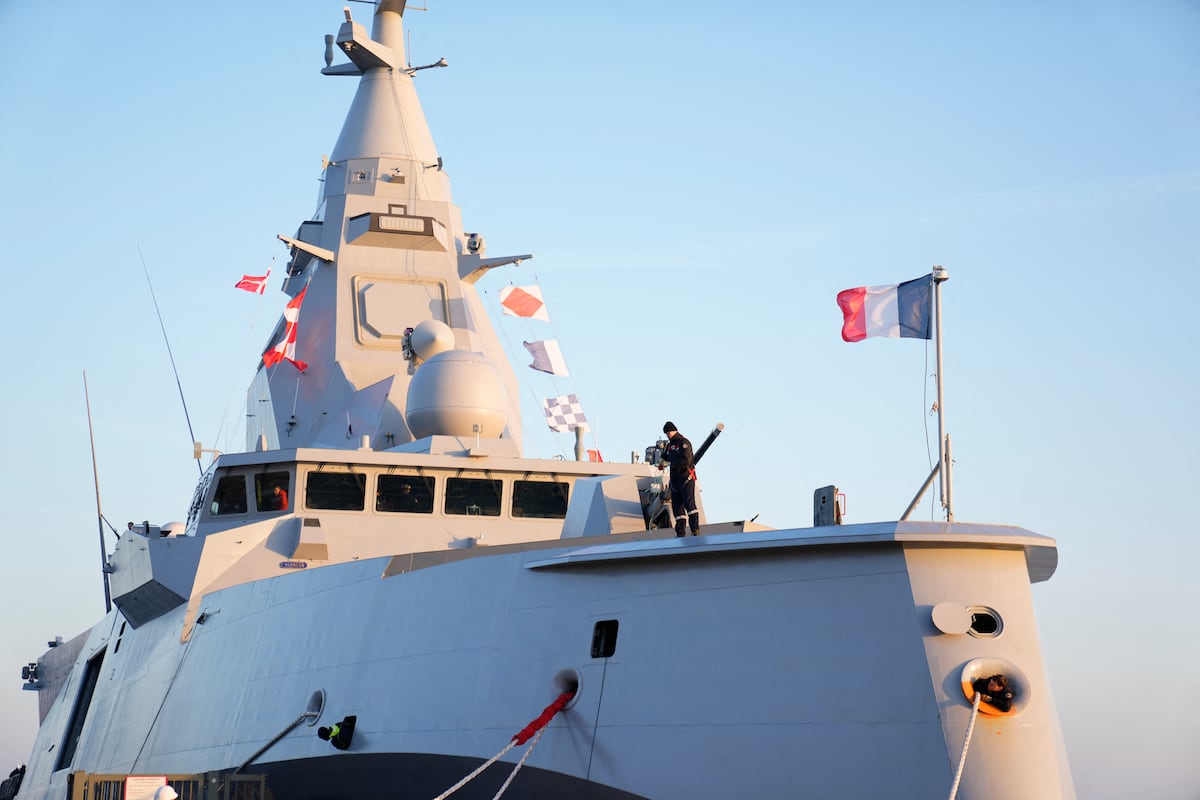
PARIS — Sweden has picked France’s Naval Group to supply four of its FDI frigates in a deal that could be worth more than 40 billion Swedish kroner, or around US$4.2 billion, with the French offer beating proposals from Spain’s Navantia and the United Kingdom’s Babcock International.
The frigates are expected to cost a little over 10 billion Swedish kroner each, with the final price depending on the integrated equipment and systems, Swedish Defence Minister Pål Jonson said in a press conference in Stockholm on Tuesday. The vessels will be equipped with MBDA’s Aster 30 missiles for long-range air defense.
The frigate purchase represents one of Sweden’s biggest defense investments since the Gripen fighter jet in the 1980s and will triple the country’s air-defense capabilities, Prime Minister Ulf Kristersson said. For Naval Group, the selection is a welcome win after Norway in August last year picked the U.K.’s Type 26 frigate , primarily manufactured by BAE Systems, over the smaller French design.
Rapid delivery is “absolutely essential given the very serious security situation we are currently in,” Jonson said. With the FDI, “Sweden is acquiring a highly advanced surface combatant for which an adversary would also need to allocate significant resources to counter,” he said.
Sweden picked the Naval Group vessel, known in French as the Frégate de Défense et d’Intervention, due to a combination of delivery time, an active production line ensuring a “very high degree of delivery reliability,” and an integrated and proven air-defense system, according to Jonson. He also cited the possibility of sharing costs with FDI operators France and Greece as important.
The first frigate in what will be named the Luleå class is expected to be delivered in 2030, based on the bid, with one frigate delivered per year, Jonson said.
Sweden's Defense Minister Pal Jonson, Prime Minister Ulf Kristersson and Chief of Defence Staff and Supreme Commandant Gen. Michael Claesson deliver a press conference aboard the Visby-class corvette HMS Haernoesand in Stockholm, Sweden, on May 19, 2026. (Lars Schroder / TT News Agency / AFP via Getty Images)
France has been ordering Swedish equipment recently, including a contract for two of Saab’s GlobalEye airborne early warning and control aircraft in December, with an option for two more.
Jonson said the time of delivery has been the main consideration for the choice of the French frigate, rather than offset agreements.
The Swedish Defence Materiel Administration will now start negotiations with France and Naval Group. The final price will depend on the subsystems and armament, with the acquisition a “very large deal” that will strengthen ties with France and open the door to further cooperation, according to the defense minister.
Kristersson said he put in a call to French President Emmanuel Macron this morning so the French president wouldn’t learn of the Swedish decision via the media.
The Swedish prime minister said there’s no connection between the frigate pick and discussions around cooperation regarding France’s nuclear capabilities.
The new frigates will make the Swedish Navy and armed forces significantly stronger, also because Sweden plans to continue to use the existing Visby corvettes “for a long time to come,” alongside the future Luleå class, according to Jonson. The corvettes will be upgraded with additional air-defense capabilities, Swedish Chief of Defence Gen. Michael Claesson said.
Kristersson, Jonson and Claesson spoke at a press conference held on the Visby-class corvette Härnösand moored on the historical Skeppsbron quay in Stockholm. The Swedish corvettes are 73 meters long and displace 650 tons.
The new surface combatants are expected to be capable of operating in NATO’s entire area of operations, and that requires larger vessels than the Visby-class corvettes, with improved long-range air defenses, according to Jonson. The FDI is 122 meters long and displaces around 4,500 tons, smaller than many recent frigate designs being built or planned in the U.K., Spain, Italy and Germany.
In addition to the Aster 30, which Jonson described as capable of shooting down ballistic missiles and comparable to the land-based Patriot air-defense system, the frigates will be equipped with the CAMM-ER medium-range air-defense system, also from pan-European missile maker MBDA.
The Aster 30 has a “completely different” range compared to what the Visby corvettes can offer and can be integrated in NATO’s integrated air and missile defense system, said Claesson, who didn’t answer a question about how many vertical launch cells the Swedish frigates will carry.
In the contract talks, Sweden will stipulate inclusion of Swedish components including Saab’s RBS-15 anti-ship missile, Torped 47 lightweight torpedo, Giraffe G1X compact radar and Trackfire remote-weapon station, as well as the BAE Systems Bofors 57mm naval gun and 40mm cannon, Jonson said.
Claesson noted the FDI has an integrated command-and-control system that can interface with NATO systems, and Sweden will be “very careful” about system compatibility.
“The frigates mean that we get a significantly greater freedom of action to be able to participate in a much larger range of the tasks that NATO sets,” Claesson said. He said one reason to move forward with the frigate purchase was because of NATO capability targets.
France had previously touted its ability to supply Sweden with a fully equipped and armed frigate in 2030, and Naval Group said in October it can produce two of the FDI frigates per year.
For the Swedish frigate acquisition, Spain’s Navantia had offered its Alfa 4000 model , with a length of 120 meters and a displacement of 4,300 metric tons, while the United Kingdom’s Babcock had pitched its Arrowhead 120 model for Sweden, with a length of 124 meters and a displacement of 4,650 tons.
France placed an order for its fifth FDI frigate in March, the final vessel currently planned in the class for the French Navy, with delivery planned for 2032. The French budget for five vessels was €4.28 billion ($5 billion), according to the 2019 defense spending plan, putting the price at around €850 million per unit.
Greece in November exercised an option for a fourth FDI frigate, and in March sent the frigate Kimon, its first vessel in the class, to Cyprus .
The FDI is equipped with a Thales Sea Fire radar with four fixed panels, and France describes the frigate as fully digital, equipped with “significant computer power” to process sensor data.
Rudy Ruitenberg is a Europe correspondent for Defense News. He started his career at Bloomberg News and has experience reporting on technology, commodity markets and politics.
巴黎——瑞典已选择法国海军集团为其提供四艘FDI护卫舰,该交易价值可能超过400亿瑞典克朗,约合42亿美元。法国的报价击败了西班牙纳凡蒂亚公司和英国巴布科克国际公司的提案。
瑞典国防部长帕尔·约翰逊周二在斯德哥尔摩举行的新闻发布会上表示,预计每艘护卫舰的造价将略高于100亿瑞典克朗,最终价格将取决于集成设备和系统。这些舰艇将配备MBDA公司的“紫菀30”(Aster 30)远程防空导弹。
瑞典首相乌尔夫·克里斯特松表示,此次护卫舰采购是瑞典自上世纪80年代购买“鹰狮”战斗机以来最大的国防投资之一,将使该国的防空能力提升三倍。对于法国海军集团而言,此次采购是一次令人欣喜的胜利。此前,挪威在去年8月选择了英国的26型护卫舰(主要由BAE系统公司制造),而非尺寸较小的法国设计。
约翰逊表示,鉴于我们目前面临的严峻安全形势,快速交付“绝对至关重要”。他指出,通过这项外国直接投资,“瑞典正在获得一款高度先进的水面作战舰艇,对手也需要投入大量资源才能应对”。
据约翰逊称,瑞典之所以选择法国海军集团的这艘舰艇(法语名为“Frégate de Défense et d'Intervention”),是因为它具备多种优势:交付时间短、生产线运转良好,能够确保“极高的交付可靠性”,并且配备了成熟可靠的集成式防空系统。他还指出,与法国和希腊等外国直接投资运营商分摊成本也是一项重要因素。
约翰逊表示,根据投标情况,首艘将被命名为吕勒奥级的护卫舰预计将于 2030 年交付,之后每年交付一艘。
2026年5月19日,瑞典国防部长帕尔·约翰逊、首相乌尔夫·克里斯特松和国防参谋长兼最高司令迈克尔·克莱松将军在瑞典斯德哥尔摩的维斯比级护卫舰“哈诺桑德”号上举行新闻发布会。(Lars Schroder / TT News Agency / AFP via Getty Images)
法国最近一直在订购瑞典的设备,包括去年 12 月签订的两架萨博 GlobalEye 空中预警和控制飞机的合同,并可以选择再购买两架。
约翰逊表示,选择法国护卫舰的主要考虑因素是交付时间,而不是补偿协议。
瑞典国防物资管理局将与法国海军集团展开谈判。最终价格将取决于子系统和武器装备,瑞典国防部长表示,此次采购是一笔“非常大的交易”,将加强瑞典与法国的关系,并为进一步合作打开大门。
克里斯特松表示,他今天早上给法国总统埃马纽埃尔·马克龙打了个电话,以免法国总统通过媒体得知瑞典的决定。
瑞典首相表示,选择护卫舰与围绕法国核能力合作的讨论之间没有任何联系。
据约翰逊称,新型护卫舰将显著增强瑞典海军和武装部队的实力,此外,瑞典计划在“未来很长一段时间内”继续使用现有的维斯比级轻型护卫舰,同时还将服役未来的吕勒奥级护卫舰。瑞典国防部长迈克尔·克莱松将军表示,这些轻型护卫舰将升级,增加防空能力。
克里斯特森、约翰逊和克莱森在停泊于斯德哥尔摩历史悠久的斯凯普斯布隆码头的维斯比级护卫舰“哈尔诺桑德”号上举行了新闻发布会。这些瑞典护卫舰长73米,排水量650吨。
据约翰逊称,新型水面作战舰艇预计将具备在北约整个作战区域作战的能力,这需要比维斯比级轻型护卫舰更大的舰艇,并配备更先进的远程防空系统。FDI级护卫舰长122米,排水量约4500吨,比英国、西班牙、意大利和德国正在建造或计划建造的许多新型护卫舰都要小。
除了约翰逊所说的能够击落弹道导弹、堪比陆基爱国者防空系统的 Aster 30 导弹外,这些护卫舰还将配备 CAMM-ER 中程防空系统,该系统同样来自泛欧导弹制造商 MBDA。
克莱松表示,Aster 30 的射程与 Visby 护卫舰所能提供的射程“完全不同”,并且可以集成到北约的综合防空和导弹防御系统中。但他没有回答关于瑞典护卫舰将携带多少个垂直发射单元的问题。
约翰逊表示,在合同谈判中,瑞典将规定加入瑞典制造的部件,包括萨博公司的RBS-15反舰导弹、Torped 47轻型鱼雷、Giraffe G1X紧凑型雷达和Trackfire遥控武器站,以及BAE系统公司的博福斯57毫米舰炮和40毫米舰炮。
克莱森指出,FDI 拥有一个可以与北约系统对接的集成指挥控制系统,瑞典将“非常谨慎”地对待系统兼容性问题。
克莱森表示:“护卫舰的到来意味着我们将拥有更大的行动自由,能够参与北约设定的更广泛的任务。” 他说,推进护卫舰采购的原因之一是北约的能力目标。
法国此前曾吹嘘其有能力在 2030 年向瑞典提供一艘装备齐全的武装护卫舰,而法国海军集团在 10 月份表示,它每年可以生产两艘 FDI 护卫舰。
在瑞典护卫舰采购项目中,西班牙纳凡蒂亚公司提供了其阿尔法4000型护卫舰,该舰长120米,排水量4300公吨;而英国巴布科克公司则向瑞典推销了其箭头120型护卫舰,该舰长124米,排水量4650吨。
今年3月,法国订购了第五艘FDI级护卫舰,这是法国海军目前计划建造的该级舰艇的最后一艘,预计将于2032年交付。根据2019年国防开支计划,法国为这五艘舰艇的预算为42.8亿欧元(50亿美元),平均每艘价格约为8.5亿欧元。
希腊在 11 月行使了建造第四艘 FDI 护卫舰的选择权,并在 3 月将该级的第一艘舰艇“基蒙”号护卫舰送往塞浦路斯。
FDI 配备了泰雷兹海火雷达,该雷达有四个固定面板。法国方面称该护卫舰为全数字化护卫舰,配备了“强大的计算机能力”来处理传感器数据。
鲁迪·鲁伊滕贝格是《防务新闻》的欧洲记者。他的职业生涯始于彭博新闻社,拥有报道科技、大宗商品市场和政治方面的经验。