Sikorsky’s Nomad 100 VTOL Drone Is Now Quad-Packed In A Container For Rapid Deployment西科斯基公司的Nomad 100垂直起降无人机现已四架打包在一个集装箱内,以便快速部署。
The Fast Pack gets a quartet of autonomous fixed-wing aircraft into action as quickly as possible from remote locales with no infrastructure. The Fast Pack gets a quartet of autonomous fixed-wing aircraft into action as quickly as possible from remote locales with no infrastructure.
新闻视频
Published Oct 14, 2026 12:31 PM EDT
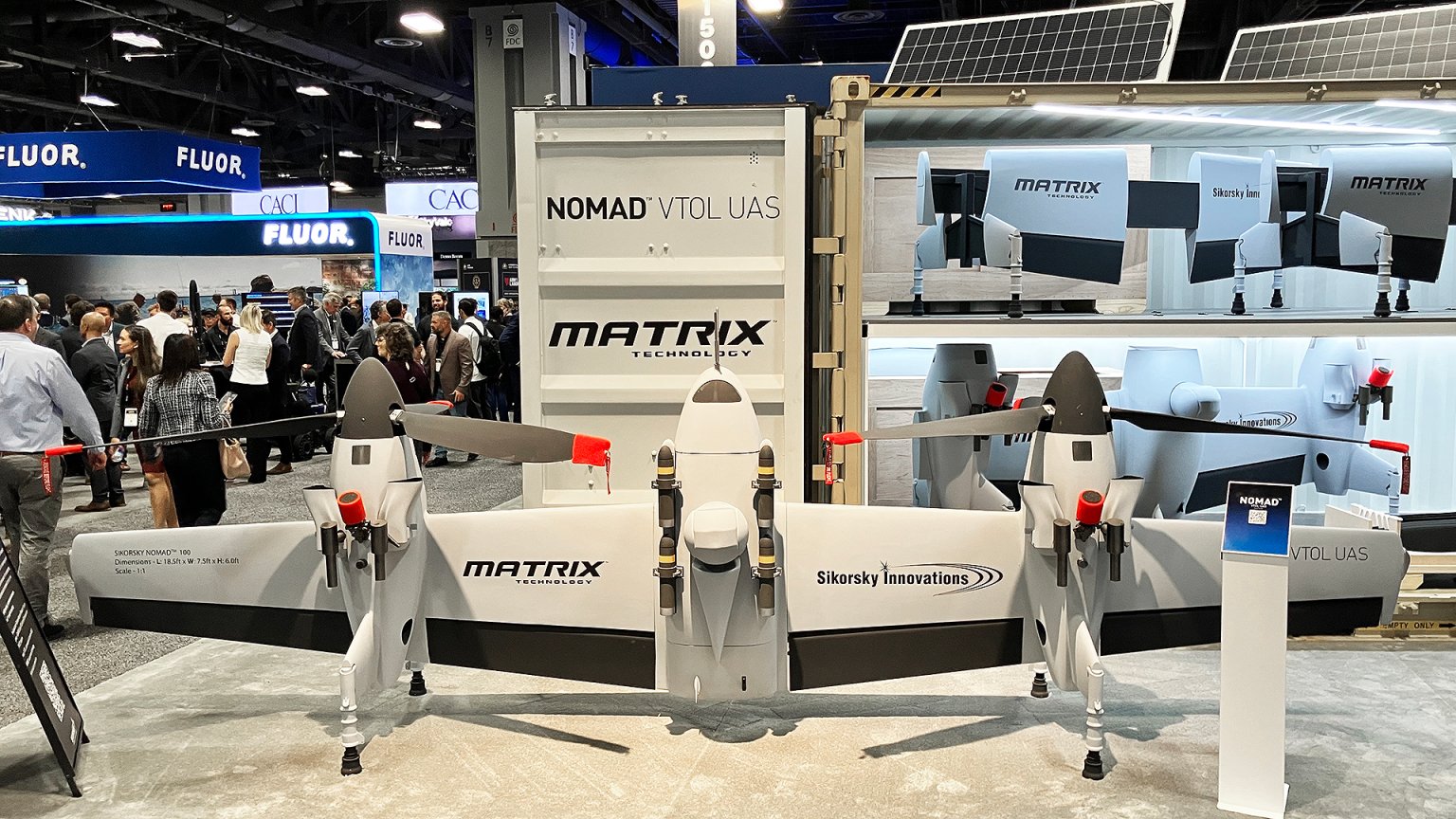
Sikorsky has unveiled a concept for a containerized deployment package for its Nomad 100 vertical takeoff and landing uncrewed aircraft system (VTOL UAS), combining four aircraft and their support equipment inside a single 20-foot shipping container. The company is pitching the Nomad 100 Fast Pack as a way to rapidly establish autonomous air capabilities at locations without runways or other conventional support infrastructure.
The concept was unveiled on October 12 at the Association of the U.S. Army’s (AUSA) main annual convention in Washington, D.C., where TWZ is in attendance. It comes as the U.S. military seeks to expand its inventory of uncrewed systems and distribute capabilities across more dispersed operating locations, particularly in preparation for a potential large-scale conflict with China in the Indo-Pacific.
Rendering of the Nomad 100 Fast Pack in action. Courtesy of Sikorsky, a Lockheed Martin company Rendering courtesy of Sikorsky, a Lockheed Martin company
“Military commanders are asking for capability that enables them to deploy worldwide into austere environments,” said Ramsey Bentley, director of Sikorsky Advanced Concepts, speaking at AUSA. They want greater situational awareness, the ability to conduct targeting and deliver effects at range, and the capacity to control multiple assets simultaneously, he added.
A rendering of soldiers preparing Nomads for launch in a typical Indo-Pacific operating environment. Sikorsky screencap
The Nomad 100 Fast Pack is built around a standard 20-foot ISO container housing four aircraft, mission-command equipment, communications, power systems, and sustainment supplies. The aim is to deliver a self-contained package that can be transported to a forward location, brought into operation, and moved again quickly. A promotional video shows the Fast Pack being transported into a combat theater by one of the company’s Black Hawk helicopters as a slung load.
Sikorsky says two Nomad 100s can be prepared for flight “out of the box” in less than 15 minutes and that the other two aircraft — stored on the upper shelf of the container — can be made available within four to six hours.
The package is designed to support runway-independent operations from locations including naval vessels, tactical vehicle staging areas, and improvised landing zones.
“We no longer require a ground control station,” explained Sikorsky Vice President and General Manager Rich Benton. “We no longer require a large group of soldiers or operators.”
Beyond the containerized package, Bentley said Nomad can be transported by truck or trailer, or potentially self-deploy in a smaller package. Sikorsky is also developing containerized deployment concepts for larger members of the Nomad family.
As we have discussed in the past , the Nomad 100 combines vertical takeoff and landing with the ability to transition to fixed-wing flight, bringing airplane-like range and endurance to a compact, runway-independent package that can operate from confined locations.
“What is very unique about this aircraft is it’s able to roll over on its wing and also fly like an airplane,” Bentley said. “So you’re getting the vertical takeoff and landing capability, along with the endurance, range, and speed of a fixed-wing aircraft.”
Sikorsky cites an endurance of 10 to 14 hours, depending on payload, a range exceeding 800 nautical miles, and a cruising speed of 70 miles per hour, with a dash speed of 90 miles per hour.
Its hybrid-electric drivetrain uses combustion engines to drive a generator that supplies power to the aircraft’s rotors and mission systems. Nomad is designed to operate on multiple fuels, including JP-8, JP-4, and Jet A.
“Ten gallons of fuel provides over 10 plus hours of operation, so it’s a very efficient system,” Bentley said. He added that the hybrid-electric design reduces maintenance requirements, emphasizing line-replaceable units over more extensive traditional aviation maintenance.
The aircraft can carry a 60-pound mission payload, including supplies such as medical equipment. Bentley said its modular center fuselage can be configured as a cargo bay or adapted for other mission equipment.
Sikorsky says the Fast Pack can support intelligence, surveillance, reconnaissance and targeting (ISR-T), light attack, and contested logistics missions, depending on customer configuration.
On display at AUSA is a Nomad configured with a forward-looking infrared (FLIR) sensor turret with laser designation capability and four small Northrop Grumman Hatchet glide munitions.
Other potential payloads include electro-optical and infrared sensors, synthetic aperture radar, launched effects, and electronic warfare systems for jamming.
A launched effect is released from a Nomad drone in an earlier Sikorsky rendering. Sikorsky screencap
The combination of a small logistical footprint and long-range flight could be particularly useful for supporting expeditionary forces . The aircraft could deliver supplies without relying on a runway or crewed helicopter, while sensor-equipped variants could provide reconnaissance and target designation. Other configurations could carry weapons or deploy additional uncrewed systems.
The Fast Pack also relies on Sikorsky’s MATRIX autonomy technology to reduce operator workload. Rather than continuously piloting each aircraft, an operator can assign a mission through a tablet-based interface and let the aircraft execute it autonomously.
A drone operator uses a tablet to control a Nomad. Sikorsky screencap
“Now, Matrix autonomy is a very mature autonomy capability. We’ve had over 1,000 flight hours on Matrix,” Bentley said.
An operator selects a mission, designates a location on a map, and initiates the flight. MATRIX then manages engine start, preflight checks, launch, navigation, and mission execution.
“For the operator, very simply, he pulls up the display. He selects a mission, say reconnaissance, and then the operator would select a point on the map where he wants that reconnaissance to occur, and then he hits start,” Bentley explained. “The aircraft Matrix autonomy takes care of everything else along the flight.”
Bentley said the system can adapt to changing environmental and tactical conditions, using onboard sensors to navigate and avoid obstacles, including hazards around landing areas.
“Our whole approach here with the advanced Matrix autonomy is: How do we take the workload off the operator?” he said. “This is not remotely piloted, although you could do that. Our approach here is that this is fully autonomous.”
Communications are designed to be network-agnostic. Bentley identified Starlink or Starshield for beyond-line-of-sight connectivity in the current configuration, alongside tactical mobile ad-hoc networking (MANET) equipment for line-of-sight communications.
MATRIX is also used in other Sikorsky autonomy efforts, including the fully uncrewed U-Hawk drone , seen in the video below, and the company’s optionally piloted Black Hawk concept . A common tablet interface could help operators manage different autonomous aircraft without needing a separate control system for each.
Nomad 100 originated under DARPA’s EVADE program, which sought to develop a vertical-lift uncrewed aircraft capability. Bentley said two customers associated with the program had placed initial orders, with additional interest from domestic and international customers.
Sikorsky has a contract for three Nomad 100s under EVADE. The company announced in July that the first had been delivered to the customer, while a second was entering flight testing at the time of the interview. The U.S. Marine Corps is also buying two Nomad 100s, Bentley told Army Times .
Sikorsky is developing the larger Nomad 500, which will offer greater payload capacity, longer range, and increased power output. One Nomad 500 can fit in a 20-foot container, while three can be transported in a 40-foot container, according to Bentley. The largest member of the family, the Nomad 1000, requires a 40-foot container for a single aircraft.
A rendering shows how the Nomad family of VTOL drones can be scaled for a variety of sea- and land-based missions. Sikorsky
The Fast Pack concept reflects a broader effort to make autonomous aircraft easier to deploy and sustain as military forces disperse across larger operating areas. Its appeal lies not just in the Nomad 100’s combination of vertical takeoff and long-range flight, but in packaging multiple aircraft and their supporting equipment into a single, relocatable system. That could be especially valuable in the Indo-Pacific, where long distances, limited infrastructure, and the vulnerability of fixed operating bases pose major challenges.
Contact the author: thomas@thewarzone.com
Comments couldn’t be loaded. Please refresh the page.
发布于美国东部时间2026年10月14日下午12:31
西科斯基公司发布了其Nomad 100垂直起降无人机系统(VTOL UAS)的集装箱式部署方案,该方案将四架无人机及其配套设备集成到一个20英尺的集装箱内。该公司将Nomad 100快速部署包定位为一种能够在没有跑道或其他常规支持基础设施的地区快速建立自主飞行能力的解决方案。
这一概念于10月12日在美国陆军协会(AUSA)于华盛顿特区举行的年度大会上首次亮相,TWZ也出席了此次大会。此举正值美军寻求扩大其无人系统库存,并将作战能力分散到更多作战地点之际,尤其是为了应对可能在印太地区与中国发生的大规模冲突。
Nomad 100 Fast Pack 的实战效果图。图片由洛克希德·马丁公司旗下的西科斯基公司提供。
“军事指挥官们要求具备在全球各种艰苦环境下部署的能力,”西科斯基先进概念公司总监拉姆齐·本特利在AUSA大会上表示。他补充说,他们需要更强的态势感知能力、远程目标定位和打击能力,以及同时控制多个目标的能力。
一张模拟照片,展现了士兵们在典型的印太作战环境下准备“游牧者”无人机起飞的场景。西科斯基公司截图
Nomad 100 快速包以一个标准的 20 英尺 ISO 集装箱为核心,内部可容纳四架飞机、任务指挥设备、通信系统、电力系统和后勤补给品。其目标是提供一个可快速运输至前线、投入使用并再次快速转移的独立组件。一段宣传视频展示了该公司的一架黑鹰直升机将快速包以吊挂方式运送至战区的场景。
西科斯基公司表示,两架 Nomad 100 飞机可以在不到 15 分钟内“开箱”完成飞行准备,而另外两架飞机——存放在集装箱的上层——可以在四到六小时内投入使用。
该软件包旨在支持从包括海军舰艇、战术车辆集结区和临时着陆区在内的地点进行无需跑道的作战行动。
西科斯基公司副总裁兼总经理里奇·本顿解释说:“我们不再需要地面控制站,也不再需要大量士兵或操作人员。”
除了集装箱式包装外,Bentley表示,Nomad还可以通过卡车或拖车运输,或者以较小的包装自行部署。西科斯基公司也在为Nomad系列中尺寸更大的型号开发集装箱式部署方案。
正如我们过去讨论过的,Nomad 100 结合了垂直起降和过渡到固定翼飞行的能力,将飞机般的航程和续航能力融入到一个紧凑、无需跑道的包装中,可以在受限地点运行。
“这架飞机的独特之处在于它既能翻滚,又能像固定翼飞机一样飞行,”本特利说。“因此,它既具备垂直起降能力,又拥有固定翼飞机的续航能力、航程和速度。”
西科斯基公司表示,根据有效载荷的不同,续航时间为 10 至 14 小时,航程超过 800 海里,巡航速度为每小时 70 英里,冲刺速度为每小时 90 英里。
其混合动力驱动系统利用内燃机驱动发电机,为飞机的旋翼和任务系统提供动力。Nomad 设计可使用多种燃料,包括 JP-8、JP-4 和 Jet A。
“十加仑燃料可提供超过十小时的运行时间,因此这是一个非常高效的系统,”本特利说道。他还补充说,混合动力设计降低了维护需求,强调可在线更换部件,而非进行更广泛的传统航空维护。
该飞机可携带60磅(约27公斤)的任务有效载荷,包括医疗设备等物资。宾利公司表示,其模块化中央机身可配置为货舱,也可改装用于搭载其他任务设备。
西科斯基表示,根据客户配置,快速背包可以支持情报、监视、侦察和目标定位 (ISR-T)、轻型攻击和对抗性后勤任务。
AUSA展出的Nomad无人机配备了前视红外(FLIR)传感器转塔,具有激光指示能力,并装有四枚小型诺斯罗普·格鲁曼斧头滑翔弹药。
其他潜在有效载荷包括光电和红外传感器、合成孔径雷达、发射效应装置和用于干扰的电子战系统。
在西科斯基早期的渲染图中,一架Nomad无人机释放了一个特效装置。西科斯基屏幕截图
这种飞机后勤保障能力强,航程远,对于支援远征部队来说尤为有用。它无需跑道或有人驾驶直升机即可运送补给,而配备传感器的型号则可以执行侦察和目标指示任务。其他配置还可以携带武器或部署额外的无人系统。
快速套件还采用了西科斯基的 MATRIX 自主飞行技术来减轻操作员的工作负荷。操作员无需持续操控每架飞机,只需通过平板电脑界面分配任务,即可让飞机自主执行。
无人机操作员使用平板电脑控制一架 Nomad 无人机。西科斯基公司屏幕截图
“现在,Matrix自主系统已经非常成熟。我们已经积累了超过1000小时的Matrix飞行时间,”本特利说。
操作员选择任务,在地图上指定位置,然后启动飞行。MATRIX 随后管理发动机启动、飞行前检查、发射、导航和任务执行。
“对操作员来说,操作非常简单,他只需调出显示屏,选择一个任务,比如侦察,然后在地图上选择一个侦察点,最后按下开始按钮,”本特利解释说。“飞机的矩阵自主系统会处理飞行过程中的其他一切。”
本特利表示,该系统能够适应不断变化的环境和战术条件,利用机载传感器进行导航并避开障碍物,包括着陆区周围的危险。
他说:“我们采用先进的Matrix自主系统的核心理念是:如何减轻操作员的工作负担。这并非远程操控,尽管理论上可以做到。我们的目标是实现完全自主运行。”
通信设计旨在与网络无关。在当前配置中,Bentley 确定使用 Starlink 或 Starshield 实现超视距连接,同时使用战术移动自组织网络 (MANET) 设备实现视距通信。
MATRIX系统也应用于西科斯基的其他自主飞行器项目中,包括视频中展示的完全无人驾驶的U-Hawk无人机,以及该公司可选有人驾驶的Black Hawk概念机。通用的平板电脑界面可以帮助操作员管理不同的自主飞行器,而无需为每架飞行器配备单独的控制系统。
Nomad 100 起源于美国国防高级研究计划局 (DARPA) 的 EVADE 项目,该项目旨在开发垂直起降无人飞行器。宾利表示,与该项目相关的两家客户已下了首批订单,此外还有国内外客户对此表示了兴趣。
西科斯基公司根据EVADE项目签订了三架Nomad 100无人机的合同。该公司在7月份宣布,第一架无人机已交付给客户,而第二架无人机在接受采访时正在进行飞行测试。本特利告诉《陆军时报》,美国海军陆战队也正在采购两架Nomad 100无人机。
西科斯基公司正在研发更大的Nomad 500,它将拥有更大的有效载荷、更远的航程和更高的动力输出。据本特利称,一架Nomad 500可以装入一个20英尺的集装箱,而三架可以装入一个40英尺的集装箱。该系列中最大的Nomad 1000,单架就需要一个40英尺的集装箱。
渲染图展示了Nomad系列垂直起降无人机如何根据不同的海陆任务进行扩展。西科斯基
快速部署包概念体现了更广泛的努力,即在军事力量分散于更大作战区域的情况下,使自主飞行器的部署和维护更加便捷。其吸引力不仅在于Nomad 100垂直起降和远程飞行能力的结合,更在于将多架飞机及其配套设备集成到一个可重新部署的系统中。这在印太地区尤为重要,因为该地区地域辽阔、基础设施有限,且固定作战基地易受攻击,这些都构成了重大挑战。
联系作者:thomas@thewarzone.com
评论加载失败,请刷新页面。