F-35C Makes First Arrested Landing Aboard A Ford Class CarrierF-35C战机首次在福特级航母上完成拦阻着陆
The landing on the future USS John F. Kennedy marks a key step in integrating the F-35C with the Ford class after years of delays and technical challenges. The landing marks a key step in integrating the F-35C with the Ford class after years of delays and technical challenges.
Published Oct 14, 2026 1:10 PM EDT
U.S. Navy photo by Mass Communication Specialist Seaman Kaitlyn Bailey
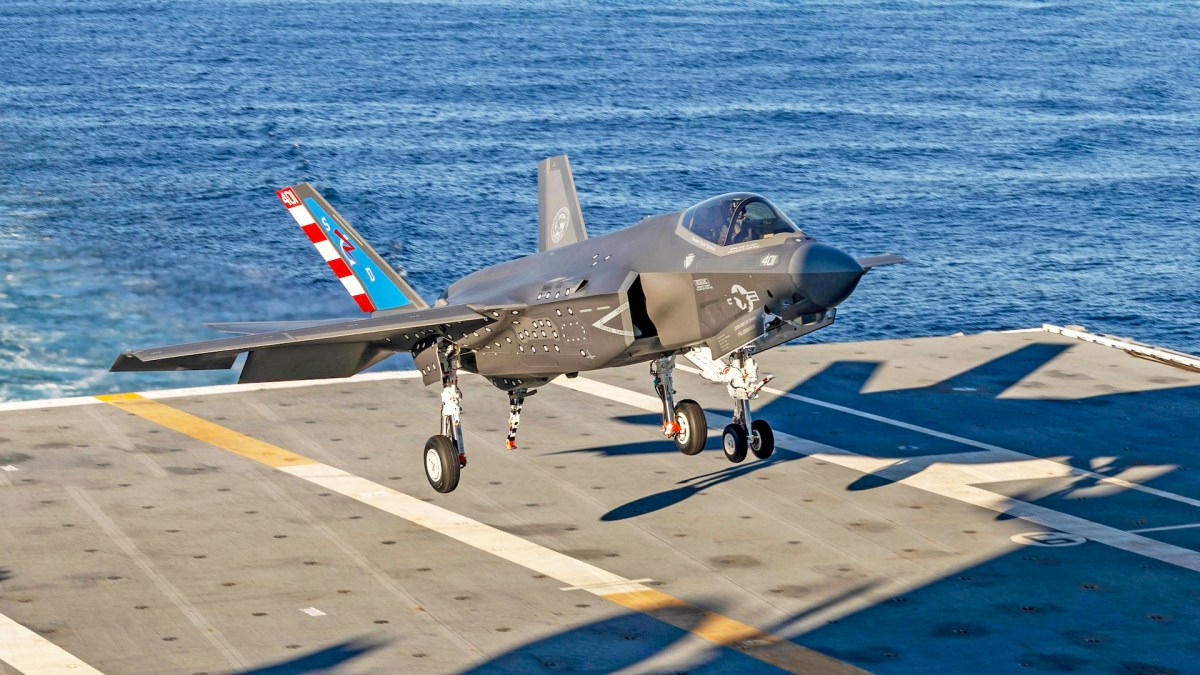
A U.S. Navy F-35C has made the first arrested landing for the type aboard a Ford class aircraft carrier, with the milestone taking place aboard the future USS John F. Kennedy (CVN 79) in the Western Atlantic on October 13, 2026. The milestone marks a major step in testing the Navy’s stealth fighter aboard its newest carrier class, following years of challenges integrating advanced launch and recovery systems.
Two F-35C test pilots assigned to Air Test and Evaluation Squadron 23 (VX-23), part of the Naval Air Warfare Center Aircraft Division (NAWCAD), flew to the carrier as part of an ongoing Aircraft Compatibility Testing (ACT) campaign. A team from the Patuxent River-based F-35 Integrated Test Force (ITF), detached to the ship, is conducting the evaluation using a specially instrumented example of the carrier-capable stealth fighter. The imagery released shows two jets, although only one is seen landing on the flattop. The other is seen carrying inert Joint Direct Attack Munition (JDAM) bombs externally.
An F-35 test pilot from Air Test and Evaluation Squadron Two Three (VX-23), Naval Air Warfare Center Aircraft Division (NAWCAD), flies an F-35C overhead the PCU John F. Kennedy in the Western Atlantic on Oct. 13, 2026. U.S. Navy
The Navy took preliminary acceptance of the carrier from Newport News Shipbuilding on September 29, following successful acceptance trials in August. That development allows the ship and its crew to conduct at-sea testing and build underway proficiency while the shipbuilder completes final systems testing ahead of formal delivery, scheduled for spring 2027.
Two F-35 test pilots from VX-23 fly F-35Cs to the PCU John F. Kennedy in the Western Atlantic on Oct. 13, 2026. U.S. Navy
The test is an important step in validating the integration of the F-35C with the Ford class. The Navy’s newest carriers use electromagnetic catapults and advanced arresting equipment , replacing the steam-powered launch systems and conventional arresting machinery found aboard the preceding Nimitz class.
Aircraft Compatibility Testing assesses the operational capabilities of a ship’s aircraft launch and recovery equipment with U.S. Navy aircraft. The process helps engineers evaluate how the carrier’s systems interact with individual aircraft and collect data needed to validate their performance.
A U.S. Navy F-35C of VX-23 makes an arrested landing on the flight deck aboard PCU John F. Kennedy . U.S. Navy photo by Mass Communication Specialist Seaman Kaitlyn Bailey
A U.S. Navy F-35C of VX-23 catches the wire on the flight deck aboard PCU John F. Kennedy . U.S. Navy photo by Mass Communication Specialist Seaman Kaitlyn Bailey
The F-35C is specifically designed for carrier operations, with larger wings, reinforced landing gear and a beefier tail hook compared with the Air Force’s F-35A. Its ability to launch from a carrier and recover through an arrested landing is central to its role in the Navy’s carrier air wings, which also include F-35Cs operated by the U.S. Marine Corps .
The use of a specially instrumented aircraft is particularly relevant to the test campaign. Instrumentation allows test teams to record data during flight-deck operations, helping them assess system performance and identify any issues requiring further evaluation.
A U.S. Navy F-35C of VX-23 with its airframe liberally adorned with telemetry markings — these act as precision visual references used during flight testing to capture exact spatial data. U.S. Navy photo by Mass Communication Specialist Seaman Kaitlyn Bailey
A close-up of one of the U.S. Navy F-35Cs of VX-23 reveals a full set of underwing stores pylons and a load of three inert 500-pound JDAM-series weapons. U.S. Navy photo by Mass Communication Specialist Seaman Kaitlyn Bailey
The first arrested landing aboard John F. Kennedy demonstrates that the ship has reached an important F-35C compatibility milestone. It does not, however, establish that all testing, certification, or operational qualification requirements have been completed.
The milestone comes against the backdrop of the Ford class program’s difficulties integrating some of its advanced aviation systems. The lead ship, USS Gerald R. Ford (CVN 78), introduced the Electromagnetic Aircraft Launch System (EMALS) and Advanced Arresting Gear (AAG), technologies intended to improve aircraft-launch flexibility, recovery performance, and overall sortie generation. Development and reliability challenges with both EMALS and AAG have contributed to delays in the class’s progress. In a 2019 report, TWZ highlighted concerns that Ford class carriers would not be ready to operate the F-35C for years.
A U.S. Navy F-35C makes an arrested landing on the flight deck aboard PCU John F. Kennedy for the first time. U.S. Navy photo by Mass Communication Specialist Seaman Kaitlyn Bailey
USS Gerald R. Ford was designed and built before the F-35C’s full carrier-integration requirements were sufficiently mature, so the Navy deferred several upgrades to a later modernization period rather than delaying the ship’s delivery. Following congressional pressure, the Navy adopted a single-phase delivery approach for USS John F. Kennedy , incorporating these modifications during construction instead.
The USS Gerald R. Ford completed its Aircraft Compatibility Testing in January 2020, following 16 days at sea, during which the crew launched and recovered 211 aircraft, testing five different airframes — but the F-35C was not included.
A U.S. Navy F-35C, attached to VX-23, after an arrested landing on the flight deck aboard PCU John F. Kennedy . U.S. Navy photo by Mass Communication Specialist Seaman Kaitlyn Bailey
Beyond EMALS and AAG, integrating the F-35C on Kennedy requires modifications to the carrier’s maintenance infrastructure and support systems. These include specialized spaces for handling the aircraft’s sensitive mission systems and classified data, computer networks and interfaces linking its maintenance and logistics systems with the Navy’s existing infrastructure, and facilities and equipment to support the upkeep of its low-observable coatings and materials. The Navy has also identified the need for more robust jet blast deflectors (JBDs), which protect flight-deck personnel and equipment from the F-35C’s intense engine exhaust.
Earlier F-35C integration work aboard Nimitz class carriers included JBD modifications to improve heat resistance and cooling, while planning for John F. Kennedy explicitly included both JBD upgrades and changes to maintenance spaces and information systems.
An F-35 test pilot from VX-23 flies an F-35C to the PCU John F. Kennedy in the Western Atlantic on Oct. 13, 2026. U.S. Navy
The latest test represents progress toward resolving the compatibility question, although the full scope of the remaining work will depend on the results of the ongoing evaluation.
The development also comes as China advances its own carrier aviation capabilities. Unlike the U.S. Navy, its Fujian aircraft carrier has demonstrated electromagnetic catapult launches and arrested recoveries involving several aircraft types, including the J-35 stealth fighter.
A J-35 is prepared for takeoff on Fujian . via Chinese internet
In contrast to the U.S. Navy, which accumulated decades of experience with steam-powered catapults before adopting electromagnetic launch technology, China chose electromagnetic catapults for its first catapult-equipped carrier .
Although China’s demonstrations aboard Fujian and the F-35C compatibility testing aboard Kennedy involve different aircraft, ships, and stages of development, both underscore the technical demands of integrating advanced aircraft with modern carrier launch and recovery systems.
For the U.S. Navy, the immediate priority is to demonstrate that the Ford class can reliably support its intended aircraft. The F-35C’s first arrested landing aboard Kennedy is a significant step in that process, with further testing — not least an EMALS takeoff — needed before the milestone can begin to translate into an operational capability.
Contact the author: thomas@thewarzone.com
Comments couldn’t be loaded. Please refresh the page.
发布于美国东部时间2026年10月14日下午1:10
美国海军大众传播专家水兵凯特琳·贝利拍摄的照片
美国海军一架F-35C战斗机在福特级航空母舰上完成了该机型的首次拦阻着陆。这一里程碑事件发生在2026年10月13日,地点是位于西大西洋的未来“约翰·F·肯尼迪”号航空母舰(CVN 79)。这一里程碑事件标志着海军在其最新型航母上测试隐形战斗机迈出了重要一步,此前多年来,该机型在集成先进的发射和回收系统方面一直面临着诸多挑战。
隶属于海军航空作战中心飞机部(NAWCAD)第23空中测试与评估中队(VX-23)的两名F-35C试飞员飞抵航母,执行正在进行的飞机兼容性测试(ACT)活动。一支来自驻扎在帕图克森特河海军航空站的F-35综合测试部队(ITF)的团队已派往该航母,使用一架经过特殊改装的舰载隐形战斗机进行评估。公布的图片显示有两架战机,但只有一架降落在航母顶部。另一架战机则外挂了惰性联合直接攻击弹药(JDAM)炸弹。
2026年10月13日,美国海军航空作战中心飞机部(NAWCAD)第二十三空中测试与评估中队(VX-23)的一名F-35试飞员驾驶F-35C战斗机飞越位于西大西洋的“约翰·F·肯尼迪”号作战指挥中心上空。
海军于9月29日从纽波特纽斯造船厂初步接收了这艘航母,此前该舰已于8月成功完成验收试验。这一进展使得该舰及其舰员能够在造船厂完成最终系统测试的同时进行海上测试并提升航行技能,正式交付预计将于2027年春季进行。
2026年10月13日,美国海军VX-23中队的两名F-35试飞员驾驶F-35C战斗机飞往位于西大西洋的“约翰·F·肯尼迪”号航母战斗训练单元(PCU)。
此次测试是验证F-35C与福特级航母整合的重要一步。海军最新型的福特级航母采用电磁弹射器和先进的阻拦设备,取代了上一代尼米兹级航母上使用的蒸汽动力弹射系统和传统阻拦装置。
飞机兼容性测试旨在评估舰载机起降设备与美国海军飞机的运行能力。该测试流程帮助工程师评估航母系统与单架飞机的交互方式,并收集验证其性能所需的数据。
美国海军VX-23中队的一架F-35C战斗机在“约翰·F·肯尼迪”号补给舰的飞行甲板上进行拦阻着陆。美国海军大众传播专家水兵凯特琳·贝利摄。
美国海军VX-23中队的一架F-35C战斗机在“约翰·F·肯尼迪”号补给舰的飞行甲板上被电线缠住。美国海军大众传播专家水兵凯特琳·贝利摄。
F-35C 专为航母作战而设计,与空军的 F-35A 相比,它拥有更大的机翼、更坚固的起落架和更粗壮的尾钩。它能够从航母上起飞并通过拦阻着陆回收,这对于其在海军航母舰载机联队中的作用至关重要,美国海军陆战队也装备了 F-35C。
使用配备专用仪器的飞机对测试活动尤为重要。这些仪器使测试团队能够在驾驶舱操作期间记录数据,从而帮助他们评估系统性能并识别任何需要进一步评估的问题。
美国海军VX-23中队的一架F-35C战斗机,机身上布满了遥测标记——这些标记在飞行测试中用作精确的视觉参考,以采集精确的空间数据。美国海军大众传播专家水兵凯特琳·贝利拍摄。
美国海军VX-23中队的一架F-35C战斗机的特写镜头显示,其机翼下挂架完整,挂载了三枚500磅重的惰性JDAM系列武器。美国海军大众传播专家水兵凯特琳·贝利拍摄。
约翰·F·肯尼迪号航母上首次成功完成阻拦着陆,表明该航母已达到F-35C兼容性方面的重要里程碑。然而,这并不意味着所有测试、认证或作战资格要求均已完成。
这一里程碑的取得,正值福特级航母项目在整合部分先进航空系统方面面临重重困难之际。首舰“杰拉尔德·R·福特”号(CVN 78)引入了电磁弹射系统(EMALS)和先进阻拦装置(AAG),这两项技术旨在提升飞机弹射灵活性、回收性能和整体出动架次。然而,EMALS和AAG在研发和可靠性方面都存在挑战,导致该级航母的建造进度有所延误。在2019年的一份报告中,TWZ强调了人们对福特级航母可能需要数年时间才能做好操作F-35C战斗机的准备的担忧。
美国海军一架F-35C战斗机首次在“约翰·F·肯尼迪”号补给舰的飞行甲板上成功进行拦阻着陆。照片由美国海军大众传播专家水兵凯特琳·贝利拍摄。
“杰拉尔德·R·福特”号航空母舰的设计和建造早于F-35C战斗机全面航母集成要求的成熟阶段,因此海军将几项升级推迟到后续的现代化改造阶段,而不是推迟该舰的交付。在国会的压力下,海军对“约翰·F·肯尼迪”号航空母舰采取了单阶段交付的方式,在建造过程中就完成了这些改装。
2020 年 1 月,杰拉尔德·R·福特号航空母舰完成了飞机兼容性测试。经过 16 天的海上航行,舰员们共起飞和回收了 211 架飞机,测试了五种不同的机身——但 F-35C 并未包含在内。
一架隶属于VX-23中队的美国海军F-35C战斗机在“约翰·F·肯尼迪”号补给舰的飞行甲板上成功着舰。美国海军大众传播专家水兵凯特琳·贝利摄。
除了电磁弹射系统(EMALS)和先进自动瞄准装置(AAG)之外,将F-35C整合到肯尼迪号航母上还需要对航母的维护基础设施和支持系统进行改造。这些改造包括:用于处理飞机敏感任务系统和机密数据的专用空间;连接其维护和后勤系统与海军现有基础设施的计算机网络和接口;以及用于维护其低可观测性涂层和材料的设施和设备。海军还指出,需要更坚固的喷气发动机尾流偏转器(JBD),以保护飞行甲板人员和设备免受F-35C发动机强劲尾流的伤害。
早期在尼米兹级航母上进行的 F-35C 集成工作包括对 JBD 进行改装以提高耐热性和冷却性能,而约翰·F·肯尼迪号航母的规划则明确包括对 JBD 进行升级以及对维护空间和信息系统进行更改。
2026年10月13日,美国海军VX-23中队的一名F-35试飞员驾驶F-35C战斗机飞往位于西大西洋的“约翰·F·肯尼迪”号航母战斗训练单元(PCU)。
最新的测试表明,在解决兼容性问题方面取得了进展,但剩余工作的全部范围将取决于正在进行的评估结果。
与此同时,中国也在不断提升自身的航母舰载机作战能力。与美国海军不同,中国的福建号航空母舰已经成功演示了多种机型的电磁弹射起飞和拦阻回收,其中包括歼-35隐形战斗机。
一架歼-35战机在福建准备起飞。(图片来自中国互联网)
与美国海军在采用电磁弹射技术之前积累了数十年的蒸汽动力弹射器经验不同,中国为其第一艘配备弹射器的航母选择了电磁弹射器。
尽管中国在福建号航母上的演示和肯尼迪号航母上的 F-35C 兼容性测试涉及不同的飞机、舰艇和研发阶段,但两者都突显了将先进飞机与现代航母起降系统集成的技术要求。
对美国海军而言,当务之急是证明福特级航母能够可靠地为其预定机型提供支持。F-35C在肯尼迪航母上完成的首次拦阻着陆是这一进程中的重要一步,但在此里程碑转化为实际作战能力之前,还需要进行更多测试——尤其是电磁弹射起飞测试。
联系作者:thomas@thewarzone.com
评论加载失败,请刷新页面。