Australia primes local production of solid rocket motors for its ammo澳大利亚优先发展本国固体火箭发动机的生产,以供应其弹药。
Subsidiaries of major global defense firms are already lining up for the business, as Canberra seeks to boost its ammunitions stocks.
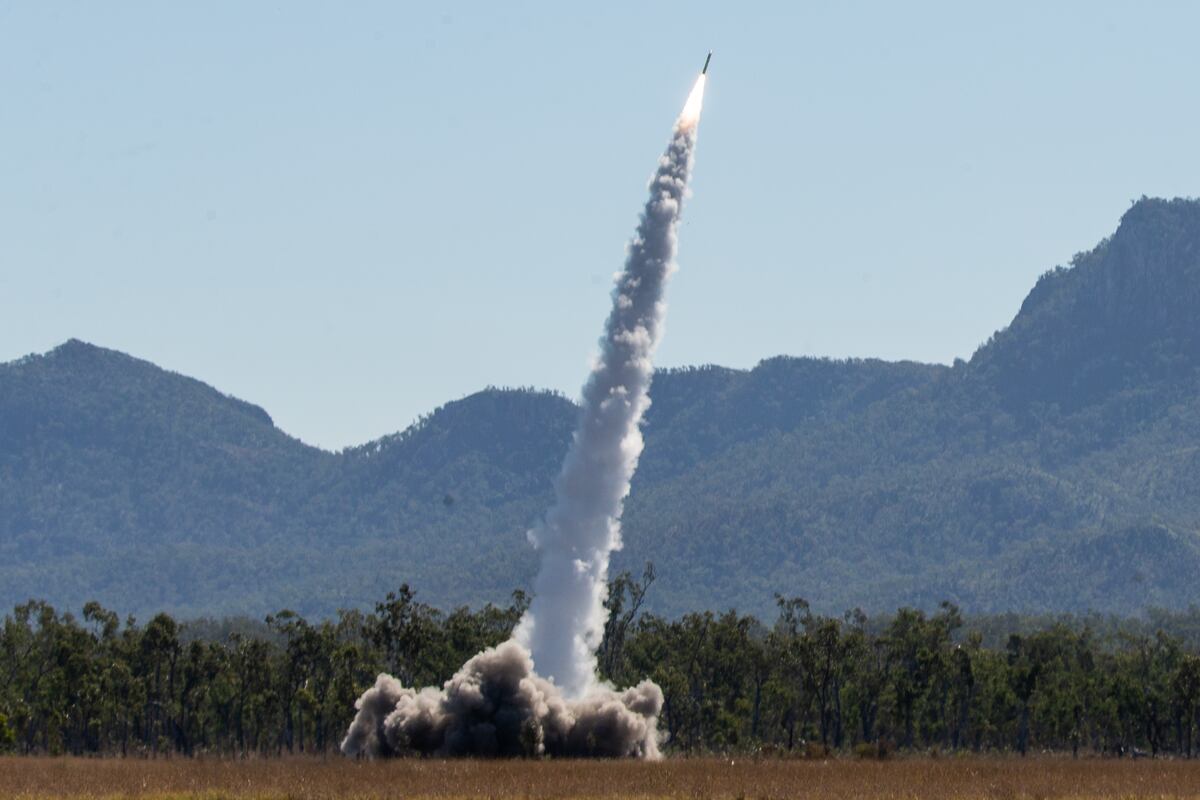
CHRISTCHURCH, New Zealand — Australia will make an initial investment in a solid rocket motor manufacturing complex, showing signs that the military is eying more autonomy from global vendors when it comes to the critical technology for its ammunitions.
Minister for Defence Industry and Capability Delivery Pat Conroy revealed the plans, to the tune of AUS$22 million, or US$15 million, earlier this month as part of the government’s Guided Weapons and Explosives Ordnance (GWEO) enterprise.
Industry sources expect a request for information to occur before year’s end, and Canberra hopes the factory will be producing motors by 2030.
The move comes as Australia has attracted local subsidiaries of global defense giants to boost the production of ammunition, including their propulsion.
Lockheed Martin Australia will begin assembling Guided Multiple Launch Rocket Systems (GMLRS) next year and, on Sept. 11, the company signed a teaming agreement with Thales Australia to explore “opportunities to advance the development and production of solid rocket motors for the Australian market,” said a statement released by the firms.
Ultimately, the partners will collaborate, qualify and produce motors and other components for GMLRS. They will also explore local supply chain options, extending even to “large, complex strategic motors.”
James Heading, a director at Lockheed Martin Australia, told Defense News: “If we can build a GMLRS rocket motor in Australia, there’s no reason why we can’t use the same technology and the same skills to build other rocket motors.”
Its chosen partner, Thales Australia, has considerable explosives and propellants expertise. For example, it is investing in large-scale preparation and explosive mixing equipment at the Mulwala munitions factory in southeastern Australia, enabling a 500% increase in the size of rocket motors that can be manufactured there.
Other companies are also angling for a slice of the envisioned solid rocket motor complex.
Ben James, CEO of Nioa Australia-New Zealand, told Defense News of a strategic partnership with Aerojet Rocketdyne, an L3Harris subsidiary. “We’re proposing a model on how Australia might move to a sovereign SRM and warhead capability,” he said.
Nioa has a long-term tenancy at the Benalla munitions facility, and the company acquired 130 hectares of adjacent land where an SRM facility could be located, James noted.
Northrop Grumman is keen to get involved, too. A spokesperson told Defense News: “Northrop Grumman is the world’s largest manufacturer of SRMs, and believes we can make a significant contribution to a sovereign SRM manufacturing capability in Australia in the future.”
The spokesperson added: “Northrop Grumman has been working with Australian industry for over three years to develop plans to manufacture SRMs and the associated components and materials in Australia,” adding that a footprint there could help fill gaps in the company’s U.S.-based SRM manufacturing supply chain.
The protracted conflict in Ukraine has created a shift in the way some American weapons makers do business, as they try to de-risk their supply chains by adding capacity in places like Australia.
Simultaneous to the SRM investment, Canberra announced AUS$60 million would be spent over five years to “develop the next generation of guided-weapons subsystems and components, such as hypersonic and long-range strike.”
A Ministry of Defence statement said the funds would “deliver industry-manufactured prototypes of the critical seeker, fuse and warhead subsystems.”
Gordon Arthur is an Asia correspondent for Defense News. After a 20-year stint working in Hong Kong, he now resides in New Zealand. He has attended military exercises and defense exhibitions in about 20 countries around the Asia-Pacific region.
新西兰基督城——澳大利亚将对固体火箭发动机制造厂进行初步投资,这表明军方正在寻求在弹药关键技术方面摆脱对全球供应商的依赖,从而获得更大的自主权。
国防工业和能力交付部长帕特·康罗伊本月早些时候公布了这项计划,金额达 2200 万澳元(约合 1500 万美元),这是政府制导武器和爆炸物军械 (GWEO) 企业的一部分。
业内人士预计,年底前将会提出信息征询请求,堪培拉方面希望该工厂能在 2030 年前开始生产电机。
此举正值澳大利亚吸引全球国防巨头的本地子公司以提升弹药(包括推进剂)产量之际。
洛克希德·马丁澳大利亚公司将于明年开始组装制导多管火箭系统(GMLRS)。9月11日,该公司与泰雷兹澳大利亚公司签署了一项合作协议,旨在探索“推进澳大利亚市场固体火箭发动机的开发和生产的机会”,两家公司在一份声明中表示。
最终,合作伙伴将携手合作,对GMLRS的电机和其他部件进行认证和生产。他们还将探索本地供应链方案,甚至包括“大型、复杂的战略电机”。
洛克希德·马丁澳大利亚公司董事詹姆斯·海丁告诉《防务新闻》:“如果我们能在澳大利亚制造GMLRS火箭发动机,那么我们没有理由不能利用相同的技术和技能来制造其他火箭发动机。”
其选定的合作伙伴泰雷兹澳大利亚公司在炸药和推进剂领域拥有丰富的专业知识。例如,该公司正在投资位于澳大利亚东南部穆尔瓦拉弹药厂的大型制备和炸药混合设备,这将使该厂火箭发动机的产量提高500%。
其他公司也在争夺设想中的固体火箭发动机综合体的一部分份额。
澳大利亚-新西兰国家航空航天局(NIOA Australia-New Zealand)首席执行官本·詹姆斯(Ben James)向《防务新闻》透露了与L3Harris旗下子公司Aerojet Rocketdyne的战略合作伙伴关系。“我们正在提出一种模式,探讨澳大利亚如何逐步发展成为拥有自主研发的短程导弹及其弹头能力的国家,”他说道。
詹姆斯指出,Nioa公司在贝纳拉弹药厂拥有长期租赁权,并且该公司收购了130公顷的邻近土地,该土地可以用于建设SRM设施。
诺斯罗普·格鲁曼公司也热衷于参与其中。一位发言人告诉《防务新闻》:“诺斯罗普·格鲁曼公司是世界上最大的SRM制造商,我们相信未来我们能够为澳大利亚自主研发SRM做出重大贡献。”
发言人补充道:“诺斯罗普·格鲁曼公司与澳大利亚工业界合作三年多,制定了在澳大利亚生产SRM及其相关组件和材料的计划。”他还补充说,在澳大利亚设立生产基地有助于填补该公司在美国的SRM制造供应链中的空白。
乌克兰旷日持久的冲突改变了一些美国武器制造商的经营方式,他们试图通过在澳大利亚等地增加产能来降低供应链的风险。
在对SRM进行投资的同时,堪培拉宣布将在五年内投入6000万澳元,用于“开发下一代制导武器子系统和组件,例如高超音速和远程打击武器”。
英国国防部发表声明称,这笔资金将“用于制造关键的导引头、引信和弹头子系统的工业制造原型”。
戈登·阿瑟是《防务新闻》的亚洲特派记者。在香港工作20年后,他现居新西兰。他曾到访亚太地区约20个国家,参加过军事演习和防务展览。