New DRIVE Lab at TP lets students generate and analyse their own datasets using an F1 simulatorTP 的全新 DRIVE 实验室让学生可以使用 F1 模拟器生成和分析自己的数据集。
Temasek Polytechnic launches DRIVE Lab with F1 simulator to help students learn data analytics through hands-on racing data. Read more at straitstimes.com.
The TL;DR: Students from the School of Informatics & IT at Temasek Polytechnic will now be able to use a Formula 1 simulator that generates data as a way of analysing data. The simulator is part of a new lab recently launched by the school.
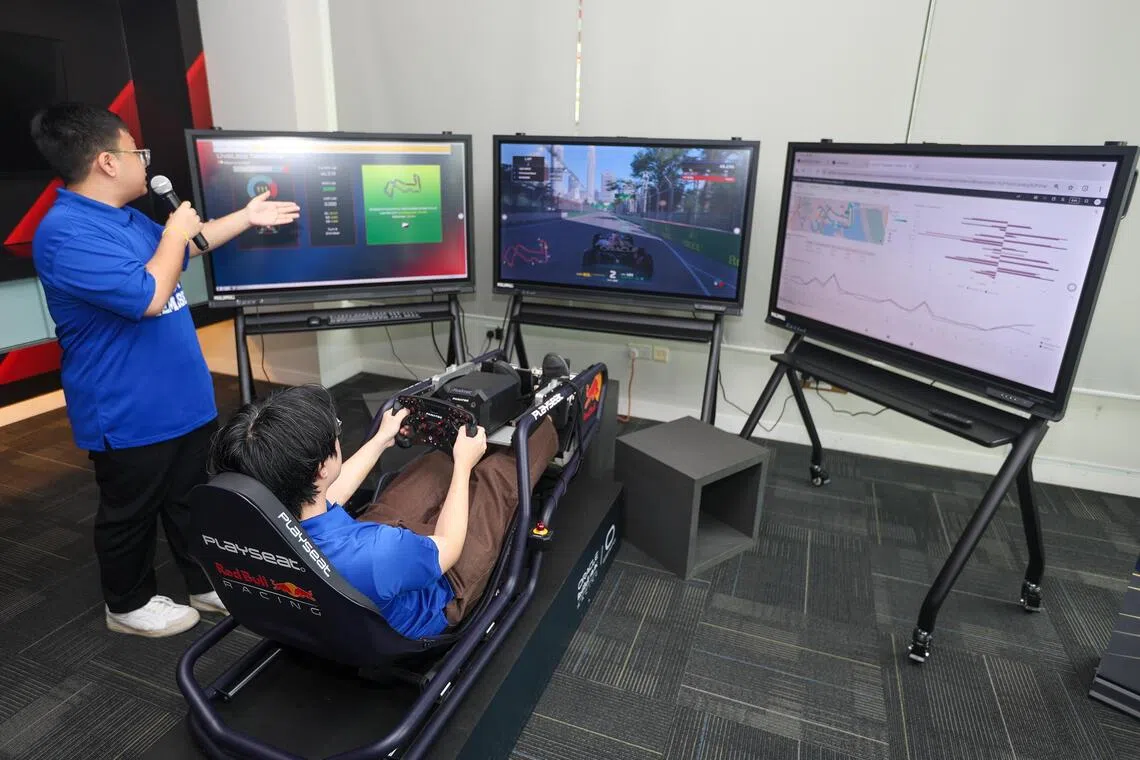
Temasek Polytechnic Big Data and Analytics second-year student Billy Lim Xiao Xi (right), alongside his course mate Khant Thu John, demonstrating the use of the simulator at the school’s DRIVE lab on Oct 6.
Published Oct 15, 2026, 06:04 AM
Updated Oct 15, 2026, 06:04 AM
Temasek Polytechnic has launched the DRIVE Lab, where School of Informatics & IT students use an F1 simulator to generate and analyse data.
The lab uses real-time race data, a Marina Bay track, and Max Verstappen’s lap times to teach steering, speed, telemetry, and data visualisation.
About 550 to 600 students a year will use the lab, alongside SPHERE and other hands-on tools, to build critical thinking and practical analytics skills.
SINGAPORE - Now students at Temasek Polytechnic can drive a Formula 1 simulator and compare their results to F1 driver Max Verstappen’s lap times.
A new life-sized racing cockpit has now been installed for students from the School of Informatics & IT at TP, at the newly launched DRIVE (Data-Driven Racing Intelligence & Virtual Experience) Lab.
Currently, the lab is hosting outreach programmes for secondary school students visiting TP. Visitors at TP Open House in January 2027 will also be able to experience the lab’s features.
Launched on Oct 6, 2026, the lab is meant to teach students data analytics skills through hands-on learning and a sport they may be interested in - from April 2027 onwards.
How it works: Students drive around a virtual version of the Marina Bay Street Circuit. Three monitors in front of the cockpit display data – one in the middle for the F1 simulator racing game, two at the sides for the data generated from the race.
The data shows students their performance throughout the race in terms of steering and speed, using Verstappen’s real-world performance as a reference point.
The steering wheel reacts to the game in real-time, shaking vigorously when a player accelerates too fast.
Separately, a feature that used to be at TP’s Data Science Hub has been rehomed to the lab: an interactive 3D globe known as SPHERE that lets students visualise geographical data and track weather patterns, such as Hurricane Katrina.
One of the electives offered to students from the School of Informatics & IT – Data Analytics for Environmental Sustainability – allows students to explore data from around the world using the globe.
Approximately 550 to 600 full-time students per year from the School of Informatics & IT will have the opportunity to use these features as part of their Year One common subject, Data Visualisation & Analytics.
Previously, students visited the TP Advanced Manufacturing Centre to learn how data analytics is applied in the manufacturing industry. The new simulator enhances these hands-on lessons.
The course chair of the Diploma in Big Data & Analytics Nami Imanishi said: “For each drive, the students can look at the data and compare their lap times and then analyse how to improve their performance.
“After that, they can try again and check whether their performance has improved or not. This is a very simple, but practical way for the students to understand how data helps people to improve their performance as well as make better decisions.”
The F1 simulator was donated by TP’s longtime partner, Oracle Corporation.
Imanishi, 52, said: “Through experiential learning, students can train their critical thinking skills.”
Course chair of the Diploma in Big Data & Analytics Nami Imanishi at the launch of Singapore's first educational F1 simulator, on Oct 6. ST PHOTO: JASEL POH
Course chair of the Diploma in Big Data & Analytics Nami Imanishi at the launch of Singapore's first educational F1 simulator, on Oct 6.
She said that the simulator will help students visualise telemetry data, which is the automated collection and transmission of data from a device to an IT system, and trace the analytics workflow.
Two second-year Big Data & Analytics students, Billy Lim Xiao Xi and Khant Thu John, gave a demonstration of the simulator.
Lim, 19, said: “As a student and F1 fan, I think (the simulator) makes learning much more interesting.”
He said that his experience at the lab would help him and his peers contextualise how data analytics can be applied in the real world.
“Data can be applied to so many more different industries, like engineering and the sciences. So, this project sort of showcases how versatile data truly can be,” he said.
John, 18, added that datasets used in their modules are typically given to students by their lecturers.
“The process of how (data) is created is a bit difficult to know. But the fact that now we are actually the ones creating our own datasets, I think that’s really cool and interesting,” said John.
简而言之:淡马锡理工学院信息与技术学院的学生现在可以使用一台能够生成数据的F1赛车模拟器来进行数据分析。这台模拟器是该学院近期推出的一个新实验室的一部分。
淡马锡理工学院大数据与分析专业二年级学生林晓曦(右)与他的同学 Khant Thu John 于 10 月 6 日在学校的 DRIVE 实验室演示模拟器的使用。
发布于 2026 年 10 月 15 日上午 6:04
更新于2026年10月15日 上午6:04
淡马锡理工学院推出了 DRIVE 实验室,信息与信息技术学院的学生使用 F1 模拟器来生成和分析数据。
该实验室利用实时比赛数据、滨海湾赛道和马克斯·维斯塔潘的圈速来教授转向、速度、遥测和数据可视化。
每年约有 550 至 600 名学生将使用该实验室,以及 SPHERE 和其他实践工具,以培养批判性思维和实践分析技能。
新加坡——现在淡马锡理工学院的学生可以驾驶一级方程式赛车模拟器,并将他们的成绩与一级方程式赛车手马克斯·维斯塔潘的圈速进行比较。
现在,TP 信息与信息技术学院的学生在新建的 DRIVE(数据驱动赛车智能与虚拟体验)实验室中安装了一个全新的真人大小的赛车驾驶舱。
目前,该实验室正在为来访淡马锡大学的中学生举办科普活动。2027年1月淡马锡大学开放日的参观者也将有机会体验该实验室的各项功能。
该实验室于 2026 年 10 月 6 日启动,旨在通过实践学习和学生可能感兴趣的运动来教授数据分析技能——从 2027 年 4 月开始。
工作原理:学生们驾驶车辆在虚拟的滨海湾街道赛道上行驶。驾驶舱前方的三台显示器显示数据——中间一台用于F1模拟赛车游戏,两侧两台用于显示比赛生成的数据。
数据显示,学生们在比赛中的转向和速度表现,以维斯塔潘的真实表现为参考点。
方向盘会根据游戏实时做出反应,当玩家加速过快时,方向盘会剧烈抖动。
另外,TP 数据科学中心曾经拥有的一个功能已被移至实验室:一个名为 SPHERE 的交互式 3D 地球仪,它可以让学生可视化地理数据并跟踪天气模式,例如卡特里娜飓风。
信息学与信息技术学院为学生提供的选修课之一——环境可持续性数据分析——允许学生使用全球地图探索来自世界各地的数据。
每年大约有 550 至 600 名来自信息与信息技术学院的全日制学生将有机会在一年级公共课程“数据可视化与分析”中使用这些功能。
此前,学生们曾参观TP先进制造中心,学习数据分析在制造业中的应用。新的模拟器进一步增强了这些实践课程的效果。
大数据与分析文凭课程主任今西奈美表示:“对于每一次驾驶,学生都可以查看数据,比较他们的圈速,然后分析如何提高他们的表现。
“之后,他们可以再次尝试,并检查自己的表现是否有所提高。这是一种非常简单但实用的方法,可以帮助学生理解数据如何帮助人们提高表现并做出更好的决策。”
F1模拟器是由TP的长期合作伙伴甲骨文公司捐赠的。
52岁的今西表示:“通过体验式学习,学生可以培养批判性思维能力。”
10月6日,大数据与分析文凭课程主任今西奈美(Nami Imanishi)出席新加坡首个F1教育模拟器的发布会。(海峡时报摄影:贾塞尔·波)
10 月 6 日,大数据与分析文凭课程主任 Nami Imanishi 出席了新加坡首个 F1 教育模拟器的发布会。
她表示,该模拟器将帮助学生可视化遥测数据(即从设备到 IT 系统的自动数据收集和传输),并跟踪分析工作流程。
两名大二大数据与分析专业的学生,Billy Lim Xiao Xi 和 Khant Thu John,对模拟器进行了演示。
19岁的林说:“作为一名学生和F1车迷,我认为(模拟器)让学习变得更有趣了。”
他说,他在实验室的经历将帮助他和他的同伴们了解数据分析如何在现实世界中应用。
“数据可以应用于更多不同的行业,例如工程和科学领域。因此,这个项目某种程度上展示了数据的真正多功能性,”他说。
18 岁的约翰补充说,他们课程模块中使用的数据集通常由讲师提供给学生。
约翰说:“数据是如何产生的,这个过程有点难以了解。但现在我们能够真正创建自己的数据集,我认为这真的很酷很有趣。”