CNA Explains: What happens when the government disagrees with the courts?CNA解读:当政府与法院意见不一致时会发生什么?
A recent High Court ruling that overturned deterrent sentences for four young scam mules prompted the government to propose changes to the law. CNA looks at similar past cases, how lawmakers responded and the constitutional limits involved.
新闻视频
A recent High Court ruling that overturned deterrent sentences for four young scam mules prompted the government to propose changes to the law. CNA looks at similar past cases, how lawmakers responded and the constitutional limits involved.
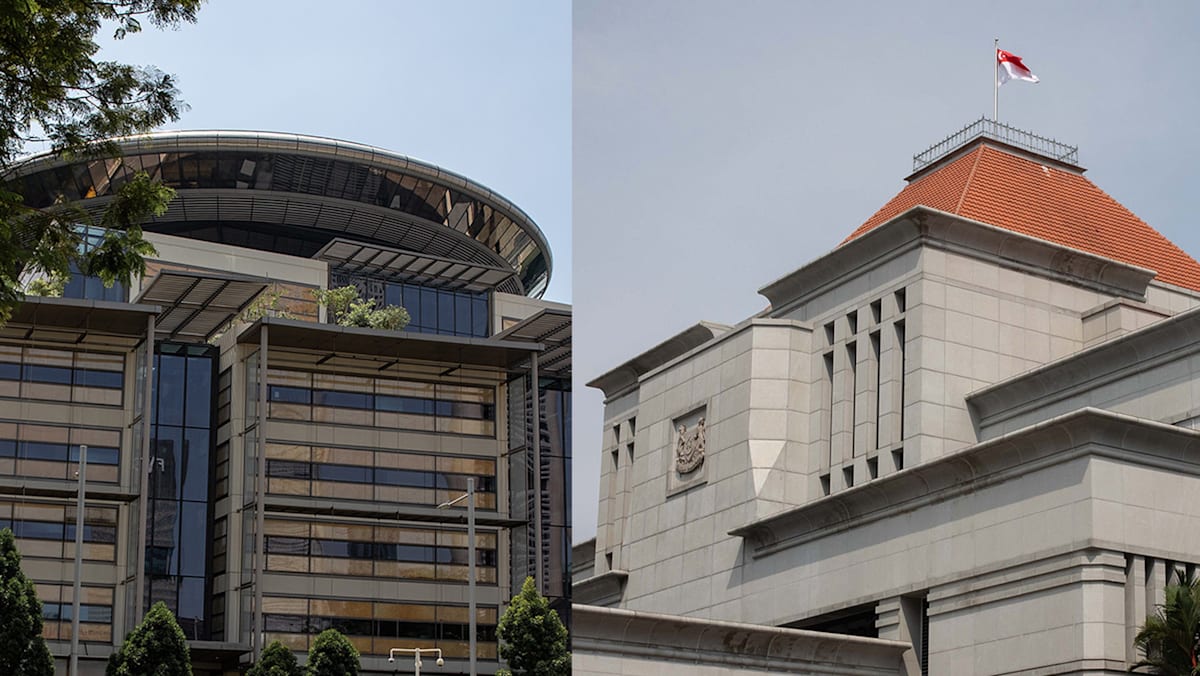
The Supreme Court (left) and the Parliament House. (Photos: CNA/Ili Mansor)
This audio is generated by an AI tool.
SINGAPORE: When the High Court overturned deterrent sentences for four young scam mules in September, opting instead for probation and community sentences, Senior Minister K Shanmugam said to parliament of the decision: “This is not the time to go soft .”
On Oct 6, Mr Shanmugam, who is also Coordinating Minister for National Security, noted that the verdict by a three-judge panel ran contrary to sentencing guidelines by the government calling for sterner penalties such as jail or reformative training.
The cases in question refer to the appeals made to the High Court by Mohamed Erzan Taib Zohri and six separate other scam-related offenders, six of whom were under the age of 21.
The three-judge coram, comprising Chief Justice Sundaresh Menon and Justice Ang Cheng Hock and Justice Hoo Sheau Peng, allowed the appeals for four cases and meted out probation and community-based sentences to them, and dismissed the remaining three.
To this end, Senior Minister Shanmugam, who is also Minister for Home Affairs, said his ministry will be tabling new legislation in parliament to give effect to its policy position on deterrent sentences for scam-related offenders, including youths.
The legislation will be "quite express" and make clear that the court's position in the September case is not to be followed, said Mr Shanmugam.
CNA looks at past instances where lawmakers stepped in after court decisions, and asks legal experts how the balance of power works in practice.
Why did the court depart from sentencing guidelines in this case?
The three-judge High Court coram in September heard the appeals of seven individuals convicted of giving scam syndicates access to their bank accounts or Singpass credentials.
In its judgment of Mohamed Erzan Taib Zohri v Public Prosecutor, the court states that "sentencing guidelines suggested by the SAP (sentencing advisory panel) are not binding on the court but are intended to offer some assistance in the sentencing process".
Among other things, the judgment also stated that it was "too blunt" to assume custodial sentence and reformative training as default for young offenders in such cases.
The parliament should also make clear if its intention was to take away particular sentencing options for an offence, the court noted.
CNA Games Guess Word Crack the word, one row at a time Buzzword Create words using the given letters Mini Sudoku Tiny puzzle, mighty brain teaser Mini Crossword Small grid, big challenge Word Search Spot as many words as you can Show More Show Less
Speaking in parliament earlier this month in response to a parliamentary question, Mr Shanmugam said that the government had made a deliberate policy judgment that deterrence and prevention must carry far greater weight when sentencing offenders.
Mr Shanmugam added that the court did not have before it "policy perspectives" nor "data on the scale of the problem of scams and scammers".
"We wanted this message to go out that every offender, young or old, will be very seriously dealt with. If a number of cases are dealt with in this way, seriously, many other would-be offenders would take reference,” said Mr Shanmugam.
The senior minister added: "The High Court said the legislation must be clear. We had proceeded on the basis that the legislation was clear. The guidelines were also clear. They are clear.
"However, the court has expressed a different view on the legislation. We respect the court's views."
What are the roles of the courts and parliament?
Experts pointed out that the ability of the government to announce plans for legislative amendments following a judicial ruling stems directly from the constitutional separation of powers.
"Parliament’s primary role is to debate and pass legislation, while the court’s role is to independently interpret and apply the law to resolve legal disputes," said Mr Faraaz Amzar, director at law firm Eugene Thuraisingam Asia LLC.
In drafting laws, the parliament specifies the range of possible punishments for certain offences, said the experts.
Among other ways, parliament can do so through sentencing advisory panel guidelines, which serve to provide greater clarity about possible sentencing outcomes and the relevant sentencing factors.
The guidelines are not legally binding on any court.
Referring to the sentencing guidelines in the Erzan case, Assistant Professor Benjamin Joshua Ong from the Singapore Management University (SMU) said the guidelines "provide for flexibility” by setting out that fines, probation and community sentences are "generally" not appropriate.
"The courts’ duty when a person is found guilty of the offence is to choose an appropriate sentence from within the range based on the specific facts of the individual case before it," said Asst Prof Ong.
"Parliament has the last word on what the text of legislation is. The courts have the last word on what that text means.
"This means that the courts have the power to authoritatively interpret legislation passed by parliament."
A view of the Supreme Court in Singapore. (Photo: CNA/Jeremy Long)
Why can court decisions differ from parliament's intention?
Discrepancies between judicial rulings and parliamentary intent can arise from several key factors, said law experts.
For one, SMU law don Eugene Tan said that it boils down to the issue of drafting of the law and the interpretation of it by the courts.
"Words and phrases in a legislation can be interpreted differently despite the best of legislative drafting," said the associate professor.
"Moreover, a legislation may not have succeeded in putting across parliament’s intention with adequate clarity."
Ms Stephanie Chew, partner at TSMP Law Corporation, said that when lawmakers craft legislation, they cannot anticipate every scenario that comes before the courts.
“So it’s parliament that makes the laws, but it's the courts' job to interpret those statutes, and apply them to real cases based on the facts,” she said.
As such, courts take into account both the purpose and wording of the law, she said.
Agreeing, SMU’s Asst Prof Ong said that in applying the law, the courts would firstly look at the text of the legislation.
"This is not an exercise in attempting to look into what intention parliament or individual MPs or ministers had at the back of their mind," he said.
"The courts will generally not look to other sources, such as the precise words of parliamentary debates, unless the words are ambiguous."
Dr Ben Chester Cheong from the Singapore University of Social Sciences (SUSS) said that even when a court identifies the purpose of a legislation, it is not allowed to "rewrite a provision to achieve a preferred policy outcome".
In the particular case of Erzan, he notes that the court had explained that parliament must make its intention clear if it wishes to remove particular sentencing options for a certain offence.
Asst Prof Ong said that there is a difference between interpretation and application of the law, and the scam-related appeal cases allowed by the High Court last month relates to the latter.
Interpretation is a question of what the words of the law mean, he said, and in this case the words are "not ambiguous".
"The meaning of the words is clear: the courts have a range of sentencing options, from probation to imprisonment to caning," said Asst Prof Ong.
"Mr Shanmugam’s view relates to the application of the law: in other words, when each option should be used."
When does parliament change the law after a court decision?
Whenever judicial decisions highlight an ambiguity in existing statutes, legislators will typically move to address and resolve the perceived gap in the law.
Asst Prof Ong of SMU said: "If parliament disagrees with what the courts say the legislative text means, parliament is free to amend the text, this time making its preferred interpretation clearer."
This has happened several times in the past, with parliament updating legislation after the court identified an ambiguity or a gap in policy.
This was the case for the 2023 repeal of Section 377A which had criminalised sex between men.
Following the Court of Appeal decision in 2022 that dismissed challenges to the law, then-Prime Minister Lee Hsien Loong said that the Minister for Law and the Attorney-General have advised of "a significant risk" of the law being struck down in a future court challenge.
Parliament subsequently repealed the law.
In this case, parliament was seen to be “resolving a wider policy issue against the background of litigation", said Dr Cheong from SUSS.
Criminal Law detainee and alleged match-fixer Dan Tan leaving the Supreme Court with his lawyers in November 2015 (Photo: Ernest Chua/TODAY)
In 2013, match-fixing syndicate leader Tan Seet Eng, also known as Dan Tan, was handed a detention order under the Criminal Law (Temporary Provisions) Act (CLTPA).
Following an appeal, the apex court in 2015 ruled Tan's detention as "unlawful" as the grounds for locking him up did not sufficiently show how his activities threatened public safety and order in Singapore.
A week later, Tan was detained again under a new order that “expressly sets out the grounds which show the extent of Tan’s match-fixing activities from and within Singapore”, and why the detention order is necessary, said MHA at the time.
In 2018, parliament approved amendments to the CLTPA, explicitly setting out the list of criminal activities for which a person can be detained under the law.
Dr Cheong describes this as a "legislative codification and clarification following a judgment".
What happens when parliament or the government disagrees with the court's interpretation?
Should parliament disagree with how the law has been applied, the House can also move to amend the text such that the court will not interpret the case in the same way again.
Experts cited the Public Prosecutor v Lam Leng Hung case of 2018, in relation to the misuse of church building funds by the City Harvest Church leaders, as an example.
In this case, the Court of Appeal had upheld the reduced sentences of six former City Harvest Church leaders found guilty of criminal breach of trust.
"The Court of Appeal held that the 'agent' limb of the then Section 409 (of the Penal Code) concerned professional agents, rather than directors merely acting as agents of their organisations," said Dr Cheong.
This means that the “agent” limb did not apply to the six church leaders.
Six City Harvest Church leaders were sentenced in court on Nov 20, 2015. They are (from top left to bottom right) church founder Kong Hee, Tan Ye Peng, Chew Eng Han, Sharon Tan, Serina Wee, and John Lam. Photo: Ernest Chua
Under the law then, an agent convicted of the crime may face up to life imprisonment, while a normal conviction of criminal breach of trust comes with a maximum jail term of only seven years.
"It expressly recognised a gap concerning enhanced punishment, while concluding that reform should be left to parliament," Dr Cheong noted of the court's decision then.
Asst Prof Ong from SMU also added how the courts back then "described Section 409 as 'increasingly inadequate' and that a 'review is not only essential but it is also long overdue', and that parliament should undertake this review and further reform".
Following the appeal outcome, Mr Shanmugam, who was then Law and Home Affairs Minister, stated in parliament the government's disagreement with the court's decision.
“There can really be no question about this… The government believes that the sentences are too low ,” he said then.
Section 409 was later broadened through the Criminal Law Reform Act 2019 to expressly cover directors, officers, partners, key executives and fiduciaries, he added.
Another noteworthy case is the detention of Chng Suan Tze and three others in 1987 under the Internal Security Act.
In 1988, the Court of Appeal released the detainees on appeal, based on the "technical" ground that the affidavit should have been signed by a minister or a cabinet secretary and not by a permanent secretary.
The court determined that the minister’s power to make a detention order depends on whether the President is satisfied that the order is necessary to stop actions prejudicial to national security.
The court said the affidavit by the permanent secretary constituted hearsay evidence of the President’s satisfaction, and was therefore insufficient.
Following this, the government re-detained Chng and the three others on the same day under fresh detention orders, noting that the court did not question the merits of the decision to detain them.
The following year, parliament approved changes to the Constitution and the ISA which, among other things, stated that the court can only review whether procedures under the ISA have been followed.
Assoc Prof Tan from SMU said: "(This) is one clear example of the political branches disagreeing with the judiciary and finding it necessary to legislatively overrule the apex court’s interpretation of certain provisions in the Internal Security Act 1960 (ISA)".
View of the parliament sitting on Oct 7, 2026. (Image: CNA)
What can parliament do – and not do – when changing the law?
In summary, parliament may draft new legislation or amend existing statutes to eliminate ambiguity and align the law with intended public policy, provided all changes remain within constitutional boundaries.
Assoc Prof Tan said: "Legislative overruling is within the constitutional power of parliament, and this is done by enacting a new law or by amending the existing law to nullify, modify, or reverse the legal effect of the judicial decision in question."
However, he added that the parliament "cannot overturn a court's specific ruling regarding the parties in a specific case", adding that the legislative overruling usually has a prospective effect in criminal cases.
In other words, while parliament has the power to change the law for future cases, it cannot overturn a specific ruling for a concluded case. Offenders can only be sentenced according to the law that was in force when the crime was committed.
This is also prescribed in the Constitution, said SUSS’ Dr Cheong.
"In criminal matters, (the Constitution) protects against retrospective criminalisation and punishment greater than that prescribed when the offence was committed," he notes.
Want an issue or topic explained? Email us at digitalnews [at] mediacorp.com.sg . Your question might become a story on our site.
Get our pick of top stories and thought-provoking articles in your inbox
Stay updated with notifications for breaking news and our best stories
Join our channel for the top reads for the day on your preferred chat app
近期高等法院推翻了对四名年轻诈骗犯的严厉判决,促使政府提议修改法律。亚洲新闻台(CNA)回顾了类似的过往案例,分析了立法者的应对措施以及相关的宪法限制。
最高法院(左)和国会大厦。(图片:CNA/Ili Mansor)
这段音频是由人工智能工具生成的。
新加坡:9 月,高等法院推翻了对四名年轻诈骗犯的严厉判决,改为缓刑和社区服务。高级部长尚穆根在国会就此决定表示:“现在不是手软的时候。”
10月6日,兼任国家安全统筹部长的尚穆根先生指出,三名法官组成的小组的判决与政府的量刑指南相悖,该指南呼吁处以更严厉的处罚,例如监禁或改造训练。
相关案件指的是穆罕默德·埃尔赞·泰布·佐赫里和其他六名与诈骗有关的罪犯向高等法院提出的上诉,其中六人未满 21 岁。
由首席大法官 Sundaresh Menon、法官 Ang Cheng Hock 和法官 Hoo Sheau Peng 组成的三名法官组成的合议庭,准许了四起案件的上诉,并判处缓刑和社区矫正,驳回了其余三起案件的上诉。
为此,兼任内政部长的尚穆根高级部长表示,他的部门将向国会提交新的立法,以落实其对包括青少年在内的诈骗相关罪犯处以威慑性刑罚的政策立场。
尚穆根先生表示,该立法将“非常明确”,并明确指出不应遵循法院在9月份案件中的立场。
CNA回顾了立法者在法院判决后介入的过往案例,并询问法律专家权力平衡在实践中是如何运作的。
法院为何在本案中偏离量刑指南?
9 月,由三名法官组成的高等法院合议庭审理了七名被判犯有向诈骗集团提供银行账户或 Singpass 凭证访问权限罪的个人的上诉。
在 Mohamed Erzan Taib Zohri 诉 Public Prosecutir 一案的判决中,法院指出,“量刑咨询小组 (SAP) 建议的量刑指南对法院没有约束力,但旨在为量刑过程提供一些帮助”。
判决书还指出,对于此类案件中的青少年罪犯,默认判处监禁和改造培训“过于草率”。
法院指出,议会还应明确其意图是否在于取消对某种罪行的特定量刑选择。
CNA游戏 猜词游戏 逐行破解单词 流行词游戏 用给定的字母组成单词 迷你数独 小小谜题,挑战你的大脑 迷你填字游戏 小方格,大挑战 单词搜索 尽可能多地找出单词 显示更多 显示更少
本月初,尚穆根先生在国会回答议员质询时表示,政府已做出明确的政策判断,即在对罪犯判刑时,威慑和预防必须占据更大的比重。
尚穆根先生补充说,法庭面前既没有“政策观点”,也没有“关于诈骗和诈骗者问题的规模的数据”。
“我们希望传达的信息是,所有违法者,无论老幼,都将受到非常严肃的处理。如果许多案件都以这种方式严肃处理,许多其他潜在的违法者就会以此为鉴,”尚穆根先生说。
这位高级部长补充道:“高等法院表示,立法必须清晰明确。我们正是基于立法清晰明确这一前提开展工作的。指导方针也很清晰。它们确实很清晰。”
“然而,法院对该项立法表达了不同的意见。我们尊重法院的意见。”
法院和议会分别扮演什么角色?
专家指出,政府在司法裁决后宣布立法修正案计划的能力,直接源于宪法规定的权力分立原则。
“议会的主要职责是辩论和通过立法,而法院的职责是独立解释和适用法律来解决法律纠纷,”尤金·图莱辛加姆亚洲有限责任公司律师事务所的董事法拉兹·阿姆扎尔先生说。
专家表示,议会在制定法律时,会明确规定某些违法行为可能受到的处罚范围。
除其他方式外,议会还可以通过量刑咨询小组的指导方针来实现这一目标,这些指导方针旨在更清楚地说明可能的量刑结果和相关的量刑因素。
这些指导原则对任何法院均不具有法律约束力。
新加坡管理大学 (SMU) 助理教授 Benjamin Joshua Ong 在谈到 Erzan 案的量刑指南时表示,该指南“提供了灵活性”,规定罚款、缓刑和社区服务“通常”不合适。
“当一个人被判犯有罪行时,法院的职责是根据个案的具体事实,在量刑范围内选择适当的刑罚,”翁助理教授说。
议会对法律文本拥有最终解释权,而法院对文本的含义拥有最终解释权。
“这意味着法院有权对议会通过的法律进行权威解释。”
新加坡最高法院一景。(图片:CNA/Jeremy Long)
为什么法院判决会与议会意图相悖?
法律专家表示,司法判决与议会意图之间的差异可能源于几个关键因素。
首先,新加坡管理大学法学院教授陈宇健表示,这归根结底是法律的起草和法院的解释问题。
“即使立法草案写得再好,其中的词语和短语也可能有不同的解释,”这位副教授说。
此外,一项立法可能未能充分清晰地传达议会的意图。
TSMP 律师事务所合伙人 Stephanie Chew 女士表示,立法者在制定法律时,无法预料到法庭会遇到的每一种情况。
“所以,立法权在于议会,而解释这些法规并根据事实将其应用于实际案件则是法院的职责,”她说。
她表示,因此,法院会同时考虑法律的目的和措辞。
新加坡管理大学的翁助理教授对此表示赞同,并指出,在适用法律时,法院首先会查看法律条文。
他说:“这并不是要探究议会、个别议员或部长们内心深处的意图。”
“除非措辞含糊不清,否则法院一般不会参考其他来源,例如议会辩论的确切措辞。”
新加坡社会科学大学 (SUSS) 的张本杰博士表示,即使法院确定了立法的目的,也不允许“改写条款以达到偏好的政策结果”。
他指出,就埃尔赞案而言,法院曾解释说,如果议会希望取消对某些罪行的特定量刑选择,则必须明确其意图。
王助理教授表示,法律的解释和适用之间存在区别,上个月高等法院允许的与诈骗案相关的上诉案件属于后者。
他说,解释法律条文的问题在于法律条文的含义,而在这个案例中,这些条文“并无歧义”。
“这些话的意思很明确:法院有多种量刑选择,从缓刑到监禁再到鞭刑,”翁助理教授说。
“尚穆根先生的观点与法律的适用有关:换句话说,就是何时应该使用每种选择。”
议会何时会在法院判决后修改法律?
每当司法判决凸显现有法规中的模糊之处时,立法者通常会采取行动来解决法律中存在的漏洞。
新加坡管理大学助理教授翁表示:“如果议会不同意法院对立法文本含义的解释,议会可以自由修改文本,使其倾向的解释更加明确。”
过去曾多次发生这种情况,法院发现政策中存在歧义或漏洞后,议会都会更新立法。
2023 年废除第 377A 条款就是这种情况,该条款曾将男性之间的性行为定为犯罪。
2022 年上诉法院驳回了对该法律的挑战后,时任总理李显龙表示,律政部长和总检察长已告知,该法律在未来的法庭挑战中“存在被推翻的重大风险”。
议会随后废除了该法律。
新跃社科大学张博士表示,在这种情况下,国会被视为“在诉讼的背景下解决更广泛的政策问题”。
2015年11月,因涉嫌操纵比赛而被刑事拘留的丹·谭(Dan Tan)与他的律师离开最高法院(照片:Ernest Chua/TODAY)。
2013 年,操纵比赛集团头目陈锡英(又名丹陈)根据《刑事法律(临时规定)法令》(CLTPA)被下达拘留令。
经过上诉,最高法院于 2015 年裁定,对谭的拘留是“非法的”,因为拘留他的理由没有充分表明他的行为如何威胁新加坡的公共安全和秩序。
一周后,谭某再次被拘留,内政部当时表示,新的拘留令“明确列出了谭某在新加坡境内外操纵比赛活动的理由”,以及拘留令的必要性。
2018 年,议会批准了对《刑事诉讼法》的修正案,明确列出了根据该法可以拘留一个人的犯罪活动清单。
张博士将其描述为“判决后的立法编纂和澄清”。
如果议会或政府不同意法院的解释,会发生什么?
如果议会不同意法律的适用方式,议会也可以修改法律条文,使法院不再以同样的方式解释案件。
专家们以 2018 年检察官诉林令雄一案为例,该案涉及城市丰收教会领袖滥用教会建设资金。
在本案中,上诉法院维持了对六名前城市丰收教会领袖的减刑判决,他们被判犯有刑事失信罪。
张医生说:“上诉法院认为,当时的《刑法》第 409 条中的‘代理人’条款指的是专业代理人,而不是仅仅作为其组织代理人的董事。”
这意味着“代理人”条款不适用于这六位教会领袖。
2015年11月20日,城市丰收教会六名领袖在法庭被判刑。他们分别是(从左上至右下):教会创始人江喜、陈一平、周英汉、陈莎伦、魏淑丽和林约翰。照片:蔡恩斯特
根据当时的法律,被判犯有此罪的代理人可能面临终身监禁,而普通的刑事背信罪最高刑期仅为七年监禁。
“法院当时的裁决明确承认在加强惩罚方面存在不足,但最终认为改革应留给议会,”张医生在谈到法院的裁决时指出。
新加坡管理大学的翁助理教授还补充说,当时的法院“将第 409 条描述为‘越来越不充分’,并表示‘审查不仅必不可少,而且早就应该进行了’,国会应该进行这项审查和进一步改革”。
上诉结果公布后,时任律政兼内政部长尚穆根先生在国会表示,政府不同意法院的裁决。
“这一点毋庸置疑……政府认为刑期太轻了,”他当时说道。
他补充说,第 409 条后来通过 2019 年《刑事法律改革法》进行了扩大,明确涵盖董事、高级职员、合伙人、主要管理人员和受托人。
另一个值得注意的案例是 1987 年根据《内部安全法》拘留了庄宣子和其他三人。
1988 年,上诉法院以“技术性”理由(即宣誓书应由部长或内阁秘书签署,而不是由常务秘书签署)为由,在上诉中释放了被拘留者。
法院裁定,部长签发拘留令的权力取决于总统是否确信该命令对于制止危害国家安全的行为是必要的。
法院表示,常务秘书的宣誓书构成总统满意的传闻证据,因此不足以作为证据。
随后,政府当天根据新的拘留令再次拘留了张某和其他三人,并指出法院并未质疑拘留他们的决定是否合理。
次年,议会批准了对宪法和《国际安全法》的修改,其中规定,法院只能审查《国际安全法》规定的程序是否得到遵守。
新加坡管理大学副教授陈表示:“(这)是一个明显的例证,表明政治部门与司法部门意见不一致,并认为有必要通过立法推翻最高法院对1960年《内部安全法》(ISA)某些条款的解释。”
2026年10月7日国会开会现场。(图片来源:CNA)
议会在修改法律时可以做什么,不可以做什么?
总而言之,议会可以起草新的法律或修改现有的法规,以消除歧义,使法律与预期的公共政策保持一致,前提是所有修改都在宪法范围内。
陈副教授表示:“立法推翻司法判决属于议会的宪法权力范围,可以通过制定新法律或修改现有法律来使相关司法判决无效、修改或撤销其法律效力。”
但他补充说,议会“不能推翻法院对特定案件中各方当事人的具体裁决”,并补充说,立法机关的推翻通常只对刑事案件产生追溯效力。
换言之,虽然议会有权修改法律以适用于未来的案件,但它无权推翻已结案件的具体判决。罪犯只能根据犯罪发生时有效的法律进行判刑。
新跃社科大学的张医生表示,宪法中也有相关规定。
他指出:“在刑事案件中,(宪法)保护人们免受追溯既往的刑事定罪和比犯罪发生时规定的刑罚更重的处罚。”
想了解某个问题或话题?请发送邮件至 digitalnews [at] mediacorp.com.sg。您的提问可能会成为我们网站上的报道内容。
订阅我们的邮件,即可获取精选热点新闻和引人深思的文章。
订阅通知,第一时间获取突发新闻和精彩报道。
加入我们的频道,即可在您常用的聊天应用上获取当日热门文章。