Veterinary extension officers key to Malaysia’s food security, says deputy minister副部长表示,兽医推广人员对马来西亚的粮食安全至关重要。
PUTRAJAYA, Oct 15 — Veterinary extension officers play a crucial role in bridging government policies, the expertise of the Department of Veterinary Services (DVS) and the...
Veterinary extension officers play a vital role in linking government policies, the Department of Veterinary Services' (DVS) expertise, and the farming community to enhance livestock productivity and food security in Malaysia.
Deputy Agriculture and Food Security Minister Datuk Chan Foong Hin emphasized the need for concrete data-driven measures like Scheduled Planned Visits and Gross Margin Analysis to evaluate the effectiveness of interventions.
Chan highlighted efforts to decrease Malaysia's meat import dependency and boost domestic production as part of the National Food Security Policy 2030.
During the 2026 Veterinary Extension Convention, three DVS guidebooks on good animal husbandry practices were launched to support training and field guidance.
PUTRAJAYA, Oct 15 — Veterinary extension officers play a crucial role in bridging government policies, the expertise of the Department of Veterinary Services (DVS) and the farming community to boost livestock productivity and strengthen national food security.
Deputy Agriculture and Food Security Minister Datuk Chan Foong Hin said the effectiveness of veterinary extension services should be measured by improvements at farm level, including lower mortality rates among young livestock, increased milk yields and animal weights, and higher incomes for farmers.
“Policies and targets will only yield results when they reach livestock farmers in the form of the right knowledge and practices.
“Therefore, Scheduled Planned Visits and Gross Margin Analysis must be implemented systematically to evaluate the effectiveness of interventions using concrete data and evidence,” he said when officiating the 2026 Veterinary Extension Convention here today.
Themed “Veterinary Extension: A Driver for Productivity and Food Security”, the convention was also attended by Veterinary Services Department director-general Datuk Dr Mohd Noor Hisham Mohd Haron.
Chan said Malaysia’s import dependency rate for beef and buffalo meat stood at 82.6 per cent in 2025, while the rate for goat and sheep meat was 90.7 per cent.
To address this dependency, he said the ministry was targeting domestic production of about 50,000 metric tonnes of beef and buffalo meat this year, with the self-sufficiency ratio (SSR) projected to increase to 18 per cent.
He said the target was supported by 68 satellite farms across seven states, which had produced more than 45,000 head of livestock.
“This strategic direction is reinforced by the National Food Security Policy 2030 (DKMN 2030), which outlines efforts to strengthen the livestock breeding industry, maximise domestic ruminant and dairy production, and bolster extension services as a catalyst for human capital development,” he said.
Chan also outlined three key priorities for the Ministry of Agriculture and Food Security: data-driven advisory services, better coordination of assistance among agencies, and building farmers’ trust through consistent guidance and follow-ups.
At the event, he launched three DVS guidebooks on good animal husbandry practices covering dairy cattle, goats and sheep, and feedlot cattle.
“Congratulations to the DVS on these publications. I hope the guidelines will be fully utilised for training and field guidance rather than merely serving as shelf decoration,” he said.
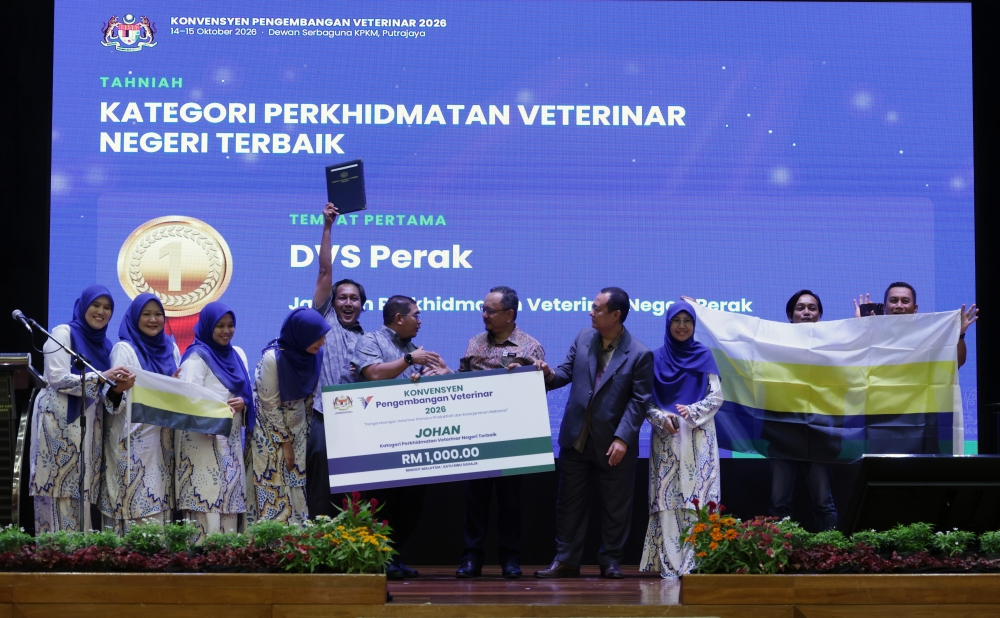
Chan also presented Perak DVS with the Overall Champion award for Best Extension Services, which came with RM500 in cash and a certificate of appreciation.
This year, 78 nominations were received across eight competition categories covering various aspects of veterinary extension services and projects.
The categories included Best State Veterinary Service, Best District Veterinary Service, Best Livestock-Based Industry Development Project, Best Veterinary Extension Project, Best Veterinary Extension Project Poster, Best Veterinary Extension Project Video Presentation, Best Veterinary Extension Mentor/Officer and Best VetEC (Veterinary Extension Centre) Operation. — Bernama
Budget 2027: RM130M boost for local film, music, and creative content
Kepong knife attack: Chinese student charged with stabbing ex-girlfriend and her brother
Perikatan ‘almost 100pc’ certain of Melaka election alliance, but Takiyuddin keeps potential partners under wraps
兽医推广人员在连接政府政策、兽医服务部 (DVS) 的专业知识和农民社区方面发挥着至关重要的作用,以提高马来西亚的畜牧业生产力和粮食安全。
农业及粮食安全部副部长拿督陈峰兴强调,需要采取具体数据驱动的措施,例如定期计划访问和毛利率分析,以评估干预措施的有效性。
陈先生强调,作为2030年国家粮食安全政策的一部分,马来西亚正努力减少对肉类进口的依赖,并提高国内产量。
在 2026 年兽医推广大会上,DVS 发布了三本关于良好畜牧业实践的指南,以支持培训和现场指导。
布城,10 月 15 日讯——兽医推广人员在连接政府政策、兽医服务部 (DVS) 的专业知识和农民群体方面发挥着至关重要的作用,以提高畜牧业生产力并加强国家粮食安全。
农业及粮食安全部副部长拿督陈峰兴表示,兽医推广服务的有效性应该通过农场层面的改善来衡量,包括降低幼畜死亡率、提高牛奶产量和牲畜体重,以及提高农民收入。
“只有当政策和目标以正确的知识和实践的形式传递给畜牧养殖户时,它们才能取得成效。”
“因此,必须系统地实施计划访问和毛利率分析,以使用具体数据和证据来评估干预措施的有效性,”他今天在为2026年兽医推广大会主持开幕式时说道。
本次大会以“兽医推广:提高生产力和保障粮食安全”为主题,兽医服务部总监拿督莫哈末·诺希山·莫哈末·哈伦博士也出席了会议。
陈先生表示,到 2025 年,马来西亚牛肉和水牛肉的进口依存度将达到 82.6%,而山羊肉和绵羊肉的进口依存度将达到 90.7%。
为了解决这种依赖性问题,他表示,该部今年的目标是国内牛肉和水牛肉产量达到约 5 万吨,预计自给率 (SSR) 将提高到 18%。
他表示,该目标得到了遍布七个州的 68 个卫星农场的支持,这些农场已生产了超过 45,000 头牲畜。
“这一战略方向得到了《2030 年国家粮食安全政策》(DKMN 2030)的强化,该政策概述了加强畜牧业、最大限度地提高国内反刍动物和奶制品产量以及加强推广服务(作为人力资本发展的催化剂)的各项举措,”他说道。
陈女士还概述了农业和粮食安全部的三个重点优先事项:数据驱动的咨询服务、更好地协调各机构间的援助,以及通过持续的指导和后续行动来建立农民的信任。
在活动中,他发布了三本关于良好畜牧业实践的DVS指南,涵盖奶牛、山羊和绵羊以及育肥牛。
“祝贺兽医服务部出版这些刊物。我希望这些指南能被充分利用于培训和实地指导,而不仅仅是摆在书架上供人欣赏,”他说。
陈先生还向霹雳州兽医服务部颁发了最佳推广服务总冠军奖,奖品包括 500 令吉现金和一份感谢状。
今年,在涵盖兽医推广服务和项目各个方面的八个竞赛类别中,共收到 78 项提名。
奖项类别包括:最佳州级兽医服务、最佳县级兽医服务、最佳畜牧业发展项目、最佳兽医推广项目、最佳兽医推广项目海报、最佳兽医推广项目视频展示、最佳兽医推广导师/官员以及最佳兽医推广中心(VetEC)运营。——马来西亚国家通讯社(Bernama)
2027年财政预算案:拨款1.3亿令吉用于本地电影、音乐和创意内容。
甲洞持刀袭击案:中国留学生被控刺伤前女友及其兄弟
国民联盟几乎百分之百确定会与马六甲州议会结成选举联盟,但塔基尤丁对潜在合作伙伴仍守口如瓶。