How a four-member government team turned red-light cameras into speed enforcers in 3 months一个由四名成员组成的政府团队如何在三个月内将闯红灯摄像头转变为测速执法工具
The Roadbuster tool processed 120,000 speeding cases in two years before it was retired, and speeding violations fell by 66 per cent at locations where it was activated.
The Roadbuster tool processed 120,000 speeding cases in two years before it was retired, and speeding violations fell by 66 per cent at locations where it was activated.
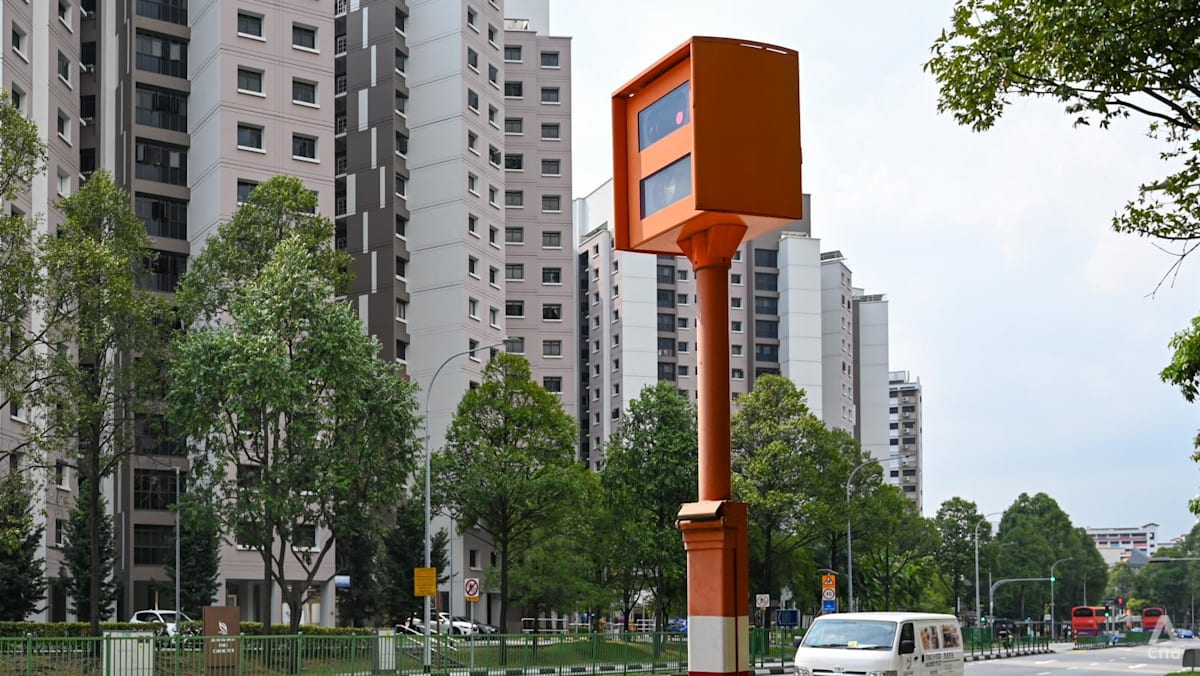
A red-light camera deployed along Jurong West Street 61 on Feb 22, 2024. It is used to detect vehicles that commit red-light running offences. (Photo: CNA/Eugene Goh)
This audio is generated by an AI tool.
SINGAPORE: In January 2024, with road accidents and fatalities rising, the traffic police were looking for a way to use more cameras to catch speeding vehicles on Singapore’s roads.
Their own vendor was already building a permanent, integrated solution, but when it would be ready was unclear.
Enter Darren Lau, a senior product manager at Open Government Products (OGP), and his three colleagues.
In three months, the four-person team built Roadbuster, a fix that allowed speeding violations captured by red-light cameras to be processed and logged as cases. They rolled it out and fine-tuned it along the way.
CNA Games Guess Word Crack the word, one row at a time Buzzword Create words using the given letters Mini Sudoku Tiny puzzle, mighty brain teaser Mini Crossword Small grid, big challenge Word Search Spot as many words as you can Show More Show Less “What people might not know is that red-light cameras also inherently have a speeding enforcement functionality, but this couldn't be operationalised by traffic police because the legacy system was really old, and their vendor couldn't enhance the system to be able to process speeding cases on red-light cameras,” said Mr Lau. “So they had this problem, and the solution would be: ‘I could pay the vendor, but I have no idea when their final solution could come up’.” At the OGP’s annual hackathon, Mr Lau and his colleagues set out to solve that problem. The need was urgent: the traffic police's mid-year update in September 2023 showed a rise in deaths from red-light running and speeding. Speeding violations at locations where the system was activated fell by 66 per cent, OGP director Lee Hongyi said in a LinkedIn post last month. “We’re sure this is not a coincidence because the trend follows for cameras we turned on later,” he said. Two years on, the traffic police have upgraded their systems to take on the capability, and Roadbuster is being retired. It processed 120,000 speeding cases and helped to prevent an unknowable number of accidents, said Mr Lee. The Singapore Police Force (SPF) told CNA that Roadbuster automated time-consuming steps, such as extracting vehicle registration numbers and speed data and creating cases in the case management system. “This has enabled officers to process cases more efficiently and devote more time to other operational work,” it said.
“What people might not know is that red-light cameras also inherently have a speeding enforcement functionality, but this couldn't be operationalised by traffic police because the legacy system was really old, and their vendor couldn't enhance the system to be able to process speeding cases on red-light cameras,” said Mr Lau.
“So they had this problem, and the solution would be: ‘I could pay the vendor, but I have no idea when their final solution could come up’.”
At the OGP’s annual hackathon, Mr Lau and his colleagues set out to solve that problem. The need was urgent: the traffic police's mid-year update in September 2023 showed a rise in deaths from red-light running and speeding.
Speeding violations at locations where the system was activated fell by 66 per cent, OGP director Lee Hongyi said in a LinkedIn post last month.
“We’re sure this is not a coincidence because the trend follows for cameras we turned on later,” he said.
Two years on, the traffic police have upgraded their systems to take on the capability, and Roadbuster is being retired. It processed 120,000 speeding cases and helped to prevent an unknowable number of accidents, said Mr Lee.
The Singapore Police Force (SPF) told CNA that Roadbuster automated time-consuming steps, such as extracting vehicle registration numbers and speed data and creating cases in the case management system.
“This has enabled officers to process cases more efficiently and devote more time to other operational work,” it said.
Senior product manager Darren Lau was part of the Open Government Products team that created the Roadbuster, an innovation which was adopted by the traffic police. (Photo: CNA/Alyssa Tan)
FROM CAMERA IMAGE TO CASE FILE
Roadbuster made it possible to take the images and information generated by the red-light cameras and turn them into cases that traffic police officers can actually process, said Mr Lau.
“Red-light cameras actually have the ability to capture speeding images. The issue for traffic police is they didn't have a way of processing these images in bulk, and being able to lodge these cases so that people who actually committed speeding offences can be notified with a letter on where you committed the offence and what was the offence you committed,” said the 36-year-old.
Speeding cases take more effort to analyse than red-light violations. A red-light camera captures a static image, but a speeding case needs more metadata, he said.
“You need the location and the speed of the car. Potentially for speeding cameras, the cases will be much higher versus red-light violations, so the volume of images that you might be processing is a lot higher.”
Roadbuster processed and consolidated metadata – such as car plate numbers, vehicle speed and location – into a format that could be uploaded easily into the case management system. Motorists who committed offences then received letters.
“We handled the most tedious part of the process, which is how do we gather images in a central location and how do we use OCR (optical character recognition) technology to quickly convert the information from images into usable information,” Mr Lau said.
Darren Lau gestures at a screenshot of the Roadbuster’s interface, taken on Oct 8, 2026 at the Open Government Products office. (Photo: CNA/Alyssa Tan)
WORKING ACROSS AGENCIES AND VENDORS
The project involved OGP, the traffic police, the Home Team Science and Technology Agency (HTX) and its vendor NCS, and red-light camera vendor Jenoptik, said Mr Lau.
Asked about overlaps or clashes, he said the team worked through obstacles through constant communication.
“There will always be some kind of friction, but really, we are trying to solve a common problem and then being able to come to the table and discuss,” he said.
Jenoptik and HTX had to adapt their systems to ingest the new table format into which Mr Lau’s team consolidated the data.
“So it's just a lot of communication and liasing together to make sure that the systems work together well,” he said. Roles were "clearly scoped out" and testing was conducted together to make sure things work, he added.
Such situations are common for teams like his, he said.
“The way OGP works is we are kind of an experimental division under GovTech, so we do enter pretty thorny situations to try and figure out what the problem is, and try to make sense of where we are,” he said.
He added that the traffic police were a “great partner” that was willing to bet on the agency and put the policy change into operation within three months.
BUILDING WHILE RUNNING
Roadbuster went live on Apr 1, 2024, but the work did not end there.
“Even after that, there were about six months of continuous refinements,” said Mr Lau.
The refinements improved the fidelity of captured images so that details were more accurate and errors fewer, he said. His team ran Roadbuster for two more years, until April this year.
The traffic police worked closely with OGP from the start of the project, providing operational requirements and jointly developing the workflow and user interface, SPF said.
“They continued refining Roadbuster based on feedback from officers who would use the system. This ensured that the system reflected actual enforcement processes that could be effectively adopted by officers eventually,” said the SPF.
This partnership enabled Roadbuster to deliver meaningful productivity gains while remaining user-centric and operationally practical, it added.
The project also taught Mr Lau’s team about fairness to the public versus speed.
“These are things that we wouldn't have known because for us, the faster I can do this (task), the better it is for traffic police. You can log more cases and I don't really care if people are penalised wrongly. They could just submit an appeal and try to handle the process that way as well,” said Mr Lau.
To avoid penalising people who did not speed or were misidentified by image recognition, the team had a police officer review each image before an offence was recorded.
Case volume rose after Roadbuster began operating, said Mr Lau. The time officers took to process a case fell from 10 minutes to three, freeing them to handle more cases or other enforcement work, he added.
When the data was consolidated and confirmed, the scale surprised the team.
“When we looked back as we handed over the project and decommissioned it, the numbers were quite staggering, because we didn’t know it would be this number of cases when we first started out,” he said.
SAME SCREEN, NEW SYSTEM
OGP did not hand Roadbuster over to the traffic police. Instead, the new traffic police system adopted the interface the team had developed, said Mr Lau.
“At the end of the day, traffic police still funded the vendor to build an integrated system directly tying the red-light cameras to the case lodging system,” he said.
“So in terms of handover, we didn't specifically hand over Roadbuster … we maintained a similar user interface between Roadbuster and the new system that was being developed.”
Because the design stayed consistent, officers needed no downtime for training, he said.
“Roadbuster was influenced by the legacy system as well, so we kind of tried to carry the consistent design language across all systems,” said Mr Lau.
On the 120,000 cases Roadbuster logged, he said handling public data safely was an utmost priority.
“Apart from passing it back to traffic police, we also store a copy of that data securely, so that if they need to reference it in the future, we are able to re-access that data and pass it back to them,” he said.
Mr Lau sees Roadbuster as an example of what OGP does best.
“We go in, we find where the biggest bottleneck is, and try to land impact with as limited resources as we can,” he said.
Get our pick of top stories and thought-provoking articles in your inbox
Stay updated with notifications for breaking news and our best stories
Join our channel for the top reads for the day on your preferred chat app
Roadbuster 工具在退役前的两年内处理了 12 万起超速案件,在启用该工具的地区,超速违章行为减少了 66%。
2024年2月22日,裕廊西61街安装了一台闯红灯摄像头。该摄像头用于检测闯红灯车辆。(图片:CNA/Eugene Goh)
这段音频由人工智能工具生成。
新加坡:2024 年 1 月,随着道路交通事故和死亡人数的增加,交警正在寻找一种方法,利用更多的摄像头来抓拍新加坡道路上的超速车辆。
他们自己的供应商已经在构建一个永久性的集成解决方案,但何时能够完成尚不清楚。
登场的是 Open Government Products (OGP) 的高级产品经理 Darren Lau 和他的三位同事。
三个月内,这个四人团队开发出了 Roadbuster,一个可以处理并记录闯红灯摄像头拍摄到的超速违章行为的修复程序。他们不断推出并完善该程序。
CNA游戏 猜词游戏 逐行破解单词 流行词游戏 用给定的字母组成单词 迷你数独 小谜题,脑力挑战 迷你填字游戏 小方格,大挑战 单词搜索 尽可能多地找出单词 显示更多 显示更少 “人们可能不知道,闯红灯摄像头本身也具有超速执法功能,但交警部门无法启用此功能,因为原有系统非常老旧,供应商也无法升级系统以处理闯红灯摄像头拍摄的超速案件,”刘先生说。“所以他们面临这个问题,而解决方案是:‘我可以付钱给供应商,但我不知道他们的最终解决方案何时才能推出。’” 在OGP的年度黑客马拉松上,刘先生和他的同事着手解决这个问题。需求迫在眉睫:交警部门在2023年9月的年中更新数据显示,因闯红灯和超速造成的死亡人数有所上升。 OGP总监李鸿毅上个月在领英上发文称,在启用该系统的路段,超速违章案件数量下降了66%。他表示:“我们确信这并非巧合,因为我们后来启用的摄像头也呈现出同样的趋势。”两年后,交警部门升级了系统以具备该功能,Roadbuster系统也随之退役。李鸿毅先生表示,该系统处理了12万起超速案件,并帮助避免了无数起交通事故。新加坡警察部队(SPF)告诉亚洲新闻台(CNA),Roadbuster系统实现了耗时步骤的自动化,例如提取车牌号码和速度数据,以及在案件管理系统中创建案件。“这使得警员能够更高效地处理案件,并将更多时间投入到其他行动中。”警方表示。
刘先生说:“人们可能不知道,闯红灯摄像头本身也具有超速执法功能,但交警无法启用此功能,因为旧系统非常老旧,而且他们的供应商无法升级系统以处理闯红灯摄像头拍摄的超速案件。”
“所以他们遇到了这个问题,而解决方案是:‘我可以付钱给供应商,但我不知道他们的最终解决方案什么时候才能出来。’”
在OGP的年度黑客马拉松上,刘先生和他的同事们着手解决这个问题。需求十分迫切:交警部门2023年9月的年中更新数据显示,闯红灯和超速造成的死亡人数有所上升。
OGP 总监李鸿义上个月在 LinkedIn 上发帖称,在启用该系统的地点,超速违章行为减少了 66%。
“我们确信这不是巧合,因为我们后来打开的摄像头也出现了同样的情况,”他说。
两年后,交警部门升级了系统,具备了相应的功能,Roadbuster系统也随之退役。李先生表示,Roadbuster系统处理了12万起超速案件,并帮助预防了无数起交通事故。
新加坡警察部队 (SPF) 告诉 CNA,Roadbuster 可以自动执行耗时的步骤,例如提取车辆登记号码和速度数据以及在案件管理系统中创建案件。
“这使得警员能够更高效地处理案件,并将更多时间投入到其他业务工作中,”声明中写道。
高级产品经理刘达伦是开放政府产品团队的成员,该团队开发了Roadbuster,这项创新已被交警部门采用。(图片:CNA/Alyssa Tan)
从相机图像到案件档案
刘先生表示,Roadbuster 使得将闯红灯摄像头生成的图像和信息转化为交警可以实际处理的案件成为可能。
“闯红灯摄像头实际上能够拍摄到超速图像。交警面临的问题是,他们没有办法批量处理这些图像,也无法将这些案件存档,以便向真正超速违章的人寄送信件,告知他们违章地点和违章内容,”这位36岁的男子说道。
他说,分析超速案件比分析闯红灯案件需要更多精力。闯红灯摄像头拍摄的是静态图像,而超速案件需要更多元数据。
“你需要车辆的位置和速度信息。超速摄像头的案件数量可能远高于闯红灯违章,因此你需要处理的图像数量也会高得多。”
Roadbuster系统处理并整合了车牌号、车速和位置等元数据,并将其转换成可以轻松上传到案件管理系统的格式。违规驾驶员随后会收到信件。
刘先生说:“我们处理了过程中最繁琐的部分,即如何将图像集中到一个地方,以及如何使用 OCR(光学字符识别)技术快速将图像信息转换为可用信息。”
2026年10月8日,在开放政府产品办公室,刘德伦(Darren Lau)指着Roadbuster界面的屏幕截图。(图片:CNA/Alyssa Tan)
与各机构和供应商合作
刘先生表示,该项目涉及OGP、交通警察、内政科技局(HTX)及其供应商NCS,以及闯红灯摄像头供应商Jenoptik。
当被问及是否存在重叠或冲突时,他表示团队通过不断沟通克服了障碍。
“摩擦总是难免的,但实际上,我们正在努力解决一个共同的问题,然后坐下来进行讨论,”他说。
Jenoptik 和 HTX 不得不调整他们的系统,以接收 Lau 先生的团队将数据整合到的新表格格式。
他说:“所以,关键在于大量的沟通和协调,以确保各个系统能够良好地协同运作。”他还补充道,所有角色都“明确划分”,并且共同进行了测试,以确保一切正常运行。
他说,像他所在的球队这样的情况很常见。
他说:“OGP 的运作方式是,我们是 GovTech 下属的一个实验部门,所以我们确实会进入一些非常棘手的情况,试图弄清楚问题所在,并试图理解我们所处的位置。”
他还补充说,交警部门是一个“很棒的合作伙伴”,他们愿意信任该机构,并在三个月内将政策变化付诸实施。
边跑边建
Roadbuster 于 2024 年 4 月 1 日上线,但工作并没有就此结束。
“即便在那之后,又进行了大约六个月的持续改进,”刘先生说。
他说,这些改进提高了图像采集的保真度,使细节更加准确,误差更少。他的团队又运行了两年Roadbuster系统,直到今年四月。
新加坡警察部队表示,交通警察从项目一开始就与OGP密切合作,提供运营需求,并共同开发工作流程和用户界面。
新加坡警察部队表示:“他们根据使用该系统的警员的反馈不断改进Roadbuster系统。这确保了该系统能够反映实际的执法流程,最终能够被警员有效采用。”
该公司补充说,此次合作使 Roadbuster 能够在保持以用户为中心和运营实用性的同时,实现有意义的生产力提升。
该项目也让刘先生的团队明白了公平对待公众与追求速度之间的平衡。
刘先生说:“这些都是我们原本不知道的事情,因为对我们来说,我完成这项任务的速度越快,对交警就越有利。这样可以记录更多案件,至于有人被错误处罚,我并不在意。他们也可以提出申诉,尝试通过这种方式解决问题。”
为了避免处罚那些没有超速或被图像识别错误识别的人,该团队在记录违法行为之前,会安排一名警官审查每张图像。
刘先生表示,自从“路霸行动”启动以来,案件数量有所增加。他还补充说,警员处理案件的时间从10分钟缩短到3分钟,使他们能够处理更多案件或其他执法工作。
当数据汇总并确认后,其规模令团队感到惊讶。
他说:“当我们回顾项目并将其关闭时,这些数字相当惊人,因为我们一开始并不知道会有这么多病例。”
同样的屏幕,全新的系统
刘先生表示,OGP并没有将Roadbuster系统移交给交警部门,而是新的交警系统采用了该团队开发的界面。
他说:“归根结底,交警部门还是出资让供应商建造了一个集成系统,将闯红灯摄像头直接与案件登记系统连接起来。”
“因此,就交接而言,我们并没有直接交接 Roadbuster……我们在 Roadbuster 和正在开发的新系统之间保持了类似的用户界面。”
他说,由于设计方案保持不变,警员无需停工进行培训。
“Roadbuster 也受到了原有系统的影响,所以我们试图在所有系统中采用一致的设计语言,”刘先生说。
Roadbuster 记录了 12 万起案件,他表示,安全处理公共数据是重中之重。
他说:“除了将数据转交给交警部门外,我们还会安全地存储一份数据副本,以便他们将来需要参考时,我们可以重新访问这些数据并将其转交给他们。”
刘先生认为 Roadbuster 是 OGP 最擅长的领域之一。
他说:“我们进入问题领域,找到最大的瓶颈,并尽可能用有限的资源产生影响。”
订阅我们的邮件,即可获取精选热点新闻和引人深思的文章。
订阅通知,第一时间获取突发新闻和精彩报道。
加入我们的频道,即可在您常用的聊天应用上获取当日热门文章。