Two S’pore-listed palm oil firms named in Greenpeace report on Indonesian plantation fires绿色和平组织报告点名两家在新加坡上市的棕榈油公司,指控其与印尼种植园火灾有关。
Greenpeace names Singapore-listed palm oil firms in an Indonesian plantation fires report, with companies disputing the findings. Read more at straitstimes.com.
新闻视频
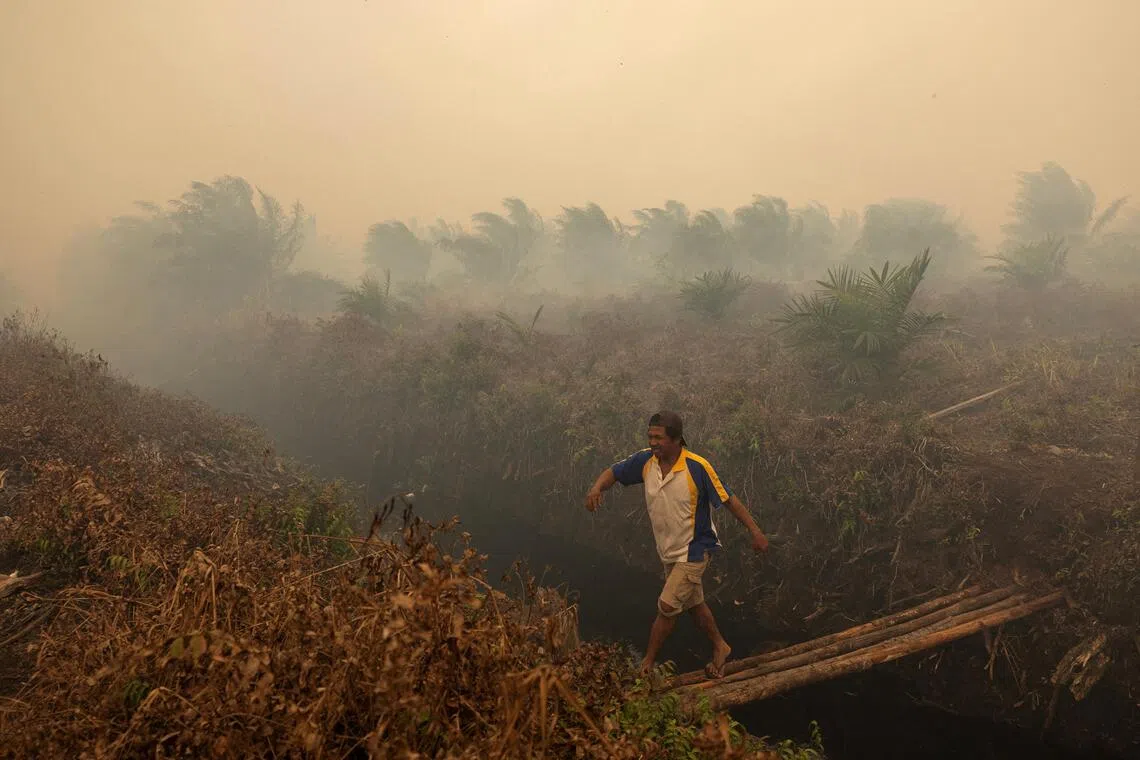
The report identified plantation concessions associated with the three companies where fires and smoke were detected between August and September.
Published Oct 15, 2026, 07:15 PM
Updated Oct 15, 2026, 11:22 PM
Greenpeace linked Singapore-listed Bumitama Agri and First Resources, plus First Borneo Plantations, to Indonesian plantation areas where fires and smoke were detected in August and September.
First Resources denied the fires started on its land, saying hotspots near its concessions did not prove responsibility and needed ground checks and spread analysis.
The report raises concern over palm oil supply chains and fire risks in West Kalimantan, where past claims also accused First Borneo of deforestation and orangutan habitat loss.
SINGAPORE – Two Singapore-listed palm oil companies, Bumitama Agri and First Resources, have been linked to plantation areas in Indonesia where fires and smoke were detected, according to an investigation by environmental group Greenpeace.
Another privately held company, First Borneo Plantations, which has ownership links to Singapore-incorporated companies, was also named in the Oct 5 report.
Mainboard-listed First Resources has disputed suggestions that the fires originated from its plantations, saying that some had started outside its concession boundaries before spreading into areas managed by the group.
A concession is an area of land that a company has been granted the right to use or develop, with the concession holder being the entity responsible for managing the land under the terms of the agreement.
In response to queries from The Straits Times on Oct 15, First Resources said the detection of hot spots or other satellite-based observations within or near a plantation concession does not “by itself establish the origin of a fire, responsibility for its occurrence, or any deliberate use of fire for land clearing by the concession holder”.
It said such conclusions require detailed investigations on the ground and an assessment of the circumstances surrounding each fire.
This includes examining when and where hot spots were first detected, as well as how subsequent fires spread over time.
“The presence of hot spots within a concession should not, in itself, be interpreted as an indication that the concession holder caused, initiated or condoned a fire,” it added.
First Resources also noted that while it detected hot spots near its plantation concessions in West Kalimantan, many were subsequently found to be outside its operating boundaries following verification.
The company said its plantations faced varying levels of fire risk, with those near concession boundaries, community-owned land and unmanaged areas being more vulnerable.
It added that its firefighting teams had been on standby at the perimeter of its concessions since hot spots were first detected nearby, providing support for firefighting efforts where possible, and coordinating with “neighbouring companies” where applicable.
In its report, Greenpeace identified a concession operated by Kayung Agro Lestari, an oil palm plantation operator in West Kalimantan, as one of the areas where fires and smoke were detected.
The company is a subsidiary of Indonesian palm oil producer Austindo Nusantara Jaya (ANJ), which was acquired by First Resources in May 2025.
First Resources initially acquired a 91.17% stake in ANJ for about US$330 million (S$423 million), before increasing its shareholding to 95.92% later that year.
ANJ holds a 99.99% stake in Kayung Agro Lestari, which has plantations spanning 13,878ha in Ketapang, West Kalimantan.
First Resources, which has a market capitalisation of $6.42 billion as at Oct 15, is majority-owned by members of Indonesia’s Fangiono family, with Ciliandra Fangiono serving as chief executive, and his brother Fang Zhixiang as deputy chief executive.
The Greenpeace report also identified Damai Agro Sejahtera, an Indonesian plantation company affiliated with Singapore-listed Bumitama Agri, as among the concessions where fires and smoke were detected.
Mainboard-listed Bumitama Agri, which has a market capitalisation of about $3.25 billion as at Oct 15, is linked to Indonesia’s Harita Group, a conglomerate with interests in mining and palm oil.
The company is controlled by the Lim family, with Lim Gunawan Hariyanto serving as its executive chairman and chief executive.
Bumitama Agri did not respond to queries from ST.
Greenpeace also identified Arjuna Utama Sawit as one of the plantation companies operating in areas where fires and smoke were detected, linking it to Indonesian palm oil group First Borneo Plantations, which it described as “originating from Singapore”.
First Borneo has historical ownership links to Singapore. According to a 2019 regulatory filing by Thai energy company PTT, Singapore-incorporated Chancellor Oil operated a palm oil business through First Borneo Plantations.
PTT disclosed that it sold its 77.56% stake in Chancellor Oil to Premier Palmoil Energy in April that year.
Indonesian businessman Alexander Thaslim is currently listed as a director of both Chancellor Oil and Premier Palmoil Energy, according to corporate filings.
First Borneo has previously faced allegations of deforestation and the destruction of orangutan habitats .
In February 2026, environmental group Mighty Earth accused First Borneo’s PT Equator Sumber Rezeki concession of continuing to clear rainforests and orangutan habitats without a permit in West Kalimantan.
该报告指出,在 8 月至 9 月期间,与这三家公司相关的种植园特许经营地发现了火灾和烟雾。
发布于 2026 年 10 月 15 日下午 7:15
更新于2026年10月15日晚上11:22
绿色和平组织将新加坡上市的 Bumitama Agri 和 First Resources,以及 First Borneo Plantations 与 8 月和 9 月在印度尼西亚种植园地区发现的火灾和烟雾联系起来。
第一资源公司否认火灾是从其土地上开始的,称在其特许经营地附近发现的热点并不能证明该公司对此负有责任,需要进行实地调查和蔓延分析。
该报告对西加里曼丹的棕榈油供应链和火灾风险表示担忧,此前的指控也曾称 First Borneo 公司造成森林砍伐和猩猩栖息地丧失。
新加坡——据环保组织绿色和平组织的一项调查显示,两家在新加坡上市的棕榈油公司 Bumitama Agri 和 First Resources 与印度尼西亚的种植园地区有关,这些地区曾发现火灾和烟雾。
另一家私营公司 First Borneo Plantations 也出现在 10 月 5 日的报告中,该公司与在新加坡注册成立的公司有所有权联系。
在主板上市的第一资源公司否认了火灾源于其种植园的说法,称部分火灾是从其特许经营边界之外开始的,然后蔓延到该集团管理的区域。
特许经营权是指公司被授予使用或开发某块土地的权利,特许经营权持有人是根据协议条款负责管理该土地的实体。
针对《海峡时报》10月15日的询问,第一资源公司表示,在种植园特许经营区内或附近探测到热点或其他基于卫星的观测结果,并不能“单独确定火灾的起因、火灾发生的责任,或特许经营权持有人故意使用火来清理土地”。
报告称,要得出这样的结论,需要对现场进行详细调查,并评估每起火灾发生的具体情况。
这包括调查何时何地首次发现热点,以及随后的火灾如何随时间蔓延。
“特许经营区内出现热点本身不应被解释为特许经营者造成、引发或纵容火灾的迹象,”声明补充道。
第一资源公司还指出,虽然该公司在其位于西加里曼丹的种植园特许经营地附近发现了热点地区,但经核实后发现,许多热点地区位于其运营边界之外。
该公司表示,其种植园面临不同程度的火灾风险,其中靠近特许经营边界、社区所有土地和未管理地区的种植园更容易受到火灾影响。
该公司补充说,自从在附近首次发现热点以来,其消防队就一直在特许经营区周边待命,尽可能为消防工作提供支持,并在适用情况下与“邻近公司”协调。
绿色和平组织在其报告中指出,西加里曼丹的油棕种植园运营商 Kayung Agro Lestari 经营的特许经营地是发现火灾和烟雾的地区之一。
该公司是印尼棕榈油生产商 Austindo Nusantara Jaya (ANJ) 的子公司,ANJ 于 2025 年 5 月被 First Resources 收购。
第一资源公司最初以约 3.3 亿美元(4.23 亿新元)的价格收购了 ANJ 91.17% 的股份,同年晚些时候又将其持股比例提高到 95.92%。
ANJ 持有 Kayung Agro Lestari 99.99% 的股份,该公司在西加里曼丹吉打邦拥有占地 13,878 公顷的种植园。
截至 10 月 15 日,市值达 64.2 亿美元的 First Resources 公司由印尼方吉奥诺家族成员控股,其中 Ciliandra Fangiono 担任首席执行官,他的兄弟方志祥担任副首席执行官。
绿色和平组织的报告还指出,与新加坡上市的 Bumitama Agri 有关联的印尼种植园公司 Damai Agro Sejahtera 也是发现火灾和烟雾的特许经营地之一。
截至 10 月 15 日,在主板上市的 Bumitama Agri 市值约为 32.5 亿美元,该公司与印尼的 Harita 集团有关联,Harita 集团是一家在采矿和棕榈油领域均有投资的综合企业。
该公司由林氏家族控制,林古纳万·哈里扬托担任执行董事长兼首席执行官。
Bumitama Agri 没有回复 ST 的询问。
绿色和平组织还指出,Arjuna Utama Sawit 是在发现火灾和烟雾的地区运营的种植园公司之一,并将其与印尼棕榈油集团 First Borneo Plantations 联系起来,称其“起源于新加坡”。
First Borneo与新加坡有着历史渊源。根据泰国能源公司PTT于2019年提交的监管文件,新加坡注册成立的Chancellor Oil公司通过First Borneo Plantations经营棕榈油业务。
PTT披露,该公司于当年4月将其持有的Chancellor Oil 77.56%的股份出售给了Premier Palmoil Energy。
根据公司备案文件,印尼商人亚历山大·塔斯利姆目前是 Chancellor Oil 和 Premier Palmoil Energy 两家公司的董事。
First Borneo 此前曾面临砍伐森林和破坏猩猩栖息地的指控。
2026 年 2 月,环保组织 Mighty Earth 指责 First Borneo 的 PT Equator Sumber Rezeki 特许经营公司在西加里曼丹未经许可继续砍伐热带雨林和猩猩栖息地。