The Full Story On That Oregon F-15 That Fired Its Missiles Into The Sea Before Landing关于俄勒冈州那架F-15战斗机在着陆前将导弹发射入海的完整报道
The jet's landing gear malfunctioned and it had to refuel with its gear down multiple times as a plan to safely ditch its ordnance came together.
新闻视频
By Joseph Trevithick
Updated Nov 27, 2020 6:25 PM EST
Last year, The War Zone
was first to report that an F-15C Eagle from the Oregon Air National Guard’s 142nd Fighter Wing had fired its live AIM-120C AMRAAM and AIM-9X Sidewinder missiles into the Pacific Ocean before making an emergency landing at Portland International Airport. At the time, details about the mishap were limited, but now we have obtained a copy of the official Air Force accident report that describes exactly what happened.
The F-15C in question, known by its serial number 78-0473 and going by the callsign “ROCK 42” at the time, was sitting alert at Portland International Airport on Feb. 20, 2019. That day, it and another alert jet were scheduled to conduct a mock scramble and then train with two additional flights of four F-15Cs each.
Despite the planned training mission, since the 78-0473 was designated to be on alert that day, it was still armed with four AIM-120Cs and two AIM-9X missiles, all of which were live, as well as 940 rounds of 20mm ammunition for its M61 Vulcan cannon . It also carried 48 MJU-10/B decoy flares and two external fuel tanks.
“The mission briefing and scramble ground operations were unremarkable,” the official accident report says, which The War Zone obtained in a redacted form via the Freedom of Information Act. Rock 42, the second in the two-ship alert flight, conducted an afterburner takeoff as part of the scramble drill at approximately 8:28 AM local time.
142nd Fighter Wing alert bird blasts out of PDX in full afterburner., Tyler Rogoway
Shortly after the takeoff, the F-15C’s pilot, whose name and rank is not present in the unredacted portions of the accident report, noticed a warning light indicating that the jet’s left main landing gear had not retracted properly. Rock 42 alerted their wingman and local air traffic controllers and requested a clear block of airspace in which to try to fix the issue.
In accordance with official Air Force procedures, the pilot lowered and then raised all of the plane’s landing gear again to see if this would unstick the left main landing gear. The pilot of the other alert F-15C, flying chase for the stricken Eagle, reported that the left main landing gear appeared to be locked in the downward position and did not move during this process.
Unable to retract the left main landing gear, Rock 42 declared an inflight emergency and then began preparing for an emergency arrested landing at Portland International Airport. “The Landing Gear Emergency-Landing checklist directed the aircrew to ‘Jettison armament and chaff/ flares …’ The MF [mishap flight] obtained a clearance to the overwater airspace to prepare for the armament jettison,” the report says.
Rock 42 fired off all 48 its MJU-10/Bs flares in the designated airspace over the Pacific Ocean without issue, after which the pilot continued to coordinate with Air Force personnel on the ground about both the nature of the landing gear issue and what to do with its remaining ordnance. A team of off-site specialists, known as a Conference Hotel , or CH, was contacted to help with continued troubleshooting. A representative from Boeing, the present prime contractor for the F-15 series, were also consulted.
F-15C dumping its flares. , Tyler Rogoway
A second attempt to lower and raise all of the landing gear also failed, but Rock 42’s wingman did observe a spurt of hydraulic fluid during the process and noted that the left main landing gear was also covered in it. However, the stricken Eagle’s pilot reported there were no problems with the jet’s hydraulic pressure according to their in-cockpit readouts. Based on the information available, the Boeing representative stated that they were confident that there was serious risk that the landing gear strut could collapse during any emergency landing.
At this point, Rock 42 was also running low on fuel. A KC-135R tanker, with the callsign Expo 91, which had already been operating in the area, had been redirected to provide support. However, there were concerns about whether the F-15C would be able to fly fast enough with its landing gear down to successfully refuel.
Rock 42’s wingman lowered their landing gear and refueled first, at a speed of 230 knots, to make sure the maneuver was safe. After that, Rock 42 also conducted a successful aerial refueling with Expo 91. Both jets linked up with the tanker a second time.
142nd Fighter F-15C refuels from a KC-135R over the Oregon Coast. , Tyler Rogoway
During these refuelings, Air Force personnel had been working out a plan for Rock 42 to safely get rid of its four AIM-120Cs and two AIM-9Xs, through a combination of firing them off and simply jettisoning them into the Pacific. “They determined, and relayed to the MF [mishap flight], that they would need a 40 nautical mile (NM) long by 12 NM wide ‘shooting lane’ at the lowest possible altitude,” according to the accident report.
Clouds off the Oregon coastline made it difficult for Rock 42’s wingman to conduct an impromptu “range sweep” to make sure there were no civilian or commercial aircraft in the lane or ships in the water below. Air traffic and shipping lane traffic data was subsequently used to confirm that the area was clear. It took three passes to fire all of the missiles.
“On the first pass the MP [mishap pilot] selectively jettisoned the AIM-120C located on station 3 (left side of fuselage), followed by the AIM-120C on station 7 (right side of fuselage),” the report says. “The MFL [mishap flight lead] observed the missiles separate from the MA [mishap aircraft] and impact the water, marking the coordinates and observing that they appeared to break apart upon impact.”
“The MP conducted two more passes firing the [remaining two] AIM-120Cs on the second pass and the AIM-9Xs on the third pass,” the report continues. “After the third pass was complete the MF proceeded to the tanker for the third and final aerial refueling, receiving fuel uneventfully.”
An F-15C fires an AIM-120 AMRAAM missile., USAF
The report does not give an explanation for why it was possible to jettison the two missiles under the fuselage, but not the others. However, this would have been due to external fuel tanks, which remained attached to the aircraft throughout the mishap, presenting an obstacle to safely jettisoning the missiles on the underwing pylons. It was also determined that there was no major added risk to the aircraft or its pilot from leaving the 940 20mm cannon shells in the internal magazine.
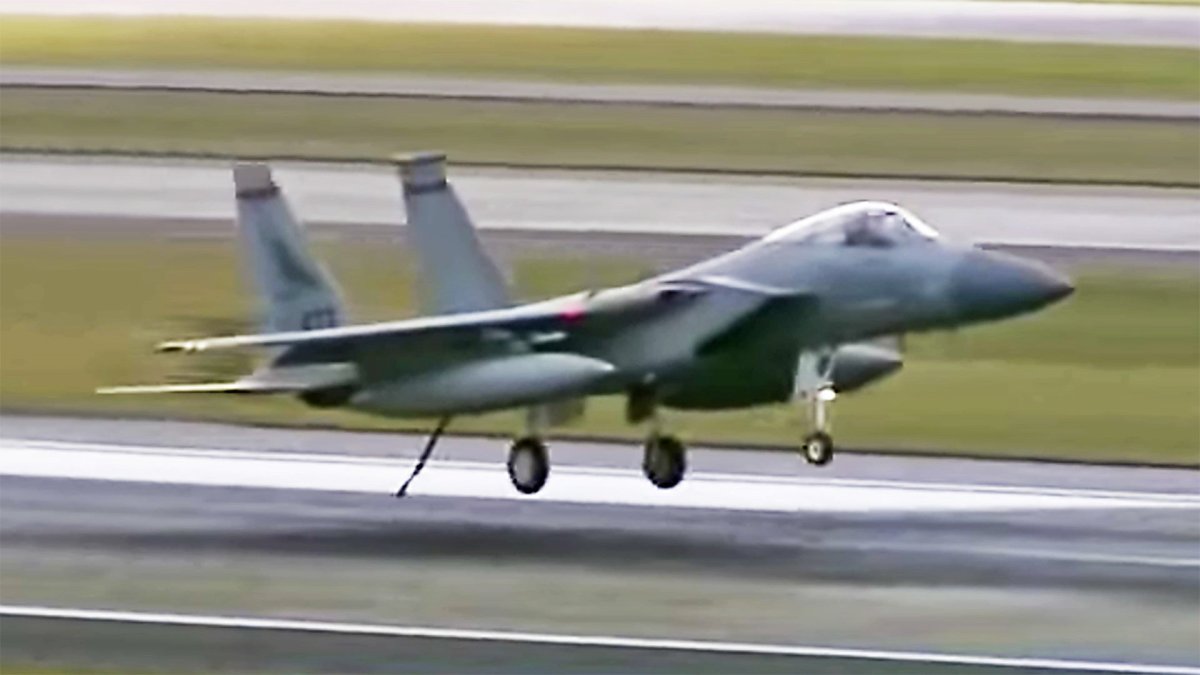
Rock 42 then moved on to the emergency arrested landing at Portland International Airport. The F-15C successfully caught the wire on the arresting system on the approach end of the airport’s runway 28L.
Unfortunately, after the pilot had put the jet’s nose wheel down on the runway, it had risen up again approximately one foot off the ground. This high engagement angle led the aircraft’s arresting hook to slam into the full up position after it caught the wire, bringing the cable up with it. “The [arresting] cable impacted the left horizontal stabilator, left tail cone, left engine exhaust, right engine exhaust, and the right tail internal countermeasures set (ICS) antenna,” causing damage to all of those components, according to the report.
The left main landing gear, however, did not collapse as was feared might happen. Emergency crews and ground personnel met the jet on the runway, secured it and then towed the 142nd’s maintenance hangar to assess the damage.
The exact cause of the landing gear malfunction and any subsequent recommendations in the report are redacted. However, the narrative and other unredacted details point to a failure in the jury link, a supporting component attached to the main landing gear strut, as a key factor. “This specific LMLG [left main landing gear assembly] was modified by Time Compliance Technical Order (TCTO) 1F-15-1680 on 07 Jul 2017, to receive a newly manufactured upper jury link, replacing the previous jury link that was prone to failure,” an unredacted portion of the report notes.
The Air Force subsequently ruled this incident to be so-called Class C mishap, which covers accidents that result in between $50,000 and $500,000 worth of damage or a nonfatal injury or illness that put someone out of work for one or more days, or both. The report says that the official total cost of the damage to the Eagle was $418,280 dollars. All of the damaged components were deemed to be repairable.
142nd Fighter Wing F-15C in one of the barns at PDX. , Tyler Rogoway
However, this figure notably and curiously does not include the cost of the expended missiles or flares. As The War Zone
noted at the time , this accident directly resulted in the loss of millions of dollars worth of missiles that would otherwise have remained in inventory.
Based on information from Pentagon budget documents , the estimated cost of each of the four lost AIM-120Cs was approximately $1 million, or $4 million in total. The accident report does not say that if the two expended AIM-9Xs were newer Block II models, which would have cost around $408,000, or older Block I missiles worth some $250,000. As of 2019, the unit price for the MJU-10/B was $184 , meaning the Eagle expended nearly $9,000 in flares during the incident, as well. The full cost of all of the expended missiles and flares would have been more than $4.5 million, at least.
Of course, what matters most is that the pilot of Rock 42 made it back safely. That the jet sustained relatively limited damage itself, despite concerns about a possible belly-up landing, means that the outcome, in the end, was largely positive.
If nothing else, it’s good to finally have a more complete description of the bizarre impromptu Oregon Coast missile shoot and emergency landing, overall. You can find a full copy of the report, as The War Zone received it, here .
Contact the author: joe@thedrive.com
Comments couldn’t be loaded. Please refresh the page.
作者:约瑟夫·特雷维西克
更新于美国东部时间2020年11月27日下午6:25。
去年,《战区》
我们率先报道了俄勒冈州空中国民警卫队第142战斗机联队的一架F-15C“鹰”式战斗机在波特兰国际机场紧急迫降前,向太平洋发射了实弹AIM-120C AMRAAM和AIM-9X“响尾蛇”导弹。当时,关于这起事故的细节有限,但现在我们已获得一份空军官方事故报告,其中详细描述了事故经过。
涉事的 F-15C 战斗机,序列号为 78-0473,当时的呼号为“ROCK 42”,于 2019 年 2 月 20 日在波特兰国际机场处于警戒状态。当天,它和另一架警戒喷气机计划进行模拟紧急起飞演习,然后与另外两架各由四架 F-15C 组成的飞行队进行训练。
尽管计划执行的是训练任务,但由于78-0473号飞机当天被指定处于警戒状态,因此它仍然携带了四枚AIM-120C和两枚AIM-9X导弹,所有导弹均为实弹,此外还携带了940发M61火神炮的20毫米炮弹。它还携带了48枚MJU-10/B诱饵弹和两个外部油箱。
官方事故报告称,“任务简报和地面紧急起飞操作均无异常”。该报告经《信息自由法》审查后获得,但内容有所删减。作为双机警戒编队中的第二架飞机,Rock 42 于当地时间上午 8 点 28 分左右进行了紧急起飞演习中的加力燃烧室起飞。
第142战斗机联队的警戒飞机从波特兰国际机场(PDX)起飞,开启加力燃烧室。——泰勒·罗戈威
起飞后不久,F-15C战斗机的飞行员(事故报告未删节部分未提及飞行员姓名和军衔)注意到一个警告灯亮起,显示飞机左侧主起落架未正确收起。Rock 42立即通知了僚机和当地空中交通管制员,并请求划拨一段空域进行故障排除。
根据空军官方程序,飞行员放下并再次收起飞机的所有起落架,以查看是否能解除左侧主起落架的卡滞状态。另一架负责护航的F-15C战斗机的飞行员报告说,左侧主起落架似乎卡在了向下位置,在此过程中没有移动。
由于无法收起左侧主起落架,Rock 42号飞机宣布空中紧急情况,并开始准备在波特兰国际机场进行紧急阻拦着陆。报告称:“起落架紧急着陆检查清单指示机组人员‘抛弃武器和箔条/干扰弹……’事故飞行队(MF)已获得进入水域上空的许可,以便准备抛弃武器。”
“岩石42”号飞机在太平洋上空的指定空域顺利发射了全部48枚MJU-10/B照明弹。之后,飞行员继续与地面空军人员协调,讨论起落架故障的原因以及如何处理剩余弹药。一支由异地专家组成的团队(称为“会议酒店”,简称CH)被联系,协助进行后续故障排除。此外,F-15系列战斗机的现任主承包商波音公司的代表也参与了咨询。
F-15C 正在投放干扰弹。,泰勒·罗戈威
第二次尝试放下并升起所有起落架也失败了,但“岩石42号”的僚机飞行员观察到在此过程中有液压油喷出,并注意到左侧主起落架上也沾满了液压油。然而,这架故障的“鹰”式飞机的飞行员报告说,根据驾驶舱内的读数,飞机的液压系统没有问题。根据现有信息,波音公司的代表表示,他们确信在任何紧急着陆过程中,起落架支柱都有可能发生严重断裂。
此时,“岩石42号”的燃料也即将耗尽。一架呼号为“Expo 91”的KC-135R加油机此前已在该区域执行任务,现已被调派前来支援。然而,人们担心F-15C在放下起落架的情况下能否以足够的速度飞行以成功完成空中加油。
Rock 42的僚机放下起落架,以230节的速度首先进行空中加油,以确保操作安全。之后,Rock 42又成功地为Expo 91进行了空中加油。两架飞机随后再次与加油机对接。
第142战斗机中队的F-15C战斗机在俄勒冈海岸上空接受KC-135R加油机的空中加油。泰勒·罗戈威
在这些空中加油期间,空军人员一直在制定一项计划,以便“岩石42”号飞机能够安全地处理其携带的四枚AIM-120C和两枚AIM-9X导弹,具体措施包括发射导弹和将其抛弃到太平洋。“他们确定,并已将这一信息传达给事故调查飞行队,他们需要在尽可能低的飞行高度下开辟一条长40海里、宽12海里的‘射击通道’,”事故报告如此写道。
俄勒冈海岸线附近的云层使得“岩石42号”的僚机难以进行临时的“航道扫描”,以确保航道上没有民用或商用飞机,下方水域也没有船只。随后,他们利用空中交通和航道交通数据确认了该区域安全。导弹发射共进行了三次。
报告称:“在第一次攻击中,事故飞行员(MP)选择性地抛弃了位于3号挂点(机身左侧)的AIM-120C导弹,随后又抛弃了位于7号挂点(机身右侧)的AIM-120C导弹。事故飞行指挥员(MFL)观察到导弹与事故飞机分离并落入水中,标记了坐标,并观察到导弹在撞击时似乎解体了。”
报告继续写道:“导弹发射机又进行了两次攻击,第二次发射了剩余的两枚AIM-120C导弹,第三次发射了AIM-9X导弹。第三次攻击完成后,导弹发射机飞往加油机进行第三次也是最后一次空中加油,加油过程顺利。”
一架F-15C战斗机发射了一枚AIM-120 AMRAAM导弹。(美国空军)
报告并未解释为何能够抛弃机身下方的两枚导弹,而其他导弹却无法抛弃。然而,这可能是由于外部油箱在事故发生期间始终与飞机相连,阻碍了翼下挂架上导弹的安全抛弃。此外,报告还认定,将940发20毫米机炮炮弹留在内部弹药库中,并未对飞机或飞行员造成重大额外风险。
随后,第42号火箭飞机进行了波特兰国际机场的紧急阻拦着陆。这架F-15C战斗机成功地钩住了机场28L跑道进近端的阻拦索。
不幸的是,飞行员将飞机前轮放下跑道后,飞机又离地约一英尺。这种过高的接触角度导致飞机的阻拦钩在钩住阻拦索后猛地向上弹起,并带动阻拦索向上弹起。报告称,“阻拦索撞击了左侧水平尾翼、左侧尾锥、左侧发动机排气口、右侧发动机排气口以及右侧尾部内部对抗装置(ICS)天线”,造成所有这些部件损坏。
然而,左侧主起落架并未像人们担心的那样坍塌。应急救援人员和地勤人员在跑道上与飞机会合,将其固定后,拖至第142战斗机联队的维修机库进行损失评估。
报告中隐去了起落架故障的确切原因以及后续建议。然而,叙述和其他未隐去的细节表明,连接主起落架支柱的支撑部件——连杆机构的故障是关键因素。报告未隐去的部分指出:“根据时间合规技术指令 (TCTO) 1F-15-1680,该特定左侧主起落架组件于 2017 年 7 月 7 日进行了改装,更换了新制造的上部连杆机构,替换了之前容易发生故障的连杆机构。”
空军随后将此次事件定性为所谓的C级事故,该级别涵盖造成5万至50万美元损失或导致人员非致命性伤亡或疾病,使某人无法工作一天或多天的事故,或两者兼有。报告称,鹰式教练机的官方总损失为418,280美元。所有受损部件均被认为可以修复。
第142战斗机联队的F-15C战斗机停放在波特兰国际机场(PDX)的其中一个机库里。泰勒·罗戈威
然而,值得注意的是,这个数字并不包括已消耗导弹或照明弹的成本。正如《战区》杂志所报道的那样。
当时指出,这次事故直接导致价值数百万美元的导弹损失,否则这些导弹本可以继续留在库存中。
根据五角大楼预算文件的信息,损失的四枚AIM-120C导弹每枚的估计成本约为100万美元,总计400万美元。事故报告并未说明,如果两枚已消耗的AIM-9X导弹是较新的Block II型(成本约为40.8万美元)还是较旧的Block I型(价值约25万美元),成本又会是多少。截至2019年,MJU-10/B的单价为184美元,这意味着“鹰”式战斗机在事故中还消耗了价值近9000美元的干扰弹。所有已消耗的导弹和干扰弹的总成本至少超过450万美元。
当然,最重要的是“岩石42号”的飞行员安全返回。尽管人们担心飞机可能会机腹着陆,但飞机本身受损相对较小,这意味着最终结果总体上是积极的。
至少,我们终于对俄勒冈海岸那次离奇的导弹发射和紧急迫降事件有了更完整的描述。您可以在这里找到《战区》收到的完整报告。
联系作者:joe@thedrive.com
评论加载失败,请刷新页面。