The Tragic Tale Of How NASA’s X-34 Space Planes Ended Up Rotting In Someone’s BackyardNASA的X-34太空飞机最终烂在某人后院的悲惨故事
The craft were once seen as the future of cheaper, faster space access. Since then they have been reduced to backyard junk that nobody wants to claim.
新闻视频
By Tyler Rogoway and Joseph Trevithick
Updated Aug 13, 2020 8:15 AM EDT
The X-34 program aimed to help break NASA and the Air Force into space far more frequently and inexpensively than ever before. In the end, a pair of rocket plane demonstrators were built, but they never were able to reach their full potential. Still, they were part of a wider family of initiatives that have resulted in the Air Force’s hugely successful X-37B mini-space plane that has remained in orbit near continuously for years. But after the shine on the program quickly faded around the turn of the Millennium, the unique craft found themselves in increasingly dire straits, stuffed in one dilapidated hangar or another, or weathering the harsh desert climate in the open.
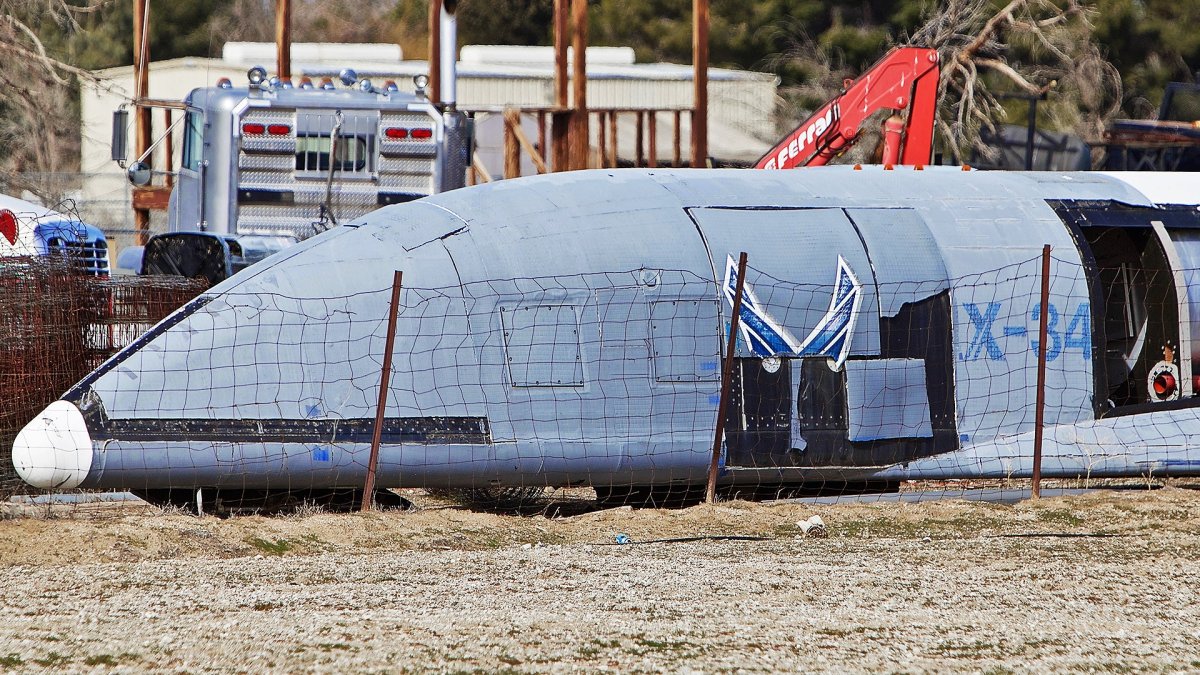
At times it even seemed like the X-34s would get a second chance at life, being brought back from the dead for some exciting new space launch program, but this never materialized. Today, these historic vehicles don’t sit in museums or as technical trainers for future aerospace engineers. Through a labyrinth of misfortune, they have found themselves rotting in someone’s backyard in Lancaster, California, not far from their long-time home at Edwards Air Force Base.
Here is the fascinating, but tragic story of how the X-34s went from potential harbingers of America’s future in space to unwanted backyard junk.
NASA kicked off the program that would lead to the unmanned X-34 in 1996 . The Marshall Space Flight Center , situated within the U.S. Army’s Redstone Arsenal in Alabama, was responsible for the project.
The main goal was to develop a testbed that could help rapidly trial new technologies for a future low-cost reusable space vehicle. In addition, the program would serve as an opportunity for NASA to explore improved management processes for fast-track development and testing of advanced systems.
One of the X-34s., NASA
A major impetus for the program was the desire to lay the groundwork for a space access platform that would be significantly cheaper than the Space Shuttle. NASA wanted to drop the price per pound of payload sent into orbit from $10,000 to $1,000, according to one official fact sheet . The total cost per flight would be no more than $500,000 .
In addition, a decade earlier, a tragic accident resulted in the loss of the Space Shuttle Challenger and her entire crew, an event that had already prompted both NASA and the U.S. military to begin exploring alternative means of getting into orbit. After the disaster, NASA only took delivery of one additional Space Shuttle, Endeavour , in 1991, specifically to replace Challenger .
Orbital Sciences Corporation subsequently received the contract to build what became known as the X-34. The company rolled out the first vehicle, known as the X-34A-1, on April 30, 1999, and subsequently delivered it to NASA’s Dryden Flight Research Center , now called the Armstrong Flight Research Center , situated within Edward Air Force Base in California.
A picture of the X-34A-1 rollout ceremony on April 30, 1999., NASA
The X-34A-1 vehicle, which NASA described as a suborbital demonstrator, was just over 58 feet long and had a wingspan of almost 28 feet. It featured a lightweight composite airframe and various features intended to enable repeated flights to and from space, including reusable fuel tanks and specialized thermal protection for high-speed flight. This latter shielding was also capable of surviving subsonic flights in poor weather, according to NASA .
The vehicle had a GPS-assisted inertial navigation system and an automated system to monitor the status of its avionics and the integrity of the vehicle, as well as its general course and flight performance, throughout its mission. The vehicle had tricycle landing gear and would land like a normal plane on a runway.
The X-34A-1 airframe at the time of its delivery to NASA., NASA
However, at the beginning of a mission, the X-34 design would rely on a mothership aircraft to get it to the appropriate altitude. Once there, the vehicle would separate from the carrier plane and then its Fastrac rocket motor would ignite, sending it soaring to an altitude of around 264,000 feet and following a pre-programmed flight route.
Engineers at the Marshall Space Flight Center had developed the Fastrac, also known as the MC-1, in-house separately as part of a program to craft a low-cost rocket engine. NASA subsequently contracted Summa Technology, Inc. to actually build these motors.
NASA expected that the pump-fed liquid fuel rocket engine would propel X-34s to hypersonic speeds of around Mach 8. The vehicle would be able to perform at least 25 complete missions.
Orbital Science’s Stargazer mothership launcher aircraft, a modified Lockheed L-1011 Tristar , carried the X-34A-1 aloft for the first captive-carry flight on June 29, 1999. Two more captive-carry tests occurred on Sept. 3 and 14, 1999.
Stargazer carries the unpowered X-34A-1 during a captive-carry test in 1999., NASA
Starting in July 2000 , NASA conducted a series of unpowered ground tests wherein a tractor truck pulled and released the X-34A-1, allowing it to coast at various speeds. On July 20, 2000, the X-34A-1 rolled along at speeds of between five and 10 miles per hour in two separate runs. Four days later, another pair of tests saw the vehicle get up to speeds of 30 miles per hour.
At that time, NASA planned to conduct another six weeks of this type of ground testing, getting the X-34A-1 up to 80 miles per hour. It is unclear if that testing regimen proceeded as expected. That same year, the vehicle was supposed to make a total of 27 unpowered and powered test flights at the Army’s White Sands Missile Range in New Mexico.
The first X-34 during tow tests in 2000., NASA
As NASA was continuing to test of X-34A-1, Orbital Sciences also built a second airframe, known as the X-34A-2 . The plan was to send this example to Holloman Air Force Base in New Mexico, where it would receive the Fastrac engine and go through a series of test firings, before moving on for flight testing at Dryden.
At Dryden, powered flight tests would see the X-34A-2 reach speeds of around Mach 2 and then up to Mach 5. Additional powered flights would then occur at the Kennedy Space Center in Florida. NASA hoped to conduct an average of one flight test every 14 days and demonstrate the ability to have the vehicle turned around and ready for another mission within 24 hours.
With the flight test data from the X-34A-1 and A-2, NASA would then evaluate a third airframe, the X-34A-3 across the full planned flight envelope. There were plans for follow-on developments using the basic X-34 design, as well. The original X-34A-1 itself received such extensive modifications that NASA sometimes referred to it as the X-34A-1A.
Originally, NASA had expected the X-34 to fall from the carrier plane and fire a Rocketdyne RS-56-OSA sustainer rocket engine, also found in the Atlas II space launch rocket, to fly to a high-suborbital position. From that altitude, it would reportedly have fired an expendable third stage with a Fastrac rocket engine, which would carry the payload into orbit.
Technicians at Dryden make improvements to the X-34A-1 in 1999., NASA
From the information available, NASA appears to have quickly abandoned this concept of operations for the three X-34As in favor of the simplified suborbital design with the Fastrac only. The eventual X-34 vehicles had no provision for a payload at all. However, there were reportedly plans for a larger, three-stage X-34B , which would have required a Boeing 747 mothership .
The X-34B, along with the entire X-34 flight test program, never came to pass. Orbital Sciences never finished the X-34A-3, either.
In 2000, NASA and Orbital Sciences, together, conducted a review of the program, its requirements, and testing schedule. The two parties concluded there were significant risks in the test plan for the vehicle’s various internal systems, especially its avionics and automated landing system. The end goal for the X-34 was for the vehicle to be able to land autonomously and do so in the face of crosswinds with gusts of more than 20 miles per hour, according to NASA .
These risks held the potential for cost overruns and delays. Orbital Science’s contract with NASA, worth almost $86 million, only covered the design and fabrication of the X-34s. The company had put in $10 million of its own money to modify Stargazer, originally intended to lift the Pegasus series of air-launched rockets, so it could carry the new vehicle.
Stargazer carrying a Pegasus XL air-launched space vehicle., NASA
The money for testing, another $16 million by the end of 1999, had come through a separate joint effort between NASA and the U.S. military known as the Space Launch Initiative (SLI). SLI was a research and development project aimed at exploring a host of technologies related to reusable space launch systems and methods of enabling rapid access to space . SLI funded research into new rocket engines , reusable rocket boosters , and reusable space launch vehicles, such as the X-34, as well as the larger and significantly more complex single-stage-to-orbit Lockheed Martin X-33 .
In 2001, NASA officially canceled the X-34 program, along with the X-33 project, in order to free up SLI funding for other higher priority work. We also don’t know if this decision was in part due to redundancies or competing programs in the classified realm . It does seem likely that the greater success NASA was having with the X-37A and X-40A programs was a contributing factor.
Despite their nomenclatures, the NASA began work on the unpowered X-40A first in 1998, with the craft serving as a testbed for the larger X-37A. Boeing derived the basic shape of both of these vehicles from Space Shuttle.
From left to right, the X-37A, X-40A, and one of the X-34As., NASA
The X-37’s mission profile was also substantially less complicated than that of the X-34 and its mothership. The miniature space shuttle would instead ride into space on top of a commercial space launch rocket.
In 2004, NASA transferred the X-37A program to the U.S. military’s Defense Advanced Research Projects Agency (DARPA), after which it became a highly classified project. Two years later, the U.S. Air Force announced the start of development of an improved X-37B vehicle .
The service eventually built two X-37Bs and the program has been a major success since then. The pair of OTVs have safely completed four orbital missions, the longest of which, so far, saw the vehicle spend more than 700 days in space.
The first X-37B getting loaded into a payload shroud at the encapsulation cell at the Astrotech facility in Titusville, Florida on April 13, 2010, ahead of its first orbital flight., USAF
The exact mission sets of the X-37Bs remain murky , but they’re still flying secretive missions today. One of the OTVs is in space right now on a fifth orbital flight that began in September 2017 and has already lasted more than 525 days .
The X-34s have not been so lucky. Back in 2002, NASA had put the two completed airframes, along with the unfinished parts of the third vehicle and related equipment, in storage at Edward’s shadowy North Base installation . Though there was some talk of potentially putting one or both them into the base museum, this never occurred.
The dilapidated hangar that held the two airframes was open and exposed to the elements, as well as birds and other animals. Our friend and aviation photographer Ashley Wallace managed to grab some pictures of them in this sorry state in 2007, which you can see below.
In 2004, the Sierra Nevada Corporation (SNC) announced that it was looking into whether it could use the X-34s as engine testbeds to support the development of its own Dream Chaser reusable space vehicle, offering the possibility of a new life for largely forgotten vehicles. But despite SNC’s interest, the vehicles remained in storage.
It’s unclear why, but Dream Chaser, which is more similar in design to NASA’s HL-20 Personnel Launch System concept, did eventually end up using the landing gear from one of these vehicles. During Dream Chaser’s first free flight in October 2013, a portion of that gear failed. This caused the lifting body to go skidding off the runway during its landing attempt at Edwards, resulting in significant damage to the vehicle.
Four years earlier, NASA, still apparently interested in finding some use for the X-34s, had towed the two vehicles out to Edwards’ Precision Impact Range Area (PIRA), where they reportedly served as laser designation practice targets for the Air Force. Out on the range, they were even more exposed to extreme shifts in temperature and poor weather. The spare parts and portions of the third airframe were steadily disposed of as waste and scrap, as well.
Early in 2010, NASA attempted to remove them from the PIRA, but the effort ended up waylaid by bad weather, leaving the vehicles sitting on an access road until they eventually being moved to another outdoor site at Dryden in May of that year. Then, in November 2010 , NASA moved the pair of X-34 vehicles from that base to the Mojave Air and Space Port . At that time, Orbital Sciences was reportedly looking to see if the vehicles were still viable test beds.
The X-34s on the way to Mojave in 2010., NASA
The thought that the X-34s could be returned to flight was exciting to aerospace enthusiasts and the move did make news and was the source of some public intrigue. The vehicles sat on the ramp at civilian test flight Mecca until some time in 2013, when they went back to Dryden.
As of 2015, satellite imagery showed that the remains of the X-34s were still at what had become known by then as NASA’s Armstrong Flight Research Center at Edwards. They were parked outside among the hulks of other disused test airframes that once operated out of the legendary installation. Around this same time, ownership of the X-34s was transferred from NASA to the Air Force.
The two X-34s sit next to Orbital Sciences Stargazer at the Mojave Air and Space Port in 2012., Google Earth
The two X-34s, at top, sitting out in the open at the Armstrong Flight Research Center in 2015., Google Earth
Fast forward to today and the X-34s no long call Armstrong Flight Test Center home, but that doesn’t mean they are sitting proudly in museums or are being used by a technical school for training. Their current resting place is a residential backyard in rural Lancaster, California, some 25 miles from their previous home at Edwards Air Force Base.
The X-34 story took a very bizarre turn in the last couple of years when the Air Force apparently donated the craft to a museum in Florida. The man who was the point of contact for the museum had to take possession of them, but was not anywhere near ready logistically to move them across the country. This would have been a major administrative and operational undertaking as each state would require special permits to move the wide loads through. We can only imagine what the bill would be to ship the rocket planes 2,000 miles east would have been, but it would have been substantial.
This is how they ended up in the back yard of the proprietor of Smith’s Quickcrane Inc. With the individual in Florida totally unprepared for the complex and expensive shipping process, he asked the contractor that had moved them off Edwards’ grounds to store them for a very short amount of time while he quickly got his affairs in order. According to the owner of Smith’s, who we talked to on the phone, what was originally supposed to be a couple weeks at the most has turned into many, many months.
The Florida man disappeared on them, leaving them with the space vehicles sitting in pieces in their yard. Then, whenever they tried to collect on the contract or dispose of the vehicles, his lawyers would pop up and try to keep it from happening. Then, just as quickly as contact had been made, that same legal counsel would inform them that they no longer represented the purchaser of the X-34s.
Clearly, the owners of Smith’s Quickcrane aren’t happy about with the situation and they just want to get paid and have the vehicles removed. But there they sit, a bizarre oddity to gawk at for anyone who drives down their road.
Check out our exclusive images from the site:
Matt Hartman/Shorealonefilms.com
The craft, which weren’t in great condition to begin with, have been subject to the elements yet again, sitting on the grass with their internals exposed in that yard for some time now. Their overall condition looks as if it has deteriorated substantially and who knows what has been taken off of them by thieves. Still, at the very least, they could be used as props to support the nearby movie making industry and it’s not as if there aren’t places nearby that deal in just those sort of services.
It remains unclear who actually holds the title to these craft or if there is even some sort of title to hold. We find it odd that the Air Force hasn’t stepped in to remove the craft or find them a new home. If these craft were donated, the recipient clearly hasn’t held up their end of the bargain. Frankly, it seems strange that no museum in the region wouldn’t have taken them in the first place.
We reached out to the Air Force for comment, but at the time of writing, we have not received a response. We will make sure to update this post when we hear back.
In the meantime, the X-34s, craft that cost many millions of dollars and were once looked as potentially transformational when it comes to developing quicker, cheaper access to space, now sit rotting in the most unexpected and undignified of places. It’s a sad end to what already was a fairly sad life.
Contact the authors: Tyler@thedrive.com and joe@thedrive.com
Editor’s note: A very special thanks to our good friend and contributor Matt Hartman of Shorealonefilms.com for assisting in bringing this piece to fruition.
Correction: An earlier version of this story said that Orbital Sciences also produced the Fastrac rocket engine that was supposed to power the X-34s. Summa Technology, Inc. of Huntsville, Alabama, which no longer exists, was the actual company NASA hired to build these engines.
Comments couldn’t be loaded. Please refresh the page.
作者:泰勒·罗戈韦和约瑟夫·特雷维西克
更新于美国东部时间2020年8月13日上午8:15
X-34计划旨在帮助NASA和空军以前所未有的频率和成本进入太空。最终,两架火箭飞机验证机被制造出来,但它们始终未能充分发挥其潜力。尽管如此,它们仍然是一系列更广泛计划的一部分,这些计划最终促成了空军极其成功的X-37B小型航天飞机的诞生,该飞机已在轨道上近乎持续运行多年。然而,在千禧年之交,随着该计划的光环迅速褪去,这些独特的飞行器陷入了日益严峻的境地,它们要么被塞进破旧的机库,要么在露天遭受恶劣的沙漠气候的侵蚀。
有时,人们甚至觉得X-34飞机或许能获得新生,被重新启用,用于某个激动人心的新太空发射计划,但这最终未能实现。如今,这些具有历史意义的飞行器既没有被收藏在博物馆里,也没有成为未来航空航天工程师的技术训练工具。由于种种不幸,它们最终落得在加利福尼亚州兰开斯特某户人家的后院里腐朽的下场,距离它们在爱德华兹空军基地的长期驻地并不远。
这是一个引人入胜却又令人惋惜的故事,讲述了 X-34 如何从美国未来太空探索的潜在先驱沦为无人问津的后院垃圾。
美国国家航空航天局 (NASA) 于 1996 年启动了最终研制出无人 X-34 的计划。位于阿拉巴马州美国陆军红石兵工厂内的马歇尔太空飞行中心负责该项目。
主要目标是开发一个测试平台,用于快速测试未来低成本可重复使用航天器的新技术。此外,该项目还将为NASA提供一个机会,探索改进管理流程,以加快先进系统的开发和测试。
X-34之一,美国宇航局
该计划的主要推动力在于希望为一种比航天飞机成本低得多的太空进出平台奠定基础。根据一份官方情况说明书,NASA希望将每磅有效载荷送入轨道的成本从1万美元降至1000美元。每次飞行的总成本将不超过50万美元。
此外,十年前,一场悲剧性的事故导致挑战者号航天飞机及其全体机组人员遇难,这一事件已经促使美国国家航空航天局(NASA)和美国军方开始探索其他进入轨道的方式。灾难发生后,NASA仅在1991年接收了一架新的航天飞机——奋进号,专门用于替代挑战者号。
轨道科学公司随后获得了建造后来被称为 X-34 的飞行器的合同。该公司于 1999 年 4 月 30 日推出了第一架飞行器,即 X-34A-1,随后将其交付给了位于加利福尼亚州爱德华兹空军基地的 NASA 德莱顿飞行研究中心(现称为阿姆斯特朗飞行研究中心)。
1999年4月30日,X-34A-1下线仪式的照片,美国国家航空航天局(NASA)。
美国宇航局(NASA)将X-34A-1飞行器描述为亚轨道验证机,其长度略超过58英尺(约17.6米),翼展近28英尺(约8.5米)。它采用轻质复合材料机身,并配备了多种旨在实现往返太空重复飞行的功能,包括可重复使用的燃料箱和用于高速飞行的专用隔热层。据NASA称,这种隔热层还能在恶劣天气下进行亚音速飞行。
该飞行器配备了GPS辅助惯性导航系统和自动化系统,用于监控其航空电子设备的状态、飞行器的完整性以及飞行器的总体航向和飞行性能,贯穿整个任务过程。该飞行器采用三点式起落架,能够像普通飞机一样在跑道上着陆。
X-34A-1机身交付给NASA时的状态。
然而,在任务开始时,X-34的设计需要依靠母机将其送至合适的飞行高度。到达高度后,飞行器将与母机分离,然后其Fastrac火箭发动机点火,使其飙升至约264,000英尺的高度,并按照预先设定的飞行路线飞行。
马歇尔太空飞行中心的工程师们曾独立研发过Fastrac发动机(也称MC-1),这是他们旨在打造低成本火箭发动机的项目的一部分。随后,NASA与Summa Technology公司签订合同,委托其实际生产这些发动机。
美国宇航局预计,这种泵送式液体燃料火箭发动机将使X-34达到约8马赫的高超音速。该飞行器至少能够执行25次完整的飞行任务。
1999 年 6 月 29 日,轨道科学公司的“观星者”母舰发射飞机(一架改装的洛克希德 L-1011 三星飞机)将 X-34A-1 送入空中,进行了首次系留飞行。1999 年 9 月 3 日和 14 日又进行了两次系留飞行测试。
1999年,美国宇航局的“观星者”号运输机在一次系留携带测试中,携带了无动力X-34A-1型飞机。
从2000年7月开始,NASA进行了一系列无动力地面测试,测试中一辆拖车牵引并释放X-34A-1,使其以不同速度滑行。2000年7月20日,X-34A-1在两次独立的测试中以每小时5至10英里的速度滑行。四天后,在另外两次测试中,该飞行器的速度达到了每小时30英里。
当时,NASA计划再进行六周的此类地面测试,使X-34A-1的飞行速度达到每小时80英里。目前尚不清楚该测试计划是否按预期进行。同年,该飞行器原计划在位于新墨西哥州的陆军白沙导弹靶场进行总共27次无动力和动力试飞。
2000年,第一架X-34在拖曳测试中。(美国国家航空航天局)
在NASA继续测试X-34A-1的同时,轨道科学公司也建造了第二架机身,即X-34A-2。计划是将这架飞机送往新墨西哥州的霍洛曼空军基地,在那里安装Fastrac发动机并进行一系列点火测试,然后再送往德莱顿飞行研究中心进行飞行测试。
在德莱顿飞行研究中心,X-34A-2 将进行动力飞行测试,速度将达到约 2 马赫,随后提升至 5 马赫。之后,还将在佛罗里达州的肯尼迪航天中心进行更多动力飞行测试。NASA 希望平均每 14 天进行一次飞行测试,并验证该飞行器能够在 24 小时内完成周转,为下一次任务做好准备。
凭借X-34A-1和A-2的飞行测试数据,NASA将对第三架飞机X-34A-3进行全面评估,涵盖其全部预定飞行包线。此外,NASA还计划基于X-34的基本设计进行后续研发。最初的X-34A-1本身也经过了大量的改进,以至于NASA有时将其称为X-34A-1A。
最初,NASA计划让X-34从运载飞机上脱落,并点燃一台与阿特拉斯II号运载火箭相同的罗克达因RS-56-OSA助推火箭发动机,飞至高亚轨道位置。据报道,届时它将从该高度点燃一个一次性使用的第三级火箭,该火箭配备一台Fastrac火箭发动机,将有效载荷送入轨道。
1999年,美国国家航空航天局(NASA)德莱顿飞行研究中心的技师们对X-34A-1进行了改进。
根据现有信息,NASA似乎很快放弃了X-34A的这种运行方案,转而采用仅配备Fastrac推进器的简化亚轨道设计。最终的X-34飞行器完全没有有效载荷。然而,据报道,NASA曾计划研制一种更大的三级X-34B,这将需要一架波音747母船。
X-34B以及整个X-34飞行测试计划最终都未能实现。轨道科学公司也未能完成X-34A-3的研发。
2000年,美国国家航空航天局(NASA)和轨道科学公司(Orbital Sciences)联合对该项目、其需求和测试计划进行了审查。双方得出结论,该飞行器各种内部系统的测试计划存在重大风险,尤其是其航空电子设备和自动着陆系统。据NASA称,X-34的最终目标是使其能够自主着陆,并且能够在超过20英里/小时的侧风阵风下完成着陆。
这些风险可能导致成本超支和工期延误。轨道科学公司与美国宇航局签订的价值近8600万美元的合同仅涵盖X-34的设计和制造。该公司还自掏腰包1000万美元,对原本用于发射飞马座系列空射火箭的“观星者”运输机进行改造,使其能够搭载新型飞行器。
美国宇航局的“观星者”号航天飞机搭载着一架“飞马座XL”空射航天器。
到1999年底,用于测试的资金又增加了1600万美元,这笔资金来自美国国家航空航天局(NASA)和美国军方的一项名为“太空发射计划”(SLI)的独立合作项目。SLI是一项研发项目,旨在探索一系列与可重复使用航天发射系统和快速进入太空的方法相关的技术。SLI资助了对新型火箭发动机、可重复使用火箭助推器和可重复使用航天运载火箭(例如X-34)以及更大、更复杂的单级入轨火箭洛克希德·马丁X-33的研究。
2001年,NASA正式取消了X-34项目以及X-33项目,以便将战略激光干涉测量(SLI)资金用于其他优先级更高的项目。我们也不清楚这一决定是否部分是由于项目重复或存在其他机密项目竞争所致。不过,NASA在X-37A和X-40A项目上取得的更大成功很可能是促成这一决定的因素之一。
尽管名称不同,但美国宇航局早在 1998 年就开始研发无动力 X-40A,该飞行器作为更大的 X-37A 的试验平台。波音公司从航天飞机中汲取了这两种飞行器的基本外形设计灵感。
从左至右依次为:X-37A、X-40A 和一架 X-34A。(美国国家航空航天局)
X-37 的任务方案也比 X-34 及其母舰简单得多。这架小型航天飞机将搭乘商业运载火箭进入太空。
2004年,NASA将X-37A项目移交给美国军方的国防高级研究计划局(DARPA),之后该项目成为高度机密项目。两年后,美国空军宣布启动改进型X-37B飞行器的研发工作。
该机构最终建造了两架X-37B,此后该项目取得了巨大成功。这两架轨道飞行器已安全完成四次轨道飞行任务,其中最长的一次任务在太空停留了700多天。
2010年4月13日,在佛罗里达州泰特斯维尔的Astrotech工厂,第一架X-37B被装入有效载荷整流罩,准备进行首次轨道飞行。(美国空军)
X-37B 的具体任务安排仍然不明朗,但它们至今仍在执行秘密任务。其中一架 OTV 目前正在太空进行第五次轨道飞行,该飞行始于 2017 年 9 月,至今已持续超过 525 天。
X-34的命运就没那么幸运了。早在2002年,NASA就将两架已完成的机身,以及第三架飞机的未完成部件和相关设备,存放在爱德华兹空军基地隐蔽的北基地。虽然曾有人提议将其中一架或两架飞机送入基地博物馆,但最终未能实现。
存放这两架飞机的破旧机库敞开着,风吹日晒雨淋,鸟类和其他动物也经常光顾。我们的朋友兼航空摄影师阿什利·华莱士在2007年拍下了一些它们当时的凄凉景象,您可以在下方看到。
2004年,内华达山脉公司(SNC)宣布,正在研究能否将X-34飞机用作发动机测试平台,以支持其自主研发的“追梦者”可重复使用航天器的开发,这为这些几乎被遗忘的飞行器带来了一线生机。但尽管SNC对此表现出浓厚的兴趣,这些飞行器最终还是被封存了起来。
目前尚不清楚具体原因,但设计上更接近NASA HL-20人员发射系统概念的追梦者号最终确实使用了HL-20的起落架。在2013年10月追梦者号的首次自由飞行中,部分起落架发生故障。这导致升力体在爱德华兹空军基地着陆时滑出跑道,造成飞行器严重损坏。
四年前,NASA显然仍然对X-34的用途感兴趣,于是将这两架飞机拖到了爱德华兹空军基地的精确打击靶场(PIRA),据报道,它们在那里被用作空军的激光指示练习靶。在靶场上,它们更容易受到极端温度变化和恶劣天气的影响。第三架飞机的备件和部分机身也逐渐被当作废料处理掉。
2010年初,NASA曾试图将这两架X-34飞行器从PIRA(可能是指某个测试场地或设施)移走,但由于恶劣天气,行动受阻,飞行器一直停放在一条通道上,直到同年5月才被转移到德莱顿飞行研究中心的另一个室外场地。随后,在2010年11月,NASA将这两架X-34飞行器从该基地转移到了莫哈韦航空航天港。据报道,当时轨道科学公司正在评估这两架飞行器是否仍然适合作为测试平台。
2010年,X-34侦察机飞往莫哈韦沙漠。(美国宇航局)
X-34 能够重返蓝天的消息令航空航天爱好者兴奋不已,这一消息也确实登上了新闻头条,引发了公众的浓厚兴趣。这些飞机一直停放在民用试飞圣地——德莱顿飞行研究中心的停机坪上,直到 2013 年的某个时候才被送回德莱顿。
截至2015年,卫星图像显示,X-34的残骸仍然停放在当时被称为NASA阿姆斯特朗飞行研究中心(位于爱德华兹空军基地)的地方。它们与其他废弃的测试飞机残骸一起停放在室外,这些飞机曾经在这个传奇的基地服役。大约在同一时期,X-34的所有权从NASA移交给了美国空军。
2012年,两架X-34飞机停放在莫哈韦航空航天港的轨道科学公司“观星者”号旁边。(图片来源:谷歌地球)
图中上方两架X-34飞机于2015年停放在阿姆斯特朗飞行研究中心露天。(图片来自谷歌地球)
如今,X-34 飞机已不再以阿姆斯特朗飞行试验中心为家,但这并不意味着它们被珍藏在博物馆里,或被技术学校用作训练工具。它们目前的安息之地是加利福尼亚州兰开斯特郊区一户人家的后院,距离它们之前的所在地——爱德华兹空军基地——约 25 英里。
X-34的故事在过去几年里出现了一个非常离奇的转折:空军竟然将这架飞机捐赠给了佛罗里达州的一家博物馆。博物馆的联系人需要接收这架飞机,但他在后勤方面完全没有做好将它们运过美国本土的准备。这将是一项巨大的行政和运营工程,因为每个州都需要特殊的许可证才能运输这些超宽的货物。我们可以想象,将这些火箭飞机运到2000英里以东的佛罗里达州需要多少费用,肯定是一笔不小的数目。
就这样,这些起重机最终出现在了史密斯快速起重机公司老板的后院。由于身在佛罗里达的那位人士对复杂而昂贵的运输流程毫无准备,他只好请求之前将起重机从爱德华兹的场地搬走的承包商暂时保管,以便他能尽快安排好一切。据我们电话采访的史密斯公司老板说,原本最多几周的保管时间,现在已经变成了几个月。
那个佛罗里达男子突然消失,留下航天器残骸堆在他们院子里。之后,每当他们试图追讨合同款项或处理这些航天器时,他的律师就会冒出来阻挠。然后,就像之前联系上他一样迅速,这位律师又会通知他们,他们不再代表X-34的买家。
显然,史密斯快速起重机公司的老板对这种情况很不满意,他们只想拿到钱,然后把车移走。但这些车就那样停在那里,成了路过此地的人不得不驻足观看的怪异景象。
请查看我们从网站上独家提供的图片:
Matt Hartman/Shorealonefilms.com
这些飞行器原本状况就不太好,如今又一次饱受风吹雨打,内部零件暴露在外,静静地躺在院子里的草地上已经有一段时间了。它们的整体状况看起来已经严重恶化,而且谁也不知道上面被盗走了什么。不过,至少它们可以作为道具,为附近的电影制作行业提供一些帮助,而且附近也确实有不少地方提供这类服务。
目前尚不清楚这些飞行器的所有权究竟归谁所有,甚至是否存在所有权归属问题。令人费解的是,空军为何没有介入移除这些飞行器或为其寻找新的归宿。如果这些飞行器是捐赠的,那么接受捐赠者显然没有履行承诺。坦白说,令人费解的是,该地区竟然没有一家博物馆愿意接收它们。
我们已联系空军征求意见,但截至发稿时尚未收到回复。一旦收到回复,我们将立即更新此帖。
与此同时,这些耗资数百万美元、曾被视为有望彻底改变太空探索方式(更快、更经济)的X-34飞船,如今却在最意想不到、最不体面的地方腐烂。对于它们原本就颇为悲惨的一生而言,这无疑是一个令人唏嘘的结局。
联系作者:Tyler@thedrive.com 和 joe@thedrive.com
编者按:特别感谢我们的好朋友兼撰稿人、Shorealonefilms.com 的 Matt Hartman,感谢他协助完成了这篇文章。
更正:此前版本报道称,轨道科学公司(Orbital Sciences)也生产了原计划用于X-34火箭的Fastrac火箭发动机。事实上,NASA聘请的负责制造这些发动机的公司是位于阿拉巴马州亨茨维尔的Summa Technology公司,该公司现已不复存在。
评论加载失败,请刷新页面。