Russia’s Su-34 Fullback Strike Jet Is The King Of Hauling Gas俄罗斯的苏-34“后卫”攻击机是运载汽油之王
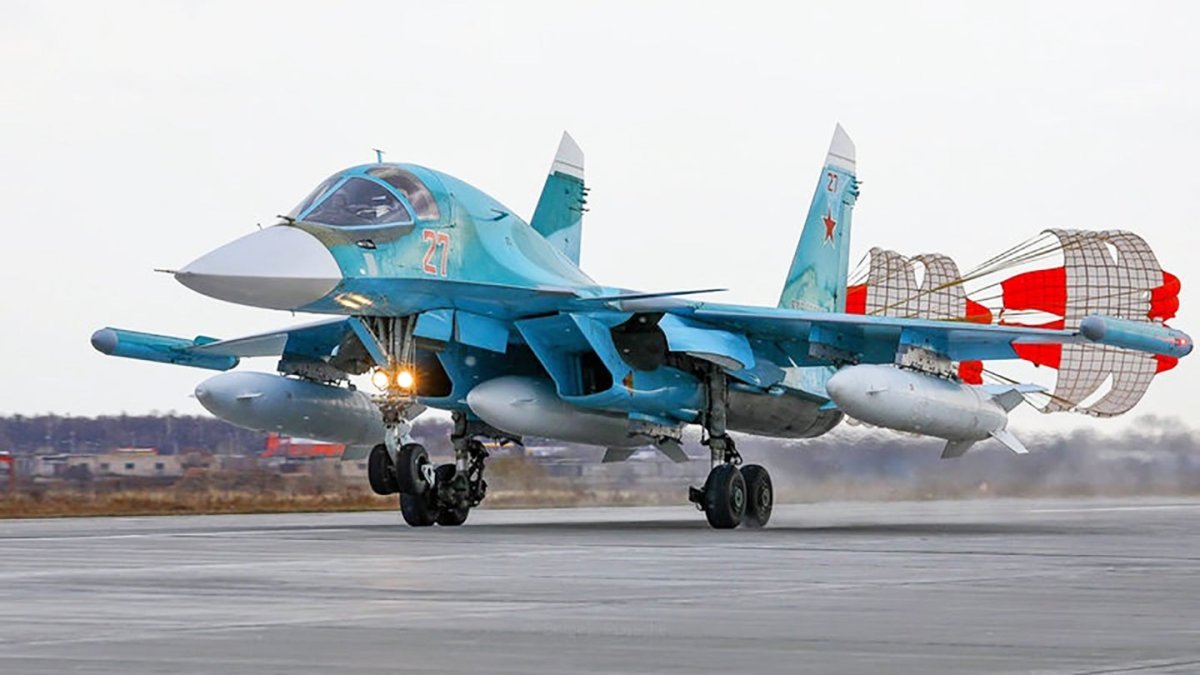
With prodigious quantities carried inside and out, the Fullback is the undisputed champion of the tactical jet fuel load.
新闻视频
By Thomas Newdick and Tyler Rogoway
Updated Jan 10, 2022 3:41 PM EST
The Russian Aerospace Forces’ Sukhoi Su-34 Fullback strike aircraft, also known by its nickname ‘Hellduck,’ is pretty much an anomaly among military aircraft in production today, with a mission profile that’s close to unique and in many ways a hangover from the Cold War. One aspect that’s notably impressive about the platypus-nosed jet is its ability to carry a staggeringly large amount of fuel for a tactical jet, leading to some potentially very long-range missions, even without aerial refueling. It truly is the king of the fast jets when it comes to how much gas it can lug into the air.
While the Su-34 is, at the DNA level, a member of the Flanker family of fighters, and while it retains a secondary air-to-air capability, its direct origins are as a dedicated strike aircraft — or a tactical bomber in Russian terminology. Studies for a strike-optimized development of the Su-27 Flanker began as early as 1977, with the aim of using as much of the fighter’s airframe as possible but combining it with specialized navigation/attack avionics.
Su-34 shot from below showing its massive external fuel tank., Pavel Adzhigildaev
With the production of the Su-24 Fencer variable-geometry strike and reconnaissance aircraft in full flow, the strike Flanker remained a low priority until 1986, when what was then known as the Su-27IB ( Istrebitel-Bombardirovshchik , or fighter-bomber) was launched. This would incorporate the Sh141 attack radar that was being developed for the stillborn Sukhoi T-60S strike aircraft, a much bigger aircraft that was closer in concept to the Tu-22M Backfire .
With that decision, the Su-27IB, later redesignated the Su-34, was earmarked as the successor to the Su-24 under the program codename Furor. The aircraft retained much of the Su-27’s airframe, and its engines, but incorporated a much-revised forward fuselage with side-by-side seating for the pilot and the navigator/weapons system operator in an armored compartment. Other major changes included an enlarged tail ‘sting’ projecting out from behind the engines.
A Su-34 taxis at Voronezh Air Base. Note the fuel tank in the tunnel between the engines., Dmitry Chushkin/Wikimedia Commons
The aircraft that the Su-34 was intended to replace, the Su-24, was often described in the West as being a Soviet counterpart to the F-111. In reality, in terms of its range, it was far closer to the Tornado IDS .
Flying at low level and at 745 miles per hour, with two drop tanks plus weapons, Soviet war planners expected the Su-24 to have a combat radius of only around 370 miles, according to information from Russian aerospace researcher and historian Stefan Büttner. In a nuclear strike role, with two freefall bombs, the operational combat radius was expected to be increased to around 480 miles. In a time of heightened tensions , Su-24s would have been moved from their bases in Poland and Hungary would have been forward-deployed to East Germany and Czechoslovakia.
A former Soviet, now Russian, Su-24M strike aircraft during a visit from its Polish base to Berlin, for the ILA aerospace exhibition, in June 1992., Rob Schleiffert/WIkimedia Commons
While the range of the Su-24 was sufficient to hit targets around 90-180 miles behind the front line, it compared poorly to the F-111. Strategic Air Command’s FB-111 , for example, could carry a pair of AGM-69 Short-Range Attack Missiles (SRAM), plus four drop tanks, and achieve an operational radius of 1,800 miles.
This shortfall was likely in mind when it came to developing the Su-34. The Su-27 was already well-served when it came to fuel capacity, with five internal tanks containing up to 20,700 pounds of fuel. The original fighter Flanker had no provision for external drop or inflight refueling but still boasted an impressive range — 2,300 miles when flown ‘clean’ at high altitude.
Su-34s practice night refueling in the Southern Military District:
In the Su-34, the internal fuel load was increased to 25,130 pounds — 26,676 according to some sources — and there was now a retractable inflight refueling probe on the port side of the nose. Despite this new capability, unrefuelled range remained of paramount importance, since in the Soviet era (and still today), aerial refueling tankers were assigned to the Long-Range Bomber branch and were not an organic part of tactical aviation doctrine.
On top of this, the Su-34 also has provision for up to three drop tanks, each containing 793 gallons, or equivalent to 5,286 pounds of fuel per tank. These are the same PTB-3000 drop tanks that can be fitted under the fixed portion of the Su-24’s wing and each carries more than the total internal fuel load of an F-5E fighter (4,516 pounds) and just roughly 1,700 pounds shy of the internal fuel volume of the F-16 (7,000 pounds).
In the case of a Fullback flying in a ‘three-bag’ configuration, adding all these fuel reserves together provides a grand total of 40,988 pounds of fuel — or 42,534 according to some sources. That is roughly the equivalent of fueling up 400 cars with 17-gallon fuel tanks or six F-16s’ internal fuel tanks. By contrast, the U.S. Air Force’s current long-range tactical strike specialist, the F-15E , carries a total of 35,550 pounds of fuel (including three external tanks plus conformal fuel tanks ).
A ferry range of 2,485 miles is possible for the Fullback, marking a huge advance over the Su-24, and allowing the Su-34 to make very long-range deployments, covering almost half the length of Russia. The ferry range is, in fact, very similar to the F-15E, which the Air Force states can reach 2,400 miles — again with the help of conformal fuel tanks plus three external fuel tanks.
F-15E Strike Eagles taxi at Balad Air Base, Iraq, after an Operation Iraqi Freedom mission. The jets have conformal fuel tanks fitted and each carries two external drop tanks., U.S. Air Force/Staff Sgt. Tony R. Tolley
More importantly, the Su-34 can achieve a range of 1,864 miles when carrying six 1,100-pound bombs, four air-to-air missiles, and auxiliary tanks, and when flying at high level. Flying a sea level with the same load, the aircraft can still cover an impressive 1,087 miles, based on data published by Russian aerospace expert Piotr Butowski .
Increase the weapons load to 8,800 pounds and the Su-34, flying at low level, can reach targets within a range of 373 miles. That grows to 684 miles when flying at high level.
A schematic diagram showing weapons and stores options for the Su-34, including fuel tanks at the bottom., TOSAKA/WIKIMEDIA COMMONS
In practical terms, this means that while the Su-24 was anticipated to strike targets 90 to 180 miles behind the front line in a very high-threat environment, the Su-34 can hit objectives over 300 miles behind the front line. This is, after all, still the Fullback’s primary mission, cutting off forward troops from supplies from the rear, by targeting lines communications as well as command-and-control hubs and depots.
As it is, the Su-34 has, so far, been employed on very different kinds of tasks, during Russia’s campaign in support of the Syrian Assad regime, launched in September 2015. During this conflict, Su-34s have mainly carried fairly small weapons loads, with external fuel tanks rarely employed. A typical load during the early days of the campaign comprised just two satellite-guided 1,100-pound KAB-500S bombs or a handful of dumb bombs.
A Su-34 at Khmeimim Air Base in Syria, armed with two KAB-500S bombs., Russian Ministry of Defense
The Fullback has so far only been used in combat in Syria, but should Russia launch a new campaign of offensive operations over Ukraine, it’s likely that Su-34 units would be heavily involved. And, thanks to their prodigious range, Fullback units from bases much further afield in Russia would be able to make a significant contribution too.
Contact the author: thomas@thedrive.com
Comments couldn’t be loaded. Please refresh the page.
作者:托马斯·纽迪克和泰勒·罗戈韦
更新于美国东部时间2022年1月10日下午3:41。
俄罗斯空天军的苏霍伊Su-34“后卫”(Fullback)攻击机,绰号“地狱鸭”(Hellduck),在当今生产的军用飞机中堪称异类,其任务类型近乎独一无二,在很多方面都带有冷战时期的印记。这款外形酷似鸭嘴兽的喷气式飞机最令人印象深刻的一点是,它作为一款战术喷气式飞机,拥有惊人的燃油携带能力,即使不进行空中加油,也能执行一些极具潜力的超远程任务。就燃油携带量而言,它堪称高速喷气式飞机中的王者。
苏-34战斗机从基因层面来说,虽然属于侧卫系列战斗机,并且保留了一定的空对空作战能力,但其最初的设计目标是专用攻击机——或者用俄语术语来说,战术轰炸机。早在1977年,俄罗斯就开始研究苏-27侧卫战斗机的攻击优化型改进方案,其目标是在尽可能保留战斗机机体结构的基础上,配备专用的导航/攻击航电系统。
从下方拍摄的苏-34照片,展示了其巨大的外部油箱。——帕维尔·阿吉吉尔达耶夫
由于苏-24“击剑手”可变后掠翼攻击侦察机的生产已全面展开,攻击型“侧卫”战斗机的优先级一直很低,直到1986年,当时被称为苏-27IB(Istrebitel-Bombardirovshchik,即战斗轰炸机)的机型才正式推出。该机将采用为夭折的苏霍伊T-60S攻击机(一款尺寸更大、设计理念更接近图-22M“逆火”的飞机)开发的Sh141攻击雷达。
基于这一决定,苏-27IB(后重新命名为苏-34)被指定为苏-24的后继机型,项目代号为“狂怒”(Furor)。该机保留了苏-27的大部分机身结构和发动机,但采用了大幅改进的前机身,飞行员和导航员/武器系统操作员并排坐在装甲舱内。其他主要变化还包括从发动机后方伸出的加长尾翼。
一架苏-34战斗机在沃罗涅日空军基地滑行。请注意发动机间通道内的油箱。(图片来源:Dmitry Chushkin/Wikimedia Commons)
苏-34原本要取代的苏-24,在西方经常被描述为苏联版的F-111。但实际上,就航程而言,它更接近于F-111的“旋风”IDS战斗机。
据俄罗斯航空航天研究员兼历史学家斯特凡·比特纳(Stefan Büttner)提供的信息,苏联战争策划者预计,苏-24战斗机在低空以745英里/小时的速度飞行,并携带两个副油箱和武器的情况下,作战半径仅为370英里左右。如果执行核打击任务,携带两枚自由落体炸弹,作战半径预计可增加到480英里左右。在局势高度紧张时期,苏-24战斗机将从其位于波兰和匈牙利的基地调往东德和捷克斯洛伐克前沿部署。
1992年6月,一架前苏联(现俄罗斯)苏-24M攻击机从其波兰基地访问柏林,参加ILA航空航天展览会。(图片来源:Rob Schleiffert/WIkimedia Commons)
虽然苏-24的航程足以打击前线后方约90-180英里处的目标,但与F-111相比却相形见绌。例如,战略空军司令部的FB-111可以携带两枚AGM-69短程攻击导弹(SRAM)和四个副油箱,作战半径可达1800英里。
在研发苏-34时,很可能已经考虑到了这一不足。苏-27在燃油容量方面已经相当充足,五个内部油箱最多可容纳20700磅燃油。最初的侧卫战斗机没有外挂油箱或空中加油装置,但仍然拥有令人印象深刻的航程——在高空“无油”飞行时可达2300英里。
苏-34战斗机在南部军区进行夜间空中加油训练:
苏-34的内部燃油载荷增加到25130磅(一些资料显示为26676磅),并且机头左侧增加了一个可伸缩的空中加油探管。尽管具备了这项新能力,但无加油航程仍然至关重要,因为在苏联时期(甚至现在也是如此),空中加油机隶属于远程轰炸机部队,并非战术航空理论的组成部分。
此外,苏-34还可挂载最多三个副油箱,每个油箱容量为793加仑,相当于5286磅燃油。这些副油箱与苏-24固定翼下方的PTB-3000副油箱相同,每个副油箱的燃油量超过F-5E战斗机的内部燃油总量(4516磅),仅比F-16的内部燃油量(7000磅)少约1700磅。
如果一架“后卫”战斗机采用“三包”配置,那么所有燃油储备加起来总共有40,988磅燃油——或者根据一些资料,是42,534磅。这大约相当于给400辆配备17加仑油箱的汽车加满油,或者相当于六架F-16战斗机的内部油箱的油量。相比之下,美国空军目前远程战术打击专家F-15E战斗机的总燃油量为35,550磅(包括三个外部油箱和保形油箱)。
“后卫”战斗机的转场航程可达2485英里,相比苏-24有了显著提升,使其能够进行超远程部署,覆盖俄罗斯近一半的国土长度。事实上,其转场航程与F-15E非常接近,美国空军称F-15E的转场航程可达2400英里——同样得益于保形油箱和三个外挂油箱。
在伊拉克巴拉德空军基地,F-15E“攻击鹰”战斗机在完成“伊拉克自由行动”任务后滑行。这些战机配备了保形油箱,每架还携带两个副油箱。(美国空军/参谋军士托尼·R·托利摄)
更重要的是,苏-34在携带六枚1100磅炸弹、四枚空空导弹和副油箱,并以高空飞行时,航程可达1864英里。根据俄罗斯航空航天专家皮奥特·布托夫斯基公布的数据,即使在海平面上携带相同载荷飞行,该机仍能达到惊人的1087英里航程。
将武器载荷增加到 8,800 磅,苏-34 在低空飞行时可以打击 373 英里范围内的目标。高空飞行时,打击范围可扩大到 684 英里。
苏-34战斗机武器和挂载选项示意图,底部为副油箱。(图片来源:TOSAKA/WIKIMEDIA COMMONS)
实际上,这意味着苏-24预计只能在高度危险的环境下打击前线后方90至180英里处的目标,而苏-34则可以打击前线后方300英里以外的目标。毕竟,这仍然是“后卫”行动的主要任务:通过打击通信线路、指挥控制中心和补给站,切断前线部队的后方补给。
迄今为止,苏-34战机在俄罗斯于2015年9月发起的声援叙利亚阿萨德政权的军事行动中,执行的任务类型多种多样。在这场冲突中,苏-34战机主要携带的武器载荷较小,很少使用副油箱。在战争初期,其典型载荷仅为两枚1100磅(约500公斤)的卫星制导KAB-500S炸弹或少量普通炸弹。
一架苏-34战斗机停放在叙利亚赫梅米姆空军基地,携带两枚KAB-500S炸弹。(俄罗斯国防部)
“后卫”战机目前仅在叙利亚投入实战,但如果俄罗斯对乌克兰发动新一轮攻势,苏-34部队很可能将深度参与其中。而且,得益于其卓越的航程,“后卫”战机从俄罗斯境内更远的基地起飞也能发挥重要作用。
联系作者:thomas@thedrive.com
评论加载失败,请刷新页面。