Why Sweden nixed new wind farms for fear of missing Russian missiles瑞典为何因担心俄罗斯导弹落入风力发电场而叫停新建风力发电场?
There are a number of ways that wind turbines, and especially large groups of them, can mess with the readings from a radar system.
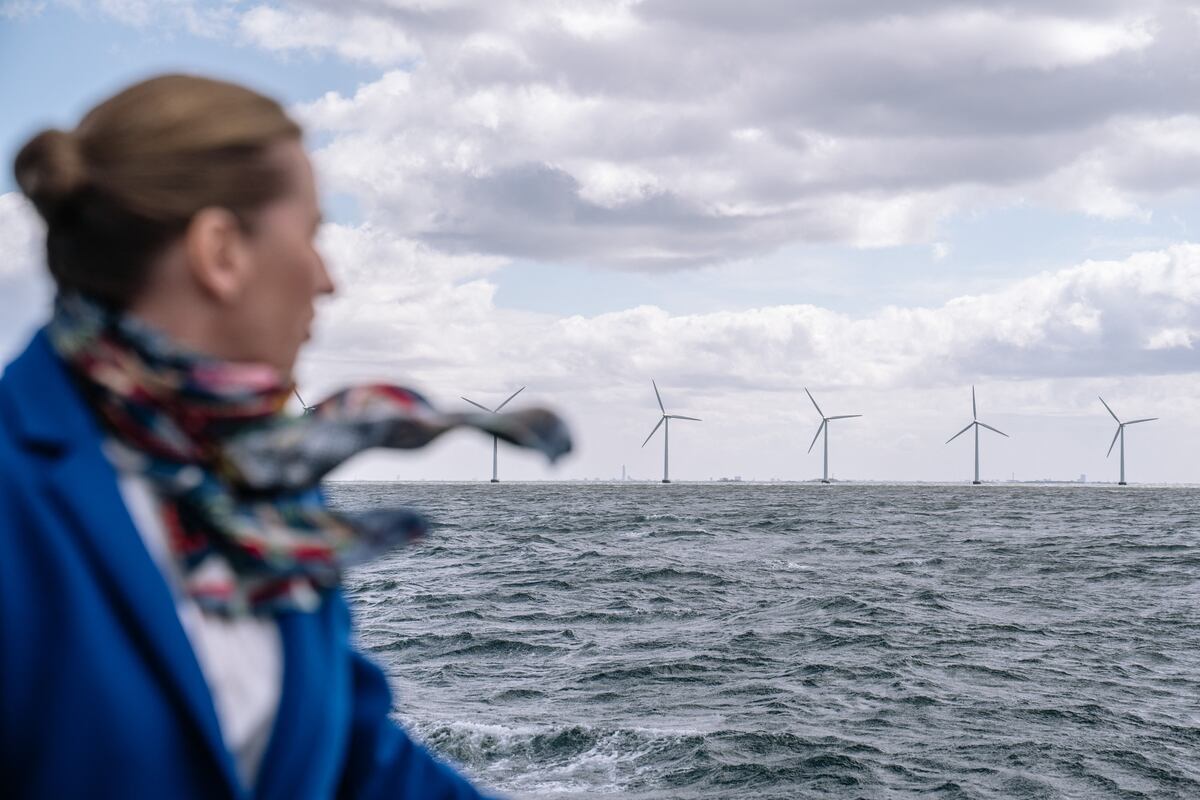
BERLIN — Sweden’s government this month blocked the construction of 13 offshore wind farms over concerns that they would shorten the country’s early-warning window for a Russian missile attack.
The decision marks another example in Europe of national security factors seeping into political decisions that were deemed civilian in nature before Russia’s full-scale invasion of Ukraine in February 2022.
In this case, the issue is about two dueling interests: sustainable-energy independence and surveillance of the national airspace. That is because wind farms can interact with radar signals, reducing the quality of the situational air picture or even outright blocking out parts of the sky.
“The reaction time in the event of a missile attack could go from 2 minutes to 60 seconds with wind farms in the way,” Swedish Defense Minister Pål Jonson wrote in a series of posts on X, formerly known as Twitter. They were accompanied by a schematic drawing of the wind farms casting a “shadow” behind them in which missiles and cruise missiles would stay undetected.
The perceived threat clearly comes from Russia, with Jonson pointing out that “the proximity to the heavily militarized” Russian exclave of Kaliningrad was “important in this context.”
Experts speaking to Defense News for this story said wind farm radar interference is a known issue. And some expressed concern that as more and more wind farms are built, the effects could get worse unless countermeasures are put in place.
“Radar interference can impede air traffic control, weather forecasting, homeland security, and national defense missions,” U.S. Department of Energy spokesperson wrote in an email to Defense News, while also stressing that “the vast majority of wind projects … pose no significant impacts to radar missions.”
There are a number of ways that wind turbines, and especially large groups of them, can mess with the readings from a radar system. For one, they can show up on the screen because, just like any other object, they bounce back the electromagnetic waves that radar relies on. The fact that they are moving – the blades are spinning, and the turbines can change orientation – can make it more difficult for analysts to filter out the noise and find actual threats in the skies.
With the wingtips rotating at a speed of up to 370 kilometers per hour (around 230 mph), they move fast enough for doppler radars to sense them as moving objects, resulting in a false positive on an operator’s screen.
Benjamin Karlson leads the Wind Turbine Radar Interference Mitigation program at the American Sandia National Laboratories. His team has tested various concepts at mitigating the problem, he said, but “there’s no silver bullet.” Radar-absorbent coating is expensive and leaves the problem of a blind spots; temporary shutoffs lead to losses for the operators of wind farms; and infill, or fallback, radars are but costly workarounds.
Governments and private companies have been aware of the issue for decades, with the topic first being presented to the U.S. Congress in 2006. Considerable research has occurred in both the U.S. and U.K.
In the United States, “the communication between the developers and the federal agencies has grown over the years,” said Karlson. The Department of Defense, Federal Aviation Administration, the country’s weather service NOAA and others all have a stake in approving new wind farm developments. Despite these hurdles, Karlson said he wasn’t aware of a single case where a wind farm proposal had to be denied outright, though adjusting the placement of individual turbines, or tweaking their dimensions, is a more common practice.
“Most potential conflicts are dealt with through minor and routine mitigation measures in the federal project evaluation process,” the Department of Energy said in a statement.
Radar systems vary greatly so what might work for one can be completely ineffective on another. Over-the-horizon radars, for example, might be especially affected by offshore wind farms. As the name suggests, these systems have a much greater range than other radars, which are generally limited to the line of sight of the antenna and so cannot see past the curvature of the earth.
The longer-range variants bounce their beams off the ionosphere layer of the atmosphere before the waves travel back close to the surface – where wind farms can get in the way and may completely block out the signal. “There is no way of mitigating that aside from not building turbines,” said Karlson.
In his announcement, the Swedish defense minister did not specify what radar systems’ signals the country was concerned about blocking, and Karlson said that there was not enough information to make an educated guess.
Additionally, “the wind farms could also lead to reduced intelligence-gathering capabilities and disrupt sensors used to detect submarines,” Jonson said in his announcement. Altogether, the construction would have “unacceptable consequences for Swedish security.”
“Clearly, the Swedish government thinks there is a big concern,” said Karlson.
Simultaneously, wind energy presents a crucial pillar in the clean energy transition, a topic that has gained exceptional pertinence in a Europe starved for energy since the Russian war in Ukraine. Traditionally, Europe obtained a large part of its energy from Russia, which controls vast oil and gas reserves and over decades built a network of pipelines to European countries to sell its hydrocarbons at a competitive price. While the green-energy transition predates the war, it has been turbocharged by it: Russia has used its leverage over European energy supply as a leverage and a weapon in its hybrid warfare, while European leaders have rushed to ween their countries off of Russian gas and oil.
According to the Swedish Energy Agency, the “supply of electricity in Sweden is stable.” Simultaneously, however, the government agency warned that “Sweden will have rising electricity prices” as a direct result of the Russian invasion of Ukraine.
The planned wind farms would have had the potential to contribute significantly to Sweden’s renewable energy production, with the rejected plans seeing turbines stretching all the way from the Åland Islands along the east coast down to Öresund.
While the government blocked the construction of the 13 proposed wind farms in the Baltic, it also greenlit the construction of the “Poseidon” wind farm off the country’s western – NATO-facing – coast, with a maximum of 81 turbines producing up to 5.5 terawatt hours per year.
Sweden’s government has committed itself to double the country’s annual electricity production in the next twenty years, in anticipation of higher consumption. A buildup of the country’s nuclear power capacity is supposed to bear the brunt of this burden, though critics have pointed out that demand is expected to increase faster than new power reactors can go online.
Similar trade-offs between wind farm construction and radar visibility have had to be made in other European countries. The British and French ministries of Defense have objected to developments over similar concerns, and various other government agencies across the continent have issued guidelines for distances that should be maintained between wind farms and different types of radar stations.
Both energy independence and climate change have increasingly entered the realm of national security in national government across Europe and the world, with leaders seeing them as integral parts of their countries’ defense and prosperity. The Swedish government’s decision points the spotlight on one dimension of this interaction that has, until now, flown under the radar.
Linus Höller is Defense News' Europe correspondent and OSINT investigator. He reports on the arms deals, sanctions, and geopolitics shaping Europe and the world. He holds master’s degrees in WMD nonproliferation, terrorism studies, and international relations, and works in four languages: English, German, Russian, and Spanish.
柏林——本月,瑞典政府以担心海上风电场会缩短该国对俄罗斯导弹袭击的预警窗口为由,叫停了13个海上风电场的建设。
这一决定标志着欧洲国家安全因素渗透到政治决策中的又一个例子,这些政治决策在俄罗斯于 2022 年 2 月全面入侵乌克兰之前被认为是民事性质的。
在这种情况下,问题涉及两个相互冲突的利益:可持续能源独立和国家空域监控。这是因为风力发电场会干扰雷达信号,降低空域态势感知的质量,甚至完全遮挡部分空域。
瑞典国防部长帕尔·约翰逊在X(前身为Twitter)上发表了一系列帖子,他写道:“如果风力发电场位于导弹袭击路径上,导弹袭击的反应时间可以从2分钟缩短到60秒。” 这些帖子还附上了一张示意图,图中显示风力发电场在其后方投下“阴影”,导弹和巡航导弹将无法被探测到。
约翰逊指出,人们感受到的威胁显然来自俄罗斯,因为“靠近高度军事化的俄罗斯飞地加里宁格勒”在“这种背景下非常重要”。
接受《防务新闻》采访的专家表示,风力发电场雷达干扰是一个已知问题。一些专家还担心,随着风力发电场的建设越来越多,如果不采取应对措施,这种影响可能会更加严重。
美国能源部发言人在给《防务新闻》的电子邮件中写道:“雷达干扰会阻碍空中交通管制、天气预报、国土安全和国防任务”,同时强调“绝大多数风电项目……不会对雷达任务造成重大影响”。
风力涡轮机,尤其是大型风力涡轮机群,会以多种方式干扰雷达系统的读数。首先,它们会像其他物体一样反射雷达赖以工作的电磁波,因此会在屏幕上显示出来。其次,由于风力涡轮机叶片会旋转,涡轮机的姿态也会改变,它们的运动会使分析人员更难过滤掉噪声,从而难以发现空中真正的威胁。
机翼翼尖旋转速度高达每小时 370 公里(约 230 英里),速度之快足以让多普勒雷达将其感知为移动物体,从而在操作员屏幕上产生误报。
本杰明·卡尔森领导着美国桑迪亚国家实验室的风力涡轮机雷达干扰缓解项目。他表示,他的团队已经测试了多种缓解该问题的方案,但“没有万全之策”。雷达吸波涂层成本高昂,而且会留下盲区;临时关闭雷达会导致风电场运营商的损失;而补充雷达或备用雷达也只是成本高昂的权宜之计。
各国政府和私营企业几十年来一直关注这个问题,该议题最早于2006年提交给美国国会。美国和英国都开展了大量研究。
卡尔森表示,在美国,“开发商与联邦机构之间的沟通近年来有所加强”。国防部、联邦航空管理局、国家海洋和大气管理局(NOAA)等机构都与新建风电场项目的审批息息相关。尽管存在这些障碍,卡尔森表示,他尚未听说过任何风电场项目提案被直接否决的案例,不过调整单个风力涡轮机的位置或尺寸则更为常见。
美国能源部在一份声明中表示:“大多数潜在冲突都通过联邦项目评估过程中的轻微和常规缓解措施来解决。”
雷达系统种类繁多,因此对一种系统有效的方法可能对另一种系统完全无效。例如,超视距雷达尤其容易受到海上风电场的影响。顾名思义,这类系统的探测范围远大于其他雷达,而其他雷达的探测范围通常仅限于天线的视线范围,因此无法越过地球曲率进行探测。
远程型无线电波会先将波束反射到大气电离层,然后再传播到近地表——而风力发电场可能会阻挡这些波束,甚至完全屏蔽信号。“除了不建风力涡轮机之外,没有其他办法可以缓解这个问题,”卡尔森说道。
瑞典国防部长在声明中没有具体说明该国担心屏蔽哪些雷达系统的信号,卡尔森表示,目前的信息不足以做出合理的猜测。
此外,约翰逊在声明中表示,“风力发电场还可能导致情报收集能力下降,并干扰用于探测潜艇的传感器。” 总而言之,这项建设将对瑞典安全造成“不可接受的后果”。
卡尔森说:“显然,瑞典政府认为这是一个非常令人担忧的问题。”
与此同时,风能是清洁能源转型的重要支柱,而自乌克兰战争以来,能源匮乏的欧洲,使得清洁能源转型这一话题显得尤为重要。传统上,欧洲的大部分能源都来自俄罗斯。俄罗斯控制着丰富的石油和天然气储量,并在数十年间修建了通往欧洲各国的管道网络,以具有竞争力的价格出售其油气资源。虽然绿色能源转型早于战争,但战争加速了这一进程:俄罗斯利用其对欧洲能源供应的控制,将其作为混合战争的筹码和武器,而欧洲领导人则急于摆脱对俄罗斯石油和天然气的依赖。
瑞典能源署表示,“瑞典的电力供应稳定”。但与此同时,该政府机构警告称,由于俄罗斯入侵乌克兰,瑞典的电价将上涨。
计划中的风力发电场原本有可能为瑞典的可再生能源生产做出重大贡献,被否决的计划中,风力涡轮机将从奥兰群岛沿着东海岸一直延伸到厄勒海峡。
尽管政府阻止了在波罗的海建造 13 个拟建风电场的计划,但同时也批准了在该国西部(面向北约)海岸附近建造“波塞冬”风电场,该风电场最多可容纳 81 台涡轮机,每年发电量可达 5.5 太瓦时。
瑞典政府承诺在未来二十年内将该国年发电量翻一番,以应对不断增长的电力需求。政府计划通过扩建核电产能来承担这一重任,但批评人士指出,电力需求的增长速度预计将超过新建核反应堆的投产速度。
在其他欧洲国家,风电场建设与雷达可见性之间也存在类似的权衡取舍。英国和法国国防部出于类似担忧,对相关开发项目提出了反对意见,欧洲大陆其他一些政府机构也发布了风电场与不同类型雷达站之间应保持距离的指导方针。
能源独立和气候变化日益成为欧洲乃至世界各国政府国家安全议题的核心,各国领导人将其视为国家国防和繁荣不可或缺的一部分。瑞典政府的决定凸显了这一互动关系中一个此前一直被忽视的层面。
林努斯·霍勒是《防务新闻》的欧洲记者和开源情报调查员。他报道影响欧洲乃至全球的军火交易、制裁和地缘政治。他拥有大规模杀伤性武器不扩散、恐怖主义研究和国际关系三个硕士学位,并精通英语、德语、俄语和西班牙语四种语言。