How small modular reactors put nuclear energy back on the table for Singapore and ASEAN小型模块化反应堆如何让核能重回新加坡和东盟的能源议程
Geopolitical instability, decarbonisation and technological advancements contribute to the nuclear push. Read more at straitstimes.com.
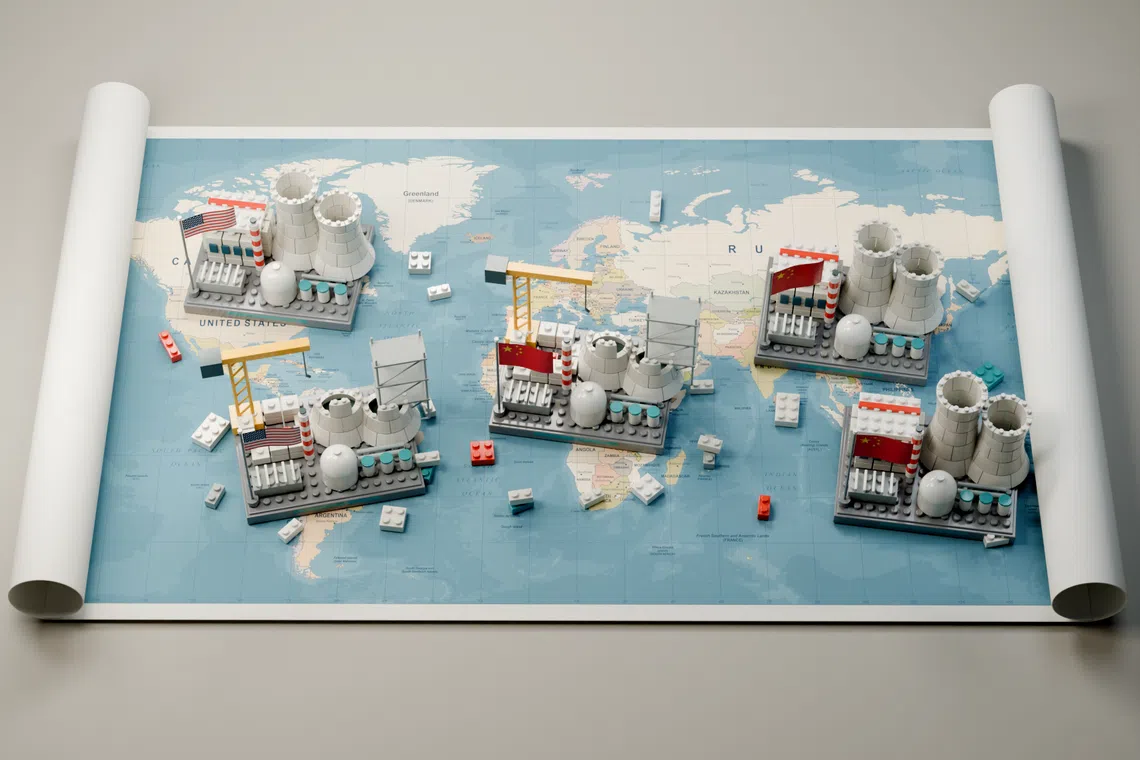
Geopolitical instability, decarbonisation and technological advancements contribute to the nuclear push.
ST GRAPHIC: CHNG CHOON HIONG
Published Oct 17, 2026, 05:00 AM
Updated Oct 17, 2026, 05:00 AM
SINGAPORE – In March 2022, as Russia’s invasion of Ukraine accelerated a global energy crisis, Singapore subtly signalled its changed stance on nuclear energy.
A report commissioned by the Energy Market Authority on the Republic’s energy future had put nuclear power back on the table, projecting it could meet up to 10 per cent of the country’s electricity needs by 2050.
In a geopolitically fragmented world where the land-constrained Republic has limited options to cut emissions, the report highlighted the promise of advanced nuclear technologies such as small modular reactors (SMRs) in helping to power the country .
SMRs are compact nuclear reactors that can be factory-assembled and installed closer to urban areas due to their smaller footprint.
This came a decade after Singapore in 2012 ruled out the use of conventional nuclear plants, due to their risks for the small and dense city-state. But Singapore had at that time kept the door open for future nuclear energy technologies.
Four years after the report was published, the Republic is thoroughly examining a nuclear future for itself – not just to meet its climate commitments, but also to safeguard its energy security.
Singapore now relies on burning natural gas, the cleanest of planet-warming fossil fuels, for about 95% of its energy needs.
But South-east Asia is grappling with the worst energy crisis since the 1970s, this time due to a war waged by Israel and the US on Iran.
Iran responded to the attacks by blockading the Strait of Hormuz , a critical waterway through which supplies of oil and gas are shipped from the Middle East to the rest of the world.
About 20% of the South-east Asian region’s liquefied natural gas imports in 2025 transited through this maritime choke point, with Singapore accounting for over half of these volumes, according to an International Energy Agency report published in October.
Energy analysts, observers and researchers told The Straits Times that geopolitical instability, the global agenda to decarbonise, and advancements in nuclear technology have helped revive the region’s ambitions to tap the energy source.
ASEAN countries including Vietnam, Thailand and the Philippines are taking steps to incorporate nuclear energy into their fuel mix.
Nuclear security researcher Julius Cesar Imperial Trajano attributed the growing interest of ASEAN countries in nuclear energy to the converging pressures of safeguarding energy security, rising electricity demand from energy-intensive industries and data centres, and shifting away from planet-warming fossil fuels.
“Nuclear is increasingly being considered not simply as a climate solution but also as a potential source of reliable, low-carbon electricity that can complement renewables,” said the research fellow at the S. Rajaratnam School of International Studies (RSIS).
While the Singapore Government has not made a decision on nuclear energy, it has beefed up its capacity to study the energy source, while announcing its plan to undergo a readiness assessment by the UN atomic watchdog in 2027 .
It has also signed at least seven pacts with countries and firms within the nuclear energy ecosystem over the past two years.
A secure energy future
Experts point to the variety of uranium fuel sources and the ability of countries to stockpile it as being among the ways that nuclear reactors can contribute to energy security.
In April, Minister-in-charge of Energy and Science and Technology in the Ministry of Trade and Industry Tan See Leng told Parliament that five one-inch-tall uranium pellets can generate the same amount of electricity as one Olympic-sized swimming pool of natural gas.
A spokesman for the World Nuclear Association (WNA), an international organisation representing the civil nuclear industry, told ST: “Uranium is sourced from a range of geopolitically diverse countries, and nuclear fuel is extremely energy dense, so many years worth of fuel can be stored on site – insulating countries from the supply and price shocks seen in oil and gas markets.”
Today’s supply shocks are having an effect similar to that of the oil crises of the 1970s, which had prompted countries such as France, Sweden and Japan to embark on major nuclear build programmes, he added.
He said: “Moving away from imported fossil fuels will strengthen energy security across the region.”
David Broadstock of the Asia-Pacific energy industry consultancy Lantau Group said the war in the Middle East is but the latest in a string of energy crises that Singapore has endured since around 2020.
Reducing the impact of such events on energy bills will require a changed energy mix, he added.
“Nuclear becomes an attractive solution here in many ways, since it can produce large volumes of electricity with stable cost profiles,” Broadstock added.
The cost of imported natural gas and power generation makes up more than 75% of the regulated electricity tariff. This means that fluctuations in fuel costs due to geopolitical developments can impact the price consumers pay.
Meanwhile, stockpiled nuclear fuel will be able to produce electricity at a predictable cost.
Across ASEAN, member states have already moved to translate nuclear plans into policy.
Vietnam, Indonesia, the Philippines and Thailand now have numerical estimates for nuclear capacity in their national plans, according to the 9th ASEAN Energy Outlook report published in October.
These range from a capacity of 600 megawatts for Thailand by 2050, to Indonesia’s goal of relying on nuclear energy for 12.1 per cent of its electricity mix by 2060.
Malaysia also formalised the integration of nuclear energy into its future energy mix in 2025, although no target figure was cited.
Ming Tan, global practice lead for nuclear energy at engineering consultancy Mott MacDonald, said a regional approach to nuclear power could benefit countries, allowing them to share knowledge, adopt common safety and technical principles, as well as reduce unnecessary duplication of effort.
“This can make it easier for countries to build capability, develop regulatory frameworks and learn from each other’s experiences while fully retaining national decision-making authority.”
A long-term domestic source of energy generation is especially pertinent for ASEAN nations, he said, as the region relies heavily on imported fuels shipped through some of the world’s busiest shipping routes.
The British-based firm was appointed by the Singapore Government in 2025 to study the safety and feasibility of advanced nuclear technologies like SMRs.
The promise of the small modular reactor
The global pivot towards nuclear power is in part powered by the rise of advanced reactors, which promise enhanced safety features and less radioactive waste, according to analysts.
According to the Nuclear Energy Agency, an intergovernmental agency that facilitates cooperation among countries with advanced nuclear technology, the number of SMR designs around the world has grown from 98 in 2024 to 156 in its latest assessment published in September.
Over the past five years, discussions about SMRs have moved beyond purely conceptual designs, said RSIS’ Trajano.
He cited developments such as greater regulatory engagement, progress towards licensing in some jurisdictions, and more attention to factory fabrication.
In September, for instance, the US’ Nuclear Regulatory Commission approved a construction permit for its first SMR after a 14-month review.
Analysts and observers said SMRs could require significantly smaller safety restriction zones than conventional nuclear reactors. This gives it an advantage over conventional reactors, especially for Singapore, other small island states and densely populated areas.
Conventional reactors typically require safety zones to be established within a 15km to 30km radius from the nuclear plant. In 2008, Singapore revealed it had considered reclaiming land at Pedra Branca to satisfy this buffer. However, the plan was dropped, as the island is less than 30km away from neighbouring Malaysia.
A spokesman for the NUS Singapore Nuclear Research and Safety Institute (SNRSI) said smaller reactor fuel inventories and enhanced safety features in SMRs could reduce the potential consequences of severe accidents and, subject to safety assessments and regulatory requirements, could allow for smaller emergency planning zones.
He added: “Newer reactor designs increasingly incorporate natural circulation, gravity and other passive safety systems to maintain cooling, reducing reliance on external power and operator intervention.”
The nuclear incident in Fukushima in 2011 occurred because a power loss had cut off cooling to reactors there, causing them to overheat and melt down.
The SNRSI spokesman cited the tri-structural isotropic fuel used in high-temperature gas-cooled reactors, a kind of SMR. Such fuels can improve the containment of radioactive materials by coating uranium kernels in layers of ceramic and carbon, reducing the risk of a meltdown.
The WNA spokesman said that the modular format of SMRs is also an advantage, as they are easier to manufacture repeatedly in factories, instead of needing to build each one from scratch.
He said: “Many of the SMR designs proposed for near-term deployment are not technological leaps; rather, they offer a potential step change in how nuclear is delivered, through factory-based, repeatable manufacturing and deployment.”
The geopolitics of SMR development
Despite the promise of SMRs, most designs remain at an early stage of commercial deployment, said Nick Ash, energy advisory leader at engineering consultancy Arup, which is advising the UK’s SMR programme.
According to the Nuclear Energy Agency’s latest assessment, only Russia and China operate commercial SMRs.
Uncertainty remains over whether their projected cost and delivery advantages will be demonstrated once financing, supporting infrastructure, fuel supply and waste management are taken into account, Ash added.
China analyst Damien Ma noted that while the US still leads on SMR innovation, China was the first to deploy a commercial land-based SMR, while Russia deployed the first floating SMR.
SMRs are touted to be cheaper than conventional nuclear reactors, but the industry has not yet developed to a point where the unit costs can be brought down.
Ma, the director of East Asia-based research centre Carnegie China, said this will still require organising manufacturing in a way that can actually achieve consistent modularity, which can then be scaled.
While Western countries had a head start in developing nuclear facilities, many of them, such as the United States and France, built few or no new reactors in the following years, losing skills, expertise and supply chain capacity.
As a result, the nuclear industrial ecosystems of many Western countries withered after decades of inaction, said David Fishman, a principal at Lantau Group who tracks the Chinese power sector.
“Most of the things that have historically driven nuclear cost overruns in the West – like regulatory complexity, licensing risk, supply chain challenges, project management failures, and financing – are still going to be problems with a smaller reactor,” Fishman noted.
Meanwhile, China has ramped up its nuclear energy capabilities, by continuously building reactors, while its designs have become increasingly standardised and cheaper, Fishman said.
China has also proven to be the only country that has built an SMR and delivered nuclear projects on time and within budget this century, he added.
He said: “Countries don’t just buy a reactor... You buy decades of fuel services, technical support and regulatory engagement.
“So the real question is which countries emerge as the potential nuclear suppliers to South-east Asia and what that means for their long-term political relationships.”
The road ahead for ASEAN
Technology aside, South-east Asia’s decision to deploy SMR technology will also hinge on long-term support, mutually agreed-upon cross-border rules, financing, waste management plans and a skilled workforce.
Nuclear energy remains the most expensive energy source to be considered in the 9th ASEAN Energy Outlook report, which notes that nuclear projects are expected to cost the region an estimated US$236 billion (S$300 billion) by 2060.
Financing nuclear projects is notoriously hard due to their scale, capital intensity, long construction timelines and technical complexity. Investors are often scared off by the risks of cost overruns and delays.
“The constraint on nuclear power in ASEAN is therefore not siting potential or stated ambition, but delivery capability,” the report found.
Public acceptance will also be key to determining the successful deployment of nuclear energy.
Countries in South-east Asia have explored the use of civilian nuclear energy since the late 1950s, but backing has waxed and waned, influenced by factors such as fluctuating government support and global nuclear events affecting public opinion.
This will be key, as the lack of acceptance has historically jeopardised the roll-out of nuclear energy. In the 1980s, for instance, public opposition and safety concerns derailed the Philippines Bataan Nuclear Plant, which never went online despite its completion.
Even if Singapore’s efforts do not translate to the deployment of nuclear energy, its work could help the Republic stay relevant amid the global nuclear renaissance.
The SNRSI spokesman said its research and nuclear laboratories will remain important as interest in nuclear power across the region continues to grow.
With 70 researchers in its stable, the institute also ensures that Singapore has its own experts to understand these developments and what they mean for the country.
Added Mott MacDonald’s Tan: “If it continues on its current path, Singapore has the potential to become one of the region’s leading centres of excellence for advanced nuclear technologies.”
Ang Qing is a journalist covering local and international breaking news at The Straits Times, with a focus on the environment, crime, technology and social issues.
地缘政治不稳定、脱碳以及技术进步都推动了核能的发展。
ST GRAPHIC:CHNG CHOON HIONG
发布于2026年10月17日 上午5:00
更新于2026年10月17日凌晨5:00
新加坡——2022年3月,随着俄罗斯入侵乌克兰加剧全球能源危机,新加坡巧妙地表明了其在核能问题上的立场转变。
能源市场管理局委托撰写的一份关于共和国能源未来的报告将核能重新提上日程,预测到 2050 年,核能可以满足该国高达 10% 的电力需求。
在地缘政治分裂的世界中,土地资源有限的共和国在减少排放方面选择有限,该报告强调了小型模块化反应堆 (SMR) 等先进核技术在帮助该国提供能源方面的潜力。
小型模块化反应堆(SMR)是一种紧凑型核反应堆,由于占地面积较小,可以在工厂组装并安装在靠近城市地区的地方。
十年前,新加坡在2012年排除了使用传统核电站的可能性,理由是其对这个人口密度高、面积小的城市国家构成风险。但当时,新加坡并未排除未来发展核能技术的可能性。
该报告发表四年后,共和国正在彻底审视自身的核能未来——不仅是为了履行其气候承诺,也是为了保障其能源安全。
新加坡目前约 95% 的能源需求依赖于燃烧天然气,而天然气是造成全球变暖的化石燃料中最清洁的一种。
但东南亚正面临自 20 世纪 70 年代以来最严重的能源危机,而这次危机是由于以色列和美国对伊朗发动的战争造成的。
伊朗对袭击事件的回应是封锁了霍尔木兹海峡,这是中东向世界其他地区运输石油和天然气的重要水道。
根据国际能源署 10 月份发布的一份报告,到 2025 年,东南亚地区约 20% 的液化天然气进口将经过这个海上咽喉要道,其中新加坡占一半以上。
能源分析师、观察家和研究人员告诉《海峡时报》,地缘政治不稳定、全球脱碳议程以及核技术的进步,都帮助该地区重燃了开发这种能源的雄心。
包括越南、泰国和菲律宾在内的东盟国家正在采取措施,将核能纳入其能源结构。
核安全研究员朱利叶斯·塞萨尔·伊姆佩里亚·特拉亚诺将东盟国家对核能日益增长的兴趣归因于以下因素的汇聚:保障能源安全、能源密集型产业和数据中心不断增长的电力需求,以及摆脱导致全球变暖的化石燃料。
“核能正日益被视为一种可靠的、低碳的电力来源,可以与可再生能源形成互补,”S. Rajaratnam国际研究院(RSIS)的研究员表示。
虽然新加坡政府尚未就核能问题做出决定,但它已加强了对这种能源的研究能力,并宣布计划在 2027 年接受联合国原子能监督机构的准备情况评估。
过去两年,该公司还与核能生态系统内的国家和公司签署了至少七项协议。
安全的能源未来
专家指出,铀燃料来源的多样性以及各国储存铀的能力,是核反应堆为能源安全做出贡献的方式之一。
今年四月,贸工部能源、科学和技术部长陈思龙在国会表示,五个一英寸高的铀颗粒可以产生相当于一个奥运会标准游泳池天然气发电量的电力。
代表民用核工业的国际组织世界核能协会(WNA)的一位发言人告诉《海峡时报》:“铀的来源地涵盖了地缘政治格局各异的国家,而且核燃料的能量密度极高,因此可以在现场储存多年的燃料——使各国免受石油和天然气市场供应和价格冲击的影响。”
他补充说,今天的供应冲击与上世纪70年代的石油危机产生了类似的影响,当时促使法国、瑞典和日本等国启动了大规模的核能建设计划。
他说:“摆脱对进口化石燃料的依赖将加强整个地区的能源安全。”
亚太能源行业咨询公司 Lantau Group 的 David Broadstock 表示,中东战争只是新加坡自 2020 年以来经历的一系列能源危机中的最新一起。
他补充说,要减少此类事件对能源账单的影响,就需要改变能源结构。
布罗德斯托克补充说:“核能在这里从很多方面来说都是一个有吸引力的解决方案,因为它能够以稳定的成本曲线生产大量的电力。”
进口天然气和发电成本占受管制电价的75%以上。这意味着,地缘政治发展导致的燃料成本波动可能会影响消费者支付的电价。
与此同时,储备的核燃料能够以可预测的成本发电。
东盟各成员国已经开始将核能计划转化为政策。
根据10月份发布的第九份东盟能源展望报告,越南、印度尼西亚、菲律宾和泰国的国家计划中都已对核电装机容量进行了量化估算。
这些目标包括泰国到 2050 年核电装机容量达到 600 兆瓦,以及印度尼西亚到 2060 年核能发电量占其电力结构 12.1% 的目标。
马来西亚也正式将核能纳入其2025年的未来能源结构,尽管没有给出具体目标数字。
工程咨询公司 Mott MacDonald 的全球核能业务负责人 Ming Tan 表示,采取区域性的核电发展方式可以使各国受益,使它们能够共享知识、采用共同的安全和技术原则,并减少不必要的重复劳动。
“这可以让各国更容易地建立能力、制定监管框架并互相学习经验,同时又能充分保留国家决策权。”
他表示,对于东盟国家而言,长期稳定的国内能源供应尤为重要,因为该地区严重依赖通过世界上一些最繁忙的航运路线运输的进口燃料。
这家总部位于英国的公司于 2025 年受新加坡政府委托,研究小型模块化反应堆等先进核技术的安全性和可行性。
小型模块化反应堆的前景
分析人士称,全球向核能转型的部分原因是先进反应堆的兴起,这些反应堆有望提高安全性并减少放射性废物。
根据促进拥有先进核技术的国家之间合作的政府间机构——核能机构的数据,全球小型模块化反应堆(SMR)设计数量已从2024年的98种增加到9月份发布的最新评估中的156种。
RSIS 的 Trajano 表示,过去五年里,关于小型模块化反应堆的讨论已经超越了纯粹的概念设计。
他列举了一些发展趋势,例如加强监管参与、一些司法管辖区在许可证发放方面取得进展,以及更加重视工厂生产。
例如,今年 9 月,美国核管理委员会经过 14 个月的审查,批准了其首个小型模块化反应堆的建造许可证。
分析人士和观察人士表示,小型模块化反应堆所需的安全限制区可能比传统核反应堆小得多。这使其比传统反应堆更具优势,尤其对新加坡、其他小型岛国和人口稠密地区而言更是如此。
传统反应堆通常需要在核电站周围15至30公里半径范围内设立安全区。2008年,新加坡曾考虑在白礁岛(Pedra Branca)填海造地以满足这一缓冲区要求。然而,由于该岛距离邻国马来西亚不足30公里,该计划最终被放弃。
新加坡国立大学新加坡核研究与安全研究所 (SNRSI) 的一位发言人表示,小型模块化反应堆 (SMR) 中较小的反应堆燃料库存和增强的安全功能可以减少严重事故的潜在后果,并且在经过安全评估和监管要求后,可以缩小应急计划区域。
他补充道:“新型反应堆设计越来越多地采用自然循环、重力和其他被动安全系统来维持冷却,从而减少对外部电源和操作人员干预的依赖。”
2011 年福岛核事故的发生是因为电力中断导致反应堆冷却系统停止运转,从而造成反应堆过热并熔毁。
塞尔维亚国家核安全研究所(SNRSI)发言人提到,高温气冷反应堆(一种小型模块化反应堆)中使用的三层结构各向同性燃料,可以通过在铀核表面包覆陶瓷和碳层来提高放射性物质的密封性能,从而降低堆芯熔毁的风险。
世界核能机构发言人表示,小型模块化反应堆的模块化设计也是一个优势,因为它们更容易在工厂中重复生产,而无需从头开始建造每一个。
他说:“许多拟在近期部署的小型模块化反应堆设计并非技术上的飞跃;相反,它们通过基于工厂的可重复制造和部署,为核能的交付方式带来了潜在的变革。”
小型模块化反应堆开发中的地缘政治问题
尽管小型模块化反应堆 (SMR) 前景广阔,但大多数设计仍处于商业部署的早期阶段。为英国小型模块化反应堆项目提供咨询的工程咨询公司奥雅纳 (Arup) 的能源咨询负责人尼克·阿什 (Nick Ash) 表示。
根据核能机构的最新评估,目前只有俄罗斯和中国运营商业小型模块化反应堆。
阿什补充说,考虑到融资、配套基础设施、燃料供应和废物管理等因素,他们预计的成本和交付优势是否能够得到体现,目前仍存在不确定性。
中国分析师马达米安指出,虽然美国在小型模块化反应堆(SMR)创新方面仍然领先,但中国是第一个部署商业陆基SMR的国家,而俄罗斯部署了第一个漂浮式SMR。
小型模块化反应堆(SMR)据称比传统核反应堆更便宜,但该行业尚未发展到能够降低单位成本的程度。
总部位于东亚的卡内基中国研究中心主任马表示,这仍然需要以一种能够真正实现一致的模块化的方式来组织生产,然后才能进行规模化生产。
虽然西方国家在发展核设施方面起步较早,但其中许多国家,如美国和法国,在随后的几年里几乎没有建造新的反应堆,导致技能、专业知识和供应链能力的流失。
兰涛集团负责人戴维·菲什曼(David Fishman)追踪中国电力行业的情况,他表示,由于数十年的不作为,许多西方国家的核工业生态系统逐渐衰落。
菲什曼指出:“历史上导致西方核电成本超支的大多数因素——例如监管复杂性、许可风险、供应链挑战、项目管理失败和融资——对于较小的反应堆来说仍然是问题。”
菲什曼表示,与此同时,中国通过不断建造反应堆,提高了核能能力,而且其设计也变得越来越标准化和便宜。
他还补充说,中国也已证明是本世纪唯一一个建造了小型模块化反应堆并按时按预算完成核电项目的国家。
他说:“各国购买的不仅仅是反应堆……而是数十年的燃料服务、技术支持和监管参与。”
“因此,真正的问题是哪些国家会成为东南亚潜在的核能供应国,以及这对它们之间的长期政治关系意味着什么。”
东盟的未来之路
除了技术之外,东南亚地区是否部署小型模块化反应堆技术,还取决于长期支持、相互商定的跨境规则、融资、废物管理计划以及熟练的劳动力。
第九份东盟能源展望报告指出,核能仍然是最昂贵的能源,预计到 2060 年,核能项目将耗费该地区约 2360 亿美元(3000 亿新元)。
由于核电项目规模庞大、资本密集、工期长且技术复杂,融资难度众所周知。投资者往往会因成本超支和工期延误的风险而望而却步。
报告指出,“因此,东盟核电发展面临的制约因素不是核电潜力或既定目标,而是交付能力。”
公众的接受程度也将是决定核能能否成功部署的关键因素。
自 20 世纪 50 年代末以来,东南亚各国一直在探索利用民用核能,但支持力度时强时弱,受到政府支持波动和影响公众舆论的全球核事件等因素的影响。
这一点至关重要,因为公众接受度不足历来都会阻碍核能的推广。例如,上世纪80年代,公众的反对和安全担忧导致菲律宾巴丹核电站项目搁浅,尽管已经竣工,但最终未能投入运营。
即使新加坡的努力最终未能转化为核能的部署,但其工作也有助于新加坡在全球核能复兴浪潮中保持其重要性。
SNRSI发言人表示,随着该地区对核能的兴趣持续增长,其研究和核实验室将继续发挥重要作用。
该研究所拥有 70 名研究人员,确保新加坡拥有自己的专家来了解这些发展及其对国家的意义。
莫特麦克唐纳公司的谭补充道:“如果新加坡继续沿着目前的道路发展,它有潜力成为该地区先进核技术领域的领先卓越中心之一。”
Ang Qing是《海峡时报》的一名记者,负责报道本地和国际突发新闻,重点关注环境、犯罪、科技和社会问题。