No relief in sight – what's driving pricier taxi and ride-hailing fares看不到任何缓解的迹象——是什么推高了出租车和网约车的费用?
The latest figures show that the price of point-to-point (P2P) transport services were 12.3 per cent higher in August 2026 than in August 2025. Fuel and Certificate of Entitlement (COE) costs are certainly to blame, but are operators also doing more to justify the higher prices?
The latest figures show that the price of point-to-point (P2P) transport services were 12.3 per cent higher in August 2026 than in August 2025. Fuel and Certificate of Entitlement (COE) costs are certainly to blame, but are operators also doing more to justify the higher prices?
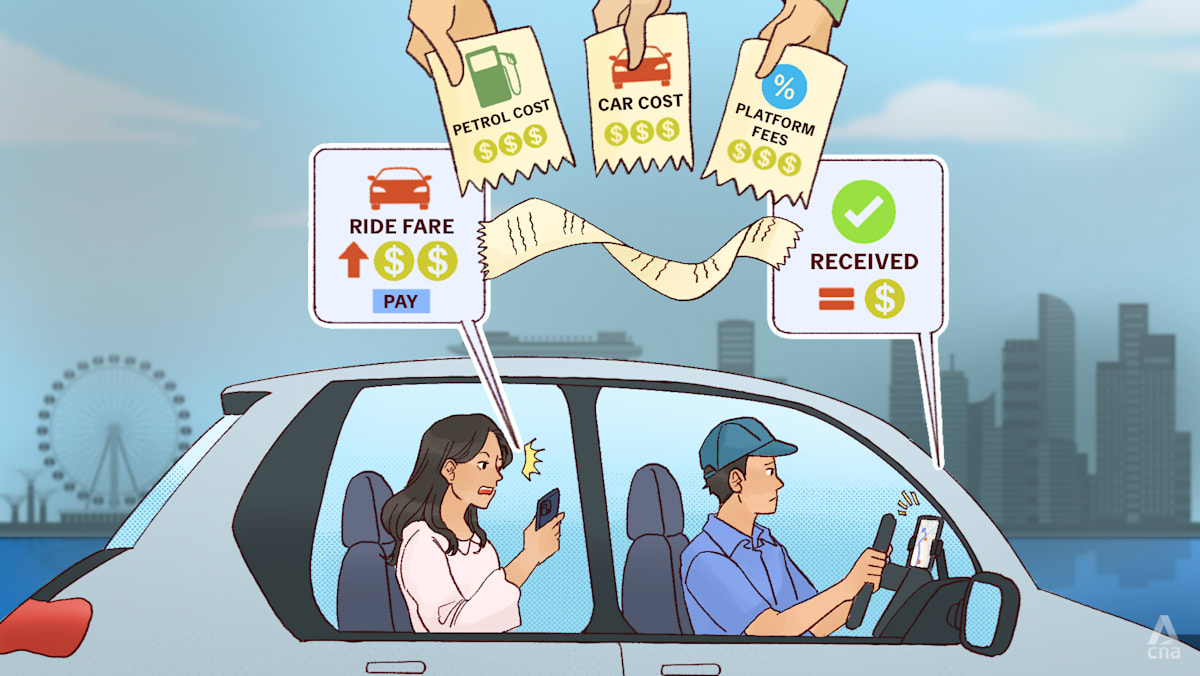
Even as taxi and ride-hailing fares increase, drivers are not reaping the gains because they face higher fuel costs, vehicle prices, as well as platform fees and commissions. (Illustration: CNA/Clara Ho)
This audio is generated by an AI tool.
Back in 2022, Woodlands resident Intan McCallum estimated that a ride-hailing trip into town would cost about S$25 (US$19). These days, however, she pays about S$30 to S$40 for a similar journey.
While living in Woodlands means such trips have "always been pricey", the 20-year-old observed that fares have been increasing sharply, especially in the past year.
Ms McCallum, who is waiting to enter university, said that using ride-hailing services regularly would be unfeasible as it would eat into her weekly allowance.
"I've also had to leave functions early to catch the last train, or in some cases, wait for the first train," she added.
CNA Games Guess Word Crack the word, one row at a time Buzzword Create words using the given letters Mini Sudoku Tiny puzzle, mighty brain teaser Mini Crossword Small grid, big challenge Word Search Spot as many words as you can Show More Show Less
Ms Intan McCallum, a 20-year-old Woodlands resident who has noticed her private-hire fares increase significantly of late, showing a receipt of her private-hire ride on Oct 15, 2026. (Photo: CNA/Jeremy Long)
Yishun resident Kelvin Ong made a similar observation, saying that in the last two years, fares have increased from about S$24 to S$28 from his home to his workplace in Bugis during off-peak hours. But he is sanguine about it.
"Factoring against issues in the Middle East due to oil prices and all that, a price increase is reasonable," said the 29-year-old, who works in a marketing firm.
Mr Ong added that private-hire platforms, having already gained market share, are likely facing less pressure to keep fares low through promotions and discounts in recent years than they did in their early years here.
Indeed, the latest figures from the Singapore Consumer Price Index tabulated by the Singapore Department of Statistics (SingStat) show that the prices of point-to-point (P2P) transport services were 12.3 per cent higher in August 2026 than in August 2025.
SingStat told CNA that the increase was mainly due to higher flat fares, rather than the level of metered taxi fares.
During the same period, the price of the overall basket of consumer goods and services used by SingStat to measure inflation increased by 2.3 per cent.
Transport analysts said the affordability of P2P services bears close attention as the sector is an important complement to the public transport network, providing transport options to areas not well-served by public transport, as well as outside of public transport operation hours.
But as the pricing of P2P services is left to the open market, the public should not expect the government to step in with subsidies should fares continue to surge, said transport economist Walter Theseira from the Singapore University of Social Sciences (SUSS).
"There is very little case for why subsidies to the P2P (sector) makes sense compared to spending the money instead on public transport," he said.
There is very little case for why subsidies to the P2P (sector) makes sense compared to spending the money instead on public transport.
Several drivers who spoke to CNA said the increased fares aren't necessarily leading to higher incomes for them. Although data from the Ministry of Manpower (MOM) shows that the incomes of drivers have risen or plateaued each year since the COVID-19 pandemic up to 2025, several of them said rising costs are hitting them harder this year.
A taxi driver, who wanted to be known only as Mr See, said that while P2P fares may be rising, much of the additional takings go towards covering increasing fuel costs rather than into his pocket.
"There's nothing we can do, there's a war going on in the Middle East, the fuel prices have increased significantly," said the 61-year-old in Mandarin.
Ms Yeo Wan Ling, adviser to the National Taxi Association (NTA) and the National Private Hire Vehicles Association (NPHVA), underscored this apparent paradox: that higher fares paid by passengers do not necessarily translate into correspondingly higher take-home earnings for drivers.
"What matters to drivers is not the headline fare, but what remains after rental or vehicle financing costs, fuel or charging costs, platform commissions and fees, insurance and other operating expenses," said Ms Yeo, who is also NTUC assistant secretary-general.
"These costs have risen over the years and continue to take a significant share of drivers' gross earnings."
Drivers noted in particular that aside from fuel costs, platform commissions and fees have risen quite substantially in recent years.
Transport analysts said that these platform commissions and fees can fund innovations and improvements, such as better matching drivers with passengers, though the benefits have been mixed, or not made transparent.
There were hopes that ride-hailing platform companies would "revolutionise" the P2P sector and offer lower fares while being profitable, but the efficiency gains have turned out to be "not as apparent", said Associate Professor Theseira.
"There are efficiency improvements such as more efficiently utilised fleets and less waiting time, but not so large that the fares are permanently lower," he said.
What remains is a situation where few are satisfied. Commuters say they are pained by higher fares and drivers are vexed by stagnating incomes, even as platforms pledge to balance the interests of both sides.
A passenger alighting from a private-hire vehicle. (Photo: CNA/Ooi Boon Keong)
WHAT'S DRIVING UP P2P FARES?
P2P transport prices spiked over the past year, after already rising steadily for the past five years.
According to SingStat data, the price of P2P transport services had increased by 47.1 per cent as of August this year, compared to the median price in 2021.
The overall basket of consumer goods and services increased by 18 per cent over the same period.
Responding to CNA's queries, SingStat said that the P2P figures were calculated using fares from major ride-hailing and taxi operators, and include all charges paid, such as platform fees, booking fees and surcharges.
Assoc Prof Theseira said that the significant increase in the prices of P2P services in the past five years is not surprising.
Post-COVID, there was a surge in demand for P2P services but a shortage of drivers, many of whom had moved on to other jobs during the pandemic.
Prices were then driven up by the Russia-Ukraine war, which started in 2022 and disrupted energy supply chains.
"There was a general sense that the corner had been turned in the last year or so because basically a lot of these issues had been worked out through the system more or less, and so inflation had come down quite sharply," said Assoc Prof Theseira.
But just as prices began to stabilise, tensions flared across the Middle East with the outbreak of the Iran war earlier this year, which "started a new round of energy cost inflation", he added.
Assoc Prof Theseira said the P2P sector is seeing a higher rise in prices than general consumer goods because all of its major cost components are becoming much more expensive than other categories of goods.
Alongside the rising cost of fuel, Certificate of Entitlement (COE) prices have also risen sharply over the last five years, which would lead to an increase in vehicle costs.
In tandem, the price of motor cars had increased by 56.8 per cent in August 2026 compared to 2021.
According to SingStat data, the price of motor cars had increased by 56.8 per cent in August 2026 compared to median prices in 2021. (Photo: CNA/Syamil Sapari)
The sharp rise in P2P fares should not be mistaken for public dissatisfaction with other forms of public transport, such as trains and buses, experts said.
After all, the user base for P2P services has always existed, even before ride-hailing entered the fray, said veteran transport engineering consultant Gopinath Menon.
"For many who don't own a car or don't want to because of the high cost of ownership and use, and who don't relish the alternative of public transport (which is) efficient and affordable, but not door-to-door, the taxi has been a popular choice," said Mr Menon, a former board member on the Public Transport Council.
By offering more efficient rides and appealing to tech-savvy commuters, ride-hailing platforms have eaten more into taxis' market share than into public transport's part of the market.
"Private-hire vehicles are chosen more for convenience than for the perceived inadequacy of public transport," said Mr Menon.
The more structural reason for the sharp rise in fares is that there is a limit to what can be optimised in the P2P business model, said Assoc Prof Theseira.
In other industries, supply chain improvements or technological advancements can significantly reduce costs, he noted. For instance, the proliferation of Chinese e-commerce platforms has led to cheaper goods from China being shipped to Singapore.
Space for such innovations in the P2P sector is limited, as it will still require a local driver and a vehicle to ferry passengers around.
"The point is that there are certain structural changes to the economy that drive efficiencies and reduction in costs in some sectors. However, when you look at the P2P sector, there is no such thing," he said.
The nominal incomes of Singaporeans have also risen, which means that drivers' wages have had to keep pace, Assoc Prof Theseira added.
"It's a good thing that Singaporean wages go up, but when Singaporean wages go up, it is inevitable that P2P (prices) go up because it is the driver's labour which is a very large part of the cost," he said.
To that end, ride-hailing companies have told CNA that fares and adjustments to platform fees are set to strike a balance between ensuring rides are competitively priced, and ensuring drivers take home sustainable earnings.
WHY DO DRIVERS SAY INCOMES ARE NOT INCREASING?
MOM data up to 2025 shows that attempts to boost drivers' incomes were working.
The monthly incomes of private-hire drivers had hit a median of S$2,500 in 2019, before they fell to S$1,700 in 2020 during the COVID-19 pandemic. They then rose to S$2,500 again and remained at that level from 2022 to 2024, before hitting a new high of S$3,000 in 2025.
Median monthly incomes for taxi drivers had likewise dipped from S$1,500 in 2019 to S$1,000 in 2020, but rose again to S$1,500 in 2022 and 2023, before rising to S$1,800 in 2024 and S$1,982 in 2025.
But drivers say things have changed in the past year, especially given the unprecedented increase in fuel prices .
For full-time taxi and private-hire vehicle driver Yeo Hooi Chye, rising fuel and vehicle costs have eaten into whatever increased earnings he may have earned, keeping his income stagnant.
He said that daily rental costs have remained at about S$110 for the past year, while petrol now costs S$50 for a day of driving, up from about S$32 at the same time last year.
"To get back this S$160, you have to drive four or five hours," said the 64-year-old. "Only after that do we make a profit."
To get back this S$160 (in fuel and rental costs), you have to drive four or five hours. Only after that do we make a profit.
Ms Yeo, the adviser to NPHVA and NTA, said that operating costs remain one of the biggest pressures on drivers' earnings.
Fuel has seen the sharpest increase, with petrol prices at major retailers having risen close to 20 per cent since March, to about S$3.45 a litre in September, while diesel has again gone above S$4 a litre.
"Vehicle, rental, financing, insurance and maintenance costs have also gone up," she said.
"Drivers start each working day needing to cover these costs, and only after that do they begin earning income for themselves."
The government in April announced a S$200 payout to eligible taxi drivers and platform workers to cushion the impact of sharp fuel price increases.
Professor Lawrence Loh, director of the Centre for Governance and Sustainability at the National University of Singapore (NUS) Business School, said that the increase in fares can also go back to the platforms in the form of increased platform fees and commissions.
Both Grab and ComfortDelGro raised platform fees this year, with Gojek and Ryde following suit in February.
Prof Loh said that historically, ride-hailing platforms have been operating with costs higher than their revenue in a bid to gain market share, and so have been "incrementally" trying to break even.
"Of course, the drivers do get some increase (in wages), but my sense is some of these increases could barely even cover the increase in the cost of living," he said.
A private-hire driver, who wanted to be known only as Mr Chiu, said that he noticed platform fees and commissions have increased as well.
Based on his conversations with passengers, Mr Chiu said that fees and commissions on some platforms were about S$3 to S$4 about two years ago, but now they have increased to at least S$5 to S$7, with pricier trips seeing up to S$15 in commissions.
Coupled with fuel prices surging, the 60-year-old said that the past year has been financially challenging for him, even though he has been driving the same number of hours.
Transport analysts say that ride-hailing platforms are more efficient than traditional taxi services in matching rides to commuters. (Photo: CNA/Ili Mansor)
WHERE ARE THE PLATFORM FEES AND COMMISSIONS GOING?
Ride-hailing platforms said that they are using platform fees and commissions to improve their technology, provide fuel rebates to drivers, and support drivers’ Central Provident Fund (CPF) contributions.
A platform fee is a charge paid by the passenger, usually added on top of the ride fare, while a commission is a charge paid by the driver to the platform, usually deducted as a percentage of the fare the driver earns.
A Grab spokesperson said that its adjustments to fares reflect broader industry-wide factors, including rising fuel costs, as well as provisions under the Platform Workers Act that safeguards drivers' "long-term earnings and security".
Passed in 2024, the Act requires platforms to contribute to eligible drivers' CPF savings and provide work injury compensation coverage.
The spokesperson added that Grab remains "deeply committed to balancing fare sustainability for drivers with affordability for riders".
"To support our driver-partners, we continuously optimise dispatch efficiency to reduce wait times between jobs and enhance productivity, while leveraging fuel discounts, electric vehicle charging rebates, and fleet partnerships to lower their daily running costs," the spokesperson said.
Grab said it has also sought to offset higher costs for commuters through cheaper options such as Group Rides and GrabHitch, which it said can reduce fares by up to 40 per cent, as well as through promotions and loyalty rewards.
A Tada spokesperson said that it had made two increases to its rider platform fee, with the most recent increase in 2025.
The spokesperson said that adjusting the platform fee was necessary to keep its zero-commission model commercially sustainable while "continuing to support drivers and provide competitively priced rides".
It also uses these fees to make contributions towards drivers' CPF and insurance coverage under the Platform Workers Act.
Tada had also revised its fuel support fee in April this year to help drivers manage rising operating costs.
"Ultimately, our goal is to strike a balance between keeping rides affordable for riders and ensuring that drivers are fairly compensated and supported," said the spokesperson.
A Ryde spokesperson said that it "periodically reviews its platform fees to ensure that we can continue operating a reliable and sustainable platform".
"Platform fees support areas including technology infrastructure, app development, safety and security, customer support, regulatory and compliance requirements, as well as continued improvements to the experience for both passengers and driver-partners," the spokesperson said.
Ryde added that it is committed to collecting no commissions through the end of 2027.
"We recognise the broader increase in point-to-point transport costs and remain focused on balancing affordability for passengers with sustainable earnings for driver-partners," it added.
The spokesperson added that the approach is not "simply to pass every increase in operating costs on to passengers".
"We also look at how we can improve driver economics and marketplace efficiency through our commission structure, incentives, better matching and routing."
A Gojek spokesperson said the platform's fares "reflect the balance between keeping rides affordable for passengers and ensuring a sustainable livelihood for driver-partners amid rising operating costs".
"We continue to offer promotions for passengers and support programmes for driver-partners, and remain committed to keeping rides accessible."
CNA asked the ride-hailing platforms about how their average fares have increased over the past five years, but they declined to provide such figures, with some citing commercial sensitivities.
CNA also reached out to taxi firms ComfortDelGro, Prime Taxi, Strides Premier and Trans-Cab to ask what measures they have taken to keep rides affordable for passengers while ensuring that driving remains financially viable. None had officially responded by publication time.
Ms Yeo acknowledged that digital platforms have brought benefits to the P2P sector, such as more efficient matching of drivers and passengers. This can help drivers reduce waiting times and find more trips, she said.
But what is lacking today is transparency: Drivers need to understand clearly what is being deducted from each trip, while commuters should also have clarity about what they are paying for, she said.
"This is why NTA and NPHVA have consistently called for greater transparency in how fares, commissions, platform charges and other fees are determined and shared," she added.
"Ultimately, when fares increase, there should be transparency over where that additional fare dollar goes. Drivers should be able to see whether they are sharing in the upside."
On balance, it is hard to say if the sharp increase in P2P fares is justified, said Dr Terence Fan, assistant professor of strategy and entrepreneurship at Singapore Management University, especially as the complete formula for how ride-hailing platforms price their services is not made public.
The transport economist said that under the taxi system, there is a very clear distinction between peak and non-peak timings and the associated percentage increase in fares. The same cannot be said for ride-hailing.
Echoing Ms Yeo's point, Dr Fan said it would also help if there were a more transparent breakdown of how companies spend their platform fees and commissions, and if it has improved passenger experience.
"In the taxi domain, which is regulated, taxi companies have to track and report the number or the per cent of the calls that they are able to answer (within a certain time)," he said.
Dr Fan added that there could be more transparency on service standards for ride-matching success rates and waiting times for ride-hailing, as there already is for taxis.
The Land Transport Authority (LTA) publishes information on ride-matching indicators, such as call answer rates and passenger waiting times for taxi bookings on ComfortDelGro.
As of July 2026, ComfortDelGro passed all its quality of service standards, such as ensuring that calls are answered by the taxi dispatch system within 30 seconds at least 70 per cent of the time, and that waiting times for taxis are under 10 minutes at least 65 per cent of the time.
LTA does not publicly release industry-wide ride-matching success rates or average waiting times for app-based ride-hailing services, while comparable Singapore-specific figures are not routinely disclosed by the major platforms.
"With the platforms, there is no equivalent service status … we don't have an equivalent index to capture how unsatisfied people are," said Dr Fan.
A taxi approaching a pick-up point. (Photo:CNA/Lim Li Ting)
IS MORE COMPETITION THE ANSWER?
It might be tempting to think that more competition would help drive fares down across the board, but Associate Professor Raymond Ong from NUS said that there is already sufficient competition in the P2P sector, with customers able to choose between various taxi and ride-hailing platform options.
"(Commuters) definitely compare across different platforms, and there is always competition about vehicle availability, waiting time, and the booking experience," said Assoc Prof Ong, who is deputy head of research and enterprise at the NUS Department of Civil and Environmental Engineering.
He added that there is also some degree of service differentiation, with some firms giving commuters options for bigger or premium vehicles.
Furthermore, more competition is not necessarily healthy for the P2P sector, said Assoc Prof Theseira from SUSS.
"Having more platforms is not going to do anything about price components like wages, energy and rental."
This could also drive prices upwards, as platforms need to attract drivers with higher wages, he added.
Having more ride-hailing and taxi firms can make matching passengers with drivers less efficient, as each operator would have a smaller pool of drivers and passengers, he noted.
"Competition is useful, but the sweet spot for this industry is somewhere between a tiny number and a lot of players," he said.
The relationship between fares and competition (or the lack of it) came under the spotlight in the aftermath of the Grab-Uber merger almost a decade ago, leading regulators to step in.
Uber sold its Southeast Asian business to Grab in 2018, resulting in the Competition and Consumer Commission of Singapore (CCS) imposing a total of more than S$13 million in financial penalties on the two ride-hailing firms, after ruling that the deal was "anti-competitive".
CCS also imposed conditions on Grab, such as maintaining its pre-merger pricing algorithm and driver commission rates, preventing Grab from changing certain prices and pricing policies without regulatory approval, and removing exclusive arrangements that prevented drivers from using competing platforms.
Uber sold its Southeast Asian business to Grab in 2018. (Photo: CNA/Nuria Ling)
Responding to CNA's queries, CCS said that "the regulatory landscape has evolved since the Grab-Uber merger in 2018".
It added that LTA had introduced the Point-to-Point Transport Regulatory Framework, which took effect in late 2020, after which CCS lifted its safeguards imposed on Grab.
The new regulatory framework included safeguards such as ensuring drivers could work across multiple ride-hailing platforms, and that operators clearly communicated fares and additional charges to passengers.
"CCS continues to monitor competition developments across markets, including the P2P transport sector, and will take enforcement action where warranted within our regulatory ambit," it told CNA.
Looking abroad, there are examples of ride-hailing companies that have taken service standards up another level to attract more customers.
The South China Morning Post reported that increased competition in China has led to ride-hailing firms offering passengers extra services such as massage chairs, karaoke entertainment, snacks and haircuts.
Assoc Prof Ong from NUS said that in Singapore, the focus is still based on "fundamentals of P2P", which is safety, reliability, convenience and service standards.
"What really matters for Singaporeans is to be able to secure a ride within a reasonable waiting time, and then travel in a safe and comfortable vehicle, having a professional driver, and reaching the destination safely," he said.
Agreeing, Ms McCallum, the Woodlands resident, said that rides arriving more quickly would make the biggest difference to her commuting experience, especially with prices getting higher.
"Small gestures like providing charging cables or water, asking us if we are comfortable with the air conditioning, and allowing us to connect our own music would also make the ride more enjoyable or just more personal," she added.
Ms McCallum added that surge pricing of fares during peak hours has been a bugbear, where she has seen fares from central areas back to Woodlands go as high as S$70.
"I think having a price cap would be great … It's just not justifiable to pay S$70 to get home after a long day of work," she said.
Ms Intan McCallum, a 20-year-old Woodlands resident who has noticed the price of her private-hire rides increase significantly over the past few years, at Admiralty Grove on Oct 15, 2026. (Photo: CNA/Jeremy Long)
But while it may hurt to see such an astronomical figure for a ride home, surge pricing helps allocate trips to those who most urgently need them, said Assoc Prof Theseira.
Before surge pricing existed, taxi operators have been adopting surcharges for peak hours and late nights, but these are "blunt" measures that propped up fares by a set percentage of the original fare, or a set amount, he noted.
"The old taxi surcharge system is not really that effective at times at balancing supply and demand," he said. "Surge pricing is actually far more efficient than the old system."
Surge pricing is thus an efficient means of ensuring that customers who most urgently need rides will get them, while others are encouraged to search for alternatives, he said.
"Many commuters don't fully understand why (P2P firms) are charging so much, but if they didn't charge this much, you won't get a vehicle to pick you up."
Short-term fluctuations notwithstanding, long-term P2P fares are likely to continue increasing in line with nominal wage growth, Assoc Prof Theseira said.
In fact, it would be bad for Singapore's economy if P2P fares see a decrease over time, he said.
"That's because a decline in P2P prices almost certainly means that the economy and travel are tanking, and Singaporeans are out of jobs and seeking to earn income by flooding the market as P2P drivers."
He added that with nominal wages increasing, it is also not realistic to expect drivers' wages to keep stagnating or fall behind.
"The reason why their wages must go up, is because there are plenty of other jobs which have changed, and if their wages don't change, then (there will be) no supply of P2P drivers."
For example, the recent increase in bus drivers' starting pay could serve as a "more attractive alternative" for those who want to be professional drivers, said Assoc Prof Theseira.
"Labour is a major cost, and labour cost is not driven by the P2P job, it is driven by alternatives," he added.
Neither should the government be expected to step in to provide subsidies to the P2P sector.
In addition to the argument that taxpayers' funds would be better used to improve the public transport system, sweeping subsidies to artificially lower the prices of P2P services would likely be an unpopular move.
Assoc Prof Theseira said: "For example, how many middle class taxpayers are going to be happy if they see that, for example, youths are using subsidised taxis to go home after partying late at night?"
From the public policy perspective, the solution to reducing fares would be to provide more last-mile transport options, such as by having shuttle buses operate last-mile trips from public transport nodes to places like hospitals.
Ms Yeo said that affordability for commuters and sustainable earnings for drivers should not be treated as competing objectives.
We need to look at the whole economics of the trip: what the passenger pays, what the platform or operator receives, what it costs the driver to provide the service, and what the driver ultimately takes home.
"We need to look at the whole economics of the trip: what the passenger pays, what the platform or operator receives, what it costs the driver to provide the service, and what the driver ultimately takes home," she said.
She said it is important to keep drivers' operating costs manageable, ensuring that commissions and charges are reasonable, and making sure drivers have sufficient trip opportunities to earn a sustainable income.
"Singapore needs enough drivers who feel that driving is worth their time and effort. If drivers cannot earn a sustainable living, they will eventually leave the sector, and that will ultimately affect availability and affordability for commuters too," she said.
NUS' Assoc Prof Ong similarly expects fares to rise over time, but said platforms can help contain costs by improving their technology to match commuters with drivers more efficiently, reducing the time drivers spend searching for passengers.
Striking a balance between demand and supply will be no less crucial in the coming years.
"If you have supply but no demand, then of course things will be expensive because the fleet costs are there," he said.
"But if you have a demand that's high but not enough supply, then the cost is there because there are always people who are willing to pay more," he said. "To find that sweet spot is actually a very big challenge."
Get our pick of top stories and thought-provoking articles in your inbox
Stay updated with notifications for breaking news and our best stories
Join our channel for the top reads for the day on your preferred chat app
最新数据显示,2026 年 8 月点对点 (P2P) 运输服务的价格比 2025 年 8 月上涨了 12.3%。燃油和拥车证 (COE) 成本无疑是罪魁祸首,但运营商是否也采取了更多措施来证明高价的合理性?
尽管出租车和网约车车费上涨,但司机们并未从中获益,因为他们面临着更高的燃油成本、车辆价格以及平台费用和佣金。(插图:CNA/Clara Ho)
这段音频由人工智能工具生成。
2022年,兀兰居民英丹·麦卡勒姆估计,打车进城大约需要25新元(19美元)。但如今,类似的行程她要花费30到40新元。
虽然住在兀兰意味着这样的旅行“一直都很贵”,但这位 20 岁的年轻人观察到,票价一直在急剧上涨,尤其是在过去一年里。
即将进入大学的麦卡勒姆女士表示,经常使用网约车服务是不切实际的,因为这会消耗她每周的零用钱。
她补充说:“我也曾不得不提前离开活动去赶末班车,或者在某些情况下,要等首班车。”
CNA游戏 猜词游戏 逐行破解单词 流行词游戏 用给定的字母组成单词 迷你数独 小小谜题,挑战你的大脑 迷你填字游戏 小方格,大挑战 单词搜索 尽可能多地找出单词 显示更多 显示更少
20岁的兀兰居民英丹·麦卡勒姆女士注意到,她最近乘坐网约车的费用大幅上涨。图为她2026年10月15日的网约车收据。(图片:CNA/Jeremy Long)
义顺居民王凯文也表达了类似的看法,他说过去两年里,非高峰时段从他家到武吉士上班的车费从大约24新元上涨到了28新元。但他对此并不担心。
“考虑到中东地区因石油价格等问题而产生的种种状况,价格上涨是合理的,”这位在营销公司工作的29岁年轻人说道。
Ong先生补充说,私召平台已经获得了市场份额,近年来它们通过促销和折扣来降低票价的压力可能比刚进入马来西亚市场时要小。
事实上,新加坡统计局 (SingStat) 公布的最新新加坡消费者价格指数数据显示,2026 年 8 月点对点 (P2P) 运输服务的价格比 2025 年 8 月高出 12.3%。
新加坡统计局告诉亚洲新闻台,此次上涨主要是由于固定车费上涨,而不是计程车费上涨。
同期,新加坡统计局用于衡量通货膨胀的消费品和服务总篮子价格上涨了 2.3%。
交通分析师表示,P2P 服务的可负担性值得密切关注,因为该行业是公共交通网络的重要补充,为公共交通服务不完善的地区以及公共交通运营时间之外的地区提供交通选择。
新加坡社会科学大学 (SUSS) 的交通经济学家沃尔特·特塞拉表示,由于 P2P 服务的定价由公开市场决定,如果票价继续飙升,公众不应指望政府会介入提供补贴。
他说:“与把钱花在公共交通上相比,几乎没有任何理由说明为什么补贴P2P(行业)是合理的。”
几乎没有任何理由可以解释为什么补贴 P2P(行业)比把钱花在公共交通上更有意义。
多位接受亚洲新闻台(CNA)采访的司机表示,车费上涨并未给他们带来更高的收入。尽管人力部(MOM)的数据显示,自新冠疫情爆发以来,到2025年,司机的收入逐年增长或保持稳定,但一些司机表示,今年不断上涨的成本对他们的影响更大。
一位只愿透露自己姓 See 的出租车司机表示,虽然 P2P 车费可能上涨,但大部分额外收入都用于支付不断上涨的燃油成本,而不是进入他的口袋。
“我们无能为力,中东正在发生战争,燃油价格大幅上涨,”这位61岁的老人用普通话说。
全国出租车协会 (NTA) 和全国私租车辆协会 (NPHVA) 的顾问杨婉玲女士强调了这一明显的悖论:乘客支付的更高车费并不一定意味着司机实际到手的收入也会相应增加。
“对司机来说,重要的不是车费本身,而是扣除租赁或车辆融资成本、燃油或充电成本、平台佣金和费用、保险和其他运营费用后剩下的钱,”同时也是全国职工总会助理秘书长的杨女士说。
“这些成本逐年上涨,并且持续占据司机总收入的很大一部分。”
司机们特别指出,除了燃油成本外,近年来平台佣金和费用也大幅上涨。
交通分析师表示,这些平台佣金和费用可以为创新和改进提供资金,例如更好地将司机与乘客匹配,尽管这些好处喜忧参半,或者不够透明。
副教授塞西拉表示,人们曾希望网约车平台公司能够“彻底改变”P2P行业,在盈利的同时提供更低的价格,但效率提升的效果“并不那么明显”。
他说:“虽然效率有所提高,例如车队利用率更高,等待时间更短,但提高的幅度还不足以使票价永久降低。”
目前的状况令许多人感到不满。通勤者抱怨票价上涨,司机则对停滞不前的收入感到恼火,尽管平台承诺会平衡双方的利益。
一名乘客从私召车下车。(图片:CNA/Ooi Boon Keong)
什么因素推高了P2P车费?
过去一年,P2P 运输价格飙升,而此前五年,P2P 运输价格已经稳步上涨。
根据新加坡统计局的数据,截至今年 8 月,P2P 运输服务的价格比 2021 年的中位数价格上涨了 47.1%。
同期,消费品和服务总篮子增长了18%。
针对亚洲新闻台的询问,新加坡统计局表示,P2P 数据是根据主要网约车和出租车运营商的车费计算得出的,包括所有已支付的费用,例如平台费、预订费和附加费。
副教授塞西拉表示,过去五年P2P服务价格大幅上涨并不令人意外。
新冠疫情后,P2P 服务需求激增,但司机短缺,许多司机在疫情期间都转行从事其他工作。
随后,始于 2022 年的俄乌战争扰乱了能源供应链,推高了油价。
“人们普遍认为,在过去一年左右的时间里,情况已经有所好转,因为基本上很多问题都通过体制得到了解决,所以通货膨胀率大幅下降,”副教授塞西拉说。
但他补充说,就在价格开始趋于稳定之际,今年早些时候伊朗战争爆发,中东地区紧张局势加剧,这“引发了新一轮能源成本上涨”。
副教授塞西拉表示,P2P 行业的价格上涨幅度高于一般消费品,因为其所有主要成本组成部分都比其他类别的商品贵得多。
随着燃油成本的上涨,拥车证(COE)价格在过去五年中也大幅上涨,这将导致车辆成本增加。
与此同时,2026 年 8 月汽车价格比 2021 年上涨了 56.8%。
根据新加坡统计局的数据,2026年8月汽车价格较2021年中位数价格上涨了56.8%。(图片:CNA/Syamil Sapari)
专家表示,P2P车费的急剧上涨不应被误认为是公众对其他公共交通方式(如火车和公共汽车)的不满。
资深交通工程顾问戈皮纳特·梅农表示,毕竟,P2P 服务的用户群体一直存在,甚至在网约车出现之前就已经存在了。
“对于许多没有车或因为拥有和使用成本高而不想拥有车的人来说,出租车一直是一个受欢迎的选择,他们也不喜欢公共交通这种高效且价格实惠但不能门到门的交通方式,”梅农先生说道,他曾是公共交通委员会的董事会成员。
通过提供更高效的出行方式并吸引精通技术的通勤者,网约车平台蚕食了出租车的市场份额,而不是公共交通的市场份额。
梅农先生说:“人们选择私人出租车更多是出于方便,而不是因为觉得公共交通不够完善。”
副教授塞西拉表示,票价大幅上涨的更深层次的结构性原因是,P2P 商业模式的优化空间是有限的。
他指出,在其他行业,供应链的改进或技术进步可以显著降低成本。例如,中国电子商务平台的蓬勃发展使得来自中国的商品能够以更低的价格运往新加坡。
P2P 领域的此类创新空间有限,因为它仍然需要当地司机和车辆来接送乘客。
他说:“关键在于,经济中某些结构性变化会推动部分行业的效率提升和成本降低。然而,当你审视P2P行业时,就会发现并不存在这种情况。”
副教授塞西拉补充说,新加坡人的名义收入也有所增长,这意味着司机的工资也必须跟上步伐。
“新加坡工资上涨是件好事,但新加坡工资上涨时,P2P(价格)上涨也是不可避免的,因为司机的劳动力成本占了成本的很大一部分,”他说。
为此,网约车公司告诉中央社,车费和平台费用的调整旨在确保乘车价格具有竞争力,同时确保司机获得可持续的收入。
为什么司机们说收入没有增加?
人力部截至 2025 年的数据显示,提高司机收入的尝试正在奏效。
2019年,私召车司机的月收入中位数达到2500新元,但在2020年新冠疫情期间降至1700新元。之后,收入回升至2500新元,并在2022年至2024年期间保持在该水平,随后在2025年达到3000新元的新高。
出租车司机的月收入中位数也从 2019 年的 1500 新元下降到 2020 年的 1000 新元,但在 2022 年和 2023 年又回升到 1500 新元,然后在 2024 年升至 1800 新元,在 2025 年升至 1982 新元。
但司机们表示,过去一年情况发生了变化,尤其是考虑到燃油价格前所未有的上涨。
对于全职出租车和私召车司机杨辉财来说,不断上涨的燃油和车辆成本已经吞噬了他可能增加的收入,使他的收入停滞不前。
他表示,过去一年来,每日租车费用一直维持在 110 新元左右,而汽油费现在每天要 50 新元,高于去年同期的 32 新元左右。
“要赚回这160新元,你得开车四五个小时,”这位64岁的老人说。“只有这样我们才能盈利。”
要收回这160新元(包括油费和租车费),你得开车四五个小时。只有这样我们才能盈利。
NPHVA 和 NTA 的顾问 Yeo 女士表示,运营成本仍然是司机收入面临的最大压力之一。
燃油价格涨幅最大,主要零售商的汽油价格自 3 月以来上涨了近 20%,9 月份达到每升约 3.45 新元,而柴油价格再次超过每升 4 新元。
“车辆、租赁、融资、保险和维护成本也都上涨了,”她说。
“司机们每天上班首先要支付这些费用,之后才能开始赚取自己的收入。”
政府在四月份宣布向符合条件的出租车司机和平台工作人员发放 200 新元的补贴,以缓解燃油价格大幅上涨带来的影响。
新加坡国立大学商学院治理与可持续发展中心主任罗劳伦斯教授表示,票价上涨也可能以平台费和佣金增加的形式返还给平台。
Grab 和 ComfortDelGro 今年都提高了平台费用,Gojek 和 Ryde 也于 2 月份效仿。
罗教授表示,从历史上看,网约车平台为了获得市场份额,运营成本一直高于收入,因此一直在“逐步”尝试实现收支平衡。
“当然,司机们的工资确实有所上涨,但我的感觉是,这些涨幅甚至都难以弥补生活成本的上涨,”他说。
一位只愿透露自己姓邱的网约车司机表示,他注意到平台费用和佣金也有所增加。
邱先生根据与乘客的交谈表示,大约两年前,一些平台的费用和佣金约为 3 至 4 新元,但现在已上涨至至少 5 至 7 新元,而价格较高的行程佣金甚至高达 15 新元。
这位 60 岁的老人表示,由于燃油价格飙升,尽管他开车的时间没有减少,但过去一年他的经济状况仍然很艰难。
交通分析人士表示,网约车平台在为乘客匹配车辆方面比传统出租车服务效率更高。(图片:CNA/Ili Mansor)
平台费用和佣金都去哪儿了?
网约车平台表示,他们正在利用平台费和佣金来改进技术、向司机提供燃油回扣,并支持司机缴纳中央公积金 (CPF)。
平台费是乘客支付的费用,通常在车费之外另行收取;而佣金是司机向平台支付的费用,通常是从司机赚取的车费中扣除的一定比例。
Grab 的一位发言人表示,其对车费的调整反映了更广泛的行业因素,包括燃油成本上涨,以及《平台工作者法》中保障司机“长期收入和安全”的规定。
该法案于 2024 年通过,要求平台向符合条件的司机缴纳公积金,并提供工伤赔偿保险。
发言人补充说,Grab 仍然“致力于在保证司机收入可持续性的同时,兼顾乘客的支付能力”。
发言人表示:“为了支持我们的司机合作伙伴,我们不断优化调度效率,以减少工作之间的等待时间并提高生产力,同时利用燃油折扣、电动汽车充电回扣和车队合作关系来降低他们的日常运营成本。”
Grab表示,公司还通过更便宜的选择(例如Group Rides和GrabHitch)来抵消通勤者更高的成本,Grab称这些服务可以将车费降低高达40%,此外还通过促销和忠诚度奖励来降低成本。
Tada 的一位发言人表示,该公司已经两次提高了骑手平台费用,最近一次是在 2025 年。
发言人表示,调整平台费用是必要的,这样才能保持其零佣金模式的商业可持续性,同时“继续支持司机并提供价格具有竞争力的乘车服务”。
它还利用这些费用为司机缴纳公积金和根据《平台工人法》获得的保险费。
今年4月,Tada也调整了燃油补贴费用,以帮助司机应对不断上涨的运营成本。
发言人表示:“最终,我们的目标是在保持乘客乘车价格合理和确保司机获得公平报酬和支持之间取得平衡。”
Ryde 的一位发言人表示,公司“会定期审查其平台费用,以确保我们能够继续运营一个可靠且可持续的平台”。
发言人表示:“平台费用用于支持技术基础设施、应用程序开发、安全保障、客户支持、监管和合规要求等领域,以及持续改善乘客和司机合作伙伴的体验。”
Ryde补充说,该公司承诺在2027年底之前不收取任何佣金。
“我们意识到点对点运输成本普遍上涨,并将继续致力于在乘客的负担能力和司机伙伴的可持续收入之间取得平衡,”声明补充道。
发言人补充说,这种做法并非“简单地将运营成本的每一项增长都转嫁给乘客”。
“我们还在研究如何通过佣金结构、激励措施、更好的匹配和路线规划来改善司机的经济状况和市场效率。”
Gojek 的一位发言人表示,该平台的票价“体现了在运营成本不断上涨的情况下,既要保证乘客能够负担得起乘车费用,又要确保司机伙伴能够维持可持续的生计”。
“我们将继续为乘客提供优惠活动,为司机伙伴提供支持计划,并始终致力于让乘客能够便捷地享受乘车服务。”
中央社询问了网约车平台过去五年平均车费的增长情况,但各平台拒绝提供相关数据,部分平台以商业敏感性为由拒绝透露。
中央社还联系了康福德高、Prime Taxi、Strides Premier 和 Trans-Cab 等出租车公司,询问他们采取了哪些措施来维持乘客的乘车价格,同时确保出租车运营的盈利能力。截至发稿时,各公司均未作出正式回应。
杨女士承认,数字平台为P2P行业带来了诸多益处,例如更高效地匹配司机和乘客。她表示,这可以帮助司机减少等待时间,获得更多订单。
但她表示,目前缺乏的是透明度:司机需要清楚地了解每次行程中扣除的费用,而通勤者也应该清楚他们支付的费用包含哪些内容。
“这就是为什么NTA和NPHVA一直呼吁提高票价、佣金、站台费和其他费用的确定和分配的透明度,”她补充道。
“归根结底,当车费上涨时,应该让司机们清楚地知道增加的车费都花在了哪里。司机们应该能够看到自己是否也从中受益。”
新加坡管理大学战略与创业学助理教授范德伦博士表示,总的来说,很难说P2P车费的大幅上涨是否合理,尤其是网约车平台如何为其服务定价的完整公式尚未公开。
这位交通经济学家指出,在出租车系统中,高峰时段和非高峰时段之间的界限非常清晰,相应的车费涨幅也很明显。而网约车则不然。
范博士赞同杨女士的观点,他表示,如果能更透明地细分公司如何使用平台费用和佣金,以及这是否改善了乘客体验,那也将有所帮助。
他说:“在受监管的出租车领域,出租车公司必须跟踪并报告他们能够在一定时间内接听的电话数量或百分比。”
范博士补充说,网约车匹配成功率和等待时间等服务标准可以更加透明,就像出租车服务那样。
陆路交通管理局 (LTA) 公布了 ComfortDelGro 出租车预订的接听率和乘客等待时间等拼车指标信息。
截至 2026 年 7 月,康福德高已通过所有服务质量标准,例如确保出租车调度系统在至少 70% 的情况下在 30 秒内接听电话,以及确保出租车等待时间在至少 65% 的情况下不超过 10 分钟。
陆路交通管理局 (LTA) 不会公开公布整个行业的乘车匹配成功率或基于应用程序的网约车服务的平均等待时间,而主要平台也不会定期披露新加坡的类似数据。
范博士说:“对于这些平台来说,没有等效的服务状态……我们没有等效的指标来衡量人们的不满意度。”
一辆出租车驶近接客点。(图片:CNA/林丽婷)
增加竞争是解决之道吗?
人们或许会认为,更多的竞争将有助于全面降低车费,但新加坡国立大学副教授 Raymond Ong 表示,P2P 领域已经存在足够的竞争,客户可以在各种出租车和网约车平台之间进行选择。
“(通勤者)肯定会在不同的平台上进行比较,而且在车辆可用性、等待时间和预订体验方面总是存在竞争,”新加坡国立大学土木与环境工程系研究与企业副主任翁副教授说。
他还补充说,服务方面也存在一定程度的差异化,一些公司为通勤者提供更大或更高级的车辆选择。
此外,新加坡社会科学大学副教授蒂塞拉表示,更多的竞争对P2P行业来说未必是好事。
“增加平台数量并不会改变工资、能源和租金等价格构成要素。”
他还补充说,这也可能导致价格上涨,因为平台需要以更高的工资来吸引司机。
他指出,网约车和出租车公司数量的增加可能会降低乘客与司机匹配的效率,因为每个运营商的司机和乘客数量都会减少。
“竞争是有益的,但这个行业的最佳规模介于参与者数量很少和参与者很多之间,”他说。
近十年前,Grab 与 Uber 合并后,票价与竞争(或缺乏竞争)之间的关系成为关注焦点,促使监管机构介入。
2018 年,Uber 将其东南亚业务出售给了 Grab,导致新加坡竞争与消费者委员会 (CCS) 对这两家网约车公司处以总计超过 1300 万新元的罚款,理由是该交易“有悖竞争”。
CCS 还对 Grab 施加了一些条件,例如维持其合并前的定价算法和司机佣金率,禁止 Grab 在未经监管部门批准的情况下更改某些价格和定价政策,并取消阻止司机使用竞争平台的排他性安排。
Uber于2018年将其东南亚业务出售给了Grab。(图片:CNA/Nuria Ling)
针对 CNA 的询问,CCS 表示,“自 2018 年 Grab-Uber 合并以来,监管环境已经发生了变化”。
声明还补充说,陆路交通管理局推出了点对点运输监管框架,该框架于 2020 年底生效,之后 CCS 取消了对 Grab 施加的保障措施。
新的监管框架包括一些保障措施,例如确保司机可以在多个网约车平台上工作,以及运营商向乘客明确传达车费和附加费用。
“CCS将继续关注包括P2P运输行业在内的各个市场的竞争发展情况,并将在监管范围内采取必要的执法行动,”该公司告诉CNA。
放眼国外,一些网约车公司已经将服务标准提升到了一个新的水平,以吸引更多顾客。
《南华早报》报道称,中国日益激烈的竞争导致网约车公司向乘客提供按摩椅、卡拉OK娱乐、小吃和理发等额外服务。
新加坡国立大学副教授翁表示,在新加坡,重点仍然基于“P2P 的基本要素”,即安全性、可靠性、便利性和服务标准。
他说:“对新加坡人来说,真正重要的是能够在合理的等待时间内叫到车,然后乘坐安全舒适的车辆,由专业司机驾驶,安全到达目的地。”
伍德兰兹居民麦卡勒姆女士对此表示赞同,她说,如果网约车能更快到达,将对她的通勤体验产生最大的影响,尤其是在价格越来越高的情况下。
她补充说:“提供充电线或饮用水,询问我们是否觉得空调舒适,以及允许我们连接自己的音乐等小举动,也会让旅程更加愉快或更加个性化。”
麦卡勒姆女士补充说,高峰时段票价上涨一直令人头疼,她曾看到从市中心返回兀兰的票价高达 70 新元。
“我认为设定价格上限会很好……辛苦工作一天后,回家却要花70新元,这实在是不合理,”她说。
2026年10月15日,20岁的兀兰居民英丹·麦卡勒姆女士在海军部林荫道表示,她注意到过去几年里,网约车的价格大幅上涨。(图片:CNA/杰里米·朗)
副教授塞西拉表示,虽然看到回家的车费如此高昂可能会让人感到心痛,但动态定价有助于将出行机会分配给最急需出行的人。
他指出,在动态定价出现之前,出租车运营商就已经开始对高峰时段和深夜收取附加费,但这些都是“简单粗暴”的措施,只是按原价的固定百分比或固定金额来提高车费。
他说:“旧的出租车附加费制度有时并不能有效地平衡供需关系。动态定价实际上比旧制度效率高得多。”
他表示,动态定价是一种有效的手段,可以确保最急需用车的乘客能够获得服务,同时鼓励其他乘客寻找替代方案。
“很多通勤者并不完全理解为什么(P2P公司)收费这么高,但如果他们不收取这么多费用,你就根本叫不到车。”
副教授塞西拉表示,尽管短期内会有波动,但长期来看,P2P 车费可能会随着名义工资的增长而继续上涨。
他表示,事实上,如果P2P车费随着时间的推移而下降,这对新加坡经济将是不利的。
“这是因为P2P价格的下降几乎肯定意味着经济和旅游业正在衰退,新加坡人失业,并试图通过涌入P2P司机市场来赚取收入。”
他还补充说,随着名义工资的增长,指望司机的工资停滞不前甚至下降也是不现实的。
“他们的工资必须上涨的原因是,许多其他工作岗位已经发生了变化,如果他们的工资不涨,那么(就会)没有P2P司机供应。”
副教授塞西拉表示,例如,最近公交车司机起薪的提高,对于那些想成为职业司机的人来说,可能是一个“更具吸引力的选择”。
“劳动力成本是一项主要成本,而劳动力成本并非由 P2P 工作驱动,而是由其他替代方案驱动,”他补充道。
也不应指望政府介入并为P2P行业提供补贴。
除了认为纳税人的资金应该更好地用于改善公共交通系统之外,大规模补贴以人为降低 P2P 服务的价格也可能是一个不受欢迎的举措。
副教授蒂塞拉说:“例如,如果中产阶级纳税人看到年轻人深夜聚会后乘坐补贴出租车回家,他们会感到高兴吗?”
从公共政策的角度来看,降低票价的办法是提供更多最后一公里交通选择,例如安排接驳巴士运营从公共交通枢纽到医院等地的最后一公里行程。
杨女士表示,通勤者的负担能力和司机的可持续收入不应被视为相互冲突的目标。
我们需要从整个行程的经济角度来看待这个问题:乘客支付的费用、平台或运营商获得的收入、司机提供服务的成本,以及司机最终到手的收入。
“我们需要从整个行程的经济角度来看待这个问题:乘客支付的费用、平台或运营商获得的收入、司机提供服务的成本,以及司机最终到手的收入,”她说。
她表示,重要的是要控制司机的运营成本,确保佣金和收费合理,并确保司机有足够的出行机会来赚取可持续的收入。
“新加坡需要足够多的司机,让他们觉得开车这份工作值得投入时间和精力。如果司机无法获得可持续的生活,他们最终会离开这个行业,这最终也会影响通勤者的出行便利性和交通费用,”她说道。
新加坡国立大学副教授翁也同样预计车费会随着时间推移而上涨,但他表示,平台可以通过改进技术来更有效地将通勤者与司机匹配,从而减少司机寻找乘客的时间,进而帮助控制成本。
在未来几年,平衡供需关系仍然至关重要。
他说:“如果供应充足但没有需求,那么价格当然会很高,因为车队成本就在那里。”
“但如果需求旺盛而供应不足,那么成本就会上升,因为总会有人愿意支付更高的价格,”他说。“找到这个最佳平衡点实际上是一个巨大的挑战。”
订阅我们的邮件,即可获取精选热点新闻和引人深思的文章。
订阅通知,第一时间获取突发新闻和精彩报道。
加入我们的频道,即可在您常用的聊天应用上获取当日热门文章。