Interview: French Army chief Schill talks technology, surprise and ‘archaic’ combat专访:法国陆军参谋长席尔谈技术、突袭和“古老”的作战方式
"We should avoid excessive analogies. France is not Ukraine," said Gen. Pierre Schill in an interview ahead of the Eurosatory defense expo near Paris.
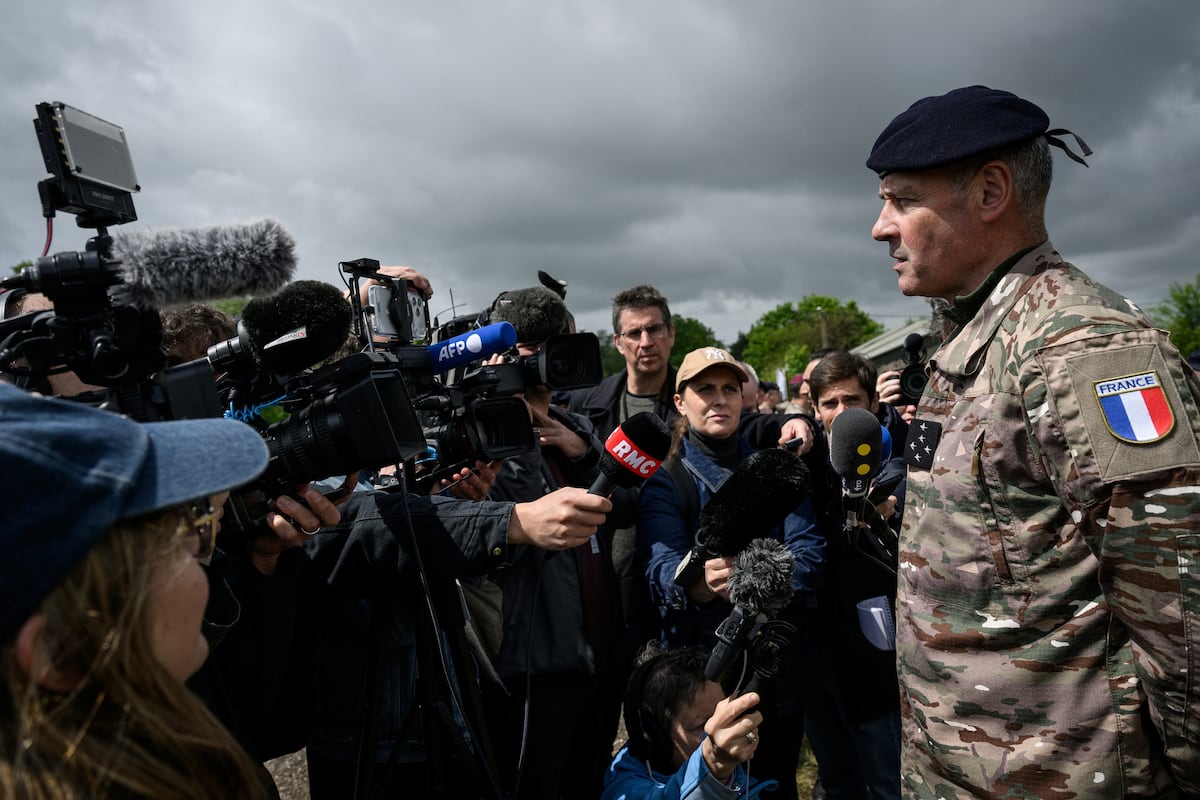
PARIS — French Army Chief of Staff Gen. Pierre Schill, in the job since July 2021, has led the country’s land forces in a push toward higher readiness and preparation for high-intensity warfare, incorporating lessons from Ukraine while preparing for networked and drone-enabled conflict.
In an interview ahead of the Eurosatory defense show here , which runs June 15-19, the general discussed how the Army is embedding innovation and adapting to a rapidly evolving battlefield.
This interview has been edited for length and clarity.
We’re in a period of accelerating innovation, but armies in peacetime often struggle to move beyond experimentation. How do you ensure adoption at unit level, and where does it still fail?
We are indeed experiencing a tremendous phase of technological acceleration, probably comparable in scale to major historic disruptions such as the Industrial Revolution or the mechanization of warfare in the twentieth century. This transformation is not over; it has probably only just begun.
In this environment, innovation cannot be considered as a final state. There is no such thing as an ‘innovated army.’ Innovation has become a permanent adaptation process. Operational superiority now depends as much on the ability to learn and evolve quickly as on the equipment itself.
To accelerate the transition from innovation to experimentation and then to operational implementation, the French Army relies on two complementary dynamics.
The first is ‘bottom-up’ innovation, based on pioneering spirit, initiative and the ability of units to adapt their practices and equipment in response to operational realities. Recent conflicts show that this tactical agility has become decisive.
The second is ‘top-down’ innovation, structured around the Future Combat Command, operational feedback and overall capability coherence. It allows us to direct efforts, establish priorities and integrate useful developments into a broader vision of future warfare.
The brigade exploratory hubs ensure the connection between these two dynamics. They enable rapid transformation of experimentation into concrete operational capabilities. The ‘subsidiarity funding mechanisms’ now allocated to them are proving to be a highly effective tool for accelerating acquisition and battlefield adaptation. We probably need more agile and reactive acquisition models to maintain operational advantage.
Armies often prepare for the last war. What is the French Army most at risk of over-learning from Ukraine, and how are you avoiding that?
The war in Ukraine is a tremendous source of lessons, but the first risk would be to turn it into the single model for future warfare.
A member of the 19th Artillery Brigade sits atop an armored vehicle during the Toll 25 exercise in the "Ile du Levant" firing site of the French DGA on Nov. 25, 2025. (Clement Mahoudeau / AFP via Getty Images)
What Ukraine demonstrates first is the spectacular acceleration of certain forms of warfare: drones, electronic warfare, battlefield transparency, data exploitation, artificial intelligence and the partial automation of tactical functions. However, at the same time, this war also shows that older, even archaic, forms of combat have not disappeared. Trenches, door-to-door urban fighting, attrition and close combat remain very concrete realities. The lesson is the superposition of forms of warfare rather than the replacement of old forms by new ones. Technology changes the methods of combat, but it does not replace maneuver, command, morale or the ability to endure over time.
We should avoid excessive analogies. France is not Ukraine. France is a nuclear power, a member of NATO, and relying on a full-spectrum military model. We are not facing the prospect of a massive enemy land invasion on our territory under the same strategic conditions as Ukraine. The French model must preserve its own coherence which means that the French Army remains able to operate across the three strategic spaces that now structure our commitments: homeland protection, operations in overseas territories and crisis zones, and high-intensity coalition warfare, for instance in Europe. This requires maintaining a versatile, adaptable and balanced force rather than one specialized in a single form of conflict.
You’ve set a goal for an “armée de combat,” or warfighting-ready army. What training has changed because of Ukraine, what did the Orion 26 exercise confirm or challenge, and what have you deliberately avoided changing?
Training has evolved toward greater realism, dispersion and friction. Units now train in disputed environments under the constant threat of drones, electronic jamming, deep strikes and information saturation.
We have also reinforced command training in degraded environments, headquarter protection, mobility, logistic survivability and combined-arms coordination.
Orion 26 confirmed the relevance of the French Army’s transformation plan. The plan that had been established was the right one. The exercise validates the need for coherent large formations capable of sustaining command over time, operating in coalition and maintaining very high operational tempos. It also confirms that the effort must focus first on differentiating capabilities, those that provide operational superiority: lethality, battlefield transparency, command and control, and sustainment. The priority is lethality, particularly deep fires.
If the French Army’s planned war-ready division in 2027 were assessed today, what capabilities would still be missing, and which would be hardest to generate in a crisis?
The coherence of a modern division does not rely solely on maneuver brigades. The most critical capabilities are often those that enable maneuver itself: deep fires, air defense, electronic warfare, command systems, logistics, bridging, mobility, maintenance and counter-drone warfare.
These are precisely the areas in which the French Army is now accelerating its effort. The updated Military Programming Law focuses on strengthening these differentiating capabilities for the divisions and the army corps.
The hardest capabilities to generate rapidly in a crisis are those requiring long-term preparation: heavy logistics, experienced command chains, stockpiles, specialized technical expertise. An army cannot be improvised when the shock comes.
Drones and intelligence, surveillance and reconnaissance have made the battlefield far more transparent and have constrained movement in Ukraine. How do you still achieve surprise, and what changes are needed to restore operational maneuver?
Surprise is not disappearing; it is changing in nature. On a more transparent battlefield, it relies less on total invisibility and more on speed, deception, dispersion, saturation and the ability to disrupt the enemy faster than he can adapt.
This requires several evolutions: stronger electronic warfare capabilities, signature reduction, hybridized networks, dispersed headquarters, faster decision loops and autonomous systems capable of operating in highly contested environments. We should also restore operational depth in maneuver. The combination of drones, robotics, long-range fires, electronic warfare and mobility should precisely recreate opportunities for breakthrough and movement. This will be one of the key challenges of land warfare in the coming decade, and a central topic at Eurosatory.
Scorpion (the French Army’s vehicle modernization program) increases connectivity but also creates complexity and risk of overload. In a degraded environment, what fails first, systems or humans, and how should the Army adapt decision-making and automation?
The risk exists in both domains. Systems can be jammed, degraded or saturated. The accumulation of information and the tempo of modern combat can also overwhelm soldiers. The answer is to use technology to simplify decision-making rather than complicate it. Artificial intelligence should help prioritize information, accelerate some tasks and reduce the cognitive load, preserving the commander’s ability to decide.
Technology enhances combat power; it must not create absolute dependency. This is precisely why ‘commanding by intent’ remains at the core of our model. The commander sets the objective, gives meaning and defines the global framework of the action, but initiative belongs to the subordinates. In a degraded, dispersed and saturated environment, this operational subsidiarity becomes a condition for effectiveness.
A French Foreign Legion paratrooper loads a camouflaged Serval armored vehicle at the end of a trench assault drill during exercise Libecciu 2026, in La Courtine, central France, on May 13, 2026. (Philippe Lopez / AFP via Getty Images)
In war, the objective comes first: What matters is mission success. Technical systems may support decision-making, but they will never replace the commander’s responsibility, moral strength or the culture of results that remains at the foundation of military command.
France aims to act as a framework nation capable of commanding major European land operations. Without U.S. enablers or command structures, what are the main gaps Europe still needs to close?
The message now addressed by the U.S. to Europeans is clear: Europe must take greater responsibility for its own defense. This does not call NATO into question. NATO remains the framework for collective defense on the continent, but it does require strengthening Europe’s ability to act more independently whenever circumstances demand it.
Europe possesses high-quality armed forces, real operational experience and a strong defense industrial and technological base. The challenge now is one of coherence, responsiveness and mass.
Contemporary conflicts remind us that the ability to sustain command over time, produce rapidly, support major military efforts and operate effectively in coalition has once again become essential. The issue is therefore at the same time operational, industrial and cultural. Europeans must rebuild production capacity, stockpiles and endurance compatible with today’s strategic realities.
They must also develop stronger shared habits of training. In this regard, France assumes a specific responsibility as a credible framework nation capable of commanding a land coalition. Our ambition is not to replace our allies, but to contribute to a stronger Europe, more capable of shaping its own strategic destiny.
How does Pendragon (the French project developing robotized ground combat) shape your expectations for the Main Ground Combat System? Where will future firepower sit, on crewed platforms or the unmanned systems that support them?
Recent conflicts have shown that the tank remains indispensable, but it can no longer be an isolated platform. What a single tank achieves today will tomorrow be generated by an interconnected combination of manned and unmanned systems.
This is precisely what Pendragon reveals: robotics is not an additional capability, it changes the way warfare itself is conducted. The central issue becomes the combat cloud, connectivity and cooperation between systems rather than a single platform. The new armored combat system remains relevant if it is conceived as a system of systems integrated into the TITAN environment of the 2030–2040 decade. Future firepower will rely on a combination of highly protected manned platforms able to decide and breakthrough, paired with swarms of autonomous systems providing mass, sensors, saturation and attrition.
Rudy Ruitenberg is a Europe correspondent for Defense News. He started his career at Bloomberg News and has experience reporting on technology, commodity markets and politics.
巴黎——自 2021 年 7 月上任以来,法国陆军总参谋长皮埃尔·希尔将军一直领导着法国陆军,致力于提高战备水平,为高强度战争做好准备,同时吸取乌克兰战争的经验教训,为网络化和无人机作战做好准备。
在 6 月 15 日至 19 日于此地举行的欧洲防务展 (Eurosatory) 开幕前夕的一次采访中,这位将军讨论了陆军如何将创新融入战场,并适应快速变化的战场环境。
为了篇幅和清晰度,本次采访内容经过编辑。
我们正处于创新加速发展的时期,但和平时期的军队往往难以摆脱试验阶段。如何确保部队层面能够采纳新技术?而这些新技术又在哪些方面存在不足?
我们确实正经历着一场巨大的技术加速发展阶段,其规模或许可以与工业革命或20世纪战争机械化等重大历史变革相媲美。这场变革尚未结束,或许才刚刚开始。
在这种环境下,创新不能被视为最终状态。不存在所谓的“创新型军队”。创新已成为一个持续适应的过程。作战优势如今不仅取决于装备本身,更取决于快速学习和发展的能力。
为了加快从创新到实验再到作战实施的过渡,法国陆军依靠两种互补的动力。
第一种是“自下而上”的创新,它基于开拓精神、主动性和部队根据作战实际情况调整战术和装备的能力。近期冲突表明,这种战术灵活性已成为决定性因素。
第二种是“自上而下”的创新,其核心是未来作战司令部、作战反馈和整体能力一致性。这种创新模式使我们能够指导工作方向、确定优先事项,并将有益的发展成果融入到更广阔的未来战争愿景中。
旅级探索中心确保了这两种动态之间的联系。它们能够将实验成果迅速转化为具体的作战能力。目前分配给它们的“辅助性资金机制”已被证明是加速装备采购和战场适应的高效工具。我们或许需要更加灵活、反应迅速的采购模式来保持作战优势。
军队往往会为上一场战争做准备。法国军队最有可能从乌克兰战争中吸取哪些过度经验?你们又是如何避免这种情况发生的?
乌克兰战争是一个巨大的经验教训来源,但第一个风险是将其变成未来战争的唯一模式。
2025年11月25日,在法国国防装备总局(DGA)位于莱万岛的射击场举行的“Toll 25”演习中,第19炮兵旅的一名士兵坐在装甲车上。(Clement Mahoudeau / AFP via Getty Images)
乌克兰战争首先展现的是某些战争形式的惊人加速发展:无人机、电子战、战场透明化、数据挖掘、人工智能以及战术功能的局部自动化。然而,与此同时,这场战争也表明,一些较为陈旧甚至过时的作战方式并未消失。战壕、巷战、消耗战和近身肉搏依然是战场上非常现实的作战方式。这场战争的教训在于,战争形式是多种形式的叠加,而非新形式取代旧形式。技术改变了作战方式,但它无法取代机动性、指挥能力、士气以及持久作战的能力。
我们应避免过度类比。法国并非乌克兰。法国是核大国,是北约成员国,并采用全方位军事模式。我们面临的战略形势与乌克兰截然不同,不会遭遇大规模敌军入侵。法国模式必须保持自身的连贯性,这意味着法国军队必须能够在构成我们当前军事承诺的三大战略领域开展行动:国土安全、海外领土和危机地区的行动,以及高强度联合作战,例如在欧洲的作战。这就要求我们维持一支多用途、适应性强且平衡的军队,而不是一支专精于单一冲突形式的军队。
你们的目标是打造一支“具备作战能力的军队”。由于乌克兰局势,训练方面发生了哪些变化?“猎户座26”演习证实或挑战了哪些方面?你们又刻意避免了哪些改变?
训练已朝着更加贴近实战、分散化和对抗化的方向发展。部队现在在充满争议的环境中进行训练,时刻面临着无人机、电子干扰、纵深打击和信息饱和的威胁。
我们还加强了在恶劣环境下的指挥训练、总部保护、机动性、后勤生存能力和联合兵种协调能力。
“猎户座26”演习证实了法国陆军转型计划的必要性。该计划是正确的。演习验证了组建能够长期维持指挥、协同作战并保持极高作战节奏的协调一致的大型部队的必要性。演习还确认,首要任务是提升部队的差异化能力,即那些能够带来作战优势的能力:杀伤力、战场透明度、指挥控制和后勤保障。杀伤力,特别是纵深火力,是重中之重。
如果今天对法国陆军计划在 2027 年组建的战备师进行评估,会发现还缺少哪些能力,以及在危机中哪些能力最难获得?
现代师的协同作战能力并非仅仅依赖于机动旅。最关键的能力往往是那些能够保障机动本身的能力:纵深火力、防空、电子战、指挥系统、后勤保障、架桥、机动性、维护和反无人机作战。
这些正是法国陆军目前正加紧努力的领域。修订后的《军事规划法》着重加强各师和军的这些差异化能力。
危机中最难迅速建立的能力是那些需要长期准备的能力:强大的后勤保障、经验丰富的指挥系统、充足的物资储备以及专业的技术专长。军队无法在危机来临时临时组建。
无人机和情报、监视与侦察手段使战场变得更加透明,并限制了乌克兰境内的行动。如何才能继续保持突袭效果?需要做出哪些改变才能恢复作战机动性?
奇袭并未消失,而是改变了性质。在日益透明的战场上,奇袭不再依赖于完全隐蔽,而是更多地依赖于速度、欺骗、分散、饱和攻击以及在敌人反应过来之前就扰乱其节奏的能力。
这需要多项变革:更强大的电子战能力、更低的特征信号、混合网络、分散式指挥中心、更快的决策循环以及能够在高度对抗环境中作战的自主系统。我们还应恢复机动作战纵深。无人机、机器人、远程火力、电子战和机动性的结合,应能精准地创造突破和机动的机会。这将是未来十年陆地战争面临的关键挑战之一,也是欧洲防务展的核心议题。
“蝎子”(法国陆军的车辆现代化项目)提高了互联互通性,但也带来了复杂性和过载风险。在环境恶化的情况下,系统和人员哪个会先出现故障?陆军应该如何调整决策和自动化流程?
风险在两个领域都存在。系统可能受到干扰、性能下降或饱和。信息的积累和现代战争的节奏也可能使士兵不堪重负。解决之道在于利用技术简化决策过程,而不是使其复杂化。人工智能应有助于对信息进行优先级排序、加快某些任务的处理速度并减轻认知负荷,从而保障指挥官的决策能力。
技术增强了作战能力,但绝不能造成绝对依赖。正因如此,“意图指挥”仍然是我们模式的核心。指挥官设定目标,赋予目标意义,并界定行动的总体框架,但主动权属于下属。在资源匮乏、分散且饱和的环境中,这种作战上的辅助性原则成为作战效能的必要条件。
2026年5月13日,在法国中部拉库尔蒂讷举行的“利贝丘2026”演习中,一名法国外籍军团伞兵在战壕突击演练结束后,正在装载一辆伪装的“薮猫”装甲车。(图片来源:Philippe Lopez / AFP via Getty Images)
在战争中,目标至上:任务成功才是最重要的。技术系统或许能够辅助决策,但它们永远无法取代指挥官的责任感、道德力量以及作为军事指挥基石的以结果为导向的文化。
法国的目标是成为一个能够指挥欧洲重大陆地行动的框架国家。在没有美国的支持或指挥体系的情况下,欧洲还需要弥补哪些主要差距?
美国现在向欧洲传递的信息很明确:欧洲必须承担更大的防务责任。这并非质疑北约。北约仍然是欧洲大陆集体防御的框架,但这确实要求欧洲在必要时增强独立行动的能力。
欧洲拥有高素质的武装力量、丰富的实战经验以及强大的国防工业和技术基础。现在的挑战在于如何实现协调一致、快速反应和大规模部署。
当代冲突提醒我们,长期维持指挥能力、快速生产能力、支持大规模军事行动的能力以及在联盟中有效作战的能力再次变得至关重要。因此,这个问题同时涉及作战、工业和文化层面。欧洲人必须重建与当今战略现实相适应的生产能力、库存和持久作战能力。
他们还必须培养更牢固的共同训练习惯。在这方面,法国作为一支能够指挥陆地联盟的可靠框架国家,承担着特殊的责任。我们的目标不是取代盟友,而是为建设一个更强大的欧洲做出贡献,使其更有能力塑造自身的战略命运。
法国的“潘德拉贡”(Pendragon)项目(旨在开发机器人地面作战系统)如何影响您对主战地面作战系统的预期?未来的火力将集中在有人驾驶平台上,还是集中在支持它们的无人系统上?
近期的冲突表明,坦克仍然不可或缺,但它不再能作为孤立的作战平台。今天一辆坦克所能取得的成就,明天将需要有人和无人系统相互协作才能实现。
这正是“潘德拉贡”计划所揭示的:机器人技术并非一种附加能力,它改变了战争本身的进行方式。核心问题不再是单一平台,而是作战云、系统间的互联互通与协同作战。如果将新型装甲作战系统视为一个系统之系统,并融入2030-2040年代的“泰坦”作战环境,那么它仍然具有现实意义。未来的火力将依赖于高防护、能够决断和突破的有人平台,以及提供数量、传感器、饱和攻击和消耗战能力的自主系统集群。
鲁迪·鲁伊滕贝格是《防务新闻》的欧洲记者。他的职业生涯始于彭博新闻社,拥有报道科技、大宗商品市场和政治方面的经验。