Cloaked in grey: The causes and effects of haze in Singapore笼罩在灰色之中:新加坡雾霾的成因和影响
The Straits Times clears the air on how the haze situation escalated and how Singapore and the region are responding. Read more at straitstimes.com.
新闻视频
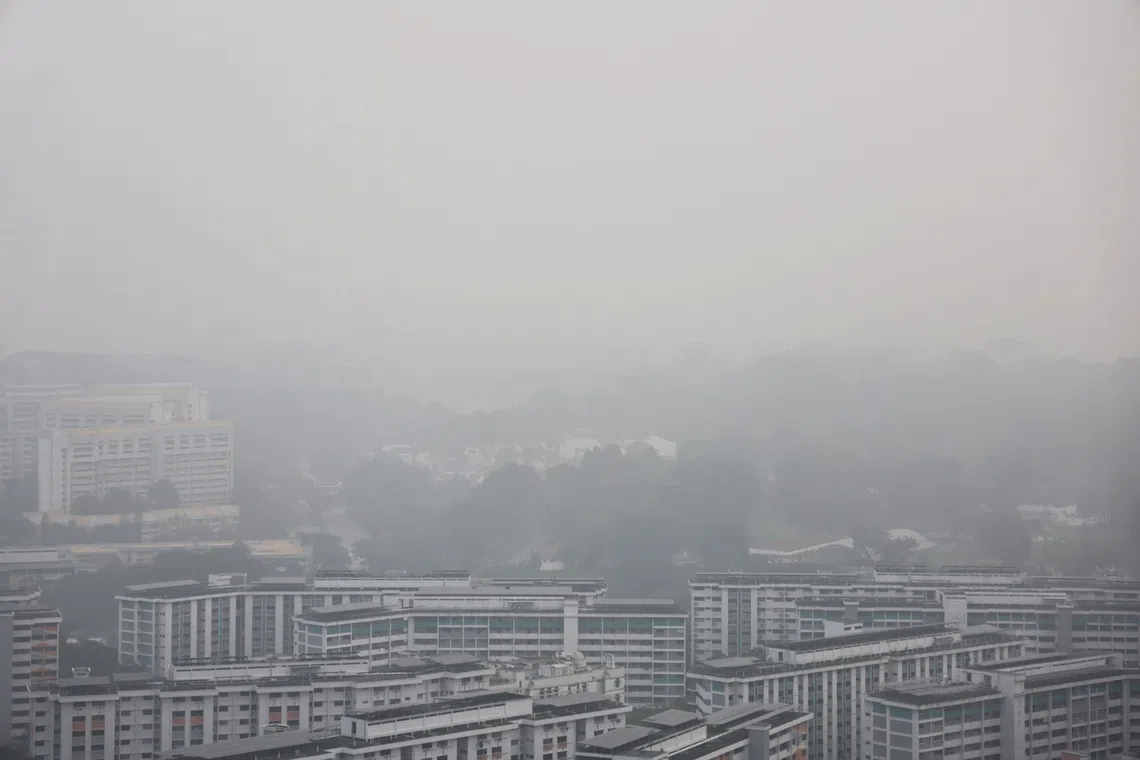
Hazy conditions seen from Clementi rea at about 7.10am on Oct 17.
ST PHOTO: KELVIN CHNG
Published Oct 18, 2026, 05:00 AM
Updated Oct 18, 2026, 05:00 AM
SINGAPORE - The Republic is experiencing its worst bout of transboundary haze in more than a decade.
Singapore should brace itself for hazy conditions to persist in the near future, with the possibility of air quality reaching hazardous levels where the Pollutant Standards Index readings exceed 300, Minister for Sustainability and the Environment Grace Fu said on Oct 16.
The Straits Times clears the air on how the haze situation escalated and how Singapore and the region are responding.
What is causing the haze?
The root cause of the haze blanketing Singapore and Malaysia is the fires raging on forest and plantation land in Indonesia .
Most blazes are sparked by slash-and-burn agriculture practices, where farmers use fire to clear land. This is illegal, but still carried out as it is much cheaper than using excavators.
While this happens regularly, the situation has worsened owing to the confluence of three factors.
1. Traditional dry season in ASEAN
The equatorial ASEAN region is in its annual dry season, which usually lasts from June to September.
The 2026 dry season has been prolonged by the ongoing El Nino phenomenon , causing a “double whammy” of hot weather drivers.
Winds blow from the south, where Indonesia is, bringing smoke haze to Singapore and Malaysia.
The 2026 El Nino could be among the strongest since at least 1950 .
El Nino brings hotter and drier conditions to Singapore and South-east Asia.
The last Godzilla El Nino was in 2015, which saw the region’s most severe haze crisis.
3. Large-scale drainage of peatlands
Unlike ordinary forest soil, peat is naturally waterlogged, accumulating partially decayed plants, roots and branches over thousands of years.
Although peatlands cover just 3% of the earth’s land surface, they store twice as much carbon as all the world’s forests combined.
Indonesia is home to the world’s largest tropical peatlands, mostly across Sumatra, Kalimantan and Papua.
But as cash crops such as oil palm and pulpwood do not grow well in waterlogged soil, peatlands are often drained to be converted into plantations.
When this happens, peatlands release carbon locked in them back into the atmosphere.
Parched peat can be a vast tinderbox, with the exposed organic content serving as fodder for fire.
When dry peat catches fire, the flames can smoulder underground – up to several metres deep – for months. This is why the smoke usually does not let up until the rainy monsoon season reaches Indonesia around November and December.
As at Oct 14, the Indonesian police have named more than 200 people and nine companies as suspects in forest and land fire cases across the country. More than 50 business entities have also been sealed off for fire-related violations.
What are the effects of severe haze?
GPs have seen have seen 20% to 30% more patients with haze-related symptoms. PHOTO: LIANHE ZAOBAO
GPs have seen have seen 20% to 30% more patients with haze-related symptoms.
PHOTO: LIANHE ZAOBAO
The haze has impacted health across Indonesia, Malaysia and Singapore.
Singapore’s Ministry of Health has reported a small spike in visits to clinics and emergency rooms due to haze-related health issues, such as runny nose, sore throat, sneezing, conjunctivitis, asthma and respiratory issues.
General practitioners have seen 20% to 30% more patients with such symptoms, and the spike in haze-related cases is overlapping with the Influenza A season.
Singapore has activated its Haze Subsidy Scheme , under which all Singapore citizens will pay no more than $10 when they seek treatment at polyclinics for haze-related ailments. Pioneer Generation and Merdeka Generation seniors will have their out-of-pocket costs capped at $5.
Travellers waiting at Sultan Abdul Aziz Shah Airport in Subang, Malaysia, on Oct 13. Worsening haze and low visibility have forced airlines to delay and divert flights across the region, including Firefly which cancelled several flights to and from Subang in Malaysia and Seletar Airport in Singapore. PHOTO: AFP
Travellers waiting at Sultan Abdul Aziz Shah Airport in Subang, Malaysia, on Oct 13. Worsening haze and low visibility have forced airlines to delay and divert flights across the region, including Firefly which cancelled several flights to and from Subang in Malaysia and Seletar Airport in Singapore.
Worsening haze and low visibility have forced airlines to delay and divert flights across the region.
Among those, Firefly cancelled several flights to and from Subang in Malaysia and Seletar Airport in Singapore.
In Indonesia, thick smog has made helicopter fire fighting operations challenging.
Contingency measures
Free N95 face masks being distributed to vulnerable groups, including the elderly, at Kallang Community Club on Oct 15. ST PHOTO: JASON QUAH
Free N95 face masks being distributed to vulnerable groups, including the elderly, at Kallang Community Club on Oct 15.
ST PHOTO: JASON QUAH
Singapore is distributing N95 masks to vulnerable Singaporeans and making air-conditioned shelters available at community clubs and selected Residents’ Network and Residents’ Committee centres.
In Indonesia, 5.3 million masks have been distributed to communities affected by the fires. Around 300 pieces of oxygen equipment were dispatched to hardest-hit areas in September.
Daily lives disrupted
Hazy conditions in Johor Bahru on Oct 8. ST PHOTO: KELVIN CHNG
Hazy conditions in Johor Bahru on Oct 8.
Schools in Johor Bahru were closed for some days in October.
Some schools in Singapore have cut back on outdoor activities and cancelled co-curricular activities, with students eating indoors during recess.
All outdoor and non-air-conditioned facilities at all ActiveSG Sport Centres were temporarily closed on Oct 16 .
Protests have spread across parts of Indonesia as frustration grows over the government’s handling of the fires, with demands for stronger fire fighting efforts, tougher action against companies and greater protection for affected communities.
Some West Kalimantan residents are suing the Indonesian authorities for “gross negligence” that has resulted in a massive public health crisis.
Singapore has issued legal notices to seven companies requesting that they stop the burning on their land in Indonesia and submit plans to extinguish the fires.
10 月 17 日上午 7 点 10 分左右,金文泰地区出现雾霾天气。
《海峡时报》摄影:KELVIN CHNG
发布于 2026 年 10 月 18 日上午 5:00
更新于2026年10月18日上午5:00
新加坡——该国正经历十多年来最严重的跨境雾霾。
新加坡永续发展及环境部长傅海燕于10月16日表示,新加坡应做好准备,应对近期持续的雾霾天气,空气质量有可能达到危险水平,污染物标准指数读数超过300。
《海峡时报》澄清了雾霾局势升级的原因以及新加坡和该地区的应对措施。
是什么原因导致了雾霾?
新加坡和马来西亚笼罩在雾霾中的根本原因是印度尼西亚森林和种植园的火灾。
大多数火灾都是由刀耕火种的农业耕作方式引起的,农民用火来清理土地。这种做法是非法的,但由于比使用挖掘机便宜得多,所以仍然被广泛采用。
虽然这种情况经常发生,但由于三个因素的共同作用,情况已经恶化。
1. 东盟的传统旱季
赤道附近的东盟地区正处于一年一度的旱季,通常从六月持续到九月。
受厄尔尼诺现象持续影响,2026 年旱季延长,导致高温天气因素“双重打击”。
风从印度尼西亚所在的南方吹来,给新加坡和马来西亚带来了烟雾。
2026 年的厄尔尼诺现象可能是自 1950 年以来最强的一次。
厄尔尼诺现象给新加坡和东南亚带来更炎热干燥的气候。
上一次哥斯拉厄尔尼诺现象发生在 2015 年,当时该地区遭遇了最严重的雾霾危机。
3. 大规模泥炭地排水
与普通的森林土壤不同,泥炭地天然含水量高,经过数千年积累了部分腐烂的植物、根和树枝。
虽然泥炭地仅占地球陆地面积的3%,但它们储存的碳量却是全世界所有森林碳储存量总和的两倍。
印度尼西亚拥有世界上最大的热带泥炭地,主要分布在苏门答腊岛、加里曼丹岛和巴布亚岛。
但由于油棕和纸浆材等经济作物在积水的土壤中生长不良,泥炭地经常被排干水分,改造成种植园。
当这种情况发生时,泥炭地会将储存在其中的碳释放回大气中。
干涸的泥炭就像一个巨大的火药桶,裸露的有机物会成为火灾的燃料。
干燥的泥炭着火后,火焰会在地下阴燃数月之久,深度可达数米。这就是为什么烟雾通常要等到11月至12月雨季来临,印尼的雨季到来时才会消散的原因。
截至10月14日,印尼警方已将200多名个人和9家公司列为全国森林和土地火灾案件的嫌疑人。另有50多家企业因涉嫌违反消防法规而被查封。
严重雾霾会造成哪些影响?
全科医生接诊的雾霾相关症状患者增加了20%至30%。图片来源:联合早报
全科医生发现,出现雾霾相关症状的患者增加了 20% 到 30%。
图片来源:联合早报
雾霾已经影响到印度尼西亚、马来西亚和新加坡的民众健康。
新加坡卫生部报告称,由于雾霾引起的健康问题,如流鼻涕、喉咙痛、打喷嚏、结膜炎、哮喘和呼吸系统疾病,前往诊所和急诊室就诊的人数略有增加。
全科医生接诊的出现此类症状的患者增加了 20% 到 30%,而且与雾霾相关的病例激增与甲型流感季节重叠。
新加坡已启动雾霾补贴计划,根据该计划,所有新加坡公民在综合诊所就诊雾霾相关疾病时,自付费用不超过10新元。建国一代和独立一代的老年人,自付费用上限为5新元。
10月13日,旅客在马来西亚梳邦苏丹阿卜杜勒·阿齐兹·沙阿机场候机。日益严重的雾霾和低能见度迫使航空公司延误或改道该地区的航班,其中包括飞萤航空,该公司取消了往返马来西亚梳邦和新加坡实里达机场的多个航班。图片:法新社
10 月 13 日,旅客在马来西亚梳邦苏丹阿卜杜勒·阿齐兹·沙阿机场候机。日益严重的雾霾和低能见度迫使航空公司延误和改道该地区的航班,其中包括飞萤航空,该公司取消了往返马来西亚梳邦和新加坡实里达机场的多个航班。
雾霾加剧,能见度降低,迫使航空公司延误或改道该地区的航班。
其中,飞萤航空取消了往返马来西亚梳邦机场和新加坡实里达机场的多趟航班。
在印度尼西亚,浓重的雾霾使直升机灭火行动面临挑战。
应急措施
10月15日,加冷民众俱乐部向包括老年人在内的弱势群体免费发放N95口罩。(海峡时报摄影:JASON QUAH)
10月15日,加冷民众俱乐部向包括老年人在内的弱势群体免费发放N95口罩。
《海峡时报》摄影:JASON QUAH
新加坡正在向弱势新加坡人分发 N95 口罩,并在民众俱乐部和部分居民网络及居民委员会中心提供空调避难所。
在印度尼西亚,已向受火灾影响的社区分发了530万个口罩。9月份,约300套氧气设备被运往受灾最严重的地区。
日常生活被打乱
10月8日,新山出现雾霾天气。(海峡时报摄影:KELVIN CHNG)
10月8日,新山出现雾霾天气。
10月份,新山的学校停课了几天。
新加坡的一些学校减少了户外活动,取消了课外活动,学生们在课间休息时都在室内用餐。
10月16日,ActiveSG所有体育中心的所有室外和非空调设施暂时关闭。
随着民众对政府处理火灾的方式越来越不满,抗议活动已蔓延至印度尼西亚部分地区,民众要求加大灭火力度,对相关公司采取更严厉的措施,并为受灾社区提供更好的保护。
西加里曼丹部分居民起诉印尼当局,指控其“严重疏忽”导致大规模公共卫生危机。
新加坡已向七家公司发出法律通知,要求它们停止在印度尼西亚土地上的焚烧行为,并提交灭火计划。