‘Failure points you to the solution’: Students win HTX award for pushing past setbacks in research“失败能指引你找到解决方案”:学生因克服科研挫折而荣获HTX奖
HTX award winners share how setbacks in STEM research led to new directions and perseverance in projects on cancer and water pollution. Read more at straitstimes.com.
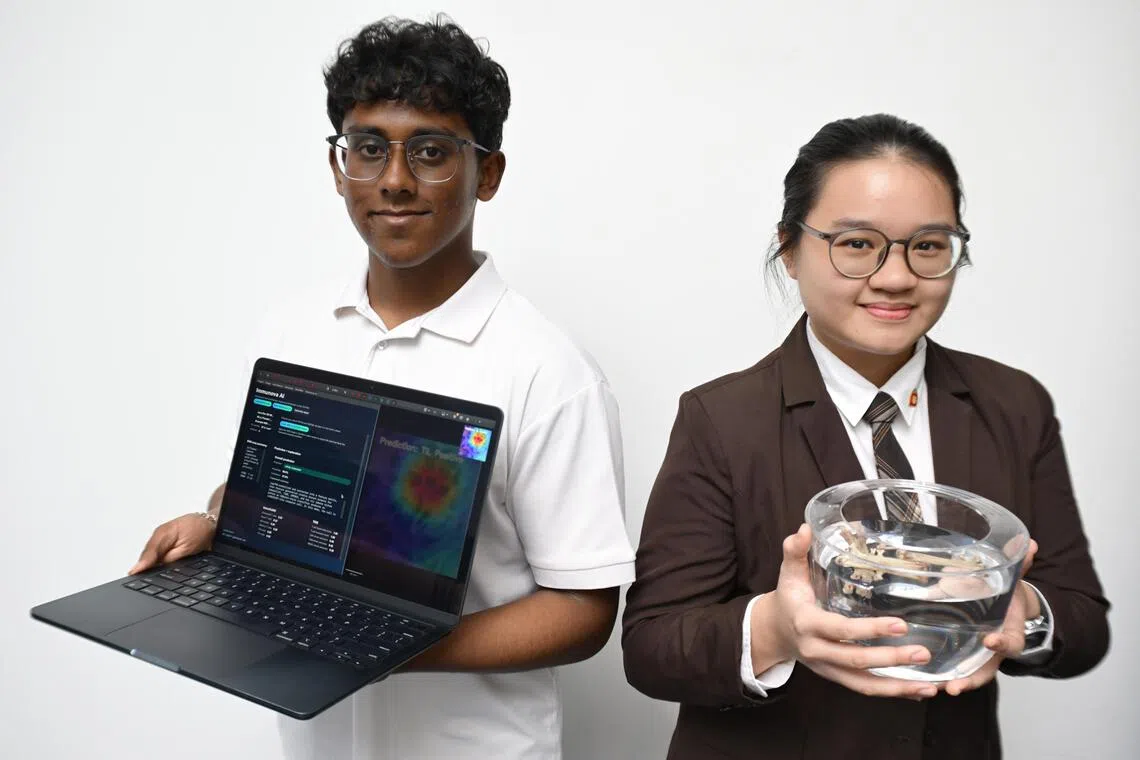
Aneesh Bondugula (left) developed an AI project to predict how patients will respond to cancer immunotherapy, while Shavonne Tok explored the use of discarded chicken bones to remove dye pollutants from water.
ST PHOTO: NG SOR LUAN
Published Oct 18, 2026, 12:00 PM
Updated Oct 18, 2026, 12:00 PM
HTX gave its first Undaunted Student Award to five students who kept going after research setbacks. The pilot drew 14 applications from three schools.
Aneesh Bondugula is training an AI model that can predict how cancer patients will respond to immunotherapy. His model initially failed on Asian data, but he changed direction and is now working with hospitals in Southeast Asia to test his project.
Shavonne Tok’s team found chicken bones could remove dye from water, but failed to do the same with silicon nanoparticles. She said research failure can still point to useful answers.
SINGAPORE – Six months into building an artificial intelligence model to help doctors select suitable patients for immunotherapy, a cancer treatment, Aneesh Bondugula faced a setback that made him rethink the project.
His team’s model, trained on patient data from The Cancer Genome Atlas, performed well when tested against other data from the same repository. But its accuracy dropped when tested against a separate Asian dataset, said the 18-year-old.
“The first thing I felt was panic,” said Aneesh, a Year 6 student at NUS High School of Mathematics and Science. “It was a lot of work that we had done during those six months.”
As the team changed direction, members left. At several points, he considered dropping the project.
But he pushed on. His perseverance has earned him recognition as one of five recipients of the first Undaunted Student Award by the Home Team Science and Technology Agency (HTX). The award recognises students who persist through setbacks in science, technology, engineering and mathematics (STEM) projects.
The first such award involved three partner schools and drew 14 applications. Recipients receive a $4,000 cash prize each and opportunities to participate in HTX’s internship programme.
The Undaunted Award was created in 2023 to recognise unsuccessful initiatives by HTX staff, in the hope that these efforts would lead to successful projects that government agencies can use. The Undaunted Student Award is a newer extension of this initiative, aimed at recognising students who demonstrate similar perseverance.
HTX, a statutory board under the Ministry of Home Affairs, develops science and technology solutions for public safety and security.
The agency’s human resources director Lim Puay Sze said the agency was already engaging STEM students through career fairs and wanted to share its values with them, particularly the willingness to persevere through failure in research.
To do so, HTX rolled out the competition with NUS High School of Mathematics and Science, Nanyang Junior College and the School of Science and Technology, Singapore.
Lim said the judging placed emphasis on “failing forward” – the lessons students learnt from setbacks and how these informed their next steps.
The agency hopes that sharing such experiences will normalise conversations about failure and build resilience among students. It plans to extend the annual award to more schools.
Aneesh was inspired by his internship at A*STAR in 2024 to start an ambitious project to combine tumour images, genomic and clinical patient data to help predict whether patients will respond to immunotherapy, a treatment that helps the immune system fight cancer.
Aneesh was inspired by his internship at A*STAR in 2024 to start an ambitious project to combine tumour images, genomic and clinical patient data to help predict whether patients will respond to immunotherapy. ST PHOTO: NG SOR LUAN
Aneesh was inspired by his internship at A*STAR in 2024 to start an ambitious project to combine tumour images, genomic and clinical patient data to help predict whether patients will respond to immunotherapy.
He said current diagnostic methods are not sufficiently accurate in predicting which patients would respond well to immunotherapy.
He was also moved by what patients told him when he was volunteering in a hospice.
“They’re not very confident about the decisions that they make when they choose their treatments. It’s a very large burden for them to bear.”
When Aneesh and his team encountered their roadblock, they initially suspected a problem with how they were training the model.
After consulting mentors, they realised that the older dataset lacked information the model needed, including certain gene data and patients’ past treatments.
They decided to shift towards newer Asian datasets. Fortunately, Aneesh had earlier built up an international network of mentors and other young people who could advise them and connect them with hospitals and researchers in their respective countries.
It took the team around three months to find Asian datasets and start training the model on them.
“I felt that the problem was worth solving, and a setback in our approach was not a sufficient reason to abandon it.”
“Even though our initial idea wasn’t working, at least we were able to find out what went wrong, and then try to find a new direction.”
Nearly two years into the project, Aneesh sees no fixed end point, preferring to focus on the next step. He is now confirming beta-testing partnerships with some hospitals and cancer centres in South-east Asia.
The aspiring medical student hopes to eventually develop a model reliable enough to be used in hospitals here to help guide treatment decisions.
Can chicken bones help remove dye pollutants?
Shavonne Tok, a JC2 student at Nanyang Junior College, encountered a different set of problems while investigating whether discarded chicken bones could remove dyes from water. ST PHOTO: NG SOR LUAN
Shavonne Tok, a JC2 student at Nanyang Junior College, encountered a different set of problems while investigating whether discarded chicken bones could remove dyes from water.
Another recipient, Shavonne Tok, a JC2 student at Nanyang Junior College, encountered a different set of problems while investigating whether discarded chicken bones could trap and remove dyes from water.
She had wanted to tackle waste and water pollution. Textile dyes from factories can enter water bodies through improper disposal, she explained.
The year-long project, undertaken with a partner through the NUS Science Research Programme, involved scraping tissue off bones to prevent mould. But some bones still developed mould during storage.
Collecting and cleaning the bones was difficult, she said. To obtain more material for larger experiments, the pair bought frozen chicken feet to cook and harvest the bones.
Collecting the 2kg of bones used for the project also meant cooking and eating chicken feet, which Tok does not like.
The pair also had to adjust their approach along the way. While they expected heating to make the bones more porous and improve dye removal, the heated bones performed worse. Examining the bones under a microscope, they found that heating appeared to have caused their porous structure to collapse, Tok said.
Hence, they dropped the heat treatment, simplifying the preparation process, she said.
The pair also tested whether the bones could be used to remove silicon nanoparticles from water, but this yielded no results after two months. Tok said they then decided to focus just on dyes. Negative results could still inform other researchers, she added.
The experience has changed how Tok views failure.
“In school, when you look at bad grades or failing, it’s like a dead end. But when you think about research and failures, the data is pointing you towards the solution to the puzzle.”
Technology and research
Aneesh Bondugula(左)开发了一个人工智能项目,用于预测患者对癌症免疫疗法的反应,而 Shavonne Tok 则探索了利用废弃鸡骨去除水中染料污染物的方法。
圣徒照片:吴索銮
发布于2026年10月18日下午12:00
更新于2026年10月18日中午12:00
HTX首次向五位在科研遭遇挫折后仍坚持不懈的学生颁发了“无畏学生奖”。该试点项目共收到来自三所院校的14份申请。
阿尼什·邦杜古拉正在训练一个人工智能模型,用于预测癌症患者对免疫疗法的反应。他的模型最初在亚洲数据上表现不佳,但他改变了方向,现在正与东南亚的医院合作测试他的项目。
莎沃恩·托克的研究团队发现鸡骨可以去除水中的染料,但硅纳米颗粒却无法达到同样的效果。她表示,研究失败仍然可以为我们提供有用的答案。
新加坡——在构建人工智能模型以帮助医生选择适合免疫疗法(一种癌症治疗方法)的患者六个月后,Aneesh Bondugula 遭遇了一次挫折,这让他重新思考了该项目。
这位18岁的少年说,他的团队利用癌症基因组图谱中的患者数据训练的模型,在用同一数据库中的其他数据进行测试时表现良好。但当用另一个亚洲数据集进行测试时,其准确率却下降了。
“我当时的第一感觉是恐慌,”新加坡国立大学数理中学六年级学生阿尼什说。“我们在过去六个月里做了很多工作。”
随着团队方向的改变,一些成员离开了。他曾多次考虑放弃这个项目。
但他坚持不懈。他的毅力使他荣获内政科技局(HTX)颁发的首届“无畏学生奖”,成为五位获奖者之一。该奖项旨在表彰在科学、技术、工程和数学(STEM)项目中克服挫折、坚持不懈的学生。
首届此类奖项共有三所合作院校参与,共收到14份申请。获奖者每人将获得4000美元现金奖励,并有机会参加HTX的实习项目。
“无畏奖”设立于2023年,旨在表彰HTX员工虽未成功但勇于尝试的创新项目,希望这些努力最终能转化为政府机构可以借鉴的成功项目。“无畏学生奖”是该倡议的延伸,旨在表彰展现出类似毅力的学生。
HTX是内政部下属的法定机构,致力于开发公共安全保障方面的科学技术解决方案。
该机构人力资源总监林培思表示,该机构已经通过招聘会与 STEM 专业学生接触,并希望与他们分享其价值观,特别是研究过程中即使失败也要坚持不懈的精神。
为此,HTX 与新加坡国立大学数学与科学中学、南洋初级学院和新加坡科技学院联合举办了此次比赛。
林表示,评判的重点是“从失败中学习”——学生从挫折中吸取的教训以及这些教训如何影响他们的下一步行动。
该机构希望通过分享此类经历,使学生们能够坦然地谈论失败,并增强他们的韧性。他们计划将这项年度奖项推广到更多学校。
2024 年,Aneesh 在 A*STAR 的实习经历激发了他开展一项雄心勃勃的项目,将肿瘤图像、基因组和临床患者数据结合起来,以帮助预测患者是否会对免疫疗法(一种帮助免疫系统对抗癌症的疗法)产生反应。
2024年,Aneesh在新加坡科技研究局(A*STAR)的实习经历激发了他启动一项雄心勃勃的项目,旨在结合肿瘤图像、基因组和临床患者数据,帮助预测患者对免疫疗法的反应。照片由《海峡时报》拍摄:NG SOR LUAN
2024 年,Aneesh 在 A*STAR 的实习经历激发了他开展一项雄心勃勃的项目,将肿瘤图像、基因组和临床患者数据结合起来,以帮助预测患者是否会对免疫疗法产生反应。
他表示,目前的诊断方法在预测哪些患者对免疫疗法反应良好方面不够准确。
他在临终关怀中心做义工时,也被病人的话语所感动。
“他们在选择治疗方案时,对自己的决定缺乏信心。这对他们来说是一个非常沉重的负担。”
当 Aneesh 和他的团队遇到难题时,他们最初怀疑是模型训练方式出了问题。
在咨询导师后,他们意识到旧的数据集缺少模型所需的信息,包括某些基因数据和患者过去的治疗情况。
他们决定转向使用更新的亚洲数据集。幸运的是,阿尼什此前已经建立了一个国际导师网络,成员包括其他年轻人,他们可以为他们提供建议,并帮助他们与各自国家的医院和研究人员建立联系。
该团队花了大约三个月的时间才找到亚洲数据集,并开始用这些数据集训练模型。
“我觉得这个问题值得解决,我们方法上的挫折不足以成为放弃它的理由。”
“虽然我们最初的想法行不通,但至少我们能够找出问题所在,然后尝试寻找新的方向。”
项目启动近两年,Aneesh 认为没有固定的终点,更愿意专注于下一步。他目前正在与东南亚的一些医院和癌症中心确认合作开展 beta 测试。
这位立志成为医学生的学生希望最终能够开发出一个足够可靠的模型,供本地医院使用,以帮助指导治疗决策。
鸡骨能帮助去除染料污染物吗?
南洋初级学院二年级学生Shavonne Tok在研究废弃鸡骨能否去除水中染料时,遇到了另一系列问题。(海峡时报照片:黄淑銮)
南洋初级学院二年级学生 Shavonne Tok 在调查废弃鸡骨是否可以去除水中的染料时,遇到了另一组问题。
另一位受助者,南洋初级学院二年级学生 Shavonne Tok,在调查废弃的鸡骨头是否可以吸附并去除水中的染料时,遇到了不同的问题。
她一直想解决垃圾和水污染问题。她解释说,工厂排放的纺织染料如果处理不当,就会进入水体。
这项为期一年的项目由新加坡国立大学科学研究计划与合作伙伴共同开展,旨在刮除骨骼上的组织以防止霉菌滋生。但即便如此,一些骨骼在储存过程中仍然长出了霉菌。
她说,收集和清理骨头很困难。为了获得更多材料进行更大规模的实验,他们购买了冷冻鸡爪,煮熟后取出骨头。
收集用于该项目的 2 公斤骨头也意味着要烹饪和食用鸡爪,而 Tok 并不喜欢吃鸡爪。
两人在研究过程中也不得不调整方法。他们原本预期加热会使骨骼更加多孔,从而提高染料去除率,但结果却适得其反。托克说,通过显微镜观察骨骼,他们发现加热似乎导致骨骼的多孔结构坍塌。
因此,他们取消了热处理步骤,简化了制备过程,她说。
两人还测试了这些骨头是否可以用来去除水中的硅纳米颗粒,但两个月后仍未取得任何结果。托克说,他们随后决定只专注于染料的研究。她补充说,即使结果为阴性,也能为其他研究人员提供参考。
这次经历改变了托克对失败的看法。
“在学校里,如果你看到糟糕的成绩或不及格,就好像走到了死胡同。但如果你思考的是研究和失败,你会发现数据正在指引你找到解开谜题的答案。”
技术与研究