Images show new North Korea uranium enrichment plant, analysts say分析人士称,图片显示了朝鲜新的铀浓缩工厂。
The facility has been referenced by the UN system’s nuclear watchdog, the International Atomic Energy Agency.
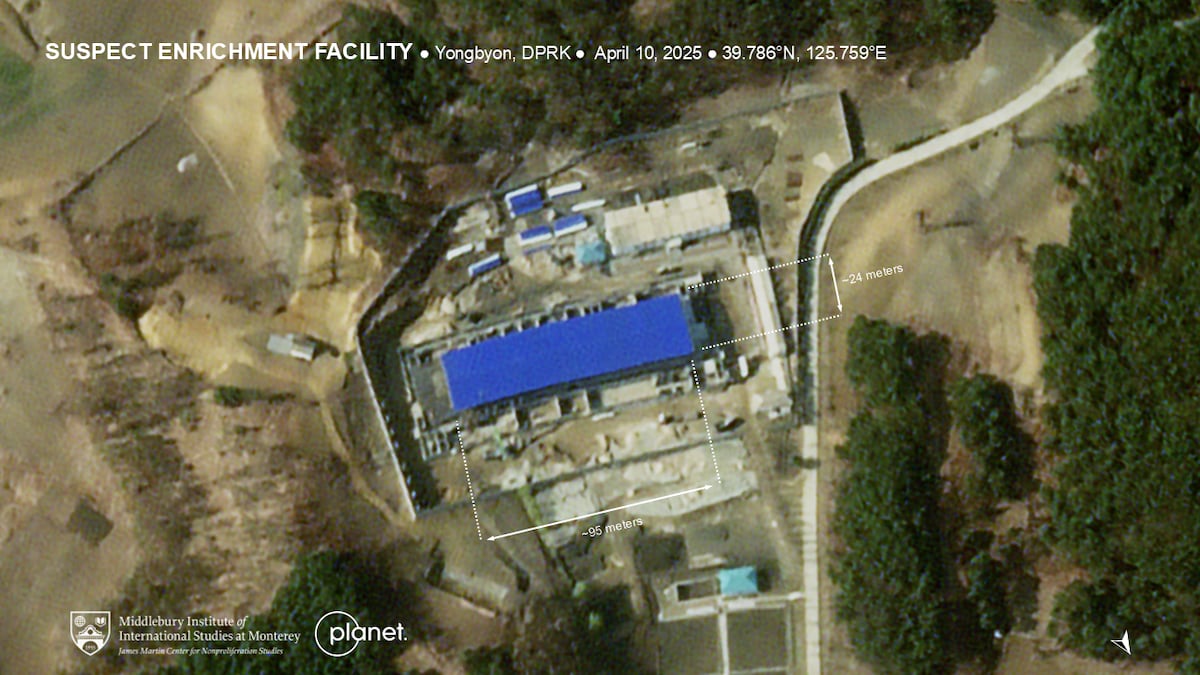
THE HAGUE, Netherlands — North Korea appears to be expanding its nuclear program through the addition of a purpose-built enrichment facility, satellite images show.
The blue-roofed building, 93 meters long and 28 meters wide, may house several thousand centrifuges used to enrich uranium isotopes to weapons-grade material once completed. It is visually almost identical to similar facilities that North Korea already operates and that have provided the uranium for the country’s six nuclear tests and growing arsenal of atomic bombs.
The facility has been referenced by the UN system’s nuclear watchdog, the International Atomic Energy Agency, although it has not yet released any images or extensive public information.
“The Agency is monitoring the construction of a new building at Yongbyon, which has dimensions and features similar to the Kangson enrichment plant,” the IAEA’s director general, Rafael Mariano Grossi, told the organization’s Board of Governors on June 9.
Researchers from the James Martin Center for Nonproliferation, based in Monterey, California, have been the first to publicly identify the site and released annotated satellite images of the location. Using commercial satellite imagery, Defense News has been able to determine that construction on the new building started in mid-February of this year.
According to the California-based experts’ accompanying estimates, the facility, located close to North Korea’s premier nuclear research complex, would be able to add anywhere from 70 to nearly 100 kilograms of highly enriched uranium to Pyongyang’s stockpile annually.
This would likely suffice for five to ten new warheads a year, based on commonly cited estimates of ten to 20 kilograms of HEU needed for an implosion-type nuclear weapon. More advanced weapons might need less.
“We are starting to see a scaling up of the North Korean nuclear program, probably to achieve some sort of desired arsenal size,” said Sam Lair, one of the researchers at the Center for Nonproliferation Studies involved in revealing the facility.
North Korea is estimated by researchers to already operate three enrichment facilities, two of which have been additionally expanded with annexes housing yet more centrifuges. Collectively, the existing sites are estimated to house over 10,000 centrifuges that produce more than 200 kilograms of weapons-grade uranium-235 every year.
“The message is clear: The North Korean nuclear program is here to stay,” said Lair, who also pointed out that Pyongyang’s state media had released unprecedented footage from Kim Jong-Un, North Korea’s leader, visiting the inside of two other enrichment plants in recent months. It was the first time North Korea published any imagery of these facilities.
“They want to show that these are large, real facilities and they won’t be bargained away in some sort of an agreement, like what the first Trump administration pursued,” Lair said. It may also send important messages to domestic audiences about Kim Jong-Un’s contribution to keeping his country – and its elite – safe from any foreign military intervention by developing its nuclear program.
North Korea has emerged as an aggressive nuclear player. The country conducted its first test in late 2006, after years of an international standoff surrounding its nuclear program. The country left the global Treaty on the Non-Proliferation of Nuclear Weapons in 2003, which still counts 191 members, including all permanent members of the Security Council.
Linus Höller is Defense News' Europe correspondent and OSINT investigator. He reports on the arms deals, sanctions, and geopolitics shaping Europe and the world. He holds master’s degrees in WMD nonproliferation, terrorism studies, and international relations, and works in four languages: English, German, Russian, and Spanish.
荷兰海牙——卫星图像显示,朝鲜似乎正在通过增建一座专门建造的浓缩设施来扩大其核计划。
这座蓝顶建筑长93米,宽28米,建成后可能容纳数千台离心机,用于将铀同位素浓缩成武器级材料。它的外观几乎与朝鲜已运营的类似设施完全相同,而这些设施正是为朝鲜的六次核试验和不断增长的原子弹库提供铀的来源。
联合国核监督机构国际原子能机构曾提及该设施,但尚未发布任何图片或广泛的公开信息。
“该机构正在监测宁边一座新建筑的建设情况,该建筑的尺寸和特点与康森浓缩工厂类似,”国际原子能机构总干事拉斐尔·马里亚诺·格罗西于6月9日向该机构理事会表示。
位于加州蒙特雷的詹姆斯·马丁防扩散中心的研究人员率先公开了该地点的位置,并发布了带有标注的卫星图像。利用商业卫星图像,《防务新闻》确定新建筑的建设始于今年2月中旬。
根据加州专家的估计,该设施位于朝鲜最重要的核研究中心附近,每年可为平壤的库存增加 70 至近 100 公斤高浓缩铀。
根据通常引用的估算,即制造一枚内爆式核武器需要10到20公斤高浓缩铀,那么这些燃料可能足以每年制造5到10枚新的核弹头。更先进的武器可能需要更少。
“我们开始看到朝鲜核计划正在扩大规模,可能是为了达到某种预期的核武库规模,”参与揭露该设施的防扩散研究中心的研究员之一萨姆·莱尔说。
据研究人员估计,朝鲜目前已运营三座铀浓缩设施,其中两座还进行了扩建,增设了附属设施,容纳了更多离心机。据估计,现有设施共拥有超过1万台离心机,每年生产超过200公斤武器级铀-235。
莱尔表示:“信息很明确:朝鲜的核计划将继续存在。”他还指出,平壤官方媒体近几个月来发布了朝鲜领导人金正恩视察另外两座浓缩铀工厂内部的史无前例的视频。这是朝鲜首次公布这些设施的影像资料。
莱尔说:“他们想表明,这些都是规模庞大、真实存在的设施,不会像特朗普第一届政府那样,在某种协议中被拱手让出。” 这或许还能向国内民众传递重要信息,表明金正恩通过发展核计划,为保护朝鲜及其精英阶层免受任何外国军事干预做出了贡献。
朝鲜已成为一个咄咄逼人的核大国。在经历了多年国际社会对其核计划的僵持之后,朝鲜于2006年底进行了首次核试验。朝鲜于2003年退出了《不扩散核武器条约》,该条约目前仍有191个成员国,其中包括安理会所有常任理事国。
林努斯·霍勒是《防务新闻》的欧洲记者和开源情报调查员。他报道影响欧洲乃至全球的军火交易、制裁和地缘政治。他拥有大规模杀伤性武器不扩散、恐怖主义研究和国际关系三个硕士学位,并精通英语、德语、俄语和西班牙语四种语言。