Estonian firm’s takeover by Emirati group tests joint EU defense rules阿联酋集团收购爱沙尼亚公司考验欧盟联合防务规则
Milrem Robotics vows to shield its prominent role in EU joint defense-technology development from the new EDGE Group majority stakeholders.
MILAN and WASHINGTON — Milrem Robotics, the European Union’s poster child for military robot development, is testing the bloc’s rules for keeping defense technology cooperation strictly a European affair, after the Emirati conglomerate Edge Group acquired a majority stake in the Estonian company.
Announced on the eve of last month’s IDEX defense exhibition in the United Arab Emirates’ capital Abu Dhabi, the takeover is meant to bolster Edge’s technological prowess in an “increasingly diverse and fiercely competitive marketplace” while underwriting Milrem’s international growth as part of the new ownership, the companies announced Feb. 15.
“A presence in Estonia also provides EDGE with strategic access to Northern Europe, increasing valuable opportunities for us across the continent and further afield, and strengthens our position as a serious global player in this sector,” Mansour AlMulla, the CEO of Edge, said in a statement.
Left unmentioned in the takeover announcement was Milrem’s role in the EU’s ecosystem for military robotics and other capabilities, nurtured through subsidies from Brussels and an understanding that knowledge gained collectively among member governments and their defense companies should remain principally in European hands.
Milrem spokesman Gert Hankewitz told Defense News the company erected “clear legal boundaries” to restrict the sharing of sensitive EU and NATO intellectual property with Edge, vowing that such information would stay “explicitly” with Milrem.
“The acquisition of Milrem’s shares was negotiated and concluded considering the specific requirements of current and upcoming EU [and] NATO programs where we already participate or plan to in the future,” he said.
The spirit of EU access rules for cooperative defense programs is restrictive by design, barring even close, democratic allies such as the U.S. from participating in technology-heavy programs, where haggling over the flow of intellectual property is expected to become a sticking point.
An Edge spokesperson declined to comment.
Milrem gained a foothold in the EU-wide field of defense robotics through the iMUGS project , short for integrated Modular Unmanned Ground System, where the Estonian company leads a consortium of 13 entities hailing from seven European countries.
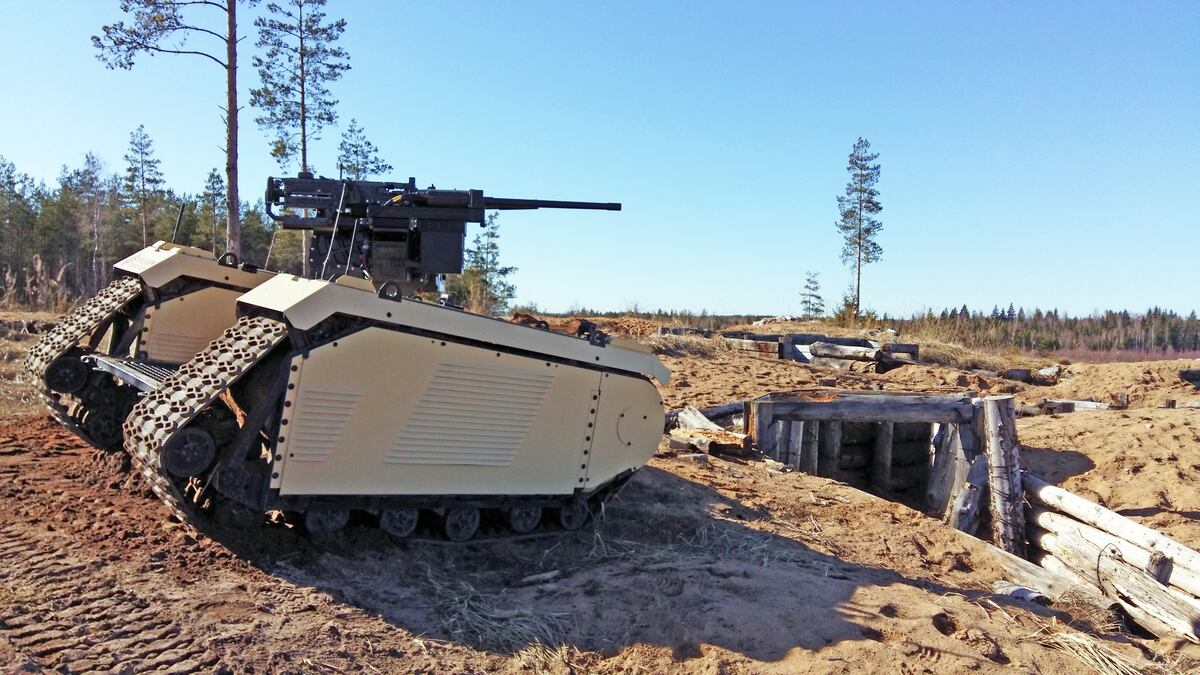
The European Commission awarded an iMUGS contract in 2020 worth close to $40 million to define a standard architecture for military unmanned ground vehicles, with Milrem’s THeMIS unmanned ground vehicle as the reference platform.
The program started under the aegis of the European Defence Industrial Development Program, or EDIDP, which funded a collection of defense projects in the 2019-2020 budget cycle to the tune of €500 million (U.S. $538 million). The push aimed to support “the competitiveness and innovation capacity of the Union’s defense industry,” according to the European Commission.
The regulation governing EDIDP projects, including iMUGS, states that companies are barred from participating if they are “subject to control by a third country or a third-country entity.”
But there is a loophole: Non-EU influence is permissible when the project’s host government gives certain “guarantees” to Brussels that the foreign ownership won’t undermine the bloc’s wider security interests, and that project-related information stays in the EU sphere.
The Estonian government, for its part, already signaled it would take up the case with Brussels.
When contacted by Defense News this month, the Estonian Defence Ministry noted that Milrem’s change of ownership had not been officially approved, as the transaction was still being concluded.
“The Estonian Ministry of Defence will assure that the participation of Estonian companies in EU defense industry programs follow EU rules,” a ministry spokesperson told Defense News. “If Milrem’s change of ownership is approved and such an assessment is deemed necessary, it will be done in accordance with the relevant EU legislation and in cooperation with the European Commission.”
Spotlighting a blind spot
The Milrem takeover by state-owned Edge, billed as the largest foreign investment in Estonia’s defense industry, spotlights what EU officials fear is a blind spot in the bloc’s exposure to foreign interests.
Leaders in Brussels have repeatedly urged all member states to adopt screening laws, especially with an eye toward Russian and Chinese business ties in the EU. So far, roughly two-thirds of the bloc’s 27 member nations have registered with the European Commission the existence of a national policy covering the screening of foreign direct investments, Defense News reported last fall .
Depending on the foreign investor, external control of key companies could directly challenge the vision of Europe’s strategic autonomy, Pieter Taal, head of the European Defence Agency’s industry strategy and EU policies unit, told reporters at the time.
The Milrem spokesman pointed to an existing organization within the Estonian government — the interagency Strategic Goods Commission — as playing a role in approving certain exports, including those to “non-allied partners” like the UAE.
The commission’s website indicates it focuses on enforcing export controls, as opposed to considering strategic ownership questions typically associated with foreign direct investment, or FDI.
The Estonian parliament, meanwhile, has prepared legislation for the government to scrutinize foreign direct investment, according to a Feb. 10 online fact sheet by the law firm Sorainen, which has offices in all three Baltic countries and Belarus.
“The primary objective of the new FDI regime is to screen both direct and indirect investments made by non-EU investors in strategically important and sensitive areas in Estonia,” Lauri Liivat, an attorney at the firm, told Defense News. “This means acquiring 10% or more of the shares or control in the companies falling under the regulation or relevant assets of such companies.”
While Estonian parliamentarians in January adopted the Foreign Investment Reliability Assessment Act, as the law is called, it won’t take effect until September.
Milrem, for its part, said it expects to keep its prominent role as a military robotics developer in the EU, even under Emirati ownership.
The responsible officer for iMUGS on the Estonian government side, Martin Jõesaar, backed that assessment, telling Defense News: “Milrem Robotics will continue to lead the EDIDP19 iMUGS project after the acquisition by Edge takes effect. Furthermore, they have no problem taking part in other EDF project in the future as long as they have methods in place to keep these projects clearly separate from the outside-of-EU owner.”
The acronym EDF is a reference to the European Defence Fund, a multibillion-euro pot that has since replaced the EDIDP scheme — with the same language on exceptions for third-country ownership.
It’s unclear if fellow European companies working with Milrem care about the implications of the Emirati takeover. Of those asked, only Krauss-Maffei Wegmann, which holds a minority stake in Milrem, responded. A spokesman told Defense News that the German armored vehicles specialist was informed of the new stakeholder mix, but he wouldn’t comment further.
A spokesman at the European Defence Agency in Brussels said it has no position on the matter, stemming from a policy of not commenting on individual countries and companies. A European Commission spokesperson did not return a request for comment.
Next up for a funding decision under EDF rules is a follow-on project to iMUGS, simply known as a second version, that would expand autonomy features to larger military vehicles.
According to Jõesaar, the nations involved in the project showed strong support for the next stage. More information is expected by the summer, but for now there will likely be more European states coming onboard, he said, and different financing alternatives will be considered to fund the program’s second stage.
In addition, the European Defence Agency in early February announced an Italian-led project focused on a common architecture for combat unmanned ground systems. Milrem’s THeMIS and Type-X platforms are part of the study lineup along with vehicles from Italy’s Iveco, Finland’s Patria and Germany’s Rheinmetall.
Elisabeth Gosselin-Malo was a Europe correspondent for Defense News. She covers a wide range of topics related to military procurement and international security, and specializes in reporting on the aviation sector. She is based in Milan, Italy.
Sebastian Sprenger is associate editor for Europe at Defense News, reporting on the state of the defense market in the region, and on U.S.-Europe cooperation and multi-national investments in defense and global security. Previously he served as managing editor for Defense News. He is based in Cologne, Germany.
米兰和华盛顿——作为欧盟军事机器人发展典范的米尔雷姆机器人公司,在阿联酋企业集团Edge Group收购了这家爱沙尼亚公司的大部分股份后,正在考验欧盟关于将国防技术合作严格限制在欧洲内部的规则。
上个月在阿联酋首都阿布扎比举行的 IDEX 防务展前夕宣布的这项收购旨在增强 Edge 在“日益多元化和竞争激烈的市场”中的技术实力,同时作为新所有权的一部分,为 Milrem 的国际增长提供保障,两家公司于 2 月 15 日宣布了这一消息。
Edge 首席执行官 Mansour AlMulla 在一份声明中表示:“在爱沙尼亚设立分支机构也为 EDGE 提供了进入北欧的战略渠道,为我们在整个欧洲大陆乃至更远地区增加了宝贵的机会,并巩固了我们作为该领域重要全球参与者的地位。”
收购公告中没有提及米尔雷姆在欧盟军事机器人和其他能力生态系统中的作用,该生态系统是通过布鲁塞尔的补贴培育的,并且遵循着成员国政府及其国防公司共同获得的知识应该主要掌握在欧洲人手中的理念。
Milrem 发言人 Gert Hankewitz 告诉《防务新闻》,该公司设立了“明确的法律界限”,限制与 Edge 共享敏感的欧盟和北约知识产权,并承诺此类信息将“明确地”保留在 Milrem 内部。
他说:“收购 Milrem 股份的谈判和最终达成,充分考虑了我们目前和即将参与或计划参与的欧盟和北约项目的具体要求。”
欧盟合作防务项目的准入规则从本质上来说就具有限制性,甚至禁止像美国这样关系密切的民主盟友参与技术密集型项目,因为在这些项目中,围绕知识产权流动的讨价还价预计会成为一个棘手的问题。
Edge公司的一位发言人拒绝置评。
Milrem 通过 iMUGS 项目(集成模块化无人地面系统)在欧盟范围内的国防机器人领域站稳了脚跟。在这个项目中,这家爱沙尼亚公司领导着一个由来自七个欧洲国家的 13 个实体组成的联盟。
2020 年,欧盟委员会授予 iMUGS 一份价值近 4000 万美元的合同,旨在为军用无人地面车辆制定标准架构,并以 Milrem 的 THeMIS 无人地面车辆作为参考平台。
该计划始于欧洲防务工业发展计划(EDIDP)的支持下,该计划在2019-2020财年预算周期内资助了一系列国防项目,总额达5亿欧元(约合5.38亿美元)。欧盟委员会表示,此举旨在支持“欧盟国防工业的竞争力和创新能力”。
管理 EDIDP 项目(包括 iMUGS)的法规规定,如果公司“受第三国或第三国实体的控制”,则禁止其参与。
但有一个漏洞:当项目所在国政府向布鲁塞尔做出某些“保证”,保证外国所有权不会损害欧盟更广泛的安全利益,并且与项目相关的信息留在欧盟范围内时,非欧盟的影响是允许的。
爱沙尼亚政府方面已经表示,将就此事与布鲁塞尔方面交涉。
本月《防务新闻》联系爱沙尼亚国防部时,爱沙尼亚国防部指出,Milrem 的所有权变更尚未获得正式批准,因为该交易仍在进行中。
爱沙尼亚国防部发言人告诉《防务新闻》:“爱沙尼亚国防部将确保爱沙尼亚公司参与欧盟国防工业项目符合欧盟规则。如果米尔雷姆公司的所有权变更获得批准,且认为有必要进行此类评估,则将根据相关的欧盟法律并与欧盟委员会合作进行。”
聚焦盲点
国有企业 Edge 收购 Milrem,被誉为爱沙尼亚国防工业最大的外国投资,凸显了欧盟官员所担心的欧盟在应对外国利益方面的盲点。
布鲁塞尔的领导人多次敦促所有成员国通过审查法,尤其关注俄罗斯和中国在欧盟的商业联系。据《防务新闻》去年秋季报道,迄今为止,欧盟27个成员国中约有三分之二已向欧盟委员会登记了涵盖外国直接投资审查的国家政策。
欧洲防务局工业战略和欧盟政策部门负责人彼得·塔尔当时告诉记者,根据外国投资者的不同,对关键公司的外部控制可能会直接挑战欧洲战略自主的愿景。
Milrem 的发言人指出,爱沙尼亚政府内部有一个现有的机构——跨部门战略物资委员会——在批准某些出口方面发挥着作用,包括对阿联酋等“非盟伙伴”的出口。
该委员会的网站显示,其重点是执行出口管制,而不是考虑通常与外国直接投资(FDI)相关的战略所有权问题。
与此同时,据在波罗的海三国和白俄罗斯均设有办事处的律师事务所 Sorainen 于 2 月 10 日发布的在线情况说明书显示,爱沙尼亚议会已准备好立法,供政府审查外国直接投资。
“新外国直接投资制度的主要目标是审查非欧盟投资者在爱沙尼亚具有战略意义和敏感领域的直接和间接投资,”该律师事务所的律师劳里·利瓦特告诉《防务新闻》。“这意味着要收购受监管公司10%或以上的股份或控制权,或收购此类公司的相关资产。”
虽然爱沙尼亚议员在1月份通过了《外国投资可靠性评估法》(该法律的名称),但该法律要到9月份才会生效。
Milrem方面表示,即使在阿联酋所有制下,它也希望继续保持其在欧盟作为军事机器人开发商的重要地位。
爱沙尼亚政府方面负责iMUGS项目的官员马丁·约萨尔(Martin Jõesaar)也支持这一评估,他告诉《防务新闻》:“在Edge公司完成收购后,Milrem Robotics将继续领导EDIDP19 iMUGS项目。此外,只要他们有相应的措施确保这些项目与欧盟以外的所有者完全分离,他们未来参与其他EDF项目也没有问题。”
EDF 是欧洲防务基金的缩写,这是一个数十亿欧元的基金,它已经取代了 EDIDP 计划——在第三国所有权的例外条款方面措辞相同。
目前尚不清楚与米尔雷姆公司合作的其他欧洲公司是否关心阿联酋收购的影响。在被问及此事的公司中,只有持有米尔雷姆公司少数股权的克劳斯-玛菲·韦格曼公司作出了回应。该公司发言人告诉《防务新闻》,这家德国装甲车辆专家公司已被告知新的股东构成,但他拒绝进一步置评。
欧洲防务局布鲁塞尔办事处的一位发言人表示,该机构对此事不持立场,其政策是不评论个别国家和公司。欧盟委员会发言人未回复置评请求。
接下来,根据 EDF 的规定,将对 iMUGS 的后续项目(简称为第二版)进行资助决定,该项目将把自主功能扩展到更大的军用车辆。
据约萨尔称,参与该项目的各国对下一阶段表现出了强烈的支持。他表示,预计夏季将公布更多信息,但目前来看,可能会有更多欧洲国家加入,并且会考虑不同的融资方案来为该项目的第二阶段提供资金。
此外,欧洲防务局在2月初宣布了一项由意大利牵头的项目,该项目旨在开发一种通用的无人地面作战系统架构。Milrem公司的THeMIS和Type-X平台以及来自意大利依维柯、芬兰帕特里亚和德国莱茵金属公司的车辆均在研究之列。
伊丽莎白·戈斯林-马洛曾任《防务新闻》欧洲通讯员。她的报道涵盖军事采购和国际安全等广泛领域,尤其擅长航空领域的报道。她常驻意大利米兰。
塞巴斯蒂安·斯普伦格是《防务新闻》欧洲版副主编,负责报道该地区的防务市场状况,以及美欧在防务和全球安全领域的合作和多国投资。此前,他曾担任《防务新闻》执行主编。他现居德国科隆。