This Is What Ground Forces Look Like To An Electronic Warfare System And Why It’s A Big Deal这就是电子战系统眼中的地面部队,以及它为何如此重要。
Modern units generate a large electromagnetic signature from their radios, sensors, and other systems that opponents can spot, track, and attack.
By Joseph Trevithick
Updated May 11, 2020 7:51 PM EDT
The head of the U.S. Army’s 11th Armored Cavalry Regiment has offered an interesting and unusually detailed look at the threat that electronic warfare and electronic support measures pose to American troops on the modern battlefield. The likelihood of a potential adversary monitoring friendly movements via electronic emissions and launching electronic attacks, as well as kinetic ones , on those units has only grown in recent years, with Russia , in particular, demonstrating just how effective these capabilities can be in Ukraine and Syria . American forces in Syria , as well as troops in Europe , have been also subjected to Russia’s electronic harassment, as well, underscoring these threats.
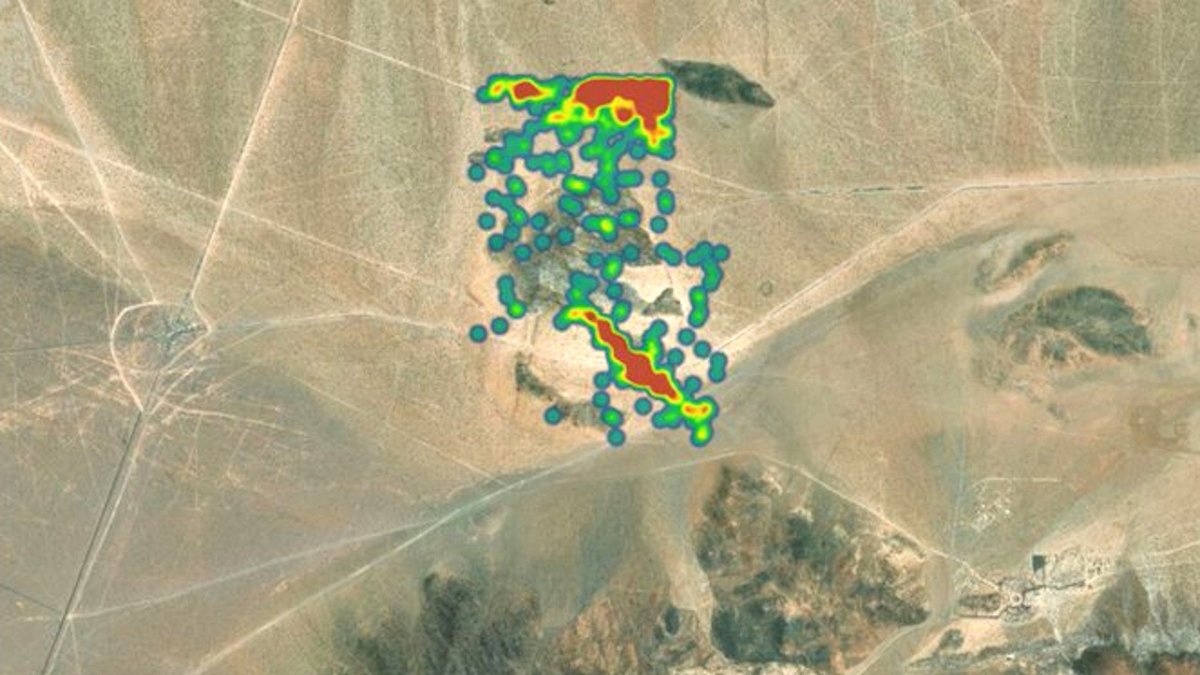
On May 7, 2020, Army Colonel Scott Woodward, the commander of the 11th Armored Cavalry Regiment , posted an annotated satellite image on Twitter that showed the electronic emissions signature of a battalion-sized element, along with support units, or “trains,” during an exercise at the National Training Center at Fort Irwin in California. The 11th is the unit at the NTC that is dedicated to playing the role of enemy troops, or the Opposing Forces (OPFOR), during exercises and has a fleet of modified vehicles and other systems to mimic the capabilities and visual appearance of potential adversaries .
Woodward’s Tweet was in response to a question about the value of certain types of modern visible camouflage . He did say that under the right circumstances that traditional methods of concealment, especially nets that break up the general outline of vehicles and make them harder to immediately identify, an important general camouflage concept , could still be useful.
“Concealment will help you stay alive a little longer in the close fight,” he wrote along with sharing the image. “What does your EW [electronic warfare] footprint look like is the larger question. If I can see you like this, it doesn’t matter how much camo you have.”
The colonel said that the specific force seen in the image had thought the natural cover in that area of the NTC, known as Moose Gardens, had sufficiently concealed their positions and that they were also protected by the fact that it was dark. He said that his opponents in the exercise used their electronic warfare systems to spot his troops from a distance of 12 kilometers away, or nearly seven and a half miles.
Woodward did not explain exactly what systems were generating the electronic signature that his opponents were able to spot, but communications and data-sharing systems certainly produce regular emissions, as do certain kinds of sensors, especially radars. The colonel also pointed out that these dangers were only going to grow as time goes on and new systems begin to enter service.
He specifically pointed out that the active protection systems that the Army is increasingly interested in installing on various vehicles to protect against anti-tank guided missiles and other infantry anti-tank weapons can dramatically increase a unit’s signature in the electromagnetic spectrum. These defensive systems rely on a variety of sensors, including small radars , to detect incoming threats.
The 11th’s commanding officer also did not say what type of system the other side had used to locate his forces. On the ground, the Army has a number of vehicle-mounted and dismounted signals intelligence systems that have secondary abilities to detect, geo-locate, and then track targets by their electronic emissions. The service also has aerial signals intelligence capabilities on both manned and unmanned platforms that can perform these functions. None of these systems have the ability to jam or otherwise attack the source of those emissions.
For some years now, the Army has been working to reinvigorate its ground-based electronic warfare and electronic support measures capabilities with new and improved systems, as well as create new units focused on employing these tactics, techniques, and procedures, as well. Two years ago, the service’s Rapid Equipping Force (REF) notably created a prototype Electronic Warfare Tactical Vehicle (EWTV) based on an M1235 Mine-Resistant Ambush Protected (MRAP). The EWTV used a modified version of a system primarily originally designed to spot and then jam remotely-triggered improvised explosive devices (IED) to spot and monitor hostile electronic signals, as well as attack them.
The prototype Electronic Warfare Tactical Vehicle., US Army
The Army has also been looking to expand its aerial electronic warfare capabilities, especially podded systems that its MQ-1C Gray Eagle drones can carry. In 2012, the service had begun development of the Networked Electronic Warfare Remotely Operated (NERO) pod in cooperation with what was then the Joint Improvised Explosive Device Defeat Organization (JIEDDO), primarily as an airborne tool to jam IED triggers. As with the EWTV, NERO’s electronic warfare capabilities had the potential for broader applications.
An MQ-1C Gray Eagle drone carrying a NERO pod., US Army
More recently, the Army hired Lockheed Martin to develop the Silent CROW pod, which also has electronic and signals intelligence, as well as cyber warfare capabilities, as part of the service’s Multi-function Electronic Warfare-Air Large (MFEW-AL) program. On Apr. 29, Lockheed Martin announced Silent CROW was moving into the second phase of development after initial risk reduction testing using an Army UV-18 Twin Otter fixed-wing aircraft as a surrogate platform to carry the system.
An artist’s conception of an MQ-1C Gray Eagle carrying the Silent CROW pod under its right wing., Lockheed Martin
This is all in line with a resurgence of interest in electronic warfare, as well as emerging cyber warfare capabilities , across the U.S. military. The U.S. Marine Corps is pursuing similar efforts to the Army’s to improve the ability of its ground forces to fight in the electromagnetic spectrum and the U.S. Air Force and the U.S. Navy both have significant electronic and cyber warfare projects in the works, as well. This is on top of the extensive electronic warfare and electronic support measures systems that both of these services field already .
With even more robust electronic warfare systems that also incorporate intelligence-gathering and cyber capabilities, Army units, as well as those from other branches, will have the ability to spot their opponents at extended distances regardless of how concealed they might be visually, just as they did with the elements of the 11th Armored Cavalry Regiment at the NTC. They will also be able to monitor their activities to glean additional information and launch electronic attacks on them.
Jamming and cyber attacks could make it difficult for them to coordinate other friendly units and cut them off from other sources of information. It could also disorient and confuse hostile forces, including by creating virtual decoys that appear to an adversary’s sensors , or even on their own electronic warfare systems, to draw their attention away from actual American troops.
The RC-12 Guardrail has been one of the Army’s most powerful signals intelligence tools for decades. Now in its latest RC-12X form, it provides multi-mission electronic surveillance support. , US Army
Just being able to geolocate enemy forces electronically, which they might not be aware is even happening, opens up the immediate possibility of launching artillery or airstrikes against those positions. Mixing those strikes together with additional electronic or cyber attacks could be particularly devastating.
American forces are also at risk of having the same things done to them. The role that electronic warfare, alongside electronic and other intelligence activity and cyber attacks, has played in Russian operations in Ukraine has been a major factor behind this renewed focus on similar capabilities within the U.S. military.
Christian Brose, a senior fellow at the Carnegie Endowment for International Peace and the head of strategy at tech startup Anduril Industries , described a prototypical series of events during an engagement in Ukraine in his new book The Kill Chain: Defending America in the Future of High-Tech Warfare . Brose describes an incident in which someone, likely a member of Russia’s intelligence community , spuriously called the mother of a Ukrainian commander and told her that her son was dead. She then hurriedly called his unencrypted cell phone to try to confirm whether this was true. When he called her back to tell everything was okay, Russian troops geolocated his forces’ positions from his cell phone signal and hit them with a rocket artillery barrage, killing him in the process.
Steve Trimble, Aviation Week ‘s Defense editor and good friend of The War Zone shared the full passage on Twitter.
This is just one of a number of similar anecdotes that have come out of Ukraine’s conflict with Russia, as well as Russian-backed proxies , in its eastern Donbass region since it began in 2014. There have also been reports that American troops in Europe have been victims of similar cyber attacks and other electronic espionage seeking to gain information about their families, among other things. Geo-locating and attacking forces by their electronic emissions, as well as jamming those transmissions to sow further confusion, has become an important component of Russia’s tactical doctrine . GPS spoofing is another emerging capability that Russia has been quick to embrace.
Russia has not limited these activities to Ukraine, either. There have been numerous reports of Russian electronic warfare attacks in Syria that are either directed at American forces or otherwise impact their operations indirectly. Electronic warfare has become such a major component of large-scale exercises in Russia that the effects often spill over into neighboring countries , as well.
A Russian R-330Zh Zhitel electronic warfare system, which is used to jam cellular satellite communications., Vitaly Kuzmin
The Kremlin hasn’t been the only one to embrace these capabilities, either. China , as well as other smaller countries , also see a clear benefit in developing electronic and cyber warfare systems, especially to counter countries, such as the United States, that have long held advantages in areas including long-range communications and data-sharing, electronic and signals intelligence, and satellite navigation.
So-called “emissions control” tactics, or EMCON, are valuable to reduce the risk that electronic surveillance and attacks pose, but can also limit a friendly forces’ general situational awareness and their ability to coordinate with each other. As such, forcing an opponent to go into a reduced emission state or a fully radio-silent operating mode can still have the effect of degrading their capabilities to some degree.
The Wolfhound is a backpack-mounted radio direction-finding system that can detect enemy communications signals and determines their approximate location., US Army
This is driving separate work in the U.S. military, among others, on electronic systems, especially sensors, such as radars and communications systems, that can work effectively in passive modes or otherwise have a low probability of intercept, making them more difficult to detect and more resilient against jamming or spoofing. You can read more about this in these past War Zone pieces .
Regardless, these electronic threats are definitely real and it’s good to see the U.S. military taking them seriously now, as well as working to give its own forces their own electronic and cyber warfare tools. When it comes to exercises at the National Training Center, it looks like Colonel Woodward and the 11th Armored Cavalry Regiment will be faced with a growing array of capabilities in the electromagnetic spectrum that will keep challenging their ability to stay hidden and get the drop on their opponents.
Contact the author: joe@thedrive.com
Comments couldn’t be loaded. Please refresh the page.
作者:约瑟夫·特雷维西克
更新于美国东部时间2020年5月11日晚上7:51
美国陆军第11装甲骑兵团团长对电子战和电子支援措施对现代战场上美军构成的威胁进行了深入且异常详尽的分析。近年来,潜在对手通过电子信号监视友军动向并对其发动电子攻击(包括动能攻击)的可能性显著增加,尤其是在乌克兰和叙利亚,俄罗斯更是充分展现了这些能力的有效性。驻叙利亚美军以及驻欧洲美军也遭受了俄罗斯的电子骚扰,这进一步凸显了这些威胁。
2020年5月7日,陆军第11装甲骑兵团指挥官斯科特·伍德沃德上校在推特上发布了一张带有注释的卫星图像,图像显示了在加利福尼亚州欧文堡国家训练中心演习期间,一个营级规模的部队及其支援单位(或称“列车”)的电子辐射特征。第11装甲骑兵团是该训练中心专门扮演敌军或假想敌部队(OPFOR)的单位,拥有一支改装车辆和其他系统,用于模拟潜在对手的能力和外观。
伍德沃德的推文是对一个关于某些现代可见伪装价值的问题的回应。他确实表示,在合适的条件下,传统的伪装方法,特别是那些能够打破车辆整体轮廓、使其难以立即识别的伪装网——这是一种重要的通用伪装理念——仍然有用。
“在近距离战斗中,隐蔽能帮你多活一会儿,”他分享这张图片时写道。“但更重要的是,你的电子战痕迹会是什么样子。如果我能这样发现你,你穿多少迷彩服都无济于事。”
上校说,照片中显示的这支部队认为,位于国家训练中心(NTC)“麋鹿花园”区域的天然掩体足以掩盖他们的位置,而且当时天色已晚,也为他们提供了保护。他还说,演习中他的对手利用电子战系统,在12公里(约7.5英里)外就发现了他的部队。
伍德沃德并未具体解释究竟是哪些系统产生了对手能够探测到的电子信号,但通信和数据共享系统无疑会产生规律性的辐射,某些类型的传感器,尤其是雷达,也会产生类似的辐射。这位上校还指出,随着时间的推移和新系统的投入使用,这些危险只会与日俱增。
他特别指出,陆军越来越倾向于在各种车辆上安装主动防护系统,以防御反坦克导弹和其他步兵反坦克武器,但这些系统会显著增加部队在电磁频谱中的特征信号。这些防御系统依靠包括小型雷达在内的多种传感器来探测来袭威胁。
第11团指挥官也没有透露对方使用了何种系统来定位其部队。在地面作战中,陆军拥有多种车载和步兵信号情报系统,这些系统具备探测、定位和跟踪目标电子辐射的辅助能力。陆军还拥有有人和无人平台上的空中信号情报能力,可以执行这些功能。但所有这些系统都不具备干扰或攻击目标辐射源的能力。
近年来,美国陆军一直致力于通过研发新型和改进型系统来重振其地面电子战和电子支援能力,并组建专注于运用这些战术、技术和程序的全新部队。两年前,陆军快速装备部队(REF)以M1235防地雷反伏击车(MRAP)为基础,研制出一款电子战战术车辆(EWTV)原型车。该EWTV采用了一种改进型系统,该系统最初主要用于探测并干扰远程引爆的简易爆炸装置(IED),如今可用于探测和监视敌方电子信号,并对其进行攻击。
美国陆军电子战战术车辆原型
陆军一直在寻求扩展其空中电子战能力,特别是其MQ-1C“灰鹰”无人机可搭载的吊舱系统。2012年,陆军与当时的联合简易爆炸装置防御组织(JIEDDO)合作,开始研发联网电子战遥控(NERO)吊舱,主要用作干扰简易爆炸装置引爆装置的空中工具。与电子战电视(EWTV)一样,NERO的电子战能力也具有更广泛的应用潜力。
一架MQ-1C“灰鹰”无人机携带NERO吊舱,美国陆军
最近,美国陆军聘请洛克希德·马丁公司开发“静默乌鸦”(Silent CROW)吊舱,该吊舱具备电子和信号情报以及网络战能力,是陆军“多功能空中电子战”(MFEW-AL)项目的一部分。4月29日,洛克希德·马丁公司宣布,“静默乌鸦”吊舱在利用陆军UV-18“双水獭”固定翼飞机作为替代平台进行初步风险降低测试后,已进入第二阶段的研发。
这是艺术家绘制的MQ-1C“灰鹰”无人机右翼下方挂载“静默乌鸦”吊舱的示意图。(洛克希德·马丁公司)
这一切都与美军对电子战和新兴网络战能力的重新关注相吻合。美国海军陆战队正采取与陆军类似的措施,提升其地面部队在电磁频谱中的作战能力;美国空军和海军也都在积极推进重要的电子战和网络战项目。此外,这两个军种目前都已部署了大量的电子战和电子支援措施系统。
凭借功能更加强大的电子战系统(该系统还融合了情报收集和网络能力),陆军部队以及其他军种的部队将能够远距离发现对手,无论其在视觉上多么隐蔽,就像他们在国家训练中心(NTC)对付第11装甲骑兵团的部分兵力那样。他们还将能够监控对手的活动,以获取更多信息并对其发动电子攻击。
干扰和网络攻击会使美军难以与其他友军部队协调行动,并切断其与其他信息来源的联系。此外,它还能迷惑敌军,例如制造虚拟诱饵,这些诱饵会出现在敌方的传感器甚至其自身的电子战系统中,从而分散其对美军的注意力。
RC-12“护栏”电子侦察机几十年来一直是美国陆军最强大的信号情报工具之一。如今,其最新型号RC-12X可提供多任务电子监视支持。
仅仅能够通过电子方式定位敌军位置(而敌军可能对此毫不知情),就为立即对这些阵地发动炮击或空袭提供了可能。如果将这些打击与额外的电子或网络攻击结合起来,后果可能不堪设想。
美军也面临着同样的风险。电子战以及电子情报活动和其他情报活动和网络攻击在俄罗斯乌克兰军事行动中所扮演的角色,是促使美军重新重视类似能力的重要因素。
卡内基国际和平基金会高级研究员、科技初创公司Anduril Industries战略主管克里斯蒂安·布罗斯在其新书《杀伤链:未来高科技战争中的美国防御》中,描述了乌克兰冲突期间发生的一系列典型事件。布罗斯描述了这样一起事件:有人(很可能是俄罗斯情报部门成员)冒充俄罗斯方面人员,打电话给一位乌克兰指挥官的母亲,谎称她的儿子已经阵亡。她随即拨打了她儿子未加密的手机,试图确认消息是否属实。当她儿子回电告知一切安好时,俄罗斯军队根据他手机的信号定位了他的部队位置,并向他们发射火箭弹,导致他当场死亡。
《航空周刊》国防编辑兼《战区》好友史蒂夫·特林布尔在推特上分享了全文。
这只是自2014年乌克兰与俄罗斯及其支持的代理人在东部顿巴斯地区爆发冲突以来,一系列类似事件中的一个例子。另有报道称,驻欧美军也遭受了类似的网络攻击和其他电子间谍活动,其目的是为了获取有关美军家属等信息。利用敌方电子信号进行地理定位和攻击,以及干扰这些信号以制造混乱,已成为俄罗斯战术理论的重要组成部分。GPS欺骗是俄罗斯迅速掌握的另一项新兴技术。
俄罗斯的这些活动也不仅限于乌克兰。有大量报道称,俄罗斯在叙利亚发动了电子战攻击,这些攻击要么直接针对美军,要么以其他方式间接影响美军的行动。电子战已成为俄罗斯大规模军事演习的重要组成部分,其影响往往也会波及邻国。
俄罗斯R-330Zh“日捷尔”电子战系统,用于干扰蜂窝卫星通信。——维塔利·库兹明
克里姆林宫并非唯一重视这些能力的国家。中国以及其他一些小国也看到了发展电子战和网络战系统的明显好处,尤其是在对抗美国等长期在远程通信和数据共享、电子和信号情报以及卫星导航等领域拥有优势的国家方面。
所谓的“电磁辐射控制”战术(EMCON)对于降低电子监视和攻击的风险固然重要,但也可能限制友军的整体态势感知能力和协同作战能力。因此,迫使对手进入低辐射状态或完全无线电静默模式,仍然能够在一定程度上削弱其作战能力。
“狼犬”是一种背包式无线电测向系统,可以探测敌方通信信号并确定其大致位置。——美国陆军
这促使包括美国军方在内的多个机构开展专门的电子系统研发工作,特别是雷达和通信系统等传感器,使其能够在被动模式下高效工作或具有极低的被拦截概率,从而更难被探测,并更能抵抗干扰或欺骗。您可以在之前的“战区”系列文章中了解更多相关信息。
无论如何,这些电子威胁的确存在,令人欣慰的是,美军现在开始认真对待这些威胁,并致力于为其部队配备电子战和网络战工具。在国家训练中心的演习中,伍德沃德上校和第11装甲骑兵团似乎将面临日益复杂的电磁频谱能力,这将不断挑战他们隐蔽行动和出其不意攻击对手的能力。
联系作者:joe@thedrive.com
评论加载失败,请刷新页面。