M80 Stiletto Is The Pentagon’s Stealthy Little Experimental Ship That CouldM80“匕首”是五角大楼的隐形小型实验舰,它
For a decade the ‘M-hulled’ Stiletto has been the surrogate for new maritime combat technologies and concepts.
新闻视频
Updated Jul 2, 2020 3:15 PM EDT
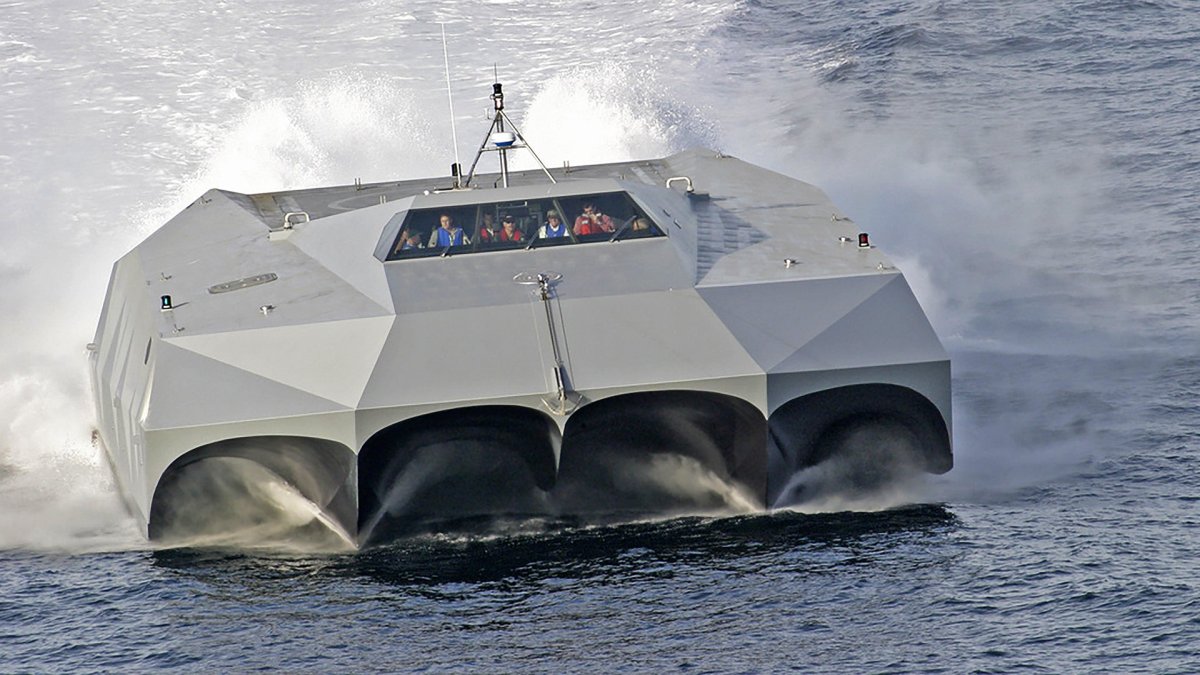
Although it looks like something from another world, the M80 Stiletto is ship designed for littoral, or “brown water,” operations. The unique craft was ordered in the mid 2000s by Secretary of Defense Donald Rumsfeld’s now defunct Office For Transformation (OFT). The vessel was originally envisioned as the centerpiece of an initiative called Project WolfPAC which aimed to revolutionize “netcentric” command and control capabilities and combat effectiveness of small ships operating cooperatively with other vessels, special warfare units and drones in the challenging littoral environment. Think of it as a stealthy floating supercomputer, mothership and command and control station that is capable of rocketing through the water at high-speeds in very shallow waters.
The Stiletto program was also an element of a larger push by Admiral Arthur Cebrowski, who ran the OFT, to get the Navy to rely less on a relatively small number of vulnerable capital ships in favor of smaller, cheaper and more numerous vessels outfitted with cutting-edge technology.
The DoD described WolfPAC as such:
“In the 21st Century, warfare will require agility and the application of tailored forces against more diffuse threats. These threats will retreat to the most complex terrain and will take advantage of both local and global seams in modern society. As part of an overall Joint Force, SOF and SOF-like forces must be prepared to support multiple simultaneous, distributed, decentralized battles and campaigns against both conventional and unconventional adaptive enemies. The threat has been watching intently and has designed denial and deception strategies, which may blunt or negate our technological superiority or may inhibit a force that is over-reliant on strike and single lines of advance. Therefore it is incumbent upon tomorrow’s joint forces to be interdependently networked and coherent to “conduct simultaneous, distributed and parallel operations synergistically across the levels of warfare, in depth. rr WolfPAC is an Office of Force Transformation (OFT) operational experiment designed to explore command and control of geographically dispersed, networked, autonomous and semi-autonomous assets. rr Forces are increasingly burdened by the lack of a coherent strategy to “control” large numbers of dispersed assets. Distributing those assets geographically, loosely federated by networks, only serves to increase the complexity of these controlling challenges. As an experimental venue, WolfPAC will serve to resolve some of the most stressing tactical and operational networked command and control challenges. As an operational experiment, WolfPAC will use a wide variety of assets and will investigate whether or not a new approach to command and control can be engineered practically and advanced operationally. The co-evolution of emerging technology with experimentation will serve to generate operationally relevant lessons for commanders and provide them with the means to command and control distributed, adaptive operations in the riverine and littoral environment.”
“In the 21st Century, warfare will require agility and the application of tailored forces against more diffuse threats. These threats will retreat to the most complex terrain and will take advantage of both local and global seams in modern society. As part of an overall Joint Force, SOF and SOF-like forces must be prepared to support multiple simultaneous, distributed, decentralized battles and campaigns against both conventional and unconventional adaptive enemies. The threat has been watching intently and has designed denial and deception strategies, which may blunt or negate our technological superiority or may inhibit a force that is over-reliant on strike and single lines of advance. Therefore it is incumbent upon tomorrow’s joint forces to be interdependently networked and coherent to “conduct simultaneous, distributed and parallel operations synergistically across the levels of warfare, in depth.
WolfPAC is an Office of Force Transformation (OFT) operational experiment designed to explore command and control of geographically dispersed, networked, autonomous and semi-autonomous assets.
Forces are increasingly burdened by the lack of a coherent strategy to “control” large numbers of dispersed assets. Distributing those assets geographically, loosely federated by networks, only serves to increase the complexity of these controlling challenges. As an experimental venue, WolfPAC will serve to resolve some of the most stressing tactical and operational networked command and control challenges. As an operational experiment, WolfPAC will use a wide variety of assets and will investigate whether or not a new approach to command and control can be engineered practically and advanced operationally. The co-evolution of emerging technology with experimentation will serve to generate operationally relevant lessons for commanders and provide them with the means to command and control distributed, adaptive operations in the riverine and littoral environment.”
What is really being described here are the computers and communications suite intended for Stilleto, as well design requirements for a ship defined by the smaller craft it is slated to carry and operate. But the M80’s unique shape, which is more spatula than stilleto-like, also comes from a pressing need to find a solution for the pounding that crews and SEALs take while traveling at high-speed through rough water on traditional v-hulled boats. The Pentagon describes the M80’s M-shaped hull and their reason for procuring it for tests:
“Stiletto is designed to channel the energy that normally is produced as wake in a conventional V-Hull craft up under the craft into tunnels created by the M-shaped hull form. The energy normally lost to an inverted V-shaped wake is now channeled into the tunnels under the craft producing a hydrodynamic lift as Stiletto makes way through the water… The craft passively lifts itself out of the water about a foot as it speeds along reducing drag. The relatively light weight of the all carbon fiber structure compared to a steel or aluminum craft and the inherent strength of the carbon fiber itself makes for a very favorable payload fraction and of course, lends to its high-speed characteristics. rr Stiletto was designed with the needs of our special forces in mind. SEALS belonging to the Navy have traditionally rode a V-Hull craft from miles offshore to insert their teams on potentially hostile shores. The wave action and resulting rough ride of the V-Hull has, over the years, taken their toll on these SEALs such that nearly a third of them are medically discharged within just 10 years of service due to the pounding G-forces applied to their bodies. The M-Hull was designed to reduce the wakes of commercial ferries in Venice to help minimize the effects of wake damage to their aging buildings. Applying the concept of a high-speed, wave-piercing assault craft to the M-Hull technology, OFT partnered with the US Special Operations Command (SOCOM) to build a mother craft to help insert their personnel so an internal boat well that can accommodate their 11-meter Rigid Hull Inflatable Boat (RHIB) was designed into the craft.”
“Stiletto is designed to channel the energy that normally is produced as wake in a conventional V-Hull craft up under the craft into tunnels created by the M-shaped hull form. The energy normally lost to an inverted V-shaped wake is now channeled into the tunnels under the craft producing a hydrodynamic lift as Stiletto makes way through the water… The craft passively lifts itself out of the water about a foot as it speeds along reducing drag. The relatively light weight of the all carbon fiber structure compared to a steel or aluminum craft and the inherent strength of the carbon fiber itself makes for a very favorable payload fraction and of course, lends to its high-speed characteristics.
Stiletto was designed with the needs of our special forces in mind. SEALS belonging to the Navy have traditionally rode a V-Hull craft from miles offshore to insert their teams on potentially hostile shores. The wave action and resulting rough ride of the V-Hull has, over the years, taken their toll on these SEALs such that nearly a third of them are medically discharged within just 10 years of service due to the pounding G-forces applied to their bodies. The M-Hull was designed to reduce the wakes of commercial ferries in Venice to help minimize the effects of wake damage to their aging buildings. Applying the concept of a high-speed, wave-piercing assault craft to the M-Hull technology, OFT partnered with the US Special Operations Command (SOCOM) to build a mother craft to help insert their personnel so an internal boat well that can accommodate their 11-meter Rigid Hull Inflatable Boat (RHIB) was designed into the craft.”
The M80’s unique hull design looks like something from another planet., M-Ship
Stiletto’s hullform drastically reduces the ship’s drag, wake and acoustic signature, and also reduces the continuous smacking of the hull against the water while operating at high speeds. It also provides a far more stable platform than a traditional monohull designs – great for launching and recovering smaller vehicles, manned and unmanned alike. So really, Stiletto started out as a technology demonstrator with complimentary goals in mind. One had more to do with the unique physical form of the vessel itself, and the other had to do more with what went inside the vessel. The idea was that the M80’s design, including its M-shaped hull, could be drastically scaled up or down, that is, if they ever wanted to put a vessel based on the design into production at all.
Stiletto at the end of her construction in San Diego., M-Ship
The M-Ship Company designed Stiletto and it was built by the Knight & Carver, a commercial and private ship builder out of San Diego, utilizing advanced composites and a slew of then cutting-edge technologies with an emphasis on adaptability. This included an open architecture computer network concept – dubbed an electronic keel – that was originally made up of a 1-gigabit local area network, with four server racks housing Kontron blade servers. Flat screen tactical displays dispersed throughout the ship, including on a series of sci-fi looking, shock absorbing mission stations located in the ship’s mission compartments, are capable of presenting a “fused picture” of Stiletto’s combat environment by marrying information from radars, electronic service measures, unmanned air, surface and underwater craft, data-links, infrared systems and other sensors.
The idea was that new technology could be added on a plug-and-play basis by just plugging the hardware in via a USB interface and having software loaded onto the ship’s computer system for quick integration. This easily reconfigurable “electronic keel” concept is now becoming a common feature on many American combat vessels, from high-tech patrol boats to stealth destroyers .
The ship went from concept to a reality in just 18 months, incredibly fast considering how unique it was at the time, and frankly, how unique it still is today. The cost to build the M80 was a relatively scant $10 million (some reports put it as $6 million).
Naval Special Warfare Center Carderock’s Combat Craft Division, known for having some of the strangest and most shadowy special operations craft on the planet in their stable, would serve as technical and operational overseers of the program. Although Stilleto was born in San Diego, the vessel would eventually would be based in Naval Amphibious Base, Little Creek where it remains today.
Being nearly half as wide as it is long (88.60 X 40 feet), with its unique M-shaped hull design that offers a relatively tiny draft, Stilleto can operate in as little as two and a half feet of water. This could put beaches and even the well decks of amphibious combat ships theoretically within its operational purview. The M80 features a unique prop placement configuration that works well in shallow environments but jet drives could take their place for extremely shallow water operations.
Stiletto’s extremely shallow draft design does not come at the sacrifice of speed or stability. The ship is powered by a quartet of Caterpillar C32 1652hp engines and can hit velocities of nearly 70 miles per hour, or 60 knots. While fully outfitted, a high-speed in the 50-55 knot range is more common. At full speed it has a range of 500 miles, but that can be extended with auxiliary fuel tanks, and its range greatly expands while ‘cruising’ at around 40 knots. The M80 is capable of operating in sea state five (13 foot waves), and has been tested at 51 knots in sea state four conditions (8 foot waves).
Its pancake-like design offers a large internal volume not constrained by the normal linear configuration of standard vessels. This results in a very spacious mission and cargo bay area and flight-deck on top that covers the majority of the ship’s planform. A rear ramp for launching and recovering rigid-hull inflatable boats (RHIBs) and unmanned surface and undersurface vehicles is also included in the baseline design.
Navy SEALs approach the M80’s rear boat ramp in a RHIB., DoD
The M80 is light enough to be craned aboard larger vessels acting as a mothership, or for very long-range repositioning transits. Its maximum gross weight is 67 tons, with nearly 45% of that being dedicated to payload. So there is plenty of capacity for fitting new systems and carrying additional cargo beyond the three crew, 12 SEALs, a 11 meter RHIB, and some small unmanned aircraft and its innovative control stations and computer gear as defined by the baseline configuration.
These features result in a small littoral combat ship with a special knack for supporting special operations and interdiction missions. Yet the adaptability that was an original hallmark of the M80 design has allowed it to survive and keep working over a decade after it was introduced into service.
After being handed over to the Navy in 2006 and run through tests related to the WolfPAC initiative, it was thrown into a long list of complex multi-ship exercises. During these exercises the stealthy ship transported special operations personnel, was used as a command and control ship, operated as part of mine clearing operations, and worked as a drug interdiction platform. Eventually it was sent to the Caribbean spent time in Columbia where it ran down drug runners with some success, following them where other vessels could not, namely over shallow reefs at high-speed. In 2012, the M80 even worked for NASA, snatching up the Inflatable Reentry Vehicle Experiment 3 (IRVE-3) test article that had been launched from Wallops Island and splashed down off the North Carolina coast.
The M80 was also used in one of the first proof of concept missions for launching light unmanned aircraft from small vessels in support of special operations. The aircraft were used for beyond-line-of-sight communications relays and providing real-time overhead surveillance for SEALs during operations. Today, deploying small UAVs from tactical fast boats has become commonplace, especially in the special operations community.
Fast forward to today and Stiletto’s mission has morphed dramatically. Many of the technological concepts and capabilities it originally featured and tested have since matured and have migrated to frontline forces and weapons platforms. Its open architecture command and control and communications suite in particular, and the “distributed” combat operations model it was built to help evolve, certainly have become a mainstay of modern American warfare. But just because these accomplishments are behind Stiletto doesn’t mean the boat has become irrelevant.
The M80 during UAV recovery operations., USN
Today the Assistant Secretary of Defense for Research & Engineering, Rapid Reaction Technology Office (RRTO) facilitates the use of M80 for quickly testing and fielding new and potentially disruptive maritime technologies such as cutting-edge sensors and unmanned craft by the Pentagon, the defense industry, foreign governments and academic institutions. By leveraging Stiletto’s ease of adaptability, all types of cutting-edge capabilities can be rushed into trials, after which they can be quickly evaluated, and either sent back for more development, sent to operational units or passed over entirely.
Which might leave you wondering why Stiletto never made it into production. Well, first off, it was never really a prototype, it was a technology demonstrator. Additionally, some sources state that the ship’s commercial grade manufacturing and carbon-fiber composite construction were simply too foreign and unproven for the Navy to bet on it in a big way. Today M-Ship is working to alleviate this issue with its “Tough Ship” initiative .
Stiletto’s M shaped hull was also thought to have been more ideally suited for littoral environments than open water, where it could encounter heavy sea states for long periods of time. Finally, the Navy became deeply invested in the troubled Littoral Combat Ship program . This vessel was far larger and more expensive than even a vastly enlarged M80 would likely have been, and it relied on aluminum hull construction instead of composites. Its mission set was also different, having to take on some roles of the “blue water” Perry class frigate it would partially replace. A “mission module” concept also dictated the LCS design, something that in has proven to be a developmental disaster.
Stiletto operating at night., DoD
The LCS has struggled since its birth, and having another littoral combat ship of sorts, and a smaller and far cheaper one, would have been a big threat to the more lucrative program. Additionally, the LCS program has long been touted as a solution for increasing the Navy’s declining mainline hull inventory number, not just creating adaptable, cheap and effective “boats” for fighting in the littoral environment. Still, M-Ship continues to evolve the theoretical M80 design, and has come up with a drone mothership offering known as the Stiletto Maritime Operations Center, an inexpensive brown water mothership of sorts for unmanned capabilities. The Navy doesn’t seem to interested in it at this time, and Special Operations Command has angled for a far larger mothership of their own.
Often times, proof of concept and technology demonstrator vehicles get discarded after their intended test program has concluded. Some survive and even thrive in private hands , but normally their unique configuration and experimental components make continued operations unaffordable and sustainability troublesome. As such, that fact that the sub $10 million M80 is still creating value for the Pentagon, even if only intermittently, is downright amazing.
Although neither the M80 or its M-shaped hull made it into active service, this “Millennium Falcon” of Navy vessels’ influence on other designs and subsystems that did is undeniable. And Stiletto appears to be set to continue work as a facilitator for emerging maritime combat technologies for years to come.
The M80 in its element, hauling ass., M-Ship
Contact the author Tyler@thedrive.com
Comments couldn’t be loaded. Please refresh the page.
更新于美国东部时间2020年7月2日下午3:15
尽管外形酷似外星飞船,M80“匕首”号却是专为近岸或“棕水”作战而设计的舰艇。这艘独特的舰艇是2000年代中期由时任国防部长唐纳德·拉姆斯菲尔德领导的现已解散的转型办公室(OFT)订购的。该舰最初被设想为“狼群计划”(Project WolfPAC)的核心,该计划旨在革新“网络中心”指挥控制能力,并提升小型舰艇在充满挑战的近岸环境中与其他舰艇、特种作战部队和无人机协同作战的作战效能。不妨将其想象成一艘隐形的漂浮超级计算机、母舰和指挥控制站,能够在极浅的水域中高速航行。
“匕首”计划也是海军上将亚瑟·塞布罗夫斯基(时任海军技术办公室主任)推动海军减少对数量相对较少且易受攻击的主力舰的依赖,转而建造数量更多、更便宜、配备尖端技术的小型舰艇的更大计划的一部分。
美国国防部对WolfPAC的描述如下:
在21世纪,战争需要敏捷性和针对性部队的运用,以应对更加分散的威胁。这些威胁将退守到最复杂的地形,并利用现代社会中存在的局部和全球性漏洞。作为联合部队的一部分,特种作战部队和类似特种作战部队的单位必须做好准备,支持针对常规和非常规适应性敌人的多场同时进行的、分散的、去中心化的战斗和战役。威胁一直在密切关注,并制定了拒止和欺骗战略,这些战略可能会削弱或抵消我们的技术优势,或者阻碍过度依赖打击和单一推进路线的部队。因此,未来的联合部队必须相互依存、网络化和协调一致,以便在各个作战层面上协同开展同时进行的、分散的和并行的纵深作战。“狼群太平洋”(WolfPAC)是部队转型办公室(OFT)的一项作战实验,旨在探索对地理位置分散、网络化、自主和半自主资产的指挥和控制。河岸部队日益面临缺乏统一战略来“控制”大量分散资产的困境。这些资产在地理上分散,并通过网络松散地联合起来,只会加剧控制挑战的复杂性。作为一项实验性举措,WolfPAC 将有助于解决一些最具压力的战术和作战网络化指挥控制难题。作为一项作战实验,WolfPAC 将使用各种资产,并研究能否在实践中构建新的指挥控制方法,并在作战中取得进展。新兴技术与实验的协同发展将有助于为指挥官提供具有作战意义的经验教训,并使他们能够指挥和控制在河流和近岸环境中的分布式、适应性作战行动。
在21世纪,战争需要敏捷性和针对性部队的运用,以应对更加分散的威胁。这些威胁将退守到最复杂的地形,并利用现代社会中存在的局部和全球性漏洞。作为联合部队的一部分,特种作战部队和类似特种作战部队的单位必须做好准备,支持多场同时进行的、分散的、去中心化的战斗和战役,以对抗常规和非常规的适应性敌人。威胁一直在密切关注,并制定了阻挠和欺骗战略,这些战略可能会削弱或抵消我们的技术优势,或者阻碍过度依赖打击和单一推进路线的部队。因此,未来的联合部队必须相互依存、网络化和协调一致,才能“在各个作战层面上协同开展同时进行的、分散的和并行的纵深作战”。
WolfPAC 是部队转型办公室 (OFT) 的一项作战实验,旨在探索对地理位置分散、联网、自主和半自主资产的指挥和控制。
部队日益面临着缺乏统一战略来“控制”大量分散资产的困境。这些资产在地理上分散,并通过网络松散地联合起来,只会加剧控制挑战的复杂性。作为一项实验性举措,WolfPAC 将有助于解决一些最具压力的战术和作战网络化指挥控制难题。作为一项作战实验,WolfPAC 将使用各种资产,并研究能否在实践中构建新的指挥控制方法,并在作战中推进其应用。新兴技术与实验的协同发展将有助于为指挥官提供具有作战意义的经验教训,并使他们能够指挥和控制在河流和近岸环境中的分布式、适应性作战行动。
这里实际描述的是为“斯蒂莱托”号(Stilleto)设计的计算机和通信套件,以及根据其计划搭载和操作的小型艇型而制定的舰艇设计要求。但M80独特的外形——与其说像匕首,不如说更像锅铲——也源于迫切需要找到一种解决方案,以应对船员和海豹突击队员在传统V型船体艇上高速穿越波涛汹涌的水域时所遭受的颠簸。五角大楼对M80的M形船体及其采购进行测试的原因进行了如下描述:
“Stiletto”的设计理念是将传统V型船体尾流中产生的能量引导至船体下方,并利用M型船体结构形成的隧道进行引导。原本会损失在倒V型尾流中的能量,现在被引导至船体下方的隧道,从而在Stiletto破水航行时产生水动力升力……该艇在高速航行时,会被动地将自身抬离水面约一英尺,从而降低阻力。与钢或铝制船体相比,全碳纤维结构的重量相对较轻,且碳纤维本身具有很高的强度,这使得其有效载荷占比非常高,当然,这也赋予了它极高的速度特性。Stiletto的设计充分考虑了特种部队的需求。海军海豹突击队历来乘坐V型船体艇从离岸数英里处出发,将队员部署到潜在的敌对海岸。多年来,V型船体艇的波浪冲击和由此带来的颠簸航行对这些海豹突击队员造成了严重的伤害,以至于近三分之一的队员在短短时间内就因伤病退役。由于承受了巨大的重力加速度,M型船体服役了10年。M型船体的设计初衷是为了减少威尼斯商业渡轮的尾流,从而最大限度地减少尾流对老旧建筑的损害。OFT公司将高速穿浪突击艇的概念应用于M型船体技术,并与美国特种作战司令部(SOCOM)合作建造了一艘母艇,用于人员投放。为此,该母艇设计了一个内部艇舱,可以容纳他们11米长的硬壳充气艇(RHIB)。
“Stiletto”的设计理念是将传统V型船体尾流中产生的能量引导至船底,并利用M型船体结构形成的隧道进行引导。原本会损失在倒V型尾流中的能量,现在被引导至船底隧道,从而在Stiletto划水时产生水动力升力……随着速度的提升,船体会被动地抬升出水面约一英尺,从而降低阻力。与钢或铝制船体相比,全碳纤维结构的重量相对较轻,且碳纤维本身具有很高的强度,这使得Stiletto的有效载荷比非常高,当然,这也赋予了它卓越的高速性能。
“匕首号”的设计充分考虑了特种部队的需求。海军海豹突击队历来乘坐V型船体艇从数英里外的海域出发,将队员部署到潜在的敌对海岸。多年来,V型船体艇的波浪冲击和由此带来的颠簸航行对这些海豹突击队员造成了严重的伤害,以至于近三分之一的队员在服役仅10年内就因承受巨大的过载而退役。M型船体艇的设计初衷是为了减少威尼斯商业渡轮的尾流,从而最大限度地减少尾流对当地老旧建筑的损害。OFT公司将高速穿浪突击艇的概念应用于M型船体艇技术,并与美国特种作战司令部(SOCOM)合作建造了一艘母艇,用于协助特种部队人员部署。为此,该艇设计了一个内部艇舱,可以容纳他们11米长的硬壳充气艇(RHIB)。
M80独特的船体设计看起来就像来自另一个星球。(M舰)
“匕首”号的船体外形大幅降低了船舶的阻力、尾流和声学特征,同时也减少了高速航行时船体与水面的持续拍击。与传统的单体船设计相比,它还提供了一个更加稳定的平台——非常适合投放和回收小型载人或无人载具。因此,“匕首”号最初是一个技术验证船,其设计目标与此相辅相成。其中一个目标更多地与船舶独特的物理形态有关,而另一个目标则更多地与船舶内部结构有关。其理念是,M80的设计,包括其M形船体,可以根据需要进行大幅度放大或缩小,前提是他们将来想要将基于该设计的船舶投入生产。
“细高跟”号在圣地亚哥的建造工程即将完成。M-Ship
“匕首”号由M-Ship公司设计,并由位于圣地亚哥的商业和私人船舶建造商Knight & Carver公司建造。该舰采用了先进的复合材料和一系列当时的尖端技术,并着重强调其适应性。这其中包括一个开放式架构的计算机网络概念——被称为“电子龙骨”——最初由一个千兆局域网组成,配备四个服务器机架,用于安装Kontron刀片服务器。舰上各处分布着平板战术显示器,包括位于舰艇任务舱内的一系列科幻风格的减震任务站,这些显示器能够整合来自雷达、电子勤务措施、无人机、水面和水下航行器、数据链、红外系统和其他传感器的信息,从而呈现“匕首”号作战环境的“融合图像”。
其理念是,只需通过USB接口插入硬件,并将软件加载到舰船计算机系统上,即可实现新技术的即插即用,快速集成。这种易于重新配置的“电子龙骨”概念如今已成为许多美国作战舰艇的常见配置,从高科技巡逻艇到隐形驱逐舰均有应用。
这艘船从概念到现实仅用了18个月,考虑到它当时的独特性,乃至即使在今天,这个速度都令人难以置信。建造M80的成本相对较低,仅为1000万美元(一些报道称是600万美元)。
海军特种作战中心卡德罗克分部的作战艇部门以拥有一些世界上最奇特、最神秘的特种作战艇而闻名,该部门将负责该项目的技术和作战监督工作。虽然“斯蒂莱托”号最初在圣地亚哥建造,但最终它将以小溪海军两栖基地为母港,并一直驻扎至今。
“斯蒂莱托”号艇宽几乎是长的一半(88.60英尺×40英尺),其独特的M型船体设计使其吃水极浅,因此可以在仅两英尺半深的水域作业。理论上,这使得它能够在浅滩甚至两栖作战舰艇的坞舱内进行作战。M80型艇采用独特的螺旋桨布置,在浅水环境中表现出色,但喷水推进器也可以用于极浅水域的作业。
“匕首”号的超浅吃水设计并未牺牲速度或稳定性。该舰由四台卡特彼勒C32型1652马力发动机提供动力,最高航速可达近70英里/小时(60节)。满载状态下,50-55节的高速更为常见。全速航行时,其航程为500英里,加装辅助油箱后航程可进一步延长;以40节左右的巡航速度航行时,航程将大幅提升。M80型能够在五级海况(13英尺浪高)下航行,并已在四级海况(8英尺浪高)下测试过51节的航速。
其扁平状设计提供了不受标准舰艇常规线性布局限制的大型内部空间。这使得任务和货物舱区域以及覆盖舰体大部分平面面积的飞行甲板都非常宽敞。基本设计中还包括用于投放和回收硬壳充气艇(RHIB)以及无人水面和水下航行器的后部坡道。
海军海豹突击队队员乘坐充气艇接近M80的后部船坡道。(美国国防部)
M80 的重量足够轻,可以用起重机吊装到作为母舰的大型舰艇上,或用于超远程重新部署。其最大总重为 67 吨,其中近 45% 用于有效载荷。因此,除了基本配置中包含的三名船员、12 名海豹突击队员、一艘 11 米长的充气艇、一些小型无人机及其创新的控制站和计算机设备之外,它还有足够的空间加装新系统并携带额外的货物。
这些特性造就了一艘小型近海战斗舰,它尤其擅长支援特种作战和拦截任务。然而,M80设计之初就具有的适应性,使其在服役十余年后依然能够生存并继续发挥作用。
2006年交付海军后,这艘隐形舰艇完成了与“狼群行动”(WolfPAC)相关的测试,随后被投入到一系列复杂的多舰联合演习中。在这些演习中,这艘隐形舰艇运送特种作战人员,用作指挥控制舰,参与扫雷行动,并作为缉毒平台执行任务。最终,它被派往加勒比海,在哥伦比亚停留一段时间,并成功追捕毒贩,在其他舰艇无法到达的地方,例如高速穿越浅礁,它都能追踪到目标。2012年,M80甚至还为美国国家航空航天局(NASA)效力,回收了从沃洛普斯岛发射并在北卡罗来纳州海岸溅落的充气式再入飞行器3号(IRVE-3)测试样机。
M80还曾用于首批从小型舰艇上发射轻型无人机以支援特种作战的概念验证任务之一。这些无人机用于超视距通信中继,并在行动中为海豹突击队提供实时高空监视。如今,从战术快艇上部署小型无人机已成为常态,尤其是在特种作战领域。
时至今日,“匕首”号的使命已发生巨大变化。它最初展示和测试的许多技术理念和能力如今已日趋成熟,并被应用于一线部队和武器平台。特别是其开放式架构的指挥控制和通信系统,以及它旨在推动发展的“分布式”作战模式,无疑已成为现代美军战争的中流砥柱。但这些成就的取得并不意味着“匕首”号已经过时。
M80在无人机回收行动中发挥作用,美国海军
如今,负责研究与工程的美国国防部助理部长办公室下属的快速反应技术办公室 (RRTO) 正在协助五角大楼、国防工业、外国政府和学术机构使用 M80 系统快速测试和部署新型且可能具有颠覆性的海上技术,例如尖端传感器和无人艇。凭借 Stiletto 系统易于适应的特性,各种尖端技术都可以迅速投入试验,之后进行快速评估,并根据评估结果决定是需要进一步开发、部署到作战部队还是直接放弃。
这或许会让你好奇为什么“匕首”号最终未能投入量产。首先,它并非真正的原型舰,而是一艘技术验证舰。此外,一些消息来源指出,该舰的商用级制造工艺和碳纤维复合材料结构对于海军而言过于陌生且未经验证,因此海军不愿大规模投资。如今,M-Ship公司正致力于通过其“坚固舰艇”计划来解决这个问题。
“匕首”号的M形船体被认为更适合近岸环境而非开阔水域,因为在开阔水域中,它可能会长时间遭遇恶劣海况。此外,海军还投入巨资研发问题重重的濒海战斗舰(LCS)项目。这艘舰艇比大幅扩建的M80型护卫舰还要庞大得多,造价也高得多,而且它采用的是铝制船体而非复合材料。它的任务也与M80型护卫舰不同,需要承担一些原本由它将部分取代的“远洋”佩里级护卫舰承担的任务。“任务模块”的概念也指导了LCS的设计,而事实证明,这最终导致了其研发上的失败。
匕首夜间行动,美国国防部
自诞生以来,濒海战斗舰(LCS)项目一直举步维艰。如果再建造一艘类似濒海战斗舰的舰艇,而且是一艘更小、更便宜的,将会对利润更为丰厚的LCS项目构成巨大威胁。此外,LCS项目长期以来被视为解决海军主力舰艇数量不断减少问题的方案,而不仅仅是为近海作战环境打造适应性强、价格低廉且高效的“舰艇”。尽管如此,M-Ship公司仍在不断改进其M80的理论设计,并推出了一款名为“匕首海上作战中心”(Stiletto Maritime Operations Center)的无人机母舰方案。这是一种价格低廉的近海作战母舰,用于执行无人作战任务。目前海军似乎对此并不感兴趣,而特种作战司令部则一直在争取建造一艘更大的母舰。
通常情况下,概念验证和技术演示车辆在完成预定的测试项目后就会被弃用。有些车辆虽然在私人手中得以保存甚至继续使用,但通常情况下,它们独特的配置和实验性部件使得持续运营成本过高,可持续性也面临诸多问题。因此,即使只是偶尔使用,造价低于1000万美元的M80仍然能为五角大楼创造价值,这着实令人惊叹。
尽管M80及其M形船体最终未能投入现役,但这款被誉为海军舰艇界的“千年隼”的战舰对其他舰艇设计和子系统的影响却是不容置疑的。“匕首”号似乎也将在未来数年继续发挥推动新兴海上作战技术发展的作用。
M80 火力全开,M 型舰艇
联系作者:Tyler@thedrive.com
评论加载失败,请刷新页面。