Norway to receive Chunmoos in 2028, reach IOC in 2029: Norwegian army leader挪威陆军领导人:挪威将于2028年接收春茂号战列舰,并于2029年达到国际作战能力标准。
Another component in deterring Russia, Acting Chief of the Norwegian Army Trond Nilsen told Breaking Defense, is having the Finnmark Brigade fully operational by 2032-2033.
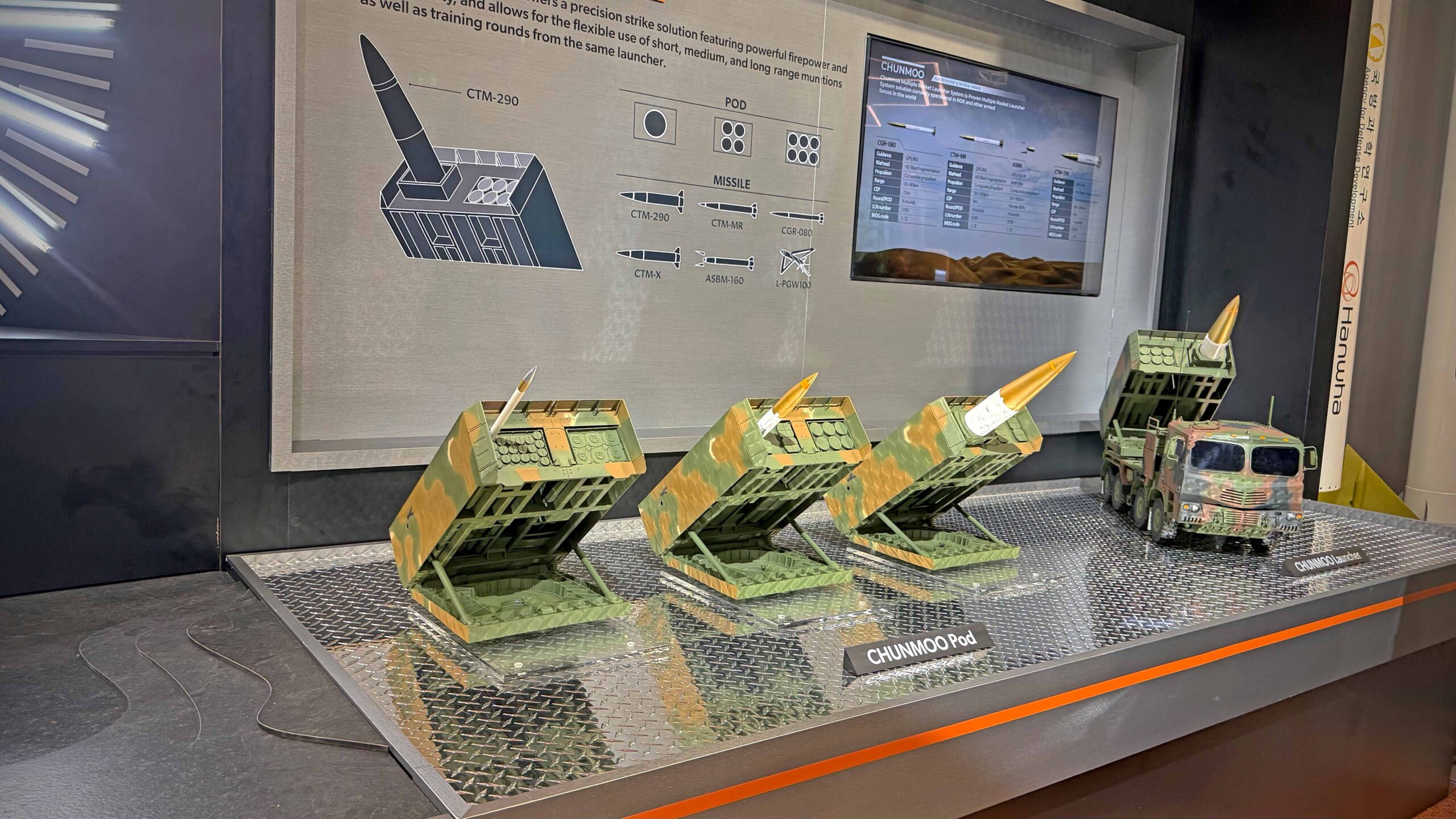
Hanwha aerospace displayed several rocket artillery pods for their K239 Chunmoo system, with specs visible in the background at the 2026 AUSA conference. (Breaking Defense)
WASHINGTON — Norway is set to begin receiving its 16 South Korean-made Chunmoo rocket artillery systems in 2028, the acting chief of the Norwegian army told Breaking Defense, as the country faces an increasing Russian threat.
“Initial capability is expected by 2029 and the operators will be trained in Norway. … The big advantage is that this [Chunmoo] will provide us with the ability to strike the enemy at long range,” Trond Nilsen told Breaking Defense during an interview on the sidelines of AUSA. According to promotional material, the Chunmoo has a range of approximately 500 kilometers (310.7 miles).
The Scandinavian country announced in January the procurement of the Chunmoo rocket artillery systems — a purchase valued at $2 billion by manufacturer Hanwha — as part of its long-range Arctic missile program.
The systems will be based in Bardufoss, in northern Norway. Following the January announcement of the contract, a report from the Independent Barents Observer quoted Norwegian Minister of Defense Tore O. Sandvik as stating that its missiles “might have sufficient range to hit the Pechenga Valley, where two of Russia’s most potent land forces are based: the 71st Guards Motorized Rifle Division and the 61st Naval Infantry Brigade,” highlighting the purchase’s strategic significance.
Another core component of Oslo’s response to deter Moscow, including along its 195-kilometer border with Russia, is the newly formed Finnmark Brigade, Nilsen explained.
“The reason we are building the Finnmark Brigade is the Russian threat; it is our response to that threat,” Nilsen said.
The unit, which was formally established in August 2025, was created to defend and patrol the country’s short but strategic border with Russia and is stationed in the far northern Arctic region. (Finnmark is located in the northeast corner of Norway, just above Finland and bordering Russia.)
How integrated modeling and simulation accelerates Europe’s defensive edge
Lockheed Martin’s ACES platform delivers a shared virtual battlespace that strengthens readiness, interoperability, and faster decision-making through advanced, integrated modeling and simulation capabilities designed for evolving global threats.
Nilsen added that while the initial ambition was to equip the brigade with approximately 4,000 personnel and have it be fully operational by 2036, the timeline has been accelerated to now trying to accomplish this by 2032-2033.
“I am happy with how it is going, and according to plan, we are doing this as fast as possible,” the official said. He added that one of the main challenges has been building the infrastructure and accommodation needed to host that amount of forces and equipment.
Inspired by the success of drones in Ukraine against Russia, the Norwegian Army has also been rolling out a drone swarm pilot project involving intelligence-gathering and autonomous drones, Nilsen told Breaking Defense, with a goal of eventually fielding it to the Finnmark Brigade .
“The first thing we did was to launch drone strategies within the land forces and have some units develop their own — now almost all units in the army have some kind of drones,” Nilsen said.
While land forces are still testing the drones, Nilsen said, the plan is to begin using them in some operational units of the Finnmark Brigade within about a year.
Breaking Defense Video
Drones take over AUSA, plus the Army’s plan to bring in new vendors
Hegseth talks autonomy at AUSA, a key show focus
Army doubles down on autonomy, stakes out Indo-Pacific role: AUSA Day 2
Telle talks ‘manufacturing rodeo,’ supply chain ‘weak links’: AUSA Day 1
New leaders, new drone command: What we expect from AUSA 2026
Unpacking Boeing’s F/A-XX win, plus a report from wartime Ukraine
How Hegseth envisions a new Autonomous Warfare Command
What Europe’s military air fleets will look like in 30 years
Riyadh gets closer to F-35s, Damascus presses sovereignty and an expert take on Iran
Drone-hunting on the border, plus turmoil at an Air Force think tank
在2026年美国宇航协会(AUSA)年会上,韩华航天公司展示了其K239“天武”火箭炮系统的几款火箭炮吊舱,背景中可以看到相关规格参数。(Breaking Defense)
华盛顿——挪威陆军代理总司令告诉《防务新闻》,随着俄罗斯威胁日益加剧,挪威将于 2028 年开始接收 16 套韩国制造的“天武”火箭炮系统。
“预计初期作战能力将于2029年实现,操作人员将在挪威接受培训。……最大的优势在于,这款(春武)导弹将使我们能够远程打击敌人,”特隆德·尼尔森在AUSA展会间隙接受Breaking Defense采访时表示。根据宣传资料,春武导弹的射程约为500公里(310.7英里)。
今年1月,这个北欧国家宣布采购“天武”火箭炮系统——这笔价值20亿美元的采购由制造商韩华公司负责——作为其远程北极导弹计划的一部分。
这些系统将部署在挪威北部的巴杜福斯。在1月份宣布签订合同后,《巴伦支独立观察家报》援引挪威国防部长托雷·桑德维克的话说,这些导弹“射程可能足以打击佩琴加山谷,那里驻扎着俄罗斯两支最强大的陆军部队:第71近卫摩托化步兵师和第61海军陆战旅”,凸显了此次采购的战略意义。
尼尔森解释说,奥斯陆为威慑莫斯科而采取的另一项核心措施,包括在其与俄罗斯接壤的 195 公里边界沿线,是新成立的芬马克旅。
尼尔森说:“我们组建芬马克旅的原因是俄罗斯的威胁;这是我们对这种威胁的回应。”
该部队于2025年8月正式成立,其任务是保卫和巡逻挪威与俄罗斯之间虽短但具有战略意义的边界,驻扎在极北的北极地区。(芬马克位于挪威东北角,紧邻芬兰,与俄罗斯接壤。)
集成建模与仿真如何加速欧洲的防御优势
洛克希德·马丁公司的 ACES 平台提供了一个共享的虚拟战场空间,通过先进的集成建模和仿真功能,增强了战备能力、互操作性和更快的决策速度,旨在应对不断演变的全球威胁。
尼尔森补充说,虽然最初的目标是到 2036 年为该旅配备约 4000 名人员并使其全面投入运作,但时间表已经加快,现在正努力在 2032-2033 年实现这一目标。
“我对目前的进展情况很满意,我们正按计划以最快的速度推进这项工作,”这位官员说。他还补充道,主要挑战之一是建设容纳如此庞大部队和装备所需的基础设施和住宿设施。
尼尔森告诉《防务新闻》,受无人机在乌克兰对抗俄罗斯的成功启发,挪威军队也一直在推行无人机集群试点项目,该项目涉及情报收集和自主无人机,目标是最终将其部署到芬马克旅。
尼尔森说:“我们做的第一件事就是在陆军内部推行无人机战略,并让一些部队自行研发无人机——现在陆军几乎所有部队都拥有某种类型的无人机。”
尼尔森表示,虽然陆军仍在测试无人机,但计划在大约一年内开始在芬马克旅的一些作战部队中使用它们。
突破性防御视频
无人机主导了美国陆军协会(AUSA)的会议,此外,陆军还计划引入新的供应商。
Hegseth 在 AUSA 大会上谈到了自主性,这是本次大会的一个重点议题。
陆军加倍强调自主性,明确印太地区角色:AUSA第二天
特勒谈“制造业乱象”、供应链“薄弱环节”:AUSA第一天
新领导人,新无人机指挥部:我们对 AUSA 2026 的期待
深入剖析波音F/A-XX的竞标结果,以及来自战时乌克兰的报道
赫格塞斯设想的新型自主作战指挥部
30年后欧洲军用空军机队会是什么样子
利雅得距离F-35战机更近一步,大马士革强调主权,以及专家对伊朗的看法
边境无人机猎杀行动,以及空军智库的动荡