The Army’s new watercraft plan banks on autonomy, commercial ships陆军的新水上舰艇计划依赖于自主航行能力和商用船舶。
The Army's plan for establishing a fleet of watercraft in the Pacific includes a commitment to deeper experimentation with autonomous vessels.
The Army’s long-awaited watercraft strategy charts a course that prioritizes sustaining an aging fleet, leveraging commercial solutions and accelerating experimentation with autonomous vessels, according to senior service leaders who helped craft it.
The new strategy, which has yet to be published publicly, takes “a much more holistic or comprehensive approach to Army watercraft,” Lt. Gen. Karl Gingrich, the Army deputy chief of staff G-8 chief, told Defense News in a recent interview.
The Army “is not going to be able to build watercraft or build ourselves out of this challenge,” Gingrich said. “The time is not there. The resources aren’t there, so … how do we sustain our current fleet and extend the life of it?”
That effort includes service-life extension programs, or SLEPs, for existing vessels. The Army has already made some investments to SLEP watercraft in fiscal 2025 and 2026 “because we knew this was coming, and we knew this was key,” Gingrich said.
The Army will buy some Maneuver Support Vessel Light, or MSV-L, landing crafts but the production numbers have scaled back to five production models. The service is being deliberate about pacing procurement, Gingrich said. When the original prototype is included in the mix, it brings the total to six ships.
“The MSV-Light is actually here in the 8th TSC right now, operating here in Hawaii, and we’re putting it through its paces with the joint force,” Maj. Gen. Gavin Gardner, the 8th Theater Sustainment Command commander, told Defense News. The vessel will participate in the Joint Pacific Multinational Readiness Center rotation in November, he said.
Even so, the Army cannot rely solely on new construction to close gaps, Gingrich said.
“We can’t build our way out of this, so the only way we’re going to be able to do it is to take a look at how do we fill the gaps in capacity and perhaps capability? How do we do that with commercial solutions, or even modified commercial solutions, where we take a commercial vessel that’s several years old, modify it for our needs, and get it out to the force.”
That approach could include soldiers operating government-owned platforms or using contracted crews, according to Gingrich.
The Army has already begun implementing key tenets of the strategy in theater, according to Gardner.
Army leadership has fully supported an effort to “leverage offshore support vessels, OSVs, which is a commercial, contracted shallow-draft watercraft, to help augment our gray-hulled boats,” Gardner said. The vessels’ cranes and “roll-on/roll-off” capabilities also allow the watercraft to access shallow-draft facilities in other countries, he added.
Contracted vessels can offer operational and perceptual benefits, according to Gardner, who described commercial vessels as “a little bit less intrusive.”
“It blends in,” he said. “And quite frankly, … it becomes a challenge for adversaries to find it and target it as well.”
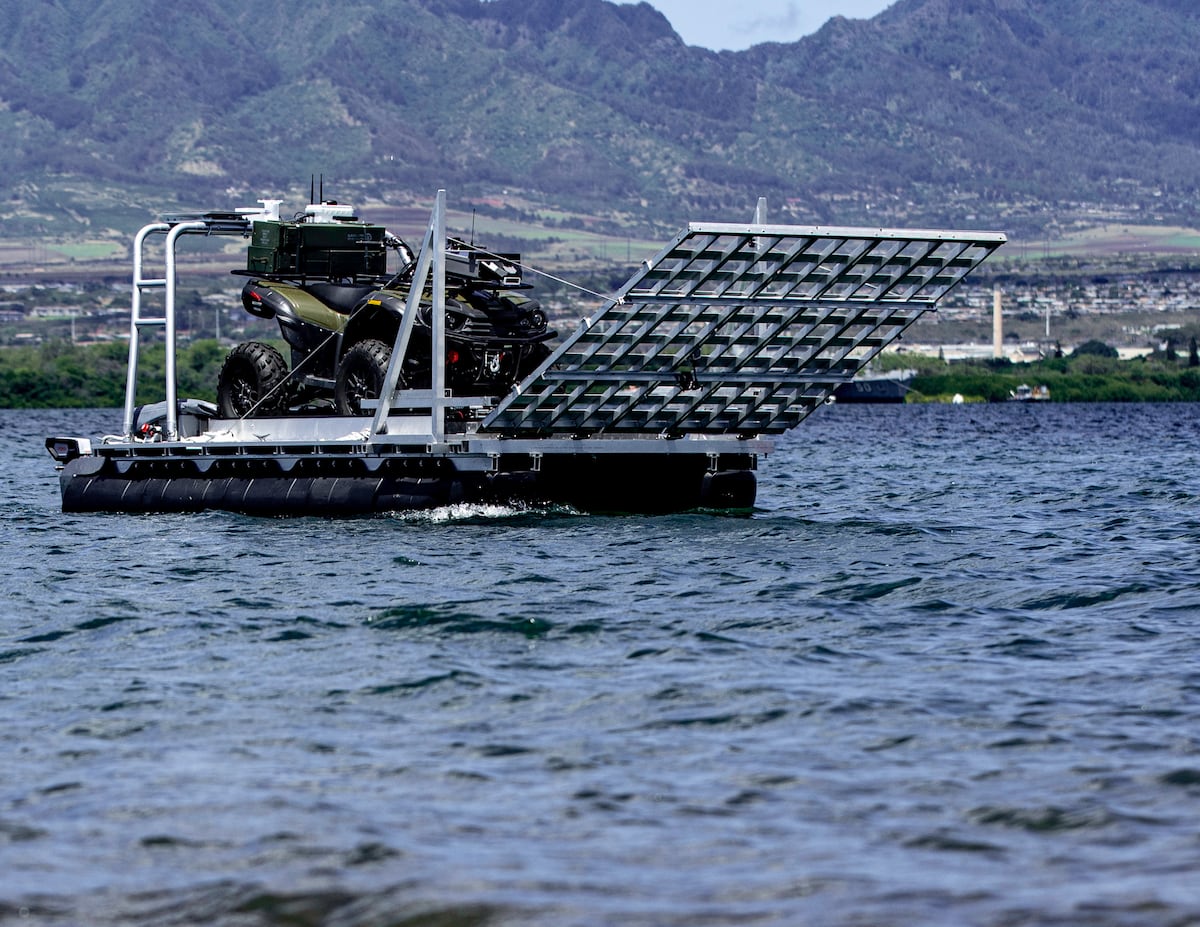
The Army is also deeply interested in pursuing autonomous watercraft, viewing it as a means to transform future sustainment operations.
“We just had some experimental days out here with a couple of vendors … where we have seen what autonomous watercraft can deliver, from a perspective of not only force protection, but what really excites me, for logistics," Gardner said.
He drew a comparison to World War II–era production, when America mass-produced cargo vessels known as Liberty ships.
“But you were still putting mariners on [Liberty ships] and putting them at risk,” Gardner said. “In the future, if we can develop it appropriately,” the Army could use autonomous watercraft to “create a distribution targeting challenge for any adversary, but also ... protect the force,” he added.
Ultimately, the goal is a hybrid fleet that blends crewed and uncrewed platforms, Gardner said.
“We save Army watercraft to do delivery of combat power, while maybe autonomous vessels are delivering that routine sustainment,” he said.
As teaming with humans and robots continues to be developed across the force, “everybody wants to talk about fighter aircraft doing that,” Gardner said. “I want to do that with watercraft and its ability to sustain the Combined Joint Force. I think it’ll be hugely powerful and the Army is moving out that way.”
Jen Judson is an award-winning journalist covering land warfare for Defense News. She has also worked for Politico and Inside Defense. She holds a Master of Science degree in journalism from Boston University and a Bachelor of Arts degree from Kenyon College.
据参与制定该战略的高级军官称,陆军期待已久的水上舰艇战略规划了一条优先保障老旧舰队、利用商业解决方案和加速自主舰艇试验的路线。
陆军副参谋长(G-8)卡尔·金里奇中将在最近接受《防务新闻》采访时表示,这项尚未公开发布的新战略“对陆军水上舰艇采取了更加全面或综合的方法”。
金里奇说,陆军“不可能通过建造水上舰艇或自行解决这一挑战”。“时间不够,资源也不够,那么……我们该如何维持现有舰队的运转并延长其使用寿命呢?”
这项工作包括对现有舰艇进行使用寿命延长计划(SLEP)。金里奇表示,陆军已经在2025和2026财年对一些舰艇的SLEP项目进行了投资,“因为我们知道这种情况会发生,而且我们知道这至关重要。”
陆军将采购一些轻型机动支援艇(MSV-L),但产量已缩减至五艘。金里奇表示,陆军正在谨慎地控制采购进度。如果将最初的原型艇也算在内,总数将达到六艘。
“MSV-Light目前就在第八战区保障司令部(8th TSC)驻扎的夏威夷基地,我们正在对其进行联合部队的全面测试,”第八战区保障司令部司令加文·加德纳少将告诉《防务新闻》。他还表示,该舰将于11月参加联合太平洋多国战备中心(Joint Pacific Multinational Readiness Center)的轮换部署。
金里奇表示,即便如此,陆军也不能仅仅依靠新建工程来弥补缺口。
“我们无法通过建造更多舰艇来解决这个问题,所以唯一的办法就是研究如何填补产能和能力方面的缺口。我们如何利用商业解决方案,甚至是改造后的商业解决方案来实现这一点?比如,我们购买一艘服役多年的商用舰艇,根据我们的需求进行改造,然后交付给部队。”
金里奇表示,这种方法可能包括士兵操作政府拥有的平台或使用承包人员。
加德纳表示,陆军已经开始在战区实施该战略的关键原则。
加德纳表示,陆军领导层全力支持“利用海上支援船(OSV)——一种商用、承包的浅吃水船舶——来增强我们现有舰艇能力”的计划。他还补充说,这些船舶的起重机和“滚装/滚卸”能力也使它们能够进入其他国家的浅吃水设施。
加德纳表示,承包船舶可以提供运营和感知方面的优势,他还将商船描述为“侵入性较小”。
“它能很好地融入周围环境,”他说。“坦白讲,……这也给对手带来了寻找和攻击它的挑战。”
陆军也对自主水上舰艇抱有浓厚的兴趣,将其视为改变未来后勤保障行动的一种手段。
“我们刚刚和几家供应商在这里进行了一些试验……我们看到了自主水上交通工具能够提供什么,不仅是从部队保护的角度来看,更重要的是,它在后勤方面也让我感到非常兴奋,”加德纳说。
他将这种情况与二战时期的生产进行了比较,当时美国大规模生产了被称为“自由轮”的货船。
“但你们仍然让海员登上(自由轮),让他们身处险境,”加德纳说。“未来,如果我们能进行适当的研发,”他补充道,陆军可以使用自主水上舰艇“给任何对手制造分散打击目标的挑战,同时也能……保护部队。”
加德纳表示,最终目标是打造一支融合有人驾驶平台和无人驾驶平台的混合舰队。
他说:“我们保留陆军舰艇用于运送作战力量,而或许自主舰艇则用于提供日常保障。”
随着全军范围内人机协同作战能力的不断提升,“每个人都想谈论战斗机如何做到这一点,”加德纳说。“我想在水上舰艇及其对联合作战部队的后勤保障能力方面也做到这一点。我认为这将非常强大,陆军正在朝着这个方向发展。”
珍·贾德森是一位屡获殊荣的记者,为《防务新闻》报道陆地战争。她也曾为《政治报》和《内幕防务》工作。她拥有波士顿大学新闻学硕士学位和凯尼恩学院文学学士学位。