Where to stash combat gear in the Indo-Pacific? The Army wants to know在印太地区应该把作战装备藏在哪里?陆军想知道。
The service is overhauling its prepositioned stock network with an eye on utility and cost.
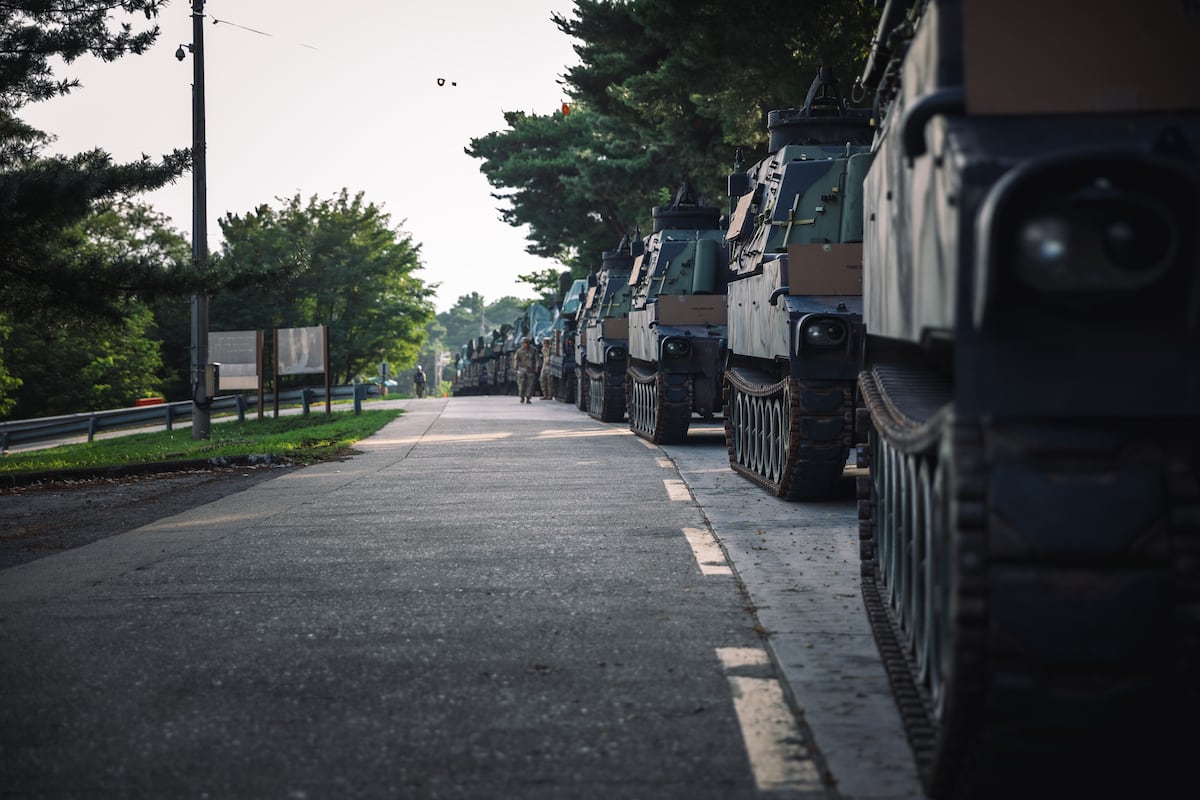
The U.S. Army is revising the worldwide distribution of forward-deployed equipment, dubbed preposition stock, as officials weigh its utility and cost, Lt. Gen. Chris Mohan, the acting Army Materiel Command commander, told Defense News.
“There are going to be changes to the [Army Prepositioned Stock] program,” Mohan said in an interview just ahead of the Association of the U.S. Army’s annual conference in Washington.
The effort was designed to stage weapons, vehicles, equipment and supplies at key global locations so forces can rapidly respond to crises. In recent years, the Army has moved from viewing the use of APS kit as a break-glass-in-case-of-emergency situation to regularly dipping into the stocks for major training exercises.
While APS has long been a cornerstone of U.S. power projection, Mohan acknowledged the system must adapt to new strategic realities, particularly as the Pentagon shifts greater focus to the Indo-Pacific theater .
“All that is being worked with the [combatant commands] right now and will be validated back through the Joint Staff, and the [secretary of defense] will approve, just like they approved some of the recent decisions on APS,” Mohan explained.
The Army has taken “a very hard look with our strategic partners like the Defense Logistics Agency and said, ‘Hey, if we all acknowledge that the tyranny of distance doesn’t get any easier from the continental United States into the Pacific theater, well, maybe we need to stock more forward across the [area of operations] north to south, east to west, so that you give flexibility and options for sustainment,’” Maj. Gen. Gavin Gardner, the Army’s 8th Theater Sustainment Command commander, told Defense News in a recent interview.
The Army is also working to increase the amount of “days of supply” across the theater, he added, “so that you’re not instantly going to be out of fuel because we didn’t plan. … We are rapidly increasing the posture across the theater to make sure that we give options to the commander.”
The Army also decided, for example, to move away from its use of prepositioned stocks on ships — called APS afloat — calculating that the vessels might not be operationally effective or sufficient for the service and the joint force’s needs in the Pacific.
Officials have moved one such equipment package to key land locations in the Pacific area, like South Korea, the Philippines and Australia, Gardner said.
“That really covers our northern, central and southern corridors,” Gardner added. “That allows us to now just bring in troops versus having to bring in equipment, which actually allows us to respond much faster to anything from a humanitarian disaster and relief … to any other crisis.”
The service is also going through an assessment of what it calls Total Army Power Projection Equipment Sets, and is considering, for instance, leaving in place some equipment belonging to units located west of the International Date Line.
“That way you’re able to respond more rapidly,” Gardner explained. “We save a little bit on transportation costs, and it allows us to have a much better persistent presence forward, which we think assists with the deterrence that we’ve been asked to do.”
The upcoming National Defense Strategy will shape those decisions, Mohan added. APS plans will align with the strategy when it is officially released, particularly the concept of land-basing in the Info-Pacific, he noted.
Positioning Army stocks in the Indo-Pacific, however, is not as straightforward as in Europe.
“Of course, I have my thoughts of where I want to put things, but it’s mainly from a distribution standpoint and an ability to move it,” Mohan said. “But, but we’ve got to work through a lot of that because INDOPACOM, it’s bilateral relationships. There’s not the alliance like you have with NATO. So that one’s going to be a little bit harder to work through.”
In Europe, NATO has invested heavily in APS infrastructure to support deterrence against Russia and to strengthen readiness across the alliance. Mohan pointed to Poland as the most advanced example.
“The most up-to-date facility we have for APS is in Poland, built by NATO to our specifications,” he said. “And it’s a beautiful facility.”
The effort to reimagine APS in the complex Indo-Pacific region, where nation-by-nation diplomacy substitutes for a NATO-like architecture, has proven to be a tough nut to crack for several presidential administrations.
“We’ve got to get to a sustainable path forward and it’s something we’re challenged with right now,” Mohan said.
Jen Judson is an award-winning journalist covering land warfare for Defense News. She has also worked for Politico and Inside Defense. She holds a Master of Science degree in journalism from Boston University and a Bachelor of Arts degree from Kenyon College.
美国陆军正在修订前沿部署装备(称为预置库存)的全球分配方式,官员们正在权衡其效用和成本。陆军装备司令部代理司令克里斯·莫汉中将告诉《防务新闻》。
“陆军预置库存计划将会有所改变,”莫汉在华盛顿举行的美国陆军协会年会前夕接受采访时表示。
这项计划旨在将武器、车辆、装备和物资部署在全球关键地点,以便部队能够迅速应对危机。近年来,陆军已不再将APS装备的使用视为紧急情况下的应急措施,而是将其作为大型训练演习的常规储备。
虽然APS长期以来一直是美国力量投射的基石,但莫汉承认,该系统必须适应新的战略现实,尤其是在五角大楼将更多注意力转移到印太地区的情况下。
“所有这些目前都在与各作战司令部进行磋商,并将通过联合参谋部进行验证,然后由国防部长批准,就像他们最近批准了一些关于高级防护系统(APS)的决定一样,”莫汉解释说。
陆军第八战区保障司令部司令加文·加德纳少将在最近接受《防务新闻》采访时表示:“陆军与国防后勤局等战略伙伴进行了非常认真的讨论,并表示:‘如果我们都承认从美国本土到太平洋战区的距离优势并没有减轻,那么或许我们需要在作战区域内,从北到南、从东到西,进行更多的前沿储备,以便为后勤保障提供灵活性和选择。’”
他还补充说,陆军也在努力增加整个战区的“物资储备天数”,“这样就不会因为我们没有做好计划而突然出现燃料短缺的情况……我们正在迅速提升整个战区的物资储备,以确保为指挥官提供多种选择。”
例如,陆军还决定放弃在船上使用预置库存(称为海上预置库存),因为这些船只可能在作战上不够有效,无法满足陆军和联合部队在太平洋地区的需求。
加德纳表示,官员们已将其中一套设备运往太平洋地区的重要陆地地点,如韩国、菲律宾和澳大利亚。
加德纳补充说:“这实际上覆盖了我们的北部、中部和南部走廊。这使得我们现在只需调集部队而无需调集装备,这实际上使我们能够更快地应对从人道主义灾难和救援……到任何其他危机。”
该部门还在对其所谓的“全军力量投送装备集”进行评估,例如,正在考虑保留一些属于位于国际日期变更线以西部队的装备。
“这样一来,我们就能更快地做出反应,”加德纳解释说。“我们节省了一些运输成本,而且这使我们能够更好地保持前沿部署,我们认为这有助于我们履行被要求承担的威慑职责。”
莫汉补充说,即将出台的《国防战略》将影响这些决策。他指出,APS计划将在战略正式发布后与其保持一致,尤其是在信息太平洋地区部署陆基基地的概念。
然而,在印太地区部署陆军物资并不像在欧洲那样简单直接。
“当然,我对物资的存放位置也有自己的想法,但主要还是从分发和调动能力的角度出发,”莫汉说。“但是,我们必须解决很多问题,因为印太司令部是双边关系,不像北约那样是联盟关系。所以这方面会更难处理。”
在欧洲,北约已在空中防护系统(APS)基础设施方面投入巨资,以支持对俄罗斯的威慑并加强整个联盟的战备能力。莫汉指出,波兰是这方面最先进的例子。
他说:“我们最先进的主动防护系统设施位于波兰,由北约根据我们的规格建造。而且,那是一座非常漂亮的设施。”
在复杂的印太地区,以国家间外交取代北约式架构,重新构想亚太安全体系的努力,已被证明是几届总统政府都难以攻克的难题。
“我们必须找到一条可持续发展的道路,而这正是我们目前面临的挑战,”莫汉说。
珍·贾德森是一位屡获殊荣的记者,为《防务新闻》报道陆地战争。她也曾为《政治报》和《内幕防务》工作。她拥有波士顿大学新闻学硕士学位和凯尼恩学院文学学士学位。