'Bridge-builders' like Singapore, Sweden key amid risk of fragmented world order: President Tharman尚达曼总统:新加坡、瑞典等“桥梁建设者”在世界秩序分裂风险中至关重要
Without countries willing to bridge geopolitical divides, growing rivalry could push the world into competing blocs, Mr Tharman said in a lecture at the Stockholm School of Economics during his state visit to Sweden.
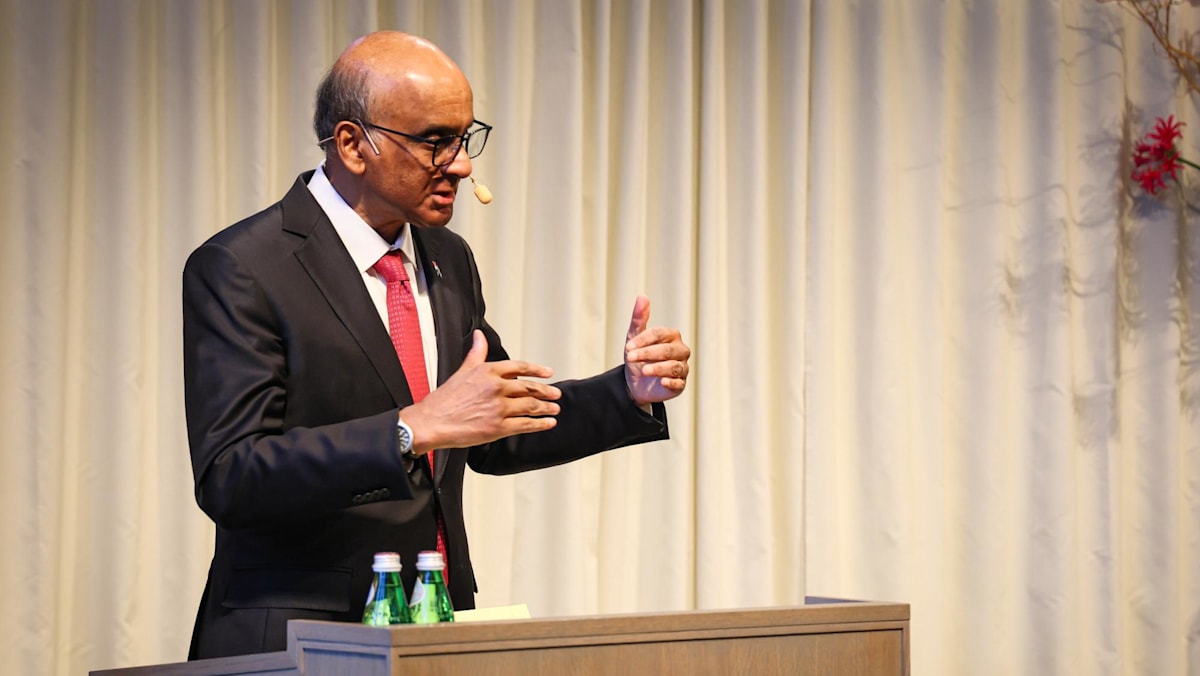
Without countries willing to bridge geopolitical divides, growing rivalry could push the world into competing blocs, Mr Tharman said in a lecture at the Stockholm School of Economics during his state visit to Sweden.
President Tharman Shanmugaratnam delivers a lecture at the Stockholm School of Economics on Oct 20, 2026. (Photo: Ministry of Digital Development and Information)
This audio is generated by an AI tool.
SINGAPORE: Countries that can act as "bridge-builders", such as Singapore and Sweden, will become increasingly important as the old United States-led world order recedes and the risk of geopolitical fragmentation grows, President Tharman Shanmugaratnam said on Tuesday (Oct 20).
He warned that the world has yet to arrive at a stable multipolar order, and could instead see growing rivalry, the weaponisation of trade and materials, and a slide towards divided blocs.
Delivering a lecture at the Stockholm School of Economics during his state visit to Sweden , Mr Tharman said such bridge-builders can play various roles, such as bringing regions together in a world where trade and investment are at risk and finding common interests between the Global North and the Global South.
They can also build coalitions for "bolder and more urgent climate action, to prevent and prepare for pandemics, and to work together to guard against the worst harms that (artificial intelligence) can bring".
CNA Games Guess Word Crack the word, one row at a time Buzzword Create words using the given letters Mini Sudoku Tiny puzzle, mighty brain teaser Mini Crossword Small grid, big challenge Word Search Spot as many words as you can Show More Show Less In addition, bridge-builders between the US and China can help preserve economic networks integral to both countries and move the world "towards a new, reformed multilateralism". "We have to work on reforms to the existing multilateral institutions, but recognise that progress can be held up by the current system of decisions by universal consensus in several of these institutions – in other words, where every country has to agree before we can move forward," said Mr Tharman. "We have to work on changing those decision-making rules and norms. But in the meantime, we have to move ahead through coalitions that work in parallel with the multilateral institutions." Mr Tharman said that while the US-led unipolar world order was a thing of the past, the world has not yet arrived at a multipolar order. He added that the world is seeing a shift in the US "from the belief and practice of enlightened self-interest, to a more narrow and immediate calculation of national interests", leading to the waning of US influence in Asia, Europe and around the world. "There are more poles, but a thinning of global leadership," he said. "The simple fact of multipolarity does not assure us of a system. If anything, we are more likely than not to see growing suspicion, friction or conflicts, weaponisation of trade and materials, and a steady grind into a world of divided blocs." On bridge-builders, he cited the example of Singapore, which is "by no means a middle power", but is working actively to improve cooperation between the Comprehensive and Progressive Agreement for Trans-Pacific Partnership (CPTPP) and the European Union, as well as between the Association of Southeast Asian Nations (ASEAN) and the EU. Sweden, meanwhile, has a tradition of being a bridge-builder, Mr Tharman said, pointing to how former United Nations Secretary-General Dag Hammarskjold, a Swede, initiated the first UN peacekeeping force following the Suez Crisis in the 1950s. "Sweden has also been building coalitions to support the health of the planet, starting more than half a century ago. And together with the other Nordic countries, is actively seeking to help Africa to make a green transition in ways that supports economic development," he said. The president also cited Australia, Canada, Ghana, Japan and the EU as a whole as being bridge-builders. NO SYSTEM POSSIBLE WITHOUT US, CHINA Mr Tharman said that no system of world order would be possible without the US and China being integral to it. "They have the largest markets. They are the largest sources of innovation. They have an overwhelming share of global AI compute. And they are essential, by virtue of their scale of carbon emissions, and in China's case, its technologies, to tackling climate change," he said. "It may appear odd to say this, given the current political mood in the United States. But the US as many know, is never unchanging. It isn't just a matter of whether the Republicans or Democrats win elections. Change also depends on the body politic." The president said that top surveys have consistently shown that the majority of Americans like the idea of global cooperation. "We cannot expect the US to get back to the responsibilities it assumed under Pax Americana, but neither should we assume an unchanging political mood," he added, The biggest difficulty in achieving a stable global order is that the world has two major powers which are "not only interdependent economically, but are close to being peers in competition", said Mr Tharman. He outlined three things that would help the US and China achieve stability in their relationship. First, both countries have to view interdependence and competition as a relationship to be managed, especially to constrain the weaponisation of materials and technologies, rather than a threat to be eliminated. "It will surely be a more dangerous world if we end up with whole AI and technology stacks decoupled, and other supply chains and payment systems decoupled. It will make for a more profoundly dangerous world," he added. Next, it has to be recognised that there is "no finishing line" in the AI race, Mr Tharman said. "There is no point at which we can say that the US or China has won decisively and permanently. Equally, the common threats will only grow, for that the US and China and all of us – the threats not just of rogue AI agents, but of rogue human actors using AI to develop more powerful cyber," he said. "And what AI has done is to reduce dramatically the gap between the ability of large, organised actors and lone, non-state actors, to develop powerful new cyber, biological or chemical weapons. No country can deal with this threat on its own." Finally, the US and China have to recognise that their domestic imbalances, including deficits, have significant international consequences, said Mr Tharman. Reforms to reduce these imbalances are in the own domestic interests, as well of that of the rest of the world. "The US cannot keep deferring the tough choices it has to make to reduce its deficits. They will exert a growing cost domestically, and be a source of instability," the president said. "China, too, has to recognise that to continue to be a large source of supply of goods to the world, it will have to be a larger source of demand than it is currently. "Reforms within China are underway, but it will need time to raise consumption. In the meantime, temporary management of China's exports, such as in its recent agreement with the EU on hybrid vehicles, and a shift in balance from exports to foreign direct investment in markets abroad, have useful roles to play." NEW, INVIGORATED DOMESTIC SOCIAL COMPACTS KEY Wrapping up his lecture, Mr Tharman said that the world cannot reach a cooperative international order without "new and invigorated social compacts" domestically. "The social compact in many countries, particularly in the advanced world, is exhausted," he said. "Ideas which excited people 40, 50 years ago no longer excite today. And to repair and reinvigorate, it seems to me we have to go backwards as well as forwards." Social democracy in its early days was "not fundamentally about the redistribution of benefits to individuals, but about investing in the public good", such as schools, health systems, transport systems and other amenities that benefit everyone, he said. "Some redistribution was necessary, and is still necessary because inequality has to be mitigated. But investing in high-quality public services was itself a progressive act, because the people who benefit most from it are the poor and the middle class. It had an uplifting tone and effect," said Mr Tharman. "But we also have to go forward. And the reality of a world of rapid technological change and global interdependence is that whilst societies have prospered as a whole, there will be groups of people who lose out." As such, democracies have to act early to support communities that lose out. While a nation may be doing well as a whole, the perceived losses of those whose jobs and communities have been displaced are real, and often have a greater impact on the body politic than the widely dispersed benefits enjoyed by the majority, Mr Tharman said. "Markets do not relieve these problems quickly, and often not at all. The task of government is to not let such problems fester, and to intervene to help those displaced," he said. "So, aggregates like (gross domestic product), overall income growth or overall unemployment rates are not all that matter in economic life, and especially not in politics. "Losses matter, even if most people gain. We must avoid at all costs a K-shaped economy and society as we move into an AI era."
In addition, bridge-builders between the US and China can help preserve economic networks integral to both countries and move the world "towards a new, reformed multilateralism".
"We have to work on reforms to the existing multilateral institutions, but recognise that progress can be held up by the current system of decisions by universal consensus in several of these institutions – in other words, where every country has to agree before we can move forward," said Mr Tharman.
"We have to work on changing those decision-making rules and norms. But in the meantime, we have to move ahead through coalitions that work in parallel with the multilateral institutions."
Mr Tharman said that while the US-led unipolar world order was a thing of the past, the world has not yet arrived at a multipolar order.
He added that the world is seeing a shift in the US "from the belief and practice of enlightened self-interest, to a more narrow and immediate calculation of national interests", leading to the waning of US influence in Asia, Europe and around the world.
"There are more poles, but a thinning of global leadership," he said. "The simple fact of multipolarity does not assure us of a system. If anything, we are more likely than not to see growing suspicion, friction or conflicts, weaponisation of trade and materials, and a steady grind into a world of divided blocs."
On bridge-builders, he cited the example of Singapore, which is "by no means a middle power", but is working actively to improve cooperation between the Comprehensive and Progressive Agreement for Trans-Pacific Partnership (CPTPP) and the European Union, as well as between the Association of Southeast Asian Nations (ASEAN) and the EU.
Sweden, meanwhile, has a tradition of being a bridge-builder, Mr Tharman said, pointing to how former United Nations Secretary-General Dag Hammarskjold, a Swede, initiated the first UN peacekeeping force following the Suez Crisis in the 1950s.
"Sweden has also been building coalitions to support the health of the planet, starting more than half a century ago. And together with the other Nordic countries, is actively seeking to help Africa to make a green transition in ways that supports economic development," he said.
The president also cited Australia, Canada, Ghana, Japan and the EU as a whole as being bridge-builders.
NO SYSTEM POSSIBLE WITHOUT US, CHINA
Mr Tharman said that no system of world order would be possible without the US and China being integral to it.
"They have the largest markets. They are the largest sources of innovation. They have an overwhelming share of global AI compute. And they are essential, by virtue of their scale of carbon emissions, and in China's case, its technologies, to tackling climate change," he said.
"It may appear odd to say this, given the current political mood in the United States. But the US as many know, is never unchanging. It isn't just a matter of whether the Republicans or Democrats win elections. Change also depends on the body politic."
The president said that top surveys have consistently shown that the majority of Americans like the idea of global cooperation.
"We cannot expect the US to get back to the responsibilities it assumed under Pax Americana, but neither should we assume an unchanging political mood," he added,
The biggest difficulty in achieving a stable global order is that the world has two major powers which are "not only interdependent economically, but are close to being peers in competition", said Mr Tharman.
He outlined three things that would help the US and China achieve stability in their relationship.
First, both countries have to view interdependence and competition as a relationship to be managed, especially to constrain the weaponisation of materials and technologies, rather than a threat to be eliminated.
"It will surely be a more dangerous world if we end up with whole AI and technology stacks decoupled, and other supply chains and payment systems decoupled. It will make for a more profoundly dangerous world," he added.
Next, it has to be recognised that there is "no finishing line" in the AI race, Mr Tharman said.
"There is no point at which we can say that the US or China has won decisively and permanently. Equally, the common threats will only grow, for that the US and China and all of us – the threats not just of rogue AI agents, but of rogue human actors using AI to develop more powerful cyber," he said.
"And what AI has done is to reduce dramatically the gap between the ability of large, organised actors and lone, non-state actors, to develop powerful new cyber, biological or chemical weapons. No country can deal with this threat on its own."
Finally, the US and China have to recognise that their domestic imbalances, including deficits, have significant international consequences, said Mr Tharman. Reforms to reduce these imbalances are in the own domestic interests, as well of that of the rest of the world.
"The US cannot keep deferring the tough choices it has to make to reduce its deficits. They will exert a growing cost domestically, and be a source of instability," the president said.
"China, too, has to recognise that to continue to be a large source of supply of goods to the world, it will have to be a larger source of demand than it is currently.
"Reforms within China are underway, but it will need time to raise consumption. In the meantime, temporary management of China's exports, such as in its recent agreement with the EU on hybrid vehicles, and a shift in balance from exports to foreign direct investment in markets abroad, have useful roles to play."
NEW, INVIGORATED DOMESTIC SOCIAL COMPACTS KEY
Wrapping up his lecture, Mr Tharman said that the world cannot reach a cooperative international order without "new and invigorated social compacts" domestically.
"The social compact in many countries, particularly in the advanced world, is exhausted," he said. "Ideas which excited people 40, 50 years ago no longer excite today. And to repair and reinvigorate, it seems to me we have to go backwards as well as forwards."
Social democracy in its early days was "not fundamentally about the redistribution of benefits to individuals, but about investing in the public good", such as schools, health systems, transport systems and other amenities that benefit everyone, he said.
"Some redistribution was necessary, and is still necessary because inequality has to be mitigated. But investing in high-quality public services was itself a progressive act, because the people who benefit most from it are the poor and the middle class. It had an uplifting tone and effect," said Mr Tharman.
"But we also have to go forward. And the reality of a world of rapid technological change and global interdependence is that whilst societies have prospered as a whole, there will be groups of people who lose out."
As such, democracies have to act early to support communities that lose out.
While a nation may be doing well as a whole, the perceived losses of those whose jobs and communities have been displaced are real, and often have a greater impact on the body politic than the widely dispersed benefits enjoyed by the majority, Mr Tharman said.
"Markets do not relieve these problems quickly, and often not at all. The task of government is to not let such problems fester, and to intervene to help those displaced," he said.
"So, aggregates like (gross domestic product), overall income growth or overall unemployment rates are not all that matter in economic life, and especially not in politics.
"Losses matter, even if most people gain. We must avoid at all costs a K-shaped economy and society as we move into an AI era."
Get our pick of top stories and thought-provoking articles in your inbox
Stay updated with notifications for breaking news and our best stories
Join our channel for the top reads for the day on your preferred chat app
尚达曼先生在对瑞典进行国事访问期间,在斯德哥尔摩经济学院发表演讲时表示,如果各国不愿弥合地缘政治分歧,日益加剧的竞争可能会将世界推向相互竞争的阵营。
2026年10月20日,尚达曼总统在斯德哥尔摩经济学院发表演讲。(图片:数码发展与信息部)
这段音频由人工智能工具生成。
新加坡:新加坡总统尚达曼周二(10月20日)表示,随着以美国为主导的旧世界秩序的衰落和地缘政治分裂风险的增加,像新加坡和瑞典这样能够发挥“桥梁建设者”作用的国家将变得越来越重要。
他警告说,世界尚未建立稳定的多极秩序,反而可能出现日益加剧的竞争、贸易和物资的武器化,以及滑向分裂集团的局面。
在对瑞典进行国事访问期间,尚达曼先生在斯德哥尔摩经济学院发表演讲时表示,这类桥梁建设者可以发挥各种作用,例如在贸易和投资面临风险的世界中将各个地区团结起来,以及在全球北方和全球南方之间寻找共同利益。
他们还可以建立联盟,采取“更大胆、更紧迫的气候行动,预防和应对流行病,并共同努力防范(人工智能)可能带来的最严重危害”。
CNA游戏 猜词游戏 逐行破解单词 流行词游戏 用给定的字母组成单词 迷你数独 小谜题,脑力挑战 迷你填字游戏 小方格,大挑战 单词搜索 尽可能多地找出单词 显示更多 显示更少 此外,中美之间的桥梁建设者可以帮助维护对两国至关重要的经济网络,并推动世界“走向新的、改革后的多边主义”。“我们必须致力于改革现有的多边机构,但也要认识到,目前其中一些机构的决策体系——即每个国家都必须同意才能推进——可能会阻碍进展,”尚达曼先生说。“我们必须努力改变这些决策规则和规范。但与此同时,我们必须通过与多边机构并行运作的联盟来推进工作。”尚达曼先生表示,虽然美国主导的单极世界秩序已成为过去,但世界尚未真正进入多极秩序。他补充说,世界正在目睹美国“从秉持开明利己主义的信念和实践,转向更加狭隘和直接地计算国家利益”,导致美国在亚洲、欧洲乃至全球的影响力日渐式微。“极点更多了,但全球领导力却在减弱,”他说道。“多极化本身并不能保证一个体系的稳定。相反,我们更有可能看到的是猜疑、摩擦或冲突加剧、贸易和物资武器化,以及世界逐渐走向分裂。”关于桥梁建设者,他以新加坡为例,指出新加坡“绝非中等强国”,但它正积极致力于改善《全面与进步跨太平洋伙伴关系协定》(CPTPP)与欧盟之间,以及东盟与欧盟之间的合作。与此同时,瑞典素有搭建桥梁的传统,达曼先生指出,瑞典人、前联合国秘书长达格·哈马舍尔德在20世纪50年代苏伊士运河危机后发起组建了第一支联合国维和部队。“瑞典也一直在构建联盟,以支持地球的健康,这项工作始于半个多世纪以前。瑞典与其他北欧国家一道,积极寻求帮助非洲实现绿色转型,从而促进经济发展。”他说道。总统还提到澳大利亚、加拿大、加纳、日本以及整个欧盟都是搭建桥梁的国家。达曼先生表示,没有美国和中国,任何体系都不可能存在。“它们拥有最大的市场,是最大的创新源泉,在全球人工智能计算领域占据着压倒性的份额。而且,鉴于它们庞大的碳排放规模,以及中国的技术实力,它们对于应对气候变化至关重要。”他说道。 “鉴于美国当前的政治氛围,说这话或许有些奇怪。但众所周知,美国并非一成不变。这不仅仅取决于共和党还是民主党赢得选举,政治格局的变迁也取决于整个政治体系。”总统表示,权威民调始终显示,大多数美国人赞同全球合作的理念。“我们不能指望美国回到‘美国治下的和平’时期所承担的责任,但我们也不应该认为政治氛围会一成不变。”他补充道。尚达曼先生指出,实现稳定的全球秩序的最大难点在于,世界有两个主要大国,“它们不仅在经济上相互依存,而且在竞争中也几乎势均力敌”。他概述了有助于美中关系稳定的三点。首先,两国必须将相互依存和竞争视为一种需要管控的关系,尤其要限制材料和技术的武器化,而不是一种需要消除的威胁。 “如果我们最终导致整个人工智能和技术体系脱钩,其他供应链和支付系统也脱钩,世界无疑会变得更加危险。这将使世界变得更加深重危险,”他补充道。接下来,尚达曼先生表示,必须认识到人工智能竞赛“没有终点”。“我们无法断言美国或中国已经取得了决定性的、永久的胜利。同样,共同的威胁只会不断增长,美国、中国以及我们所有人都会面临这些威胁——不仅是来自失控人工智能体的威胁,还有来自利用人工智能开发更强大网络武器的失控人类行为者的威胁,”他说道。“人工智能已经极大地缩小了大型有组织行为体和孤立的非国家行为体在开发强大的新型网络、生物或化学武器方面的能力差距。任何国家都无法独自应对这种威胁。”最后,尚达曼先生表示,美国和中国必须认识到,它们国内的失衡,包括赤字,会产生重大的国际后果。减少这些失衡的改革既符合美国自身的国内利益,也符合世界其他地区的利益。“美国不能再拖延必须做出的艰难抉择,以减少其赤字。这将给国内带来越来越大的成本,并成为不稳定的根源,”总统说。“中国也必须认识到,要想继续成为世界商品供应的主要来源,就必须比现在成为更大的需求来源。”“中国正在进行改革,但提高消费需要时间。”与此同时,对中国出口进行临时管理,例如近期与欧盟就混合动力汽车达成的协议,以及将经济重心从出口转向对海外市场的直接投资,都能发挥有益的作用。” 新的、充满活力的国内社会契约至关重要 尚达曼先生在演讲结尾指出,如果没有“新的、充满活力的国内社会契约”,世界就无法建立合作的国际秩序。“许多国家,特别是发达国家的社会契约已经失效,”他说道。“四五十年前令人振奋的理念,如今已不再令人振奋。在我看来,为了修复和重振社会契约,我们必须既向前发展,也向后探索。” 他表示,社会民主主义早期“从根本上来说并非是将利益重新分配给个人,而是投资于公共产品”,例如学校、医疗系统、交通系统以及其他惠及所有人的公共设施。“一些再分配是必要的,而且现在仍然是必要的,因为必须缓解不平等现象。” “投资高质量的公共服务本身就是一种进步之举,因为从中受益最多的是穷人和中产阶级。这具有振奋人心的效果,”达曼先生说。“但我们也必须向前看。在技术快速变革和全球相互依存的时代,现实情况是,尽管社会整体繁荣发展,但总会有一些群体遭受损失。” 因此,民主国家必须及早采取行动,支持那些遭受损失的群体。达曼先生表示,虽然一个国家整体发展良好,但那些失去工作和社区的人所感受到的损失是真实存在的,而且往往比大多数人享有的广泛利益对政治体系的影响更大。“市场并不能迅速缓解这些问题,而且往往根本无法缓解。” “政府的职责是防止此类问题恶化,并介入帮助那些流离失所的人,”他说道。“因此,像国内生产总值、总体收入增长或总体失业率这样的指标,并非经济生活中最重要的,尤其是在政治领域。损失至关重要,即便大多数人从中受益。在我们迈向人工智能时代之际,我们必须不惜一切代价避免出现K型经济和社会。”
此外,中美之间的桥梁建设者可以帮助维护对两国至关重要的经济网络,并推动世界“走向新的、改革后的多边主义”。
“我们必须致力于改革现有的多边机构,但也要认识到,目前其中一些机构的决策机制是普遍共识,这可能会阻碍改革进程——换句话说,每个国家都必须同意才能向前推进,”达曼先生说。
“我们必须努力改变这些决策规则和规范。但与此同时,我们必须通过与多边机构并行运作的联盟来推进工作。”
尚达曼先生表示,虽然美国主导的单极世界秩序已成为过去,但世界尚未达到多极秩序。
他还补充说,世界正在目睹美国“从信奉和实践开明的利己主义,转变为更加狭隘和直接地计算国家利益”,导致美国在亚洲、欧洲和世界各地的影响力减弱。
他说:“极点更多了,但全球领导力却在减弱。多极化本身并不能保证一个体系的稳定。相反,我们更有可能看到的是猜疑、摩擦或冲突加剧,贸易和物资被武器化,以及世界逐渐走向分裂。”
关于桥梁建设者,他以新加坡为例,指出新加坡“绝非中等强国”,但正积极致力于改善《全面与进步跨太平洋伙伴关系协定》(CPTPP)与欧盟之间的合作,以及东南亚国家联盟(东盟)与欧盟之间的合作。
塔尔曼先生表示,瑞典一直以来都有搭建桥梁的传统,他指出,前联合国秘书长达格·哈马舍尔德(瑞典人)在 20 世纪 50 年代苏伊士运河危机后发起组建了第一支联合国维和部队。
“瑞典早在半个多世纪前就开始建立联盟,以支持地球健康。瑞典与其他北欧国家一道,积极寻求帮助非洲实现绿色转型,从而促进经济发展。”他说道。
总统还提到澳大利亚、加拿大、加纳、日本以及整个欧盟都是桥梁建设者。
没有我们,任何体系都不可能存在,中国。
尚达曼先生表示,如果没有美国和中国的参与,任何世界秩序体系都不可能存在。
他说:“它们拥有最大的市场,是最大的创新源泉,在全球人工智能计算领域占据着压倒性的份额。而且,鉴于它们的碳排放规模,以及中国的技术实力,它们对于应对气候变化至关重要。”
“鉴于美国当前的政治氛围,这么说或许有些奇怪。但众所周知,美国从来都不是一成不变的。这不仅仅取决于共和党还是民主党赢得选举,变革也取决于政治体制。”
总统表示,各大民调始终显示,大多数美国人赞成全球合作。
“我们不能指望美国重新承担起在‘美国治下的和平’时期所承担的责任,但我们也不应该认为政治氛围会一成不变,”他补充道。
尚达曼先生表示,实现稳定的全球秩序的最大困难在于,世界上有两个主要大国,“它们不仅在经济上相互依存,而且在竞争中也几乎是势均力敌的对手”。
他概述了有助于美中关系稳定的三件事。
首先,两国必须将相互依存和竞争视为需要管控的关系,特别是要限制材料和技术的武器化,而不是需要消除的威胁。
他补充说:“如果我们最终导致人工智能和技术堆栈完全脱钩,其他供应链和支付系统也脱钩,那世界肯定会变得更加危险。这将使世界变得更加深重危险。”
塔曼先生表示,接下来必须认识到,人工智能竞赛“没有终点线”。
“我们现在还不能断言美国或中国已经取得了决定性的、永久性的胜利。同样,共同的威胁只会不断增加,美国、中国以及我们所有人都会面临这样的威胁——不仅是来自失控人工智能体的威胁,还有来自利用人工智能开发更强大网络空间的失控人类行为者的威胁,”他说道。
“人工智能的出现极大地缩小了大型有组织行为体与孤立的非国家行为体在研发威力强大的新型网络、生物或化学武器方面的能力差距。任何国家都无法独自应对这种威胁。”
最后,尚达曼先生表示,美国和中国必须认识到,它们国内的失衡,包括赤字,会产生重大的国际影响。进行改革以减少这些失衡,既符合它们自身的国内利益,也符合世界其他地区的利益。
总统表示:“美国不能再一再推迟做出艰难抉择以减少赤字。这样做会给国内带来越来越大的成本,并成为不稳定的根源。”
“中国也必须认识到,要想继续成为世界商品供应的重要来源,就必须成为比现在更大的需求来源。”
“中国正在进行改革,但提振消费需要时间。与此同时,对中国出口进行临时管理,例如最近与欧盟就混合动力汽车达成的协议,以及将经济重心从出口转向对海外市场的直接投资,都将发挥积极作用。”
新的、充满活力的国内社会契约是关键
达曼先生在演讲结束时表示,如果没有国内“新的、更有活力的社会契约”,世界就无法实现合作的国际秩序。
他说:“许多国家,特别是发达国家,社会契约已经失效。四五十年前令人振奋的理念,如今已不再令人振奋。在我看来,为了修复和重振社会契约,我们既要向前看,也要向后看。”
他说,社会民主主义早期“从根本上来说,不是将利益重新分配给个人,而是投资于公共利益”,例如学校、医疗系统、交通系统和其他惠及所有人的公共设施。
“过去需要进行一些财富再分配,现在仍然需要,因为必须缓解不平等现象。但投资高质量的公共服务本身就是一项进步举措,因为从中受益最多的是穷人和中产阶级。这具有鼓舞人心的效果,”达曼先生说。
“但我们也必须向前看。在技术快速变革和全球相互依存的世界中,现实情况是,虽然社会整体上繁荣发展,但总会有一些群体处于劣势。”
因此,民主国家必须及早采取行动,支持那些处于劣势的群体。
尚达曼先生表示,虽然一个国家整体上可能发展良好,但那些失去工作和社区的人所感受到的损失是真实的,而且往往比大多数人广泛享有的利益对政治体制的影响更大。
他说:“市场并不能迅速缓解这些问题,而且往往根本不起作用。政府的任务是防止这些问题恶化,并进行干预以帮助那些流离失所的人。”
“因此,像(国内生产总值)、总体收入增长或总体失业率这样的总量指标,在经济生活中并不重要,尤其是在政治中更不重要。”
“即使大多数人受益,损失也至关重要。在迈向人工智能时代的过程中,我们必须不惜一切代价避免出现K型经济和社会结构。”
订阅我们的邮件,即可获取精选热点新闻和引人深思的文章。
订阅通知,第一时间获取突发新闻和精彩报道。
加入我们的频道,即可在您常用的聊天应用上获取当日热门文章。